

You can sit in silence every day and still be governed by worry, resentment, comparison, or fear of loss. That doesn’t necessarily mean you need a more advanced technique. More often, it means one technique is being asked to do several different jobs.
A workable contemplative path trains attention, examines the identity behind your reactions, loosens your demand for permanent outcomes, and carries insight back into dharma. When those parts support one another, practice stops being an escape from life and becomes a way of meeting life freely.
Inner freedom is not a permanently calm mind
If you judge contemplation by whether it produces a pleasant mood, every difficult day will look like failure. Calm is valuable, but it changes with sleep, conflict, health, work, and countless other conditions. A state that depends on favorable conditions cannot by itself be freedom.
In ordinary life, inner freedom appears as a reduced compulsion to obey every thought and emotion. Anger may arise, but it doesn’t have to write your message. Grief may remain, but it doesn’t have to make love seem meaningless. Anxiety may speak, but it doesn’t automatically get the deciding vote. You gain enough inward space to choose the response that accords with dharma.
This practical freedom should not be confused with the full meaning of moksha. In the Advaita Vedanta framework, liberation is not something added to you in the future, but the recognition of the ever-present Self and the removal of ignorance about it. Emotional steadiness can prepare the mind for that recognition, yet a quieter personality is not the same thing as Self-realization.
After a difficult encounter, therefore, ask better questions than "Was I calm?" Ask: Did the reaction completely choose my conduct? Could I see the reaction without turning it into my identity? Did I return to truthful and compassionate action? These questions reveal whether contemplation is entering your character rather than remaining confined to the meditation seat.
Give each contemplative practice one clear job
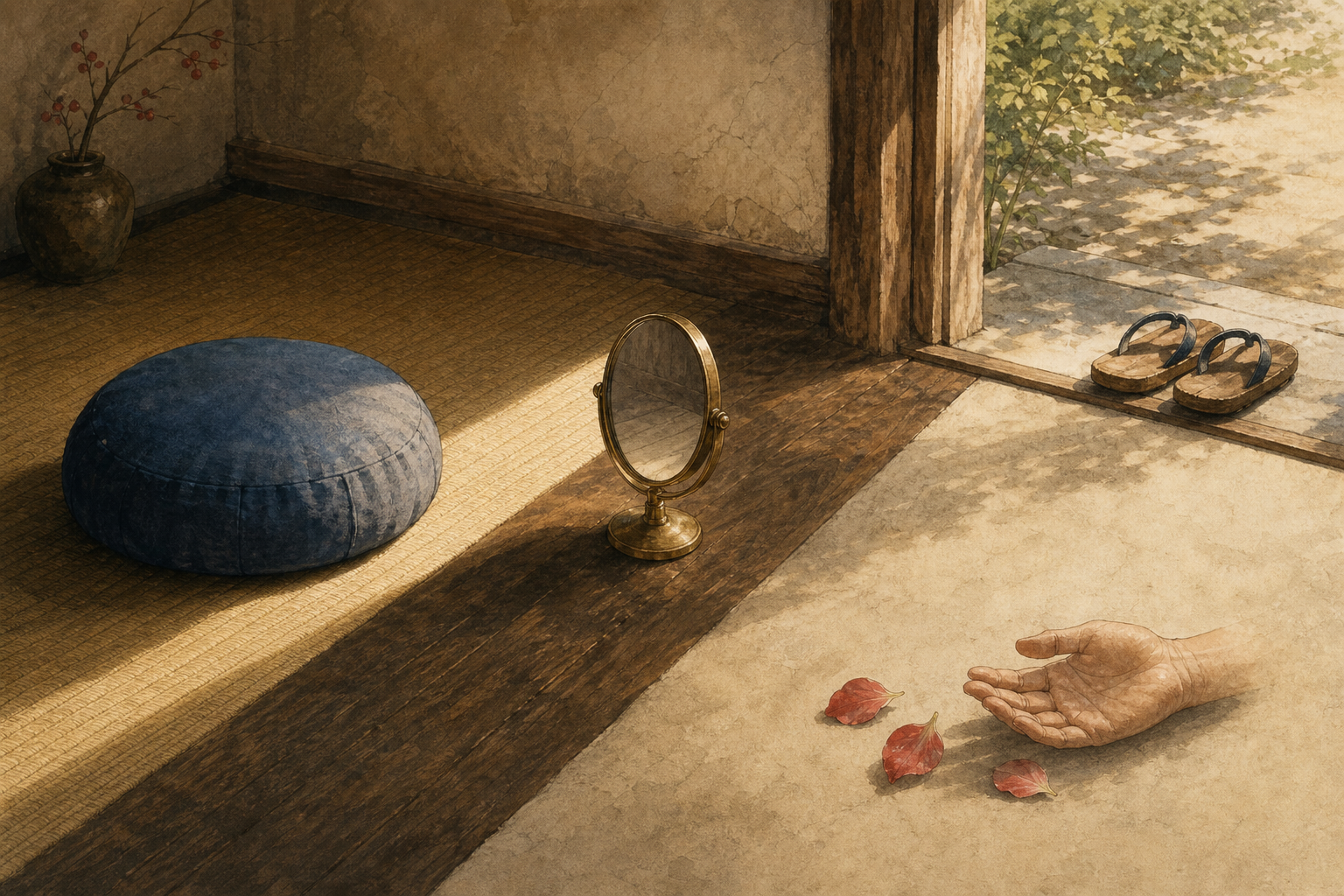
Dhyana and vichara are often mentioned together because they correct different weaknesses. Meditation steadies a dispersed mind. Enquiry directs that steadiness toward the nature of the experiencer. Ethical discipline protects both practices from becoming self-absorption, while non-attachment and seva test whether insight survives contact with changing circumstances.
| Practice | Its immediate job | A common misdirection | What to notice in daily life |
|---|---|---|---|
| Yama, niyama, ahimsa, and satya | Bring conduct into alignment with the freedom you seek | Treating ethics as optional preparation | You need fewer excuses to defend what you did |
| Dhyana | Develop a continuous, less reactive flow of attention | Trying to manufacture a blank mind | You can return from distraction without irritation |
| Vichara | Examine who claims thoughts, roles, and experiences as "me" | Collecting clever verbal answers | A passing thought feels less like a final definition of you |
| Anitya and vairagya | Reveal change and loosen possessiveness toward outcomes | Withdrawing affection to avoid pain | You can care deeply without demanding control |
| Dharma and seva | Translate inward clarity into responsible action | Using solitude to avoid difficult duties | You do what is needed without making praise the payment |
The order matters. Ethical contradiction keeps the mind agitated. An agitated mind has difficulty sustaining attention. Unstable attention turns enquiry into abstract debate. Abstract insight, left untested by service and duty, can coexist comfortably with the same old habits. This is why ethical living, meditation, enquiry, and right action form a connected discipline.
A sequence you can use without leaving ordinary life
- Name the ethical edge before you sit. Identify the live point of friction: the truth you are avoiding, the person you want to punish, the boundary you need to state without cruelty, or the duty you keep postponing. This prevents meditation from becoming detached from the day you are actually living.
- Settle the body and collect the senses. Take a steady posture and let breathing become relaxed. Attend to the breath without forcing it. If pranayama already belongs to your established practice, it can prepare attention; otherwise, simple observation is enough.
- Stay with one object in dhyana. Use a chosen contemplative object, such as the breath or the sacred focus given within your tradition. When the mind wanders, notice the wandering and return. The return is part of the discipline, not evidence that the discipline failed.
- Turn toward vichara after some steadiness is present. When a thought such as "I have been rejected" appears, notice that the thought is known. Ask what is aware of it. Roles, memories, sensations, and judgments are all experienced objects; enquiry investigates the knower rather than replacing one personal description with another.
- Close with one act of dharma. Decide what the insight requires when you rise: an honest conversation, patient listening, a completed responsibility, a boundary without malice, or service performed without seeking recognition. Then do that before searching for another teaching or technique.
If the mind is too agitated for enquiry, don’t force a philosophical contest inside your head. Remain with the grounding work of posture, breath, ethical restraint, and simple attention. Vichara needs clarity, not strain. Conversely, if meditation merely makes you comfortable while an obvious duty goes undone, the next practice is probably action rather than another sitting.
Contemplation is not a test of how much distress you can endure. If a practice repeatedly deepens distress or interferes with ordinary functioning, stop forcing it and seek guidance from an experienced teacher. Where mental health is involved, use an appropriately qualified professional; spiritual practice should not be treated as a replacement for care.
Use impermanence precisely where clinging hurts

Impermanence is easy to accept as a general idea and difficult to accept when a relationship, role, hope, or familiar version of yourself changes. The mind quietly turns "this matters to me" into "this must remain as it was." When reality refuses that demand, pain is joined by resistance, blame, and attempts to control what no longer belongs to your control.
Anitya names the fact of change. Vairagya is the loosening of the grip that demands otherwise. Neither requires you to pretend that loss doesn’t hurt. Human bonds arise through conditions such as proximity, shared interests, karma, and stages of life, and those conditions also change. Seeing this clearly can make love more attentive because you no longer treat another person as a permanent possession.
The fact-demand-dharma check
When you are caught in a changing relationship or outcome, write down three separate statements:
- The fact: What has verifiably changed, without interpretation or accusation?
- The demand: What are you insisting must remain under your control?
- The dharma: What truthful, compassionate, and self-respecting action is available now?
Suppose a friendship has grown distant. The fact may be that communication has become less frequent. The demand may be that the bond must retain its former shape to prove it was real. Dharma may call for one honest attempt to understand, respect for the other person’s freedom, and a refusal either to manipulate or to retaliate. This does not tell you that every relationship should end. It separates wise effort from possessive effort.
Non-attachment is sometimes misread as emotional coldness. The distinction is visible in conduct. Indifference avoids another person’s need because involvement is inconvenient. Vairagya can offer care while accepting that care does not buy control. Indifference suppresses grief to protect an image of strength. Vairagya permits grief without turning it into a demand that the past return.
You can test your response through the four brahmaviharas. Maitri asks whether goodwill remains. Karuna asks whether suffering, including your own, is being met without contempt. Mudita prevents another person’s growth from feeling like your defeat. Upeksha keeps compassion from collapsing into control. These qualities join warmth to equanimity, which is the heart of non-possessive love.
Where words no longer help, a simple ritual can mark the transition. Lighting a diya in gratitude for a relationship that has changed can honor what was good without pretending that its old form continues. The ritual is not a mechanism for erasing memory. It gives remembrance a dignified place so that memory doesn’t have to become grasping.
Learn across Dharmic traditions without erasing them
Hinduism, Buddhism, Jainism, and Sikhism share a civilizational seriousness about disciplining attention, reducing selfish attachment, and expressing insight through ethical conduct. That kinship makes dialogue fruitful. It does not make their teachings interchangeable.
Within Hindu paths, dhyana can steady the mind for discriminative knowledge, while Advaita vichara investigates the witnessing awareness behind changing thoughts, sensations, and roles. The Upanishadic movement through shravana, manana, and nididhyasana also reminds you that enquiry includes receiving a teaching, reasoning carefully about it, and contemplating it deeply. It is not merely repeating "Who am I?" until a special state appears.
Within Buddhism, meditative stability supports insight into impermanence and non-self. The practical observation that experience is changing should not be carelessly translated into the Advaita conclusion about Atman. Similar contemplative instruments can operate within different accounts of what liberation means.
Within Jainism, dharma dhyana and shukla dhyana belong to a discipline of purification and ahimsa. Anekantavada also challenges rigid attachment to a single partial viewpoint. Its value is not simply that it makes you feel flexible; it should make your judgments less violent and your conduct more careful.
Within Sikhism, simran joins remembrance to vichar, while hukam and seva prevent inwardness from becoming an attempt to dominate outcomes or abandon the world. Remembrance must reach conduct. Service reveals whether the ego has merely made spiritual attainment into another possession.
The practical rule is to keep a home grammar for your deepest questions. If you follow an established sampradaya, lineage, or Gurmat discipline, let its understanding of the human problem, practice, and liberation remain coherent. You can recognize the contemplative resonances among dhyana, enquiry, remembrance, non-violence, and service without detaching those practices from the truths they are meant to embody.
This also protects you from a common form of spiritual shopping. When every uncomfortable stage sends you to a new vocabulary, no method receives enough fidelity to expose your habits. Choose a coherent path, remain open to wisdom in neighboring Dharmic traditions, and judge borrowed practices by whether they deepen integrity rather than merely increase novelty.
Key takeaways
- Measure practical inner freedom by how much choice remains when a difficult thought, emotion, or outcome appears, not by whether you maintain a pleasant mood.
- Use ethical discipline as the foundation, dhyana to steady attention, vichara to examine identity, and dharma or seva to test insight in action.
- When enquiry becomes a stream of verbal answers, return to direct observation of the thought, the fact that it is known, and the awareness to which it appears.
- Apply impermanence through a fact-demand-dharma check so that acceptance does not become passivity and love does not become possession.
- Honor the kinship among Hindu, Buddhist, Jain, and Sikh contemplative disciplines without flattening their distinct understandings of liberation.
At your next sitting, keep the experiment small and complete: one ethical intention, one steady contemplative object, one sincere enquiry, and one act of dharma afterward. When you rise, perform that act before looking for the next technique. Inner freedom becomes credible when the person who leaves the meditation seat is less governed by fear, grasping, and self-deception than the person who sat down.
References
- DharmaRenaissance Blog — Impermanence and Human Bonds: Hindu Wisdom on Loving, Letting Go, and Lasting Peace
- DharmaRenaissance Blog — Dhyana and Vichara: Harmonizing Meditation and Enquiry for Self-Realization in Hinduism
