

If you are a Hindu student, parent, alumnus, or faculty member trying to understand the Rutgers controversy, the central question is not whether Hindutva may be criticized. It may be. The real question is whether a university can host forceful political criticism without turning Hindu students, their sacred symbols, or an entire religious community into proxies for Indian politics.
You do not have to choose between academic freedom and Hindu dignity. A credible campus should protect challenging speech while demanding precise definitions, testable evidence, meaningful questions, clear institutional boundaries, and protection from intimidation. Those standards give you a practical way to judge what happened at Rutgers and respond without asking anyone to suppress debate.
The dispute was about the terms of debate, not merely its existence
The Rutgers program was titled Hindutva in America: A Threat to Equality and Religious Pluralism. That wording did more than identify a field of inquiry. It announced a conclusion – that Hindutva constitutes a threat – before the discussion began. A university may host a program framed that way, but an accusatory title increases its responsibility to define the accused phenomenon, substantiate its claims, and provide a fair opportunity for scrutiny.
Hindu students and community advocates did not simply demand that Rutgers cancel an objectionable conversation. They sought a clear distinction between the speech of panelists and the position of the university, along with safeguards for students who believed the event could intensify anti-Hindu hostility. The silent student rally outside the venue was officially permitted, and Hindu chaplain Hitesh Trivedi emphasized the paired obligations of academic debate and student well-being.
That distinction matters. Cancellation would prevent an audience from hearing and testing the claims. Institutional clarification, viewpoint diversity, an open question period, and safety measures would make those claims easier to test. The second approach is not a retreat from academic freedom. It is how academic freedom acquires intellectual value.
Four Members of Congress – Sanford Bishop, Suhas Subramanyam, Rich McCormick, and Shri Thanedar – wrote to Rutgers leadership on October 24. They warned that the event’s framing and materials could misrepresent a diverse religious community and increase prejudice toward Hindu students. Their intervention did not determine whether any panelist’s argument was right or wrong. It showed that the controversy had moved beyond disagreement over ideas and into a concrete question about campus climate.
Four distinctions keep criticism from becoming collective suspicion

Arguments about Hindutva become unproductive when several different subjects are compressed into one ominous label. Before accepting or rejecting a claim, ask what exactly the speaker is naming, who is responsible for the alleged conduct, and what evidence connects the two.
Hinduism is not a synonym for Hindutva
Hinduism is a vast and internally diverse religious civilization. Hindutva is a contested political and cultural term. A speaker may use it to describe an electoral ideology, a theory of nationhood, a network of organizations, or nearly any public expression of Hindu identity. Those uses are not interchangeable.
You can test a panel’s precision with three questions: What definition of Hindutva is being used? Which named actors, statements, policies, or actions satisfy that definition? What evidence connects those particulars to a wider conclusion? If the argument begins with a political organization but ends by casting ordinary Hindu worshippers, temples, or student associations as suspect, the category has expanded without being defended.
A Hindu Swastika is not the Nazi Hakenkreuz
Community observers said panelists equated the Nazi Hakenkreuz with the Hindu Swastika. That is not a minor terminological dispute. The Swastika has ancient sacred meaning in Hinduism, Buddhism, and Jainism, while related forms also appear in Sikh heritage and broader Indian culture. Hitler’s emblem belongs to the history and symbolism of Nazism.
Context, orientation, visual treatment, and historical use can help an audience identify a particular representation, but the fundamental correction is simpler: a sacred Dharmic symbol should not be assigned Nazi meaning merely because an English-speaking audience has been trained to recognize only the twentieth-century European appropriation. If a speaker discusses both symbols, insist on separate names, histories, and meanings. Precision here protects Jewish memory and Dharmic religious literacy at the same time.
Criticism of an ideology is not permission to stigmatize believers
A panel can investigate nationalism, political funding, lobbying, discrimination, or majoritarian conduct. The relevant unit of analysis should be the actor responsible for the conduct. Political parties, governments, advocacy organizations, donors, religious communities, and individual students are different actors with different levels of power and responsibility.
Watch for a recurring substitution: a claim begins with a named political actor, shifts to vaguely defined Hindu organizations, and lands on Hindus as a collective. That move does not become rigorous because it occurs in an academic room. Ask the speaker to identify each transition and the evidence supporting it.
Protected speech is not the same as institutional endorsement
A university logo, department name, official venue, promotional channel, or faculty title can reasonably lead students to wonder whether an event represents an institutional position. The answer should not be left to guesswork. Rutgers could protect speech while stating who selected the panel, who funded the program, whether it was curricular or extracurricular, and whether the university endorsed its conclusions.
The useful request is therefore not, “Stop this viewpoint.” It is, “Explain the university’s relationship to this event, disclose the selection process, and provide an equivalent path for informed response.” That request preserves both expression and institutional accountability.
Why the Rutgers event generated a safety controversy
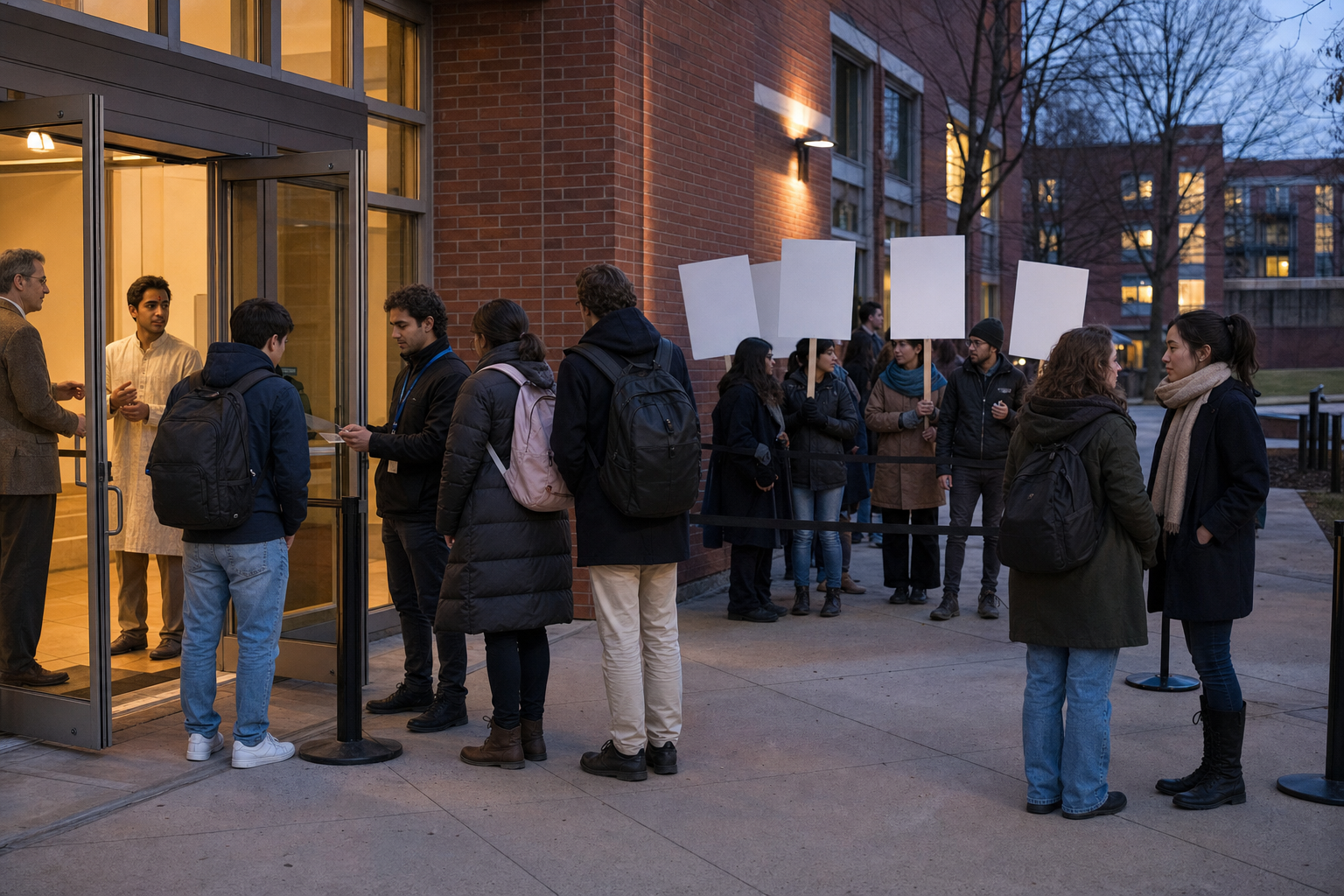
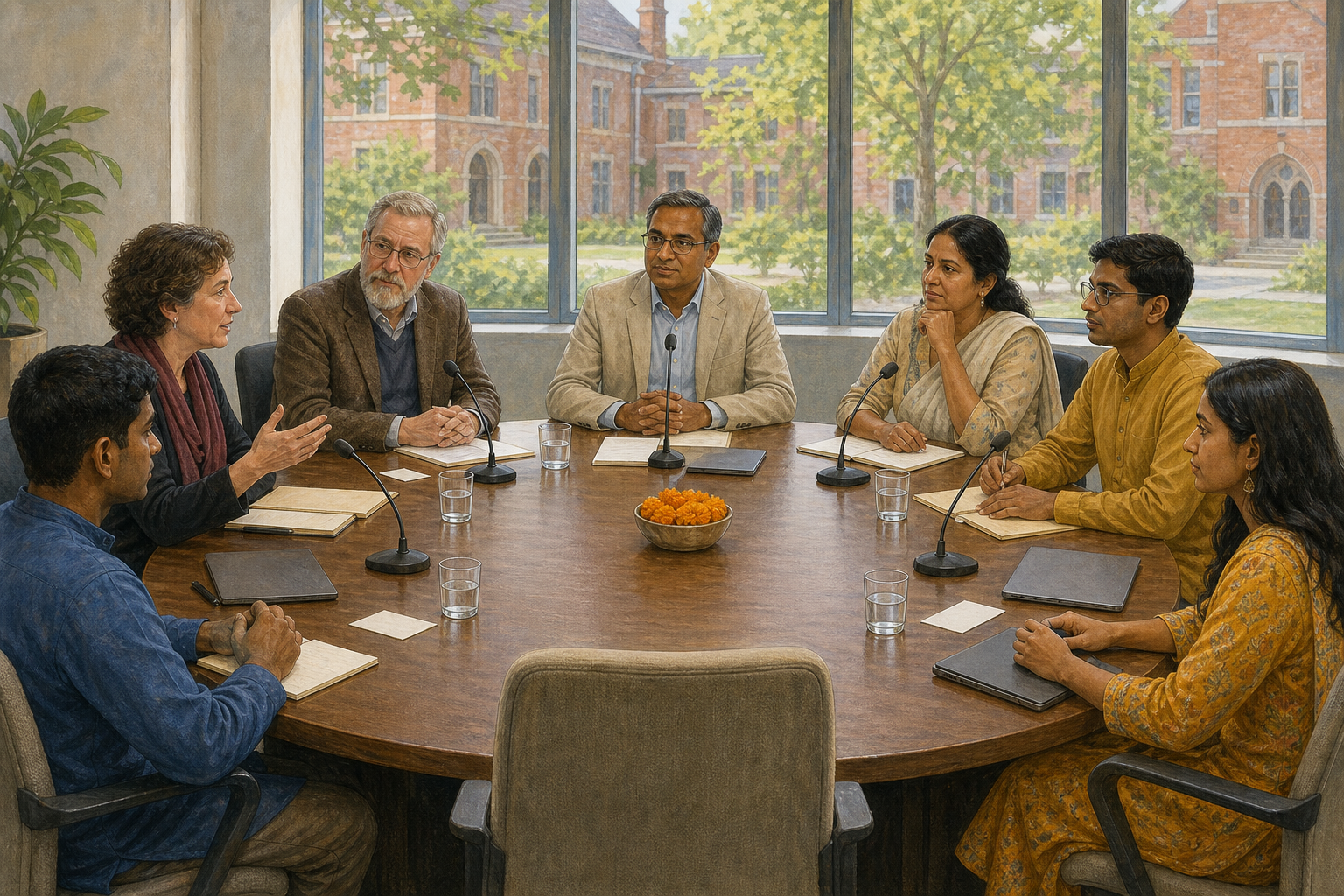
Community observers described a panel with no practicing Hindu participants and limited opportunities for practicing Hindu attendees to question categorical claims about their religion and identity. Panel composition alone does not prove that an argument is false; religious practitioners do not possess a veto over scholarship about their traditions. But excluding practitioners becomes consequential when speakers make sweeping claims about how a living community understands itself and the format does not permit those claims to be tested.
The reported denial of Hinduphobia sharpened that problem. Critics pointed to vandalism at Hindu temples in the United States since December 2023 and state-level anti-hate data that they said showed increasing anti-Hindu incidents, reaching the second-highest level after antisemitism in some jurisdictions. Comparative hate-crime claims require care: before repeating a ranking, ask for the jurisdiction, period, reporting definition, raw count, population basis, and underlying dataset. But dismissing the category of Hinduphobia altogether prevents serious examination before the evidence is even considered.
Broad claims that American Hindu organizations receive undisclosed payments from the Indian government raise a similar evidentiary problem. A responsible allegation should identify the organization, payment or transfer, date range, documentary basis, relevant disclosure rule, and response from the accused party. Without those particulars, a foreign-influence claim can turn ordinary Hindu civic participation into presumptive disloyalty.
The most serious boundary concerns personal safety. Hindu students held a silent, permitted protest and reportedly encountered hostility, including an attempt to expose participants’ identities online. An anonymous student said fear kept some peers away. Students should not have to reveal themselves publicly or absorb retaliatory attention merely to ask their university for fair treatment.
Doxxing is not rebuttal. Nor is filming quiet participants for online targeting, circulating unverified identities, or pressuring students to declare political loyalties because they are Hindu. A university that protects contentious events should apply the same seriousness to threats and targeted exposure around those events. Otherwise, formal permission to speak exists alongside a practical warning that some students will pay more for using it.
Key takeaways
- Criticism of Hindutva is legitimate; treating Hindu students as stand-ins for a government, party, or ideology is not.
- An accusatory panel title creates a stronger need for definitions, named evidence, meaningful questions, and transparent sponsorship.
- The Hindu Swastika and Nazi Hakenkreuz require separate names, histories, and meanings. Conflating them is not harmless shorthand.
- A claim about Hinduphobia should be examined using identifiable incidents and clearly defined data, not accepted or dismissed by assertion.
- Student safety includes protection from threats, retaliation, and attempts to expose participants’ identities online.
- The strongest response asks for more rigorous speech, not less speech: corrections, records, response opportunities, fair moderation, and institutional clarity.
How to respond without surrendering academic freedom
If you are a student, parent, or alumnus
Your first communication should be a one-page factual record, not a sweeping manifesto. A short, verifiable complaint is harder to dismiss and easier for administrators, trustees, journalists, or lawmakers to investigate.
- Record the event’s exact title, date, sponsoring units, advertised speakers, and public description. Save the original event page and promotional material.
- Separate what you personally witnessed from what another attendee reported. For each disputed statement, record the speaker’s words as accurately as possible, the surrounding context, and whether a recording or transcript exists.
- Name the specific defect. Examples include an undefined use of Hindutva, a Hinduism-Hindutva substitution, conflation of the Swastika and Hakenkreuz, an unsupported foreign-funding allegation, a blocked question, or targeted exposure of a participant.
- Ask for a proportionate remedy: a public clarification, factual correction, preserved recording, published transcript, follow-up forum, written response opportunity, disclosed sponsorship, or announced moderation policy.
- Keep safety evidence intact. Preserve screenshots, links, timestamps, usernames, emails, and witness names before requesting removal of threatening or identifying material. Share them through the university’s designated safety and student-affairs channels rather than amplifying them publicly.
- State explicitly that you support the right to discuss and criticize Hindutva. This keeps the complaint centered on rigor, equal treatment, and safety rather than on suppressing a political viewpoint.
If someone publishes private information, makes a credible threat, or appears to be organizing in-person harassment, do not retaliate or investigate the person yourself. Preserve the evidence and contact campus safety or local emergency services as the urgency requires. Rules governing harassment and unlawful disclosure vary by jurisdiction, so obtain qualified legal guidance if you are considering formal legal action.
If you are faculty or a university administrator
Do not answer a discrimination concern with a generic statement about free speech. Students may already agree that the event should be allowed. Address the actual questions: what role the university played, how claims were vetted, whether participants could challenge them, and how targeted students were protected.
- Publish the institutional relationship to the event: sponsor, co-sponsor, host, funder, or venue provider.
- Require speakers to define contested terms and distinguish religious identity from political affiliation.
- When a program makes categorical claims about a living religion, include relevant scholarly and practitioner knowledge on the panel or provide a comparably visible response forum.
- Announce question-and-answer rules before the event, apply them consistently, and explain any decision to cut off a question.
- Ask for documentary support before promotional material or official channels repeat allegations of foreign funding, covert influence, or organizational wrongdoing.
- Brief security and student-affairs staff on the difference between peaceful protest, disruptive conduct, protected criticism, threats, and attempts to expose private identities.
- After the event, publish corrections or clarifications when a sacred symbol, community, or factual claim was materially misrepresented.
A Dharmic response should also resist isolation. Hindus, Buddhists, Jains, and Sikhs have distinct identities, but they share intertwined histories and, in several traditions, sacred use of the Swastika. Cooperation around religious literacy, evidence, and equal treatment is stronger than an argument reduced to Indian party politics.
The next contentious campus event will not be improved by asking students to stay quiet or by asking scholars to avoid difficult questions. Start now with a written record, five narrow remedies, and a firm refusal to confuse a Hindu student with a political state. That is how you defend open inquiry without making Hindu dignity the price of admission.
References
- CoHNA – Rutgers ‘Hindutva’ Panel Ignites Outrage: Community Mobilizes, Lawmakers Urge Student Safety
