
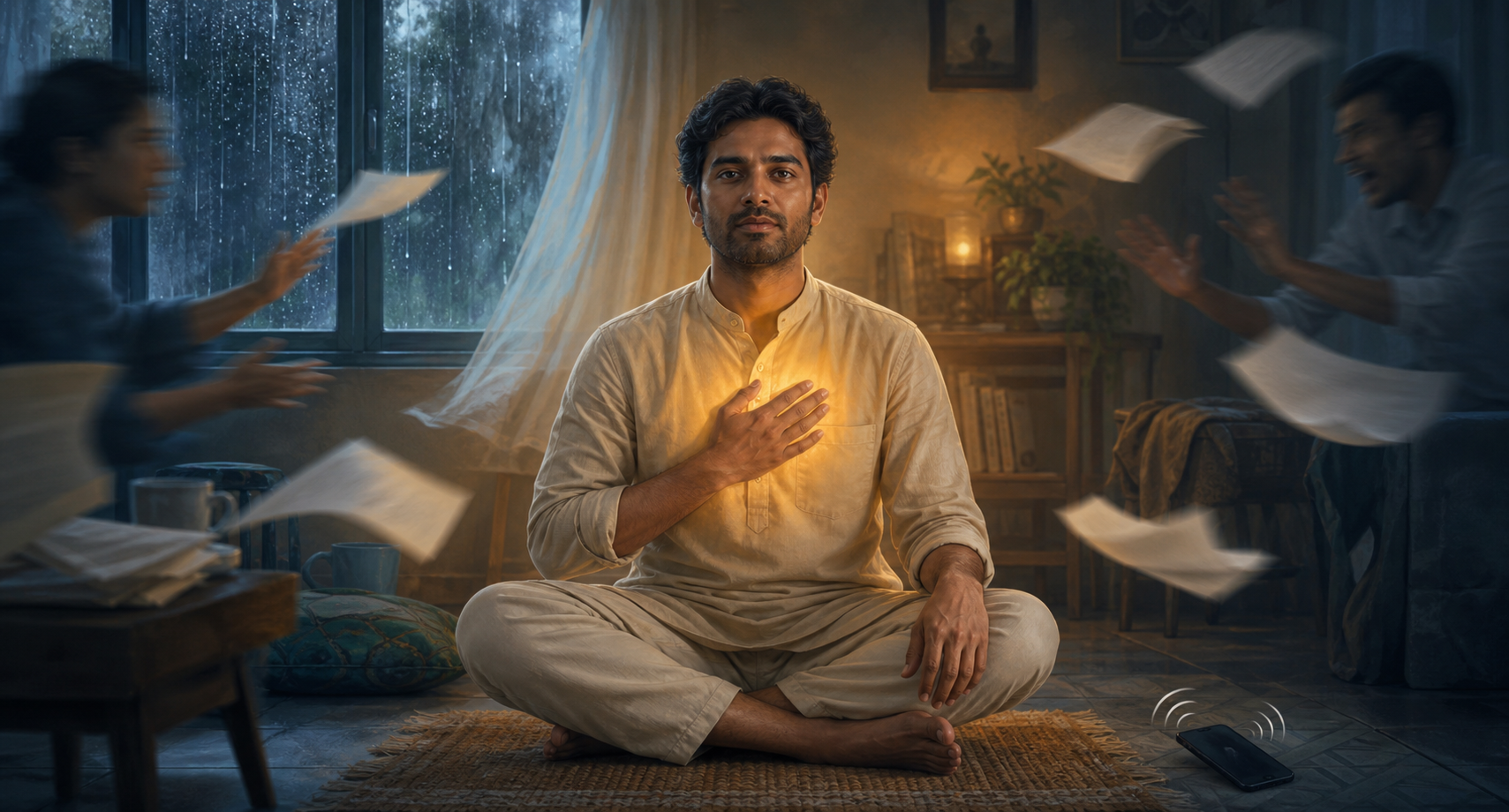
You know the moment when resilience is needed: anger has already reached your tongue, anxiety is rehearsing every possible failure, or criticism has made a measured response feel impossible. The immediate problem is not that an emotion appeared. It is that the emotion is about to choose your next action.
Hindu practice offers a disciplined alternative. You steady the breath, witness the movement of the mind, remember your dharma, and act without making your peace dependent on the result. This does not make you emotionless. It gives you enough inner room to feel fully without reacting blindly.
Key takeaways
- Equanimity means remaining capable of right action during pleasure and pain. It does not mean denying either one.
- When emotion is intense, use a simple sequence: pause, breathe, observe, and choose the response that best serves dharma.
- Prāṇāyāma, mantra japa, dhyāna, and svādhyāya work best as regular disciplines, not merely as emergency techniques.
- Karma Yoga reduces emotional dependence on praise, blame, victory, and disappointment by returning attention to the duty you can perform now.
- Seek qualified professional help when distress repeatedly impairs ordinary functioning or creates a risk of harm. Spiritual practice should support appropriate care, not replace it.
Emotional resilience is steadiness, not emotional suppression
Suppression says, “I should not be angry,” while the anger continues to direct your posture, tone, and decisions. Resilience says, “Anger is present, but it does not have sole authority over what I do next.” That distinction is the heart of the practice.
The Bhagavad Gita places this capacity within the ideal of the sthitaprajña, a person whose understanding remains steady amid changing conditions. Joy and sorrow still occur. Praise can still feel pleasant, and criticism can still hurt. The achievement is not numbness but freedom from being pulled into unwise action by every fluctuation.
You can test whether you are practising steadiness or suppression by asking what happens next. If you deny anger but become cold, punishing, or passive-aggressive, the emotion is still governing you. If you acknowledge it, identify the violated value or attachment beneath it, and select a proportionate response, the emotion has become information rather than command.
The Upanishadic language of the inner witness, or sākṣin, provides a useful way to create this space. A thought, sensation, or mood can be observed because it is an experience occurring within awareness; it need not be treated as your entire identity. “Fear is present” leaves room for discernment. “I am fear” closes that room. This movement from reactivity toward witnessed, purposeful action is central to emotional resilience in Hindu practice.
Witness-awareness must not become an excuse to abandon responsibility. If you have caused harm, calmness does not erase the need to apologise or repair it. If another person is behaving abusively, equanimity does not require you to remain available for mistreatment. A steady mind should make boundaries and duties clearer, not less important.
Related ideals appear across the Dharmic traditions: Buddhist upekkhā, Jain sāmāyika, and Sikh sehaj each value forms of balance and non-reactivity. These are not interchangeable doctrines, but they share a practical insight: inner steadiness can protect compassion, clarity, and non-harm when circumstances are difficult.
Use a four-move dharmic pause before you respond

When you are emotionally flooded, a complex teaching is hard to retrieve. Use the same short sequence each time so that it becomes familiar: pause, breathe, observe, and act according to dharma.
- Pause the outward reaction. Do not send the message, deliver the accusation, make the promise, or announce the decision yet. If possible, put down the object in your hand and stop composing your defence. The pause is not surrender. It prevents the first impulse from becoming an irreversible act.
- Steady the breath. Let the breathing become comfortable and unforced. Follow each inhalation and exhalation without introducing a demanding ratio or breath retention. The purpose here is not a display of yogic control; it is to give attention a stable place to rest while the emotional surge changes.
- Observe the full reaction. Notice the bodily sensation, name the emotion, identify the story in the mind, and recognise the action impulse. You might find tightness in the jaw, anger, the thought that you are being disrespected, and an urge to humiliate the other person. Separating these elements makes the reaction easier to examine.
- Choose the dharmic action. Ask which duty belongs to you in this situation, which response causes the least unnecessary harm, and what you would still consider honourable after the emotion passes. Then take the smallest useful action: ask a clarifying question, state a boundary, correct an error, leave an unsafe situation, or defer a decision until you can make it responsibly.
The sequence should not be used to rationalise avoidance. Some situations require prompt action. A safety threat may require leaving and contacting appropriate help; a serious workplace error may require immediate disclosure. The pause is meant to remove needless reactivity, not urgency itself.
A helpful final check is to separate fact from interpretation. “The deadline changed” is a fact. “No one respects my work” is an interpretation. The interpretation may contain something worth investigating, but treating it as established fact will usually intensify the reaction before you know what happened.
Build steadiness before the difficult moment arrives
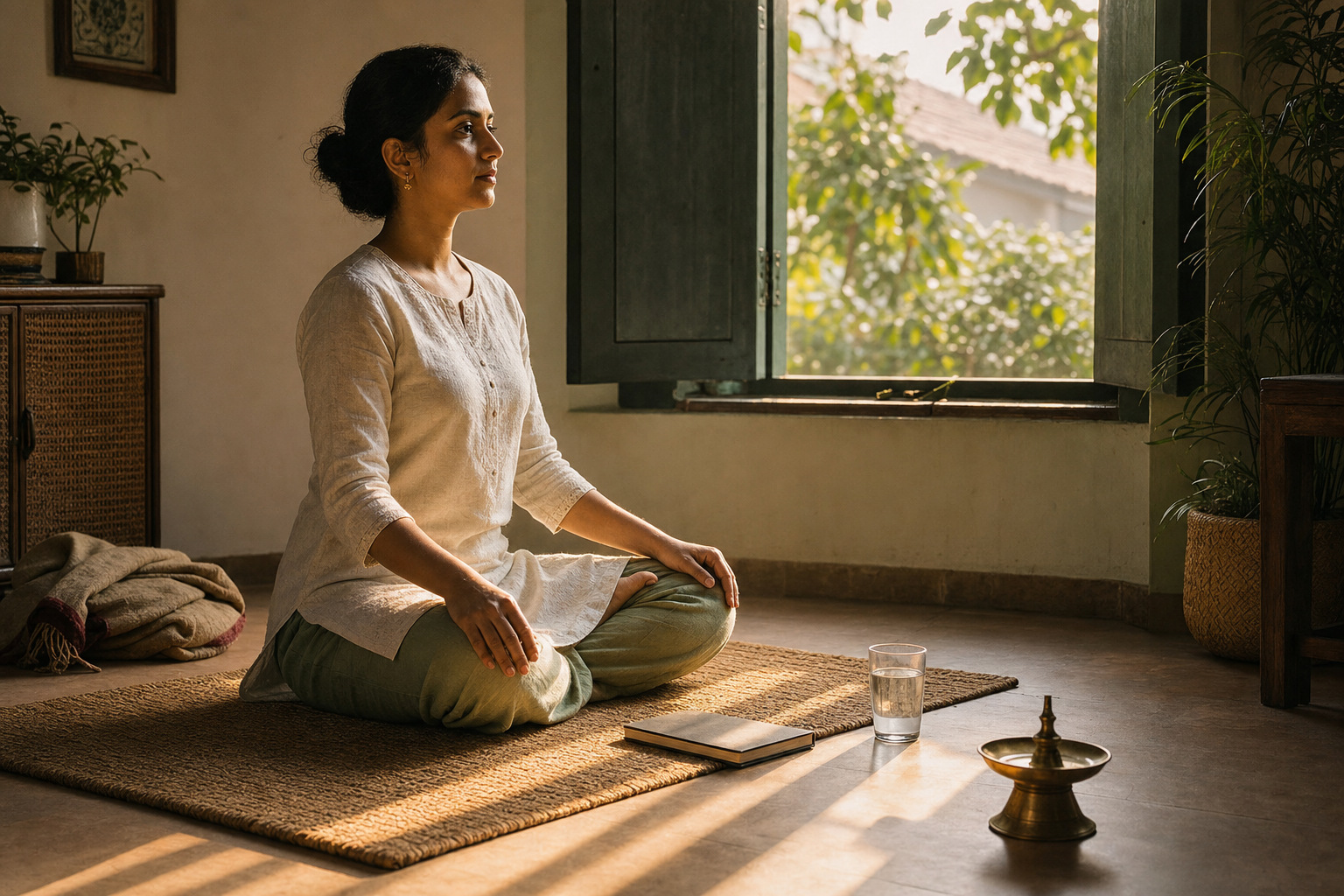
Emergency calming is useful, but emotional resilience is built through abhyāsa, repeated practice. Choose a dependable cue in your day, such as completing morning purification or sitting before you open your phone, and connect it to a compact routine. A modest practice you repeat is more useful than an elaborate practice you continually postpone.
- Begin with gentle prāṇāyāma. Follow a calm, natural breath until attention is less scattered. Avoid turning the exercise into a contest. Force, strain, and ambitious retention are unnecessary for the purpose of emotional centring.
- Continue with mantra japa. Use a mantra that belongs meaningfully within your family practice, sampradāya, or guidance from a qualified teacher. Return attention to its sound whenever the mind wanders. Constantly changing mantras can turn practice into novelty-seeking rather than concentration.
- Sit in dhyāna. Notice thoughts and sensations without chasing pleasant ones or fighting unpleasant ones. When a memory or worry appears, recognise it and return to the chosen focus. The return is not evidence of failure; it is the actual repetition through which steadiness develops.
- Close with svādhyāya. Examine a recent emotional episode. Ask what occurred, what you felt, which outcome or identity you were protecting, and what dharma required. Keep the inquiry concrete. “I became defensive when corrected because I wanted to appear infallible” is more useful than “I need to be more spiritual.”
Use the same inquiry after pleasant experiences as well. Attachment is not limited to fear and anger. Praise can make you dependent on approval, success can make you careless, and excitement can produce commitments you cannot fulfil. Equanimity trains you to receive pleasure gratefully without asking it to guarantee your worth.
Do not measure progress by whether difficult emotions disappear. Look for behavioural evidence: you interrupt fewer people, send fewer regrettable messages, recover perspective more readily, and repair harm without spending as much energy defending your self-image. The direction matters more than performing the identity of a permanently serene person.
Bring Karma Yoga into the places that test you

Karma Yoga corrects a common source of emotional instability: making your willingness to act depend on a guaranteed result. You still plan carefully and pursue a worthy outcome. You simply refuse to hand your inner balance to everything you cannot control.
Before a demanding task, sort the situation plainly. Your preparation, honesty, effort, timing, and treatment of others belong to your field of action. Other people’s praise, their private motives, every external obstacle, and the final result do not belong to you in the same way. Attend fully to the first group. Respond intelligently to the second without pretending you can command it.
During a family disagreement
First identify the relationship-duty that anger is obscuring. Being a parent, spouse, sibling, or adult child may require firmness, patience, truthfulness, protection, or apology. It does not require winning every exchange. Before stating your conclusion, reflect back the concrete concern you heard. Then address the conduct or decision at issue without turning it into a verdict on the other person’s entire character.
Under pressure at work or in study
Anxious thinking often moves attention away from the duty in front of you and toward imagined praise, blame, success, or disgrace. Return to the next honest action. Clarify the requirement, disclose a genuine risk, correct what can be corrected, and complete the work that remains. Detachment from the result is not indifference to quality; it is freedom from wasting the present task on rehearsals of a future reaction.
When social media provokes you
Do not confuse immediacy with courage. Draft the response, apply the dharmic pause, and ask what the message will actually accomplish. A correction that protects truth or prevents harm may be warranted. A reply designed mainly to display superiority usually feeds ahaṅkāra while claiming to defend principle. You can oppose adharma without imitating the contempt you oppose.
When you receive praise or criticism
Extract usable information from both. Praise may reveal a strength worth applying responsibly; criticism may expose an error worth correcting. Neither should become a total account of who you are. Ask what is true, what action follows, and what can now be released. This keeps appreciation from becoming vanity and correction from becoming humiliation.
Choose one recurring trigger today and write the dharmic response you want available when it returns. Pair that intention with one daily cue for breath, japa, meditation, and reflection. You are not waiting to become untroubled before acting well. You are training so that, when trouble comes, your values reach the moment before your impulse does.
References
