

You may be here because a college has allowed one religious marker, a saffron response is being urged, and you want to know what equal treatment actually requires. The useful question is not which side can fill a corridor with more visible symbols. It is whether the campus has one defensible rule for conscience, uniforms, organised campaigns, examinations and outside groups.
That distinction matters after Sri Ram Sena reportedly distributed saffron shawls at selected Hubballi colleges in early June 2026, following institutional relaxations of earlier hijab restrictions. If you are a student, parent, teacher or administrator, the practical answer is neither selective accommodation nor retaliatory escalation. It is a written, neutral rule with a quick route for resolving hard cases.
One controversy contains three different decisions
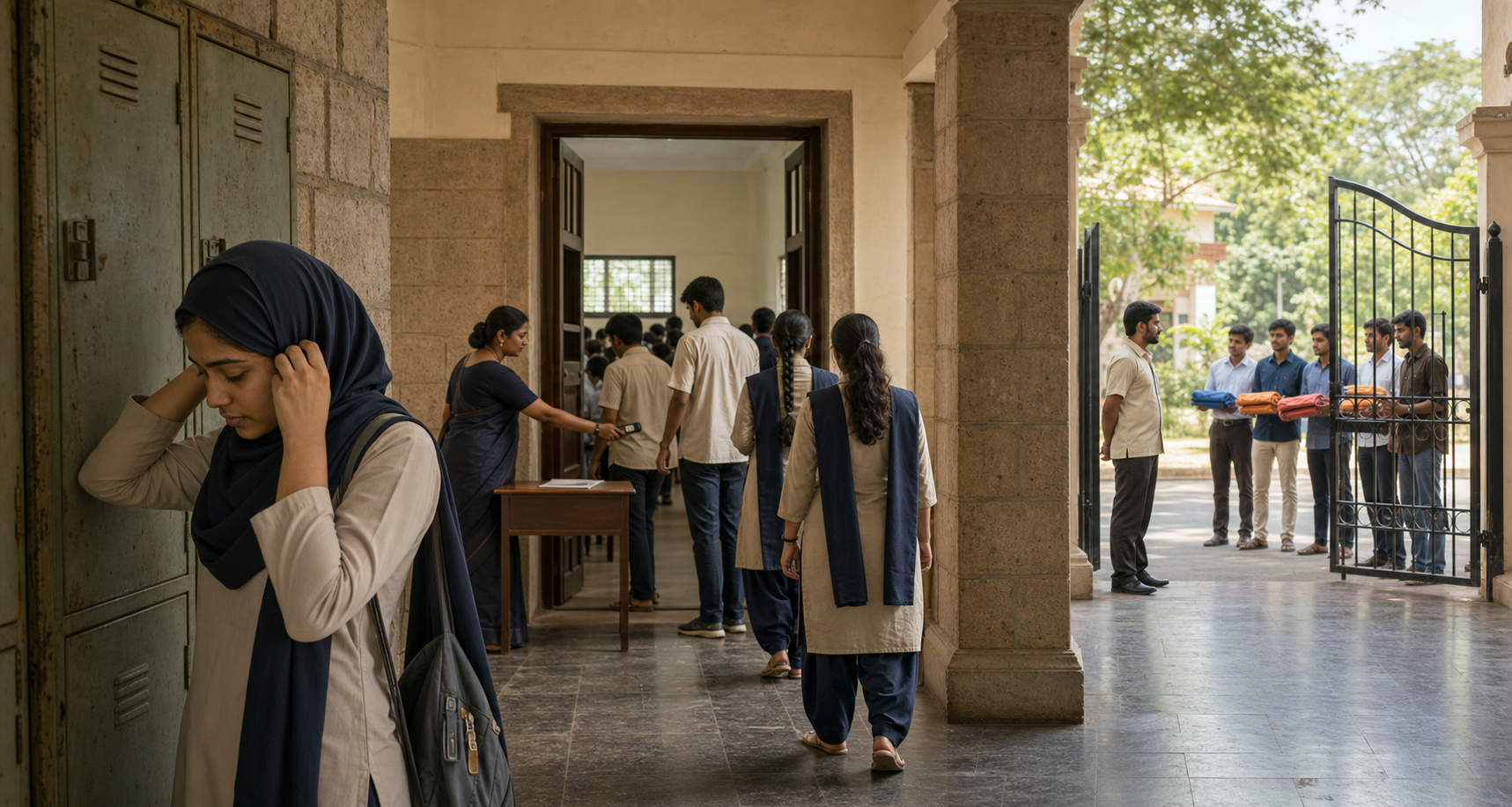
A campus dispute becomes harder to solve when every visible symbol is treated as the same act. Personal observance, deviation from a prescribed uniform and an organised political campaign can overlap, but they are not automatically identical.
Start by classifying the conduct before debating the community associated with it:
| Situation | The question the college should ask | A workable neutral default |
|---|---|---|
| An individual wears a religious symbol or garment | Does a published uniform rule cover it, and is an accommodation available? | Apply the same written request and review process to every sincerely held belief. |
| A symbol is worn in a classroom or examination | Is there a specific concern involving uniformity, identification, safety or exam integrity? | Use the least intrusive measure that resolves the stated concern. |
| Students distribute matching apparel or organise a demonstration | Is this personal observance or coordinated expression? | Use neutral time, place and manner rules, with no disruption or intimidation. |
| An outside organisation distributes material on campus | Was access authorised under a rule open to all groups? | Require prior permission and keep unauthorised mobilisation out of teaching spaces. |
| A student challenges a decision | Can the institution identify the clause, reason and appeal route? | Give a written response and preserve access to learning while the issue is reviewed where safely possible. |
This prevents a common error: confusing equality with visual sameness. A privately worn item and hundreds of items distributed as part of a campaign may involve different conduct. A college can regulate organised distribution without declaring the associated faith or colour objectionable. Conversely, it cannot call one item personal conscience and dismiss a functionally comparable request merely because it comes from another community.
Bhagwa carries sacred and civilisational meaning for many Hindus. Its use in a coordinated campaign does not erase that meaning. But sacred meaning also does not exempt a campaign from ordinary rules governing outside involvement, classroom disruption or pressure on students. The same distinction should protect a Muslim student whose hijab is a personal observance from being treated automatically as an organiser of a political action.
The Hindu concern about asymmetry is legitimate. If a college quietly relaxes a rule for one community but invokes uniformity against another, it creates distrust. The remedy is to expose and correct the unequal rule, not to pressure students into becoming a compulsory counter-bloc.
Constitutional rights protect conscience, but not every form of mobilisation
The constitutional starting point is broader than a contest between hijab and saffron. Articles 14, 19(1)(a), 21 and 25 bring equality, expression, dignity and freedom of conscience into the analysis. Article 25 itself makes religious freedom subject to public order, morality, health and other fundamental rights. A right is therefore real without being unlimited.
Educational institutions also have legitimate responsibilities. They can prescribe reasonable uniform, safety, identification and examination rules. The harder questions are whether a restriction has a legitimate purpose, applies without religious favour or hostility, goes no further than necessary, and leaves room for a less intrusive accommodation.
The judicial history must be described carefully. In March 2022, the Karnataka High Court upheld a government order supporting prescribed uniforms and did not require hijab accommodation inside certain classrooms. In October 2022, the Supreme Court produced a split verdict, and the matter was later slated for consideration by a larger bench. That sequence does not justify telling students that the Supreme Court unanimously settled every question about religious attire in every educational setting.
Do not rely on an old headline before excluding a student, withholding an examination opportunity or imposing discipline in 2026. A college should verify the current binding position, applicable state legislation, relevant rules under the Karnataka Education Act and its own validly adopted policy. Where the consequence could materially affect a student’s education, the institution and the affected family should obtain advice from a qualified lawyer on the current facts rather than treating this general framework as an answer to an individual legal case.
The essential religious practices doctrine remains part of the surrounding legal debate, but administrators should not turn every first-line decision into a theological trial. Many cases can be resolved through neutral questions: What is the actual institutional need? Does the rule cover comparable conduct? Can identification occur privately? Can an accommodation preserve both conscience and academic order? A narrow operational solution is often more stable than an improvised judgment about whose belief is religious enough.
Use six tests to tell a fair rule from selective enforcement

If you are evaluating a college policy, ask these questions in order. A rule that cannot survive them should be repaired before it is enforced through exclusion or punishment.
- Is the rule written, dated and publicly available? Students should not discover a dress restriction through an oral command at a classroom or examination door.
- Does it regulate a category of conduct rather than a favoured or disfavoured identity? A policy may address head coverings, additions to a uniform, organised apparel distribution or external campaigning. It should not change its standard after learning which community is involved.
- What legitimate purpose does the restriction serve? The institution should name the actual concern, such as identification, safety, examination integrity or classroom order. General discomfort with a visible faith is not an operational reason.
- Is the rule limited to the place and time where that purpose exists? A concern inside an examination room does not automatically justify a campus-wide prohibition. A classroom uniform rule does not automatically govern a voluntary event outside teaching hours.
- Was a less restrictive option considered? Private identification, a same-gender verification process, a compatible form of religious attire or moving organised expression outside teaching space may solve the problem without a total prohibition.
- Can the student receive reasons and appeal promptly? A right that can be reviewed only after classes or examinations have been missed is often hollow in practice.
Consistency does not mean pretending that every object has the same function. Compare like with like. If a hijab is being considered as an individual religious accommodation, compare it with other individual accommodation requests. If saffron shawls are being distributed in bulk to create a coordinated display, compare that activity with other organised distributions and demonstrations. If either item is worn by an individual under a uniform exception, apply the same sincerity, safety and identification conditions.
A fair policy also protects voluntariness. No student should be intimidated into removing a sincerely worn item. No student should be pressured to accept and wear a saffron shawl to prove Hindu solidarity. A no-intimidation clause should cover threats, ridicule, physical obstruction, coercive distribution and retaliation regardless of the symbol involved.
Visible symbols can harden group boundaries when they become proxies for a larger political struggle. The practical warning is not to erase identity; it is to stop the institution from rewarding escalation. If each new display produces a larger counter-display, the classroom becomes a contest for dominance rather than a place of learning. A neutral rule should remove that incentive before the cycle begins.
What students, parents and colleges should do before the next confrontation
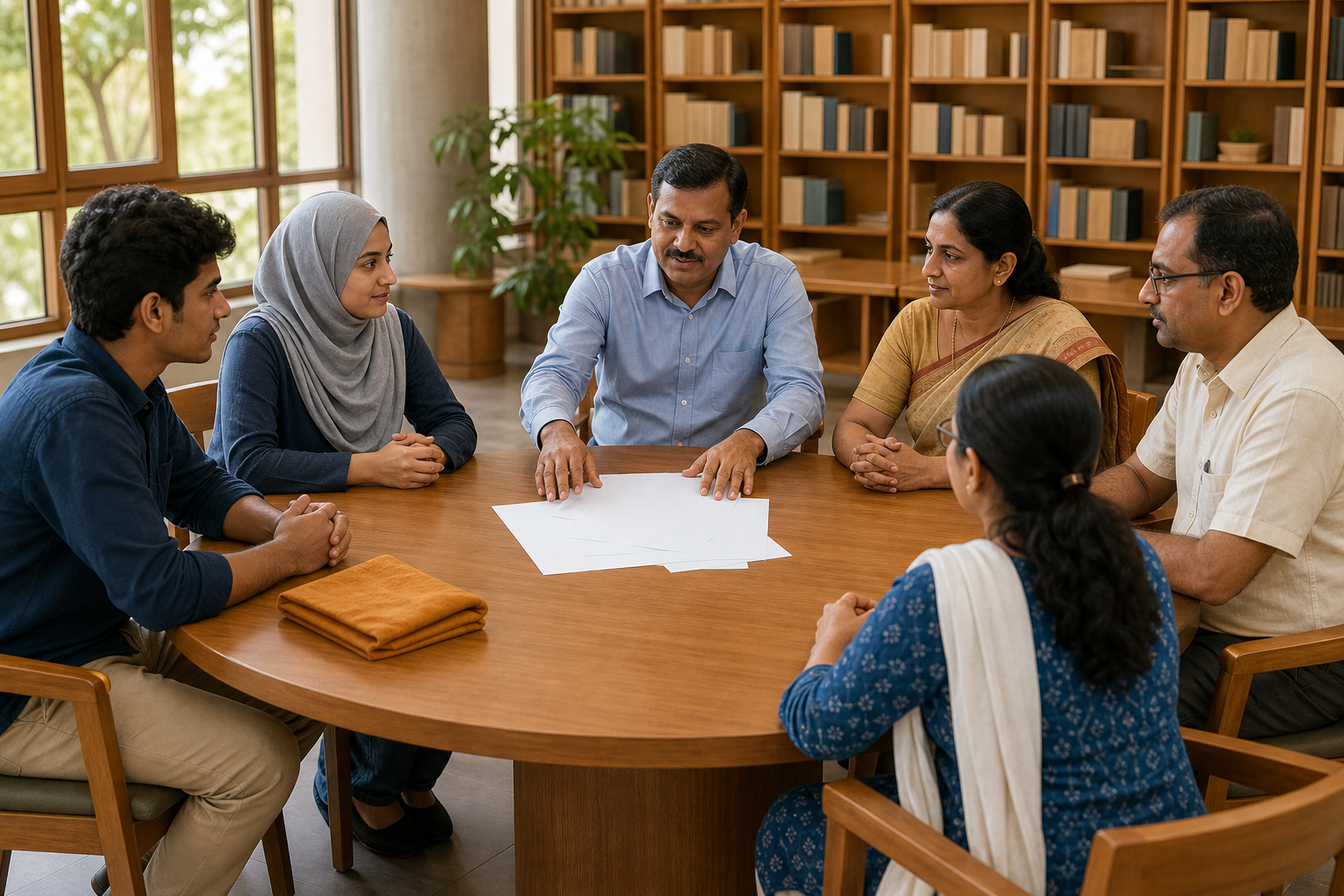
If you are a student or parent
- Obtain the current policy itself. Save the circular, publication date, version and webpage. Ask whether it applies to classrooms, laboratories, corridors, hostels, ceremonies and examinations; do not assume one rule covers every setting.
- Record the event in neutral terms. Note the date, location, item involved, instruction given, official who gave it and immediate consequence. Separate what you observed from what others claimed online.
- Ask for the exact clause and comparator. A useful written question is: Which published rule applies, what institutional purpose does it serve, and how is the same rule applied to comparable requests from other communities?
- If the matter concerns personal observance, request an accommodation in writing. Explain the requested practice, where it would apply and any practical alternative you can accept. Ask for a written approval or a denial with reasons.
- Protect access to learning while review is pending. Request an interim arrangement such as private identification, an agreed uniform-compatible adjustment or another minimally intrusive measure. Do not assume that staging a confrontation at an examination door will preserve your rights or your academic opportunity.
- Ask for a decision schedule. A useful institutional benchmark is acknowledgement within 24 hours, a first hearing within 72 hours and resolution of a non-complex matter within 7 to 10 days. These are proposed service standards, not universal statutory deadlines; if the college uses different timelines, ask it to state them.
If anyone is threatened, physically blocked or coerced, treat that as a safety matter rather than merely a dress-code disagreement. Use the institution’s immediate safety channel and inform a parent, guardian or trusted official where appropriate. Preserve evidence without circulating unverified names or inflammatory clips that could expose uninvolved students.
If you administer a college
The first task is to replace improvisation with one visible process. Frontline staff should not be inventing policy at the gate while senior officials issue different explanations later.
- Publish one authoritative policy page containing the current circular, prior versions, scope, accommodation form, appeal route and a live FAQ.
- State separately the rules for ordinary classrooms, examinations, laboratories, non-teaching spaces, organised student expression and outside organisations. Ambiguity between these settings is where selective enforcement begins.
- Pause unauthorised distribution and coordinated mobilisation inside teaching spaces under a rule that applies to every ideology and faith. Do not describe saffron, hijab or another religious identity as inherently disruptive.
- Assign accommodation decisions to a small, multi-faith and multi-disciplinary committee rather than a single gatekeeper. Record the institutional aim, alternatives considered, conditions imposed and reasons for the outcome.
- Create neutral examination instructions in advance. Cover permissible attire, identity verification, security screening and same-gender checks where needed. Candidates should know the procedure before arriving at the venue.
- Train invigilators, security staff, hostel wardens and class coordinators in documentation, anti-bias practice and de-escalation. Give them scenarios and a named official to contact; a slogan about harmony is not an operating procedure.
- Use a neutral permit system for campus distributions and events. Require prior approval, defined times and places, no interference with teaching, and no intimidation. Route requests from external organisations through the same process.
- Publish an anonymised quarterly dashboard showing accommodation requests, approvals, denials with reasons, incident counts and resolution times. Track attendance and examination participation after policy changes so that an apparently orderly rule is not quietly excluding students.
A Campus Harmony Council can support this work if it has a precise role. Include student representatives, faculty, administrators and trained mediators. Let it identify recurring problems, facilitate restorative discussions and review implementation patterns. Do not use it as a substitute for the official who must make a timely, appealable decision.
Documentation is more than protection against litigation. It forces the institution to explain why a restriction is necessary and why a narrower alternative would not work. That record makes unequal treatment easier to detect and a proportionate decision easier to defend.
A Dharmic response should defend both dignity and discipline
Sarva dharma sambhava should not become an excuse for administrative vagueness. Equal regard requires clear limits as well as respect. A campus can honour freedom of conscience, recognise the civilisational place of saffron and still prevent any religious or political organisation from converting a lecture hall into a mobilisation site.
A pro-Hindu position need not choose between silence about unequal treatment and permanent symbolic confrontation. It can insist on four things at once: Hindu students must not be shamed for sincerely expressed identity; Muslim students must not be collectively treated as political actors; institutions must apply comparable rules to comparable conduct; and outside groups must not commandeer students or academic space.
Campus culture also needs work after the immediate rule is settled. Joint service projects, story-based learning and structured dialogue can bring Hindu, Buddhist, Jain, Sikh and other students into cooperative settings where nobody is reduced to a garment or campaign. These activities should not demand theological agreement. Their purpose is to make disagreement less vulnerable to rumour, peer pressure and organised provocation.
Key takeaways
- Classify the conduct first: personal observance, uniform accommodation, examination protocol, organised expression or outside mobilisation.
- Equality compares functionally similar cases. It does not require a college to treat private attire and mass distribution as the same event.
- Religious freedom and institutional order are both constitutionally relevant; neither supplies an automatic answer to every setting.
- A defensible rule is written, neutral, proportionate, limited to a legitimate purpose and open to timely appeal.
- Students should seek the exact clause and a written remedy. Colleges should publish separate procedures for classrooms, examinations and organised activities.
- Hindu equality is better protected by transparent parity than by coercing students into an escalating contest of symbols.
Your next move is concrete: find the college’s current circular and ask whether it explains, in writing, how the same principles apply to personal religious attire, organised apparel campaigns, examinations and external distributions. If it cannot answer that question, the policy needs repair before the next student is punished or the next group is mobilised.
References
