
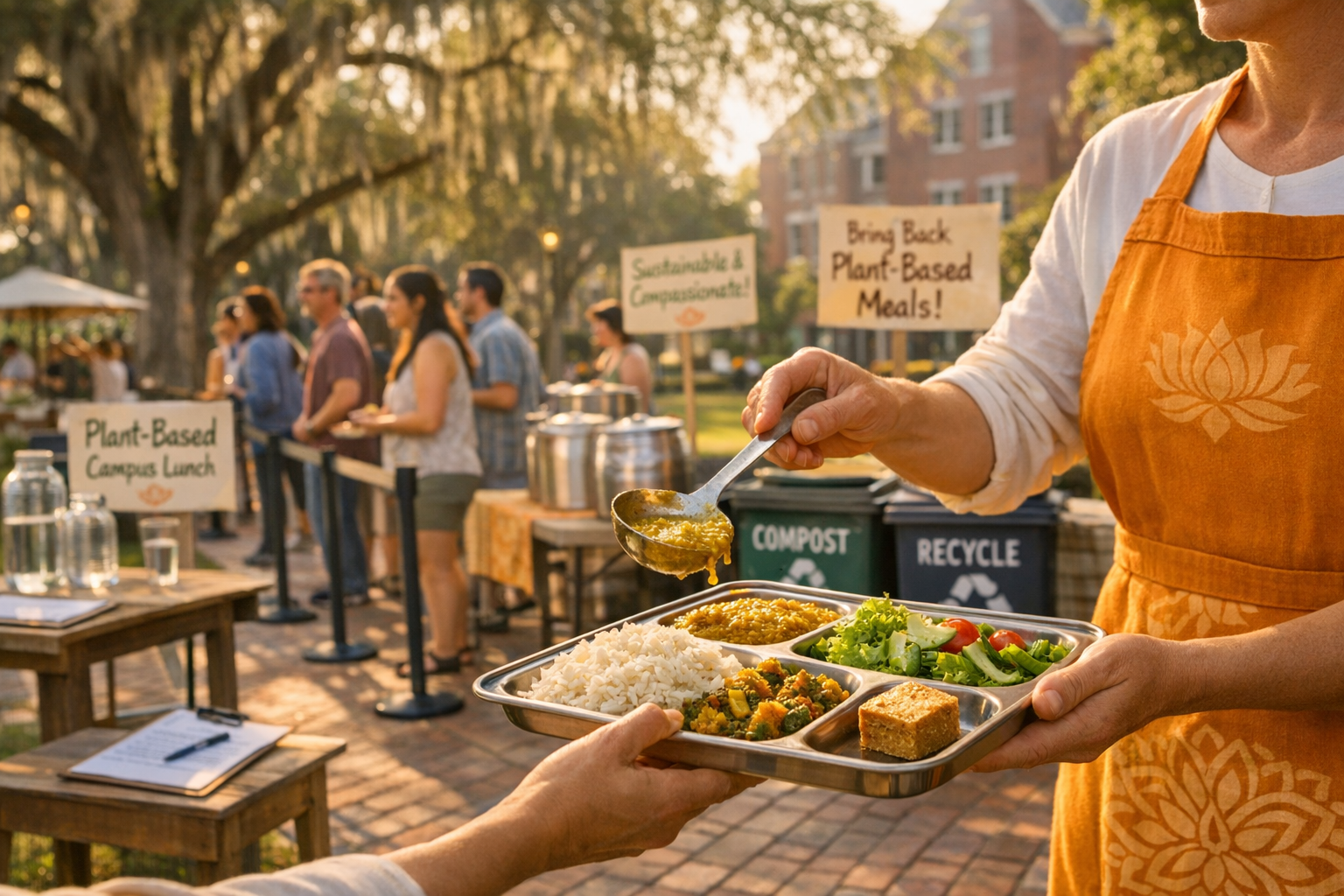
“Bring Back Krishna Lunch!” has become a unifying refrain on the University of Florida campus as hundreds of students, alumni, faculty, and community members endorse a petition urging administratorsspecifically the Office of the Vice President for Business Affairs, Brandi Rentonto restore the long-standing Krishna Lunch program. The petition’s rapid uptake underscores how deeply the program is woven into the daily rhythms, wellbeing, and cultural life of Gainesville’s academic community.
For decades, Krishna Lunchorganized by ISKCON of Gainesville (Hare Krishna)served freshly prepared, plant-based meals that were affordable, consistent, and open to all, regardless of background or belief. Beyond its culinary appeal, the program functioned as a social anchor: students met friends in the queue, faculty paused between classes to share a plate, and visitors encountered a living introduction to dharmic values through wholesome food and warm, courteous service.
Historically associated with the Plaza of the Americas, Krishna Lunch offered a simple, balanced menutypically a grain, a legume-based entrée, seasonal vegetables, salad, and a small sweetthoughtfully designed to deliver satiety and steady energy. Many regulars recall how a plate of rice, sabjī, and halavā after exams felt like a moment of calm in a demanding semester. In the tradition’s own lexicon, this is prasadam: food prepared in a spirit of gratitude and shared without barriers.
Recent administrative changes and compliance reviewscommon at large public universitieshave affected program operations on campus. Such reviews generally consider multiple factors: equitable vendor access, liability, food-safety standards, accessibility, crowd management, and the stewardship of shared spaces. The petitioning community recognizes these obligations yet contends that a solution can meet all regulatory requirements while safeguarding a program that demonstrably advances student wellness, cultural literacy, and sustainability goals.
Viewed through a dharmic lens, Krishna Lunch exemplifies values held in common across Hinduism, Buddhism, Jainism, and Sikhism. The practice of ahimsa (non-harm) informs a plant-forward menu; Sikh seva and langar find close parallels in open, donation-supported community meals; Buddhist dana is reflected in the offering-and-sharing ethic; and Jain aparigraha resonates in the program’s emphasis on simplicity and restraint. In a plural campus environment, these convergences offer a living classroom in interfaith harmony.
From a policy perspective, public universities manage expressive, cultural, and service activities under content- and viewpoint-neutral frameworks. U.S. jurisprudence affirms neutral access for religiously affiliated groups when criteria are applied evenly (e.g., Rosenberger v. Rector, 1995; Good News Club v. Milford, 2001). Food service adds a parallel layerpermits, insurance, health codes, and equitable vendor rulesbut these are administrative pathways, not barriers, when all parties collaborate in good faith.
Food safety and risk management remain central. Well-documented measuresHACCP-aligned procedures, ServSafe-trained staff, hot–cold temperature control, cross-contact prevention for allergens, clear ingredient disclosures, and handwashing and sanitization standardsare routine in compliant community kitchens. When integrated with proactive queue design, ADA-compliant layouts, and clear egress routes, such programs can operate safely even at scale.
Nutrition science also weighs in favor of the model. A legume–grain pairing supports complete amino acid profiles, while vegetables, legumes, and whole grains collectively deliver fiber, micronutrients, and sustained energy. When thoughtfully planned, plant-based plates meet macronutrient needs while moderating saturated fat and promoting cardiometabolic health. Transparent labeling (including potential allergens such as gluten, tree nuts, or soy) and periodic menu audits can further align the program with university wellness objectives.
Sustainability is a notable co-benefit. Peer-reviewed research consistently finds that plant-forward meals carry substantially lower greenhouse-gas emissions and land and water footprints than meat-centric alternatives. Krishna Lunch’s formatbatch cooking, minimal packaging, and opportunities for compostingmaps naturally onto campus climate action plans. Tracking proxy metrics such as kilograms CO₂e per plate, landfill diversion rates, and food-waste reduction gives administrators data for continuous improvement.
Affordability and food security place the program within the social mission of a public university. National surveys indicate that a significant share of college students experiences food insecurity during the academic year. A predictable, low-cost, plant-based option reduces that burden without compromising nutrition. Because Krishna Lunch is open to all and not contingent on religious adherence, it strengthens inclusion rather than erecting boundaries.
Cultural and civic outcomes are equally salient. The line for Krishna Lunch often functioned as a microcosm of campus lifeundergraduates, graduate students, faculty, and staff exchanging ideas over a shared meal. For many first-year students, that first plate of prasadam anchored a sense of place; for graduating seniors, it became a memory that stitched together their academic journey with the community that sustained it.
Stakeholders across the dharmic spectrum have long understood food as a vehicle for unity. On many campuses, Sikh “Langar on the Lawn” events run parallel to programs like Krishna Lunch; Buddhist and Jain student associations host ahimsa-themed meals; Hindu groups celebrate anna-dāna around festivals. Coordinated programming across these associations would not only meet the blog’s ethos of dharmic unity but also model interfaith cooperation in daily practice.
A pragmatic reinstatement pathway is well within reach. A time-bound memorandum of understanding (MOU) can clarify roles and responsibilities: designated locations and hours; health department permits; insurance and indemnification; crowd-flow plans; waste diversion and cleanup protocols; and procedures for weather contingencies. A joint oversight groupincluding Business Affairs, Environmental Health and Safety, student government, and program representativescan meet periodically to review operations and data.
Operationally, several low-friction controls ensure safety and equity: cashless options to speed queues; point-of-service allergen notices; compost and recycling stations; traffic cones or stanchions to preserve ADA routes; and coordinated schedules to avoid conflicts with other vendors. These steps are standard in campus event management and scale predictably with demand.
Evaluation closes the loop. Administrators and organizers can agree on transparent metricsdaily headcount, average wait time, incident reports (if any), waste diversion, and participant satisfactionpublished each term. Such reporting demonstrates regulatory compliance, informs incremental improvements, and reassures the broader campus community that stewardship is active and accountable.
Equity among campus vendors is an important consideration. A neutral, clearly published access frameworkfirst-come scheduling within designated zones, fee parity where applicable, and transparent safety requirementsensures that Krishna Lunch’s return does not displace others but rather complements the university’s diverse food ecology. Because participation is voluntary and non-coercive, expressive concerns are minimized while choice is maximized.
The petition’s core message is ultimately civic rather than sectarian. Supporters seek the restoration of a program that feeds bodies and builds bridges, upholds sustainability targets, respects public-health norms, and advances pluralism in a manner consistent with the values of a flagship public university. The practical steps outlined above allow Business Affairs and community partners to address legitimate administrative requirements without sacrificing a tradition that meaningfully serves student welfare.
If implemented with care, the University of Florida can model how dharmic traditionsHinduism, Buddhism, Jainism, and Sikhismconverge around shared principles of ahimsa, seva, and community. In this light, “Bring Back Krishna Lunch!” reads not as a nostalgic slogan but as an evidence-based call to preserve a sustainable, inclusive, and educational practice that has long enriched campus life.
Inspired by this post on Dandavats.
