
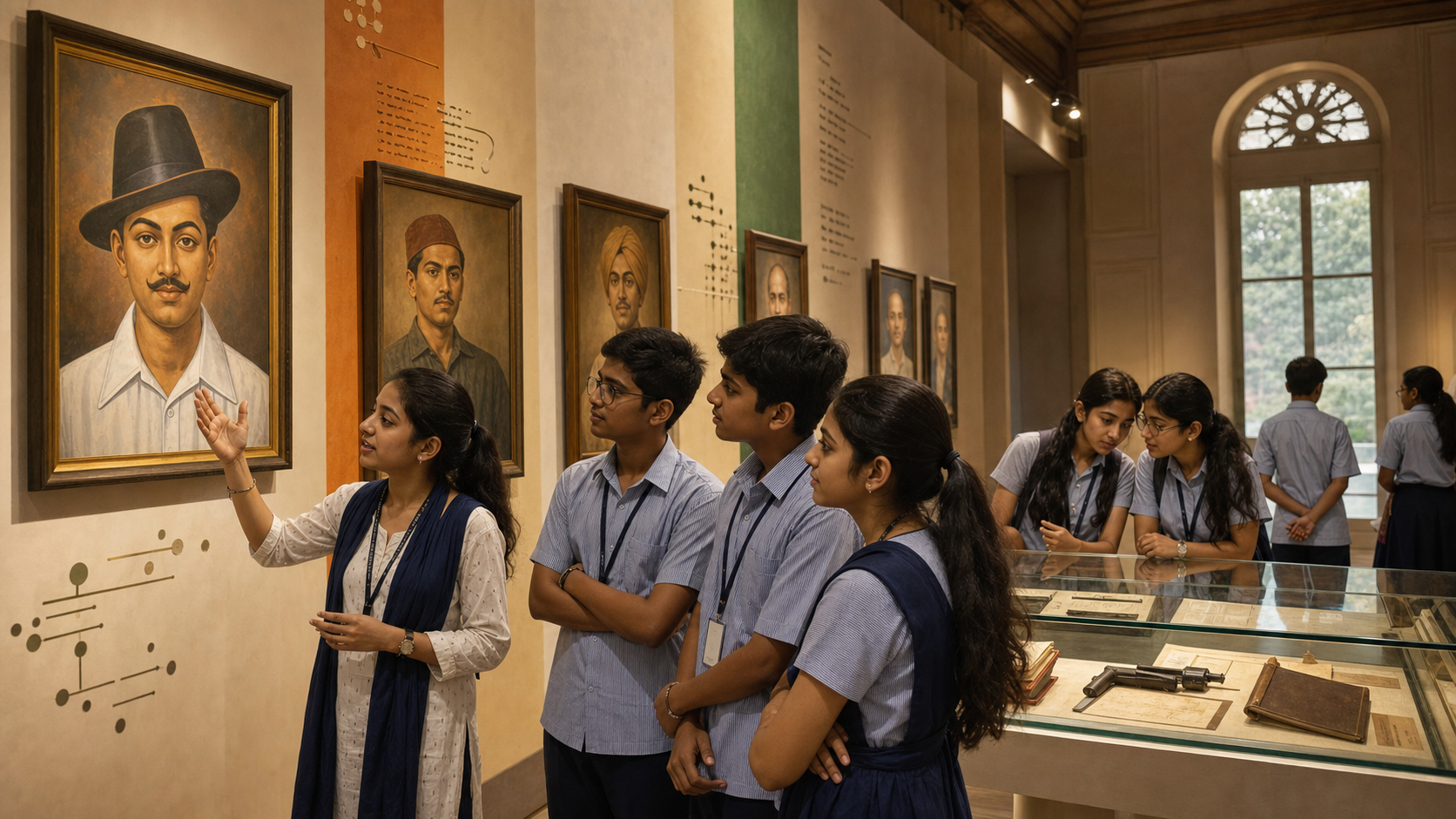
If you are planning a Kranti Gatha exhibition for students, the difficult part is not filling a hall with portraits. It is making sure young visitors leave knowing whose sacrifices they encountered, why those choices mattered, and what responsibility follows from inheriting freedom.
The Republic Day Kranti Gatha exhibition in Kamthe offers a useful model. Portraits, timelines and concise historical summaries were combined with guided walk-throughs, reflective questions and group discussion. The transferable lesson is in that sequence: present the history clearly, help students interpret it, and give their response somewhere constructive to go.
Define the result before collecting the material
Do not begin by asking how many panels will fit in the room. Begin by completing three outcome statements. These statements become your test for every portrait, caption, question and activity you later include.
- After the exhibition, a student should be able to explain at least one sacrifice or contribution in accurate, ordinary language.
- A student should be able to connect that historical choice with a value such as courage, seva, ahimsa or unity.
- A student should be able to identify one present-day civic duty that does not depend on holding office, joining a party or receiving public recognition.
This prevents patriotism from becoming a memory test. Dates and names matter, but remembering them is not the final purpose. A young person should also understand what a person chose, what that choice cost, whom it served and why the episode belongs in Bharat’s public memory.
Use one content check for every display item:
- Who is this person or group?
- What did they do or refuse to do?
- What danger, hardship or sacrifice did the choice involve?
- How did the contribution serve the freedom struggle or the wider community?
- What should a visitor understand rather than merely admire?
If a panel cannot answer these questions from documented information, revise it or remove it. A large portrait with an emotional slogan may command attention, but it does not necessarily teach history.
Do not reserve the exhibition only for the most famous names. In Kamthe, revolutionary courage appeared alongside the everyday contributions of lesser-known participants. That curatorial decision teaches an important civic truth: national life is shaped both by exceptional sacrifice and by people who accept necessary work without expecting to become symbols.
Accuracy is part of the ethical duty of remembrance. Check the spelling of names, keep dates and sequences consistent, and separate documented events from interpretation. If an episode is uncertain or contested, say so plainly instead of turning the strongest version of a claim into a caption. Reverence does not require exaggeration.
Design a route, not a collection of disconnected panels
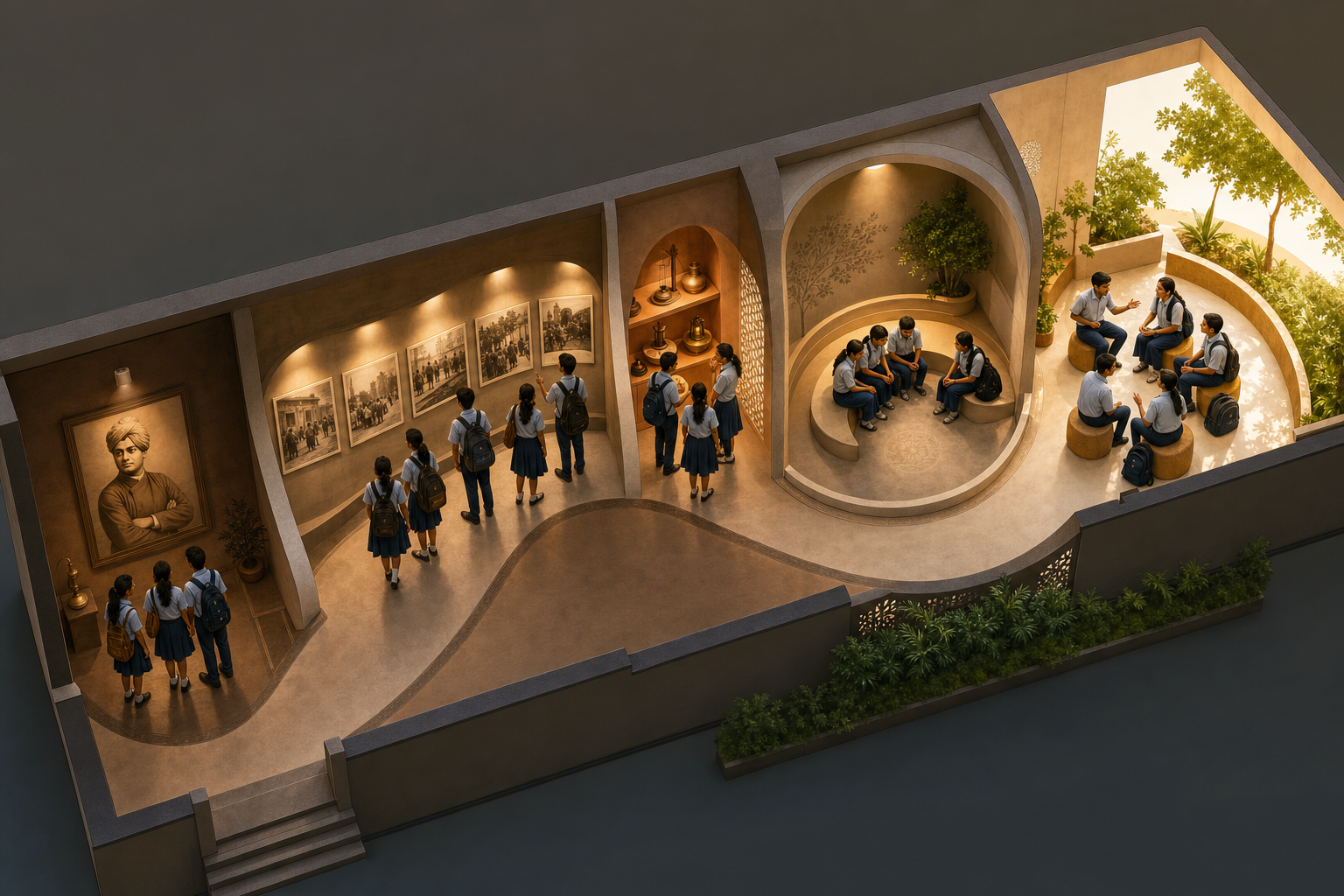
A visitor should not have to invent the relationship between one display and the next. Build a visible narrative route through the exhibition. A simple route can move through five stages:
- Begin with a question. Ask what freedom demanded from ordinary people, or what duties remain after political freedom has been won. The opening question gives students a reason to examine the material that follows.
- Establish the chronological backbone. Use a timeline to show where each person, episode or movement belongs. Without that backbone, individual stories can become isolated acts of bravery with no historical relationship to one another.
- Move from events to human choices. Pair a portrait with a short account of the decision, contribution and consequence involved. The portrait creates recognition; the explanation creates understanding.
- Include the work behind the visible struggle. Make room for organisers, messengers, families, community supporters and other participants whose contributions may not fit the familiar image of a revolutionary hero.
- End with a civic question. Ask what courage, discipline, unity or service requires from a citizen now. The closing panel should open a path into conduct rather than demand a particular emotional response.
Each panel should do one clear job. Give it a factual heading, a concise explanation and a question that can be answered from the material or discussed with a guide. If one panel tries to carry a biography, a political argument, several moral lessons and a list of dates, students are likely to retain only the portrait.
The guide’s role is not to repeat every caption aloud. A guided walk-through should direct attention to turning points: a decision made under pressure, a quiet act that enabled larger action, or a sacrifice whose public consequence is easy to overlook. Pause where interpretation is needed, then let students examine the evidence in front of them.
Discussion should come after students have encountered enough material to form a view. Asking for an opinion too early rewards confidence rather than attention. First establish who, what and when. Then ask why the episode matters and what value it reveals.
Use the Dharmic frame without flattening distinct traditions
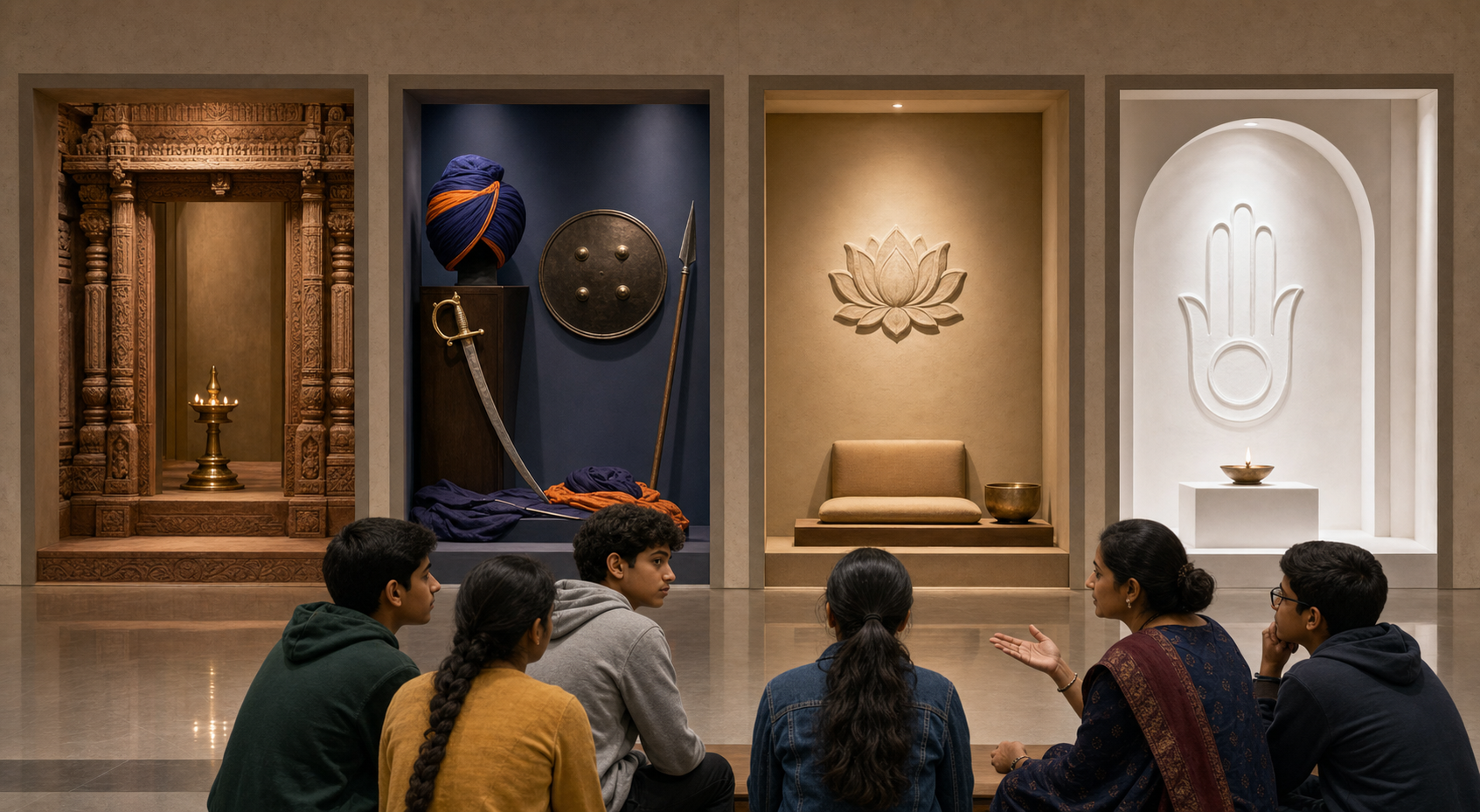
A Dharmic exhibition becomes credible when values help students interpret conduct. It becomes weak when values are added as decorative words beneath unrelated portraits. The Kamthe programme used courage, seva, ahimsa and unity as shared points of reflection across Hindu, Buddhist, Jain and Sikh traditions.
You can give each value a precise function:
- Courage directs attention to action taken despite real cost. Ask what fear or pressure had to be overcome, not merely whether an act looked heroic.
- Seva brings less visible contributors into view. Ask who performed necessary work for the community without making personal recognition the condition of service.
- Ahimsa creates a serious question about means, restraint and regard for life. Do not pretend that every episode in a freedom struggle followed the same method or resolved moral tensions in the same way.
- Unity helps students notice cooperation across social and religious differences. It should not be used to claim that Hinduism, Buddhism, Jainism and Sikhism are identical or that historical disagreements never existed.
Shared ethical language is a bridge, not proof of sameness. Young visitors can recognise a common concern for duty, self-discipline, compassion and public service while also learning that each tradition has its own teachings, institutions and historical experiences. That distinction protects both unity and intellectual honesty.
Use questions that hold the values open for thought:
- When do courage and restraint reinforce one another?
- What distinguishes seva from the pursuit of visibility or praise?
- How can people act in unity without erasing genuine differences?
- What does dharma ask of someone who benefits from sacrifices made by earlier generations?
A facilitator should keep these discussions tied to the historical episode under examination. Otherwise, values can drift into slogans that every student is expected to affirm but no one has learned to apply.
Give patriotic feeling a path into civic service
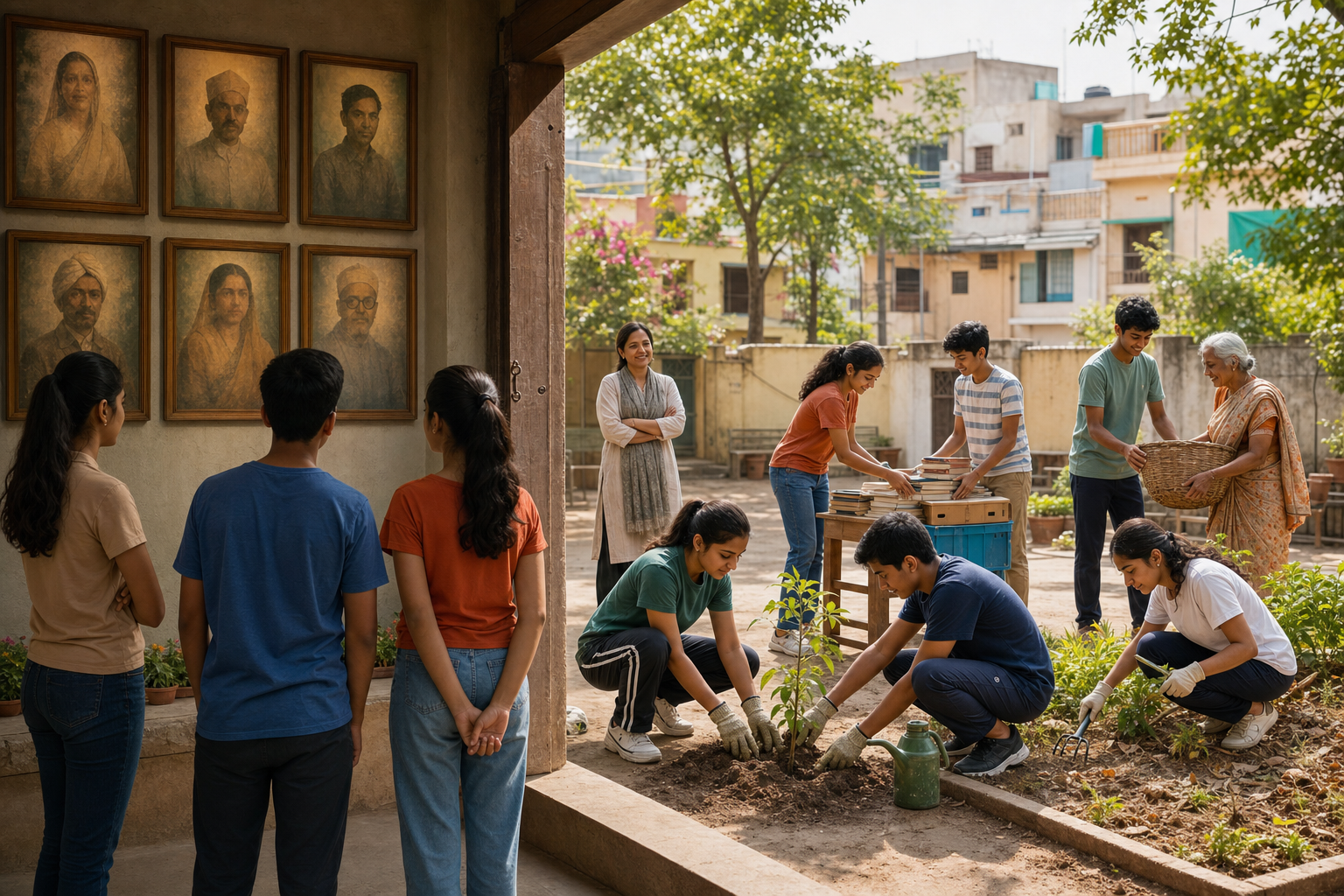
Emotion is not a reliable endpoint. At Kamthe, teachers noticed greater curiosity, while students expressed gratitude, purpose and a desire to serve their communities. Those responses are encouraging, but they do not by themselves establish lasting change. They tell you where the follow-through should begin.
Finish the exhibition with a modest action menu. The action should be specific enough to complete and closely related to what the student has learned. Suitable choices include:
- Research and verify the story of a lesser-known local participant in Bharat’s freedom struggle.
- Prepare a short, accurately sourced explanation of one exhibition panel for a younger student.
- Record one unanswered historical question and pursue it with a teacher or librarian.
- Join a practical act of service for a school, neighbourhood or shared public place.
- Hold a family discussion about one sacrifice shown in the exhibition and bring a new question back to class.
Do not turn the action menu into a pledge that pressures students to display emotion. Let them select a bounded responsibility and state what completion would look like. This respects their agency while making clear that remembrance has consequences.
Teachers, parents and organisers have different follow-through roles:
- Teachers can open the next lesson with questions collected during the visit. This turns curiosity into further learning instead of repeating the tour.
- Parents can ask a child which choice in the exhibition was hardest to understand and why. That question usually produces more thought than asking whether the event was enjoyable.
- Organisers can record which panels generated questions, where visitors lost the sequence, and which civic actions students selected. Those observations should shape the next edition.
Evaluate the programme at three levels. First, can visitors accurately retell a person or episode? Second, can they connect the episode to a Dharmic or civic value without relying on a slogan? Third, did they choose and complete a relevant act of learning or service? Attendance alone cannot answer any of those questions.
Recurrence matters because one commemorative day cannot carry an entire civic education. Community participants in Kamthe called for periodic local exhibitions around national days. Keep the chronological foundation, but rotate lesser-known stories, local connections and discussion questions. Repetition then deepens knowledge instead of merely reproducing the same display.
Key takeaways
- Set learning, interpretation and civic-action outcomes before choosing portraits or filling wall space.
- Connect every person to a documented choice, cost, contribution and public consequence.
- Use a timeline to establish sequence, then use human stories to make that sequence meaningful.
- Treat courage, seva, ahimsa and unity as questions for ethical reflection, not labels pasted onto history.
- End with a bounded act of learning or service, and revisit it after the exhibition.
- Repeat the programme with fresh local material and improve it from the questions visitors actually asked.
If you have only one planning meeting, use it to write the sentence a student should be able to say while leaving the exhibition. Then make every panel, prompt and activity earn its place by helping that sentence become true.
References
