

You see a university event on Hindutva, read the title, and notice that every invited speaker appears to begin from the same conclusion. If you are a Hindu student, scholar, parent, or community advocate, the immediate question is practical: should you object, attend, ask for another speaker, organise a counter-event, or walk away?
The strongest response is not to demand protection from criticism. It is to defend the freedom to investigate Hindutva while insisting that the investigation meet serious academic standards. Hindu representation should mean access to the argument, the evidence, and the right of reply. It should not mean immunity from difficult questions.
Define what is being criticised before debating it

Many arguments about Hindutva fail before the first speaker reaches the evidence. One participant uses the word for a political ideology. Another uses it for Hindu civilisational consciousness. A third treats it as a synonym for Hinduism, Hindu organisations, the Indian state, or any Hindu who objects to the panel. These are not interchangeable claims.
Hinduism encompasses diverse philosophies, devotional paths, rituals, communities, and ways of life. Hindutva is a disputed label used across political and cultural arguments. Buddhism, Jainism, and Sikhism have relationships with the broader dharmic civilisation, but they remain distinct traditions whose adherents must be allowed to describe their own identities. A useful discussion must preserve these distinctions rather than folding every dharmic person into one political category.
Before accepting a claim about Hindutva, ask five questions:
- What exact definition of Hindutva is being used?
- Is the claim about an idea, a text, an organisation, a government, a historical period, or a population?
- Is the speaker making a descriptive claim, a moral judgement, or a causal claim about harm?
- What evidence could disprove or qualify the claim?
- Are ordinary Hindu beliefs or symbols being assigned political meanings that their practitioners do not recognise?
These questions prevent a common rhetorical slide: evidence about one organisation becomes a conclusion about Hindutva in every context, and that conclusion then becomes a suspicion directed at Hindus generally. Criticism of a political movement can be legitimate and necessary. Collective suspicion is something else.
The treatment of sacred symbols provides a clear accuracy test. The Swastika is sacred in Hinduism, Buddhism, and Jainism and must not be collapsed into the Nazi Hakenkreuz. If a lecturer uses the Nazi association to interpret a dharmic Swastika without its religious and historical context, the problem is not that the subject feels uncomfortable. The problem is that the identification is inaccurate and prejudicial.
The same discipline applies to the word Hinduphobia. Anglophone references to the term reach back to the late nineteenth century, so it cannot reasonably be dismissed as something invented only for a current political dispute. That history does not prove that every criticism of Hinduism or Hindutva is Hinduphobic. It does establish that the allegation deserves examination rather than automatic ridicule.
Academic freedom protects challenge, not intellectual immunity
Academic freedom gives scholars room to pursue difficult questions, reach unpopular conclusions, and criticise religious or political ideas. It also gives other scholars and students room to expose weak definitions, selective evidence, double standards, and factual mistakes. A university has not protected inquiry merely because it allowed the first claim to be spoken. Inquiry requires the possibility of an informed answer.
This is why cancellation is usually the wrong first demand. Trying to prevent a speaker from appearing can shift attention from the defects in the argument to a dispute over whether the argument may be heard. A more effective request is specific: disclose the event’s framing, add a qualified interlocutor, protect a genuine question period, publish the evidentiary basis for major claims, or host a structured response.
Representation does not require every lecture about Hinduism to include a Hindu respondent. Nor does a Hindu name on a programme guarantee intellectual diversity. For a panel that portrays an ideology associated with a living minority as a threat, however, credibility depends on giving relevant dissent a meaningful route into the discussion.
That representation has three different functions:
- Subject expertise: someone must be able to test historical, textual, legal, or political claims in the field where they are made.
- Community self-description: practitioners must be able to explain what a symbol, practice, or identity means within their tradition.
- Adversarial scrutiny: at least one participant must be willing and equipped to challenge the panel’s central proposition rather than merely add another version of it.
No single person necessarily performs all three roles. A practitioner should not be treated as the authorised voice of every Hindu, and an academic credential should not be treated as permission to disregard practitioners when describing their own sacred life. Good event design places the forms of knowledge in conversation.
Four standards help you distinguish robust scholarship from a platform that merely borrows academic prestige:
- Contestability: central claims can be questioned, and disagreement is answered with reasons rather than labels.
- Symmetry: comparable evidence and moral standards are applied across religions, political movements, and communities.
- Competence: speakers have expertise relevant to the particular claims they make.
- Access: affected people can hear the case, inspect its basis, ask questions, and seek corrections.
Articles 18 and 19 of the Universal Declaration of Human Rights, together with the International Covenant on Civil and Political Rights, provide a useful baseline: freedom of belief and freedom of expression belong together. Neither freedom promises agreeable speech. Both are weakened when a community may be discussed but is treated as presumptively illegitimate when it replies.
Audit a campus event before calling it biased
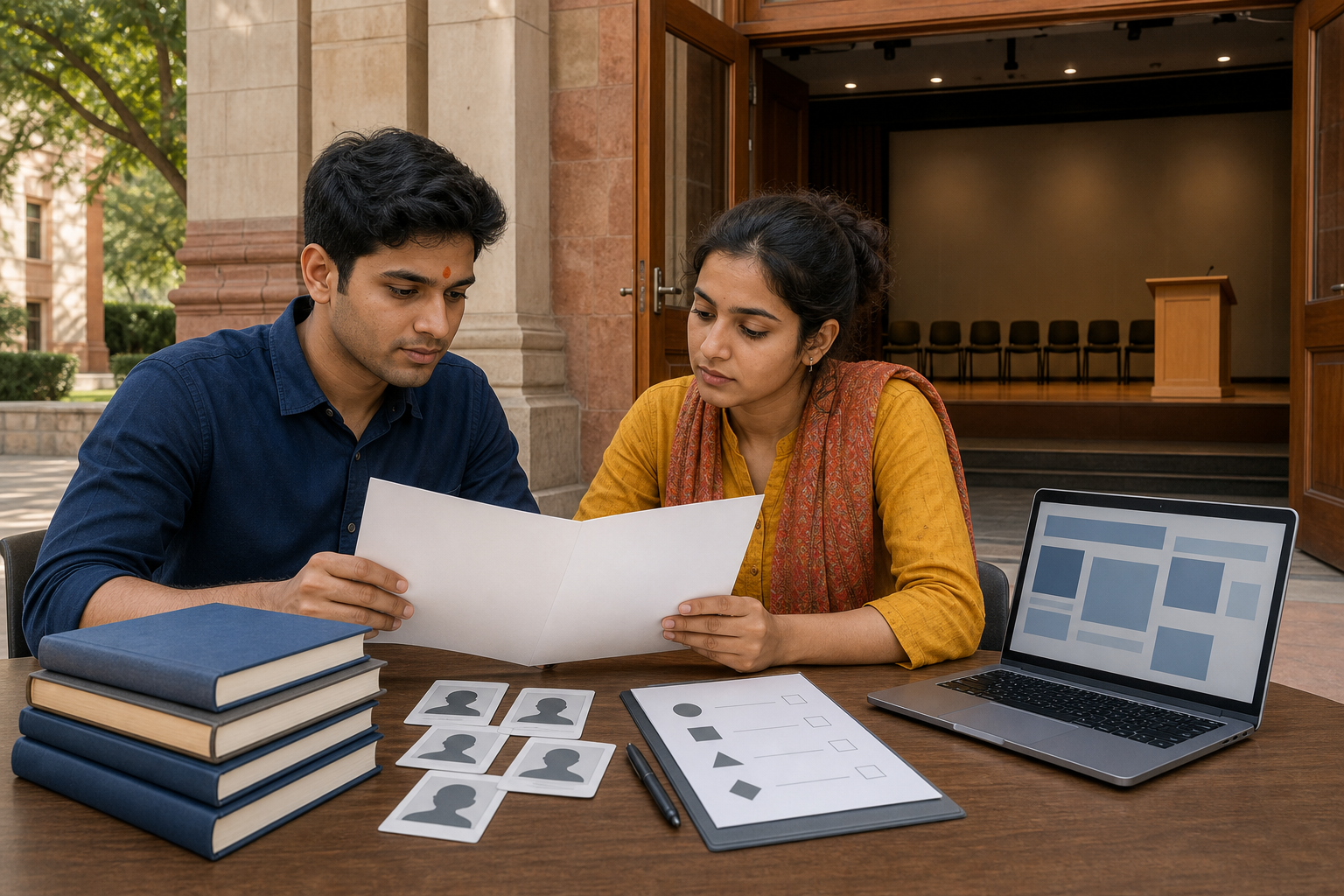
If you call an event Hinduphobic without showing why, organisers can dismiss the criticism as a political reaction. Build the case from observable choices instead. Save the event description, read the speaker biographies, identify the principal proposition, and examine the question procedure. Then use a consistent audit.
| What to inspect | Sign of serious inquiry | Warning sign |
|---|---|---|
| Scope | The event identifies the organisation, period, text, policy, or conduct under examination. | Hindutva, Hinduism, India, and Hindus are treated as one undifferentiated object. |
| Central terms | Speakers define contested terms and keep those definitions stable. | The meaning expands whenever a challenge is raised. |
| Range of positions | A qualified participant can dispute the event’s main proposition. | Speakers differ on details but share the conclusion announced in the title. |
| Evidence | Claims are tied to identifiable texts, conduct, policies, or data with enough context to evaluate them. | Labels, isolated images, or guilt by association substitute for a traceable case. |
| Religious literacy | Dharmic symbols and practices are identified in their own historical and religious contexts. | Sacred meanings are erased so that political or Nazi associations can be presumed. |
| Challenge procedure | The moderator allows concise questions, follow-up where needed, and correction of factual errors. | Questions are screened by viewpoint, compressed into token participation, or answered with personal characterisation. |
Do not score diversity by headcount. Three speakers can carry three professional titles and still reproduce one interpretive frame. Conversely, adding one Hindu participant as a ceremonial presence does not create balance if that person cannot challenge the argument. Audit positions, methods, and opportunities to reply.
A Rutgers University panel held on 27 October illustrates why this audit matters. The event was titled Hindutva in America: A Threat to Equality and Religious Pluralism, was chaired by Audrey Truschke, and was perceived by many Hindu American attendees as one-sided. That perception alone does not settle the validity of every claim made on the stage. It does create a reasonable institutional question: what serious mechanism existed for qualified Hindu disagreement to be heard and answered?
A loaded title is not automatically illegitimate; a university may host an argument with a definite thesis. The title does, however, place a heavier duty on the organisers to distinguish the object of criticism, support the allegation, invite scrutiny, and prevent the thesis from becoming a judgement on an entire minority.
Turn your objection into a record that can be answered

General accusations create general denials. A usable intervention names the exact claim, explains the defect, supplies contrary evidence or missing context, and requests a proportionate remedy. You can do that before, during, and after an event.
- Choose the outcome before writing. Decide whether you want a definition clarified, a speaker added, a factual correction issued, a question period protected, or a follow-up forum scheduled. Do not combine every grievance into one demand.
- Send a short written request. Quote the event’s own language, identify the missing perspective, and propose a named type of participant or format change. Ask for a written reply. A precise request is harder to misrepresent than an angry thread on social media.
- Prepare a claim sheet. For each important assertion, note the speaker’s definition, the evidence offered, the missing context, and the question you want answered. Separate factual errors from interpretive disagreements.
- Ask a question, not a miniature speech. A strong form is: “You defined X as __ and relied on __. How does your argument account for __?” This gives the audience a proposition it can evaluate and makes evasion visible without requiring confrontation.
- Preserve context. Record the exact wording, speaker, and place in the discussion. Mark clearly whether your note is a quotation or a paraphrase. Follow the venue’s recording rules, and do not circulate clipped material as though it captured the entire exchange.
- Request the smallest adequate remedy. A mistaken symbol may require a correction. A one-sided panel may require a response event. Repeated refusal to permit substantive challenge may justify a formal complaint about process. Match the remedy to the documented defect.
Public accounts of the Rutgers event state that attendee Suresh Krishnamoorthy sought a conversation with Audrey Truschke after the session, that the request was declined, and that later posts on X characterised Hindu activists as “fascists”. An outside reader cannot reconstruct every intention from a brief encounter. The practical lesson is narrower: when dialogue fails, document the request and response accurately, avoid speculating about motives, and renew the invitation in a format where the substantive questions cannot be reduced to personalities.
Keep scholarly disagreement and anti-Hindu harassment in separate evidentiary files. Hindu communities have reported online slurs, protesters describing Hindu deities as foreign demons, vandalism at temples, and pressure around the use of Hindu terms and practices. Such incidents warrant clear documentation and an appropriate institutional response. They do not, by themselves, disprove a scholar’s political argument. Equally, the existence of legitimate academic criticism does not make harassment unreal. Conflating the two weakens both cases.
Use normal campus security procedures for credible threats or property risks. Do not describe peaceful disagreement as a security emergency, and do not treat intimidation as ordinary debate. Precision protects participants while keeping security language from becoming another way to stigmatise a community.
Build a forum capable of changing minds

A single panel is often too small for the questions placed under the word Hindutva. History, political ideology, religious identity, civil rights, diaspora experience, and media representation require different kinds of evidence. If organisers want to address all of them, they should expand the format rather than compress every dispute into a sequence of speeches.
A credible “Who Owns Hindutva?” forum should begin with a written proposition and shared definitions. Participants should receive the major claims and reading materials in advance. Opening presentations should state evidence, not merely positions. A moderator should then test each side’s strongest claim, allow direct but civil response, and reserve audience time for questions that have not already been answered.
The proposed programme can include the history and usage of Hinduphobia, pluralism within India, the distinction between sacred symbols and political ideologies, and standards for studying Hindu, Buddhist, Jain, and Sikh traditions. A weekend format combining moderated debate, exhibits, and teach-ins is appropriate when the agenda genuinely covers this breadth. A narrower question should receive a narrower event.
Participant selection should be transparent. Include scholars who genuinely disagree, practitioners who can speak to religious meaning, and advocates able to address civil-rights consequences. Ensure that Hindu women are present as substantive contributors, not only as evidence of demographic variety. Invite Buddhist, Jain, or Sikh voices when their traditions, symbols, or identities are actually part of the proposition; do not use them as generic substitutes for Hindu representation.
The most useful compact asks something of both institutions and Hindu organisations. Universities should protect critical scholarship, use precise language, permit evidence-based challenge, and correct material errors. Hindu advocates should reject speaker vetoes, distinguish offence from falsity, avoid personal intimidation, and accept that Hindu communities contain real internal disagreement. Neither side should demand ideological loyalty as the price of participation.
The forum should leave a public intellectual record: the proposition, speaker biographies, principal evidence, recording or transcript where permitted, unanswered questions, and later corrections. This matters because the objective is not to declare a winner at the door. It is to let students, journalists, policymakers, and community members inspect how the conclusions were reached.
Key takeaways
- Defend the right to criticise Hindutva, then test the criticism for definition, evidence, symmetry, and openness to rebuttal.
- Do not allow Hinduism, Hindutva, India, and individual Hindus to be treated as interchangeable categories.
- Ask for meaningful participation: relevant expertise, community self-description, and a participant able to contest the central thesis.
- Document exact claims and request proportionate remedies instead of leading with a general accusation of bias.
- Separate academic disagreement from harassment so that each can be assessed using the evidence appropriate to it.
If a questionable event has been announced on your campus, begin with one page. State the contested definition, identify the missing perspective, name the format change you want, and give the organiser a fair opportunity to respond. If that request is accepted, participate seriously. If it is refused, preserve the record and build the better forum yourself. That is how Hindu representation becomes an academic contribution rather than a plea for permission to speak.
References
