
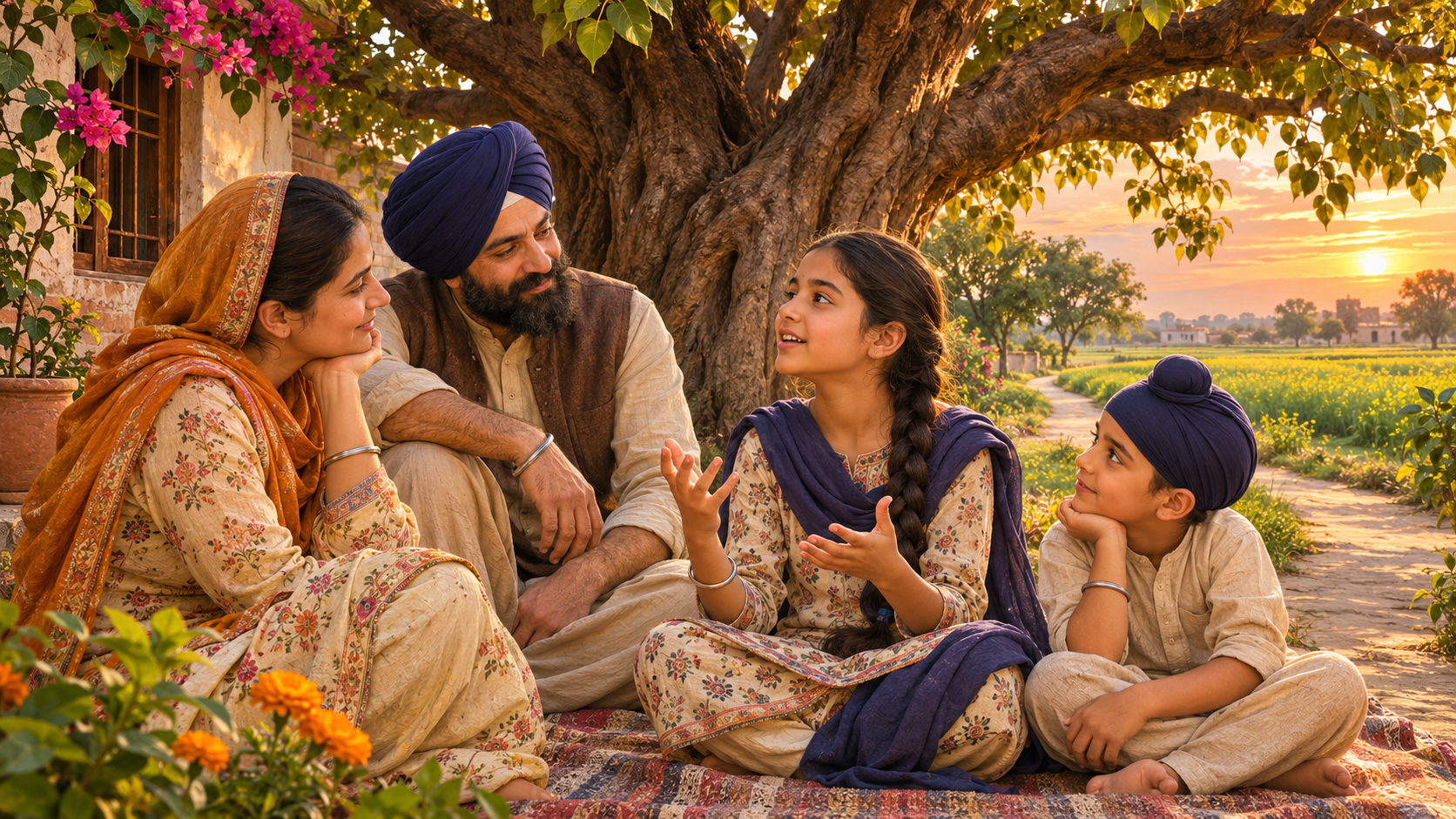
Your child may know Sikh words, recognise familiar stories, and behave well at the gurdwara. Yet you may still wonder whether Sikhi is shaping the choices made when no adult is watching. That is the harder parenting question: not whether a child can repeat a value, but whether the child can recognise when that value is needed.
Baba Buddha gives Sikh parents a demanding and hopeful starting point. His remembered childhood wisdom tells us not to treat discernment as something that appears only after childhood. You can nurture it now – through the questions you welcome, the conduct you model, and the ordinary decisions you let your child examine.
Baba Buddha changes what you look for in a child
The Sikh memory of Baba Buddha presents him as the wise child. The important word for a parent is not merely wise, but child. Childhood and insight are not opposites.
This does not mean expecting a child to speak like an elder, suppress emotion, or carry adult burdens. A wise child is still playful, unfinished, dependent, and capable of poor decisions. Wisdom appears in smaller movements of attention and conscience.
- The child notices that someone has been excluded, even when the group finds the exclusion amusing.
- The child asks why a rule exists instead of merely searching for a way around it.
- The child can admit, I did that, without immediately shifting blame.
- The child pauses between feeling an impulse and acting on it.
- The child sees that a truthful response can also be compassionate.
- The child tries to repair harm instead of treating an apology as a password that ends the conversation.
These signs are easy to miss if you reward only quietness, quick religious answers, or public politeness. Notice the moral movement instead. Say, You saw that your friend was alone and made room, or You told the truth even though it was uncomfortable. Naming the choice helps your child understand what can be repeated.
Avoid turning wisdom into a fixed identity: You are the sensible one, You never cause trouble, or You are more mature than other children. Such labels give a child a role to protect. Praise the act of noticing, questioning, choosing, or repairing. That leaves room for mistakes and growth.
Make your home safe for serious questions
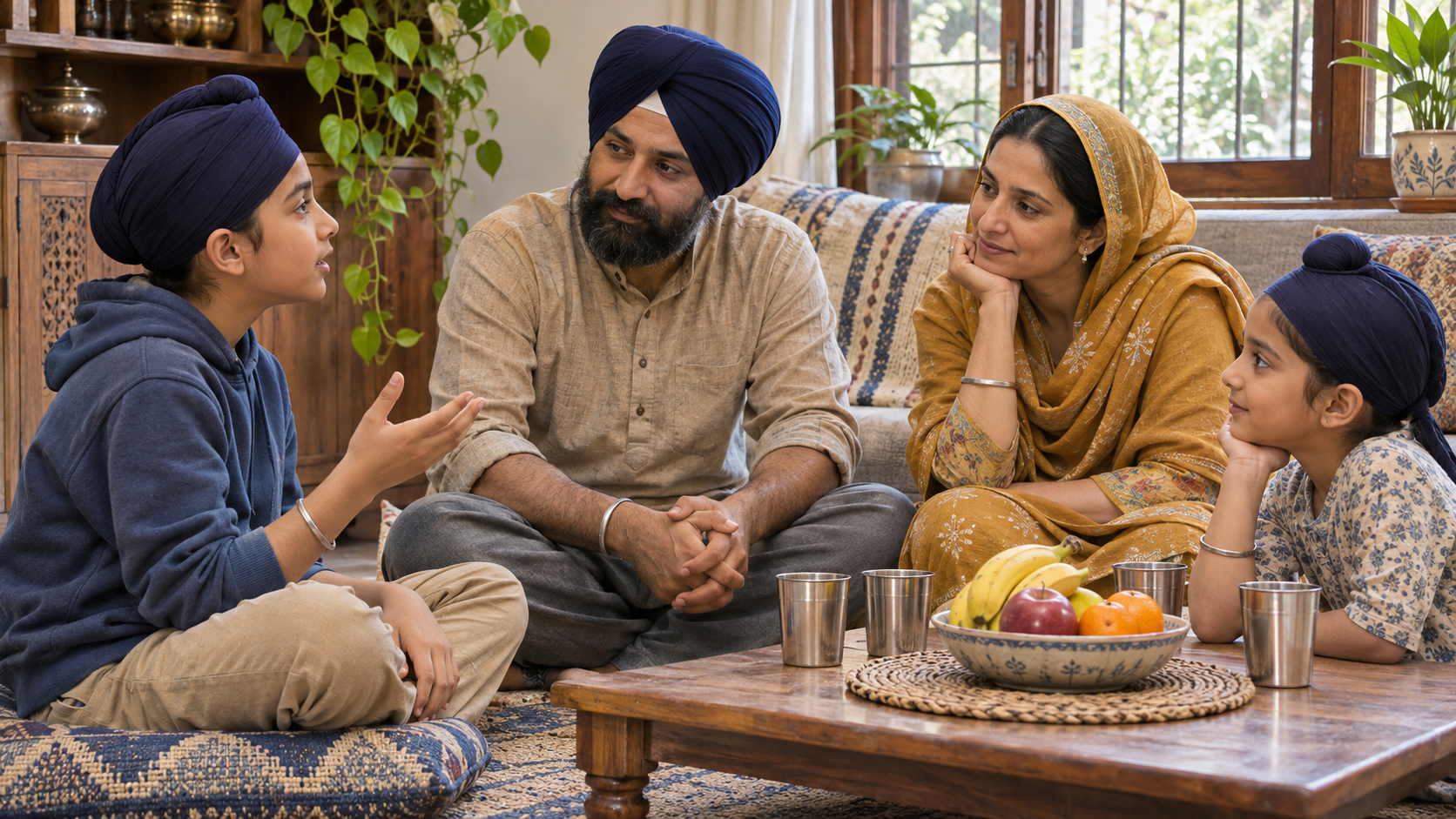
Children often approach a serious question sideways. It may arrive as an objection, an awkward remark, or resistance at the worst possible moment. If every difficult question is treated as disrespect, the child learns to hide uncertainty rather than examine it.
Welcoming a question does not require surrendering your judgment or removing a boundary. It means separating the right to inquire from the right to behave however one wishes. A useful response follows a clear pattern:
- Receive the question. Ask, What are you noticing? or What part does not make sense to you?
- Clarify the real concern. A complaint about a family practice may actually concern fairness, embarrassment, belonging, or a rule the child does not understand.
- State the boundary plainly. If the behaviour is harmful or disrespectful, say so without turning the child’s question into the offence.
- Connect the decision to a value. Explain whether truthfulness, compassion, courage, responsibility, humility, or seva is at stake.
- Invite a better choice. Ask what the child could do that honours both the concern and the value.
- Return to the question if needed. Saying I do not know enough to answer that well is more trustworthy than filling the silence with certainty.
Suppose your child asks, Why should I apologise when I am still angry? A demand for instant obedience may produce the word sorry, but it does not produce understanding. You could say: You are allowed to feel angry. You are still responsible for the hurt your words caused. What repair would be honest rather than forced? The boundary remains, but the child must now think morally rather than perform compliance.
This is one way to take seriously the reminder that children do not have to wait to grow in wisdom, compassion, and love for Sikhi. They need suitable opportunities to exercise those capacities while adults remain present to guide them.
Move Sikhi from the lesson into the decision

A child can enjoy a sakhi and still fail to recognise its value in the corridor at school, in a sibling dispute, or in a family conversation. The missing step is transfer. After discussing a Sikh value, help the child locate a decision in which that value changes what someone does.
- Before school: Ask who might be overlooked and what making room for that person could look like. This turns compassion into something observable.
- After a conflict: Ask separately, What was true?, What was hurtful?, and What needs repair? This prevents truthfulness from becoming an excuse for cruelty.
- During a purchase: Ask whether the desire comes from need, enjoyment, comparison, or status. The aim is not to shame wanting, but to help the child notice what is directing it.
- When gossip or ridicule appears: Ask how courage can protect someone without creating another target. This moves the conversation beyond the vague instruction to be nice.
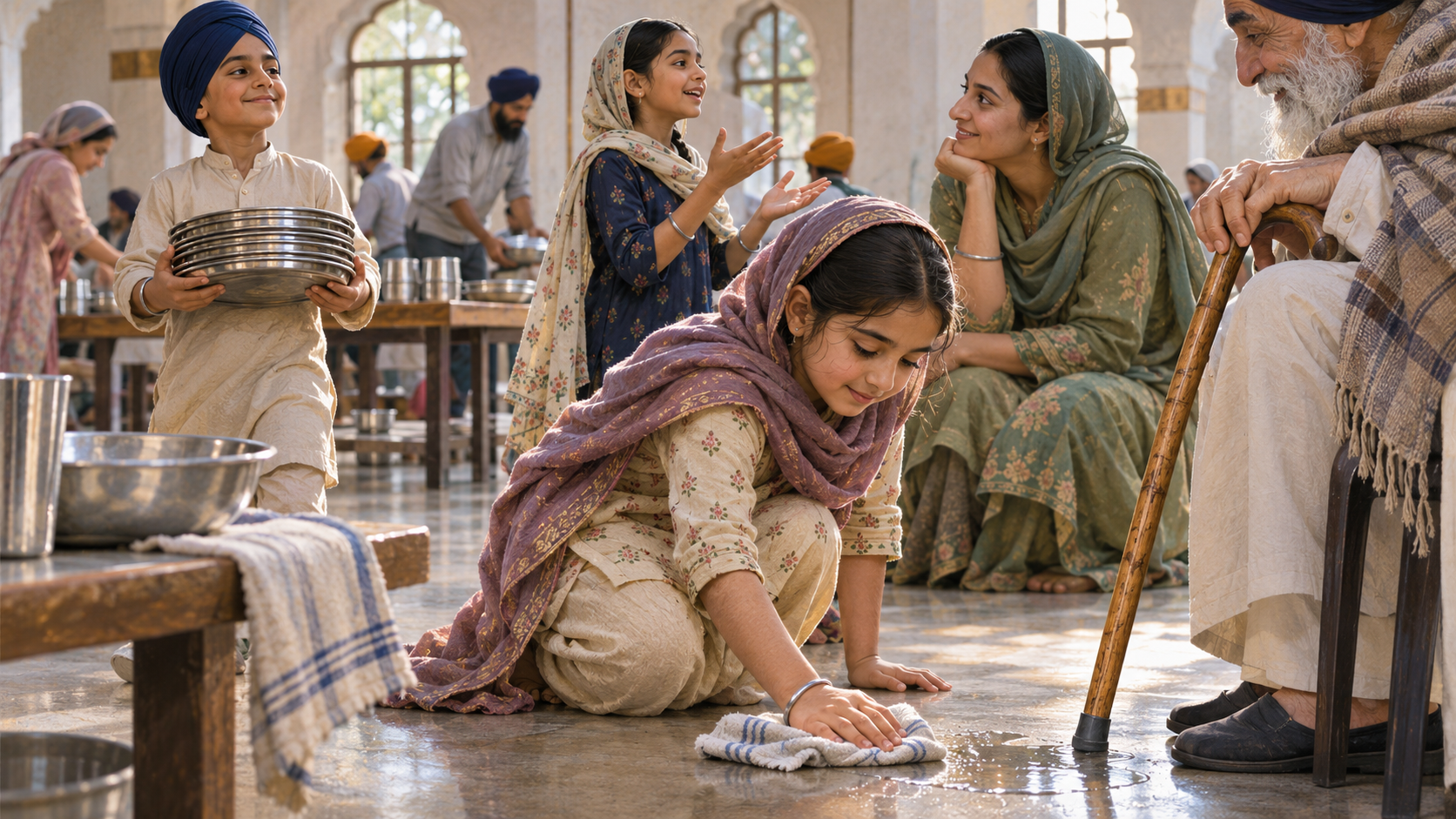
- At the gurdwara: Let the child participate in age-appropriate seva, then ask whom the work served and what would happen if everyone waited to be served instead.
- When the child receives help: Ask what gratitude requires beyond saying thank you. Sometimes the answer is care, responsibility, or helping another person in turn.
Stories become more formative when you resist using them as tests. Before sharing the account of Baba Buddha, ask, What makes someone wise? Afterwards, ask, What did the child notice that another person might miss? and Where could you need that kind of attention? The purpose is not to extract the approved sentence. It is to let the child’s own judgment enter the conversation.
Do not end every discussion with Be like Baba Buddha. That instruction is too large to use. Bring the example down to the next choice: listen before answering, notice who is affected, tell the truth without humiliation, or repair what you damaged. A child can practise a concrete action; an idealised personality is much harder to inhabit.
Do not confuse obedience, fluency, or solemnity with wisdom
Good boundaries matter. So does respect for parents, elders, teachers, and the sangat. But an outwardly correct response does not always reveal what is happening within the child. Use the behaviour as the beginning of inquiry, not the final proof of character.
| What you observe | What it does not prove | What to ask next |
|---|---|---|
| The child stays silent | That the child understands or agrees | What are you thinking but finding difficult to say? |
| The child recites the expected answer | That the value can be used in a real choice | Where might this become difficult to practise? |
| The child agrees immediately | That the child has considered the consequences | Who could be affected by this decision? |
| The child says sorry | That the harm is understood or repaired | What changed for the other person, and what can you put right? |
| The child behaves well in public | That the same conduct appears without an audience | What helps you choose this when nobody is praising you? |
A wise child may disagree with you. The parenting task is to teach a disciplined form of disagreement: identify the issue, give a reason, listen to the other person, avoid contempt, and accept that a responsible adult may still uphold the boundary. You can say, Tell me what seems unfair. I will listen. You may not insult anyone, and the safety rule still stands.
Religious fluency deserves similar care. A child who knows the vocabulary of Sikhi has gained something valuable, but recall and judgment are different capacities. Follow a knowledge question with an application question. After asking what seva means, ask what seva would require when the available task is unnoticed, inconvenient, or unlikely to earn praise.
Adults must also allow their own conduct to be examined. If you demand truth but hide an error, praise compassion but ridicule someone at home, or speak of humility while refusing to apologise, the contradiction becomes the lesson. A direct repair – I spoke harshly. That was wrong. I will say it again without insulting you – shows that Sikh values govern authority as well as childhood.
Begin with a recurring family conversation
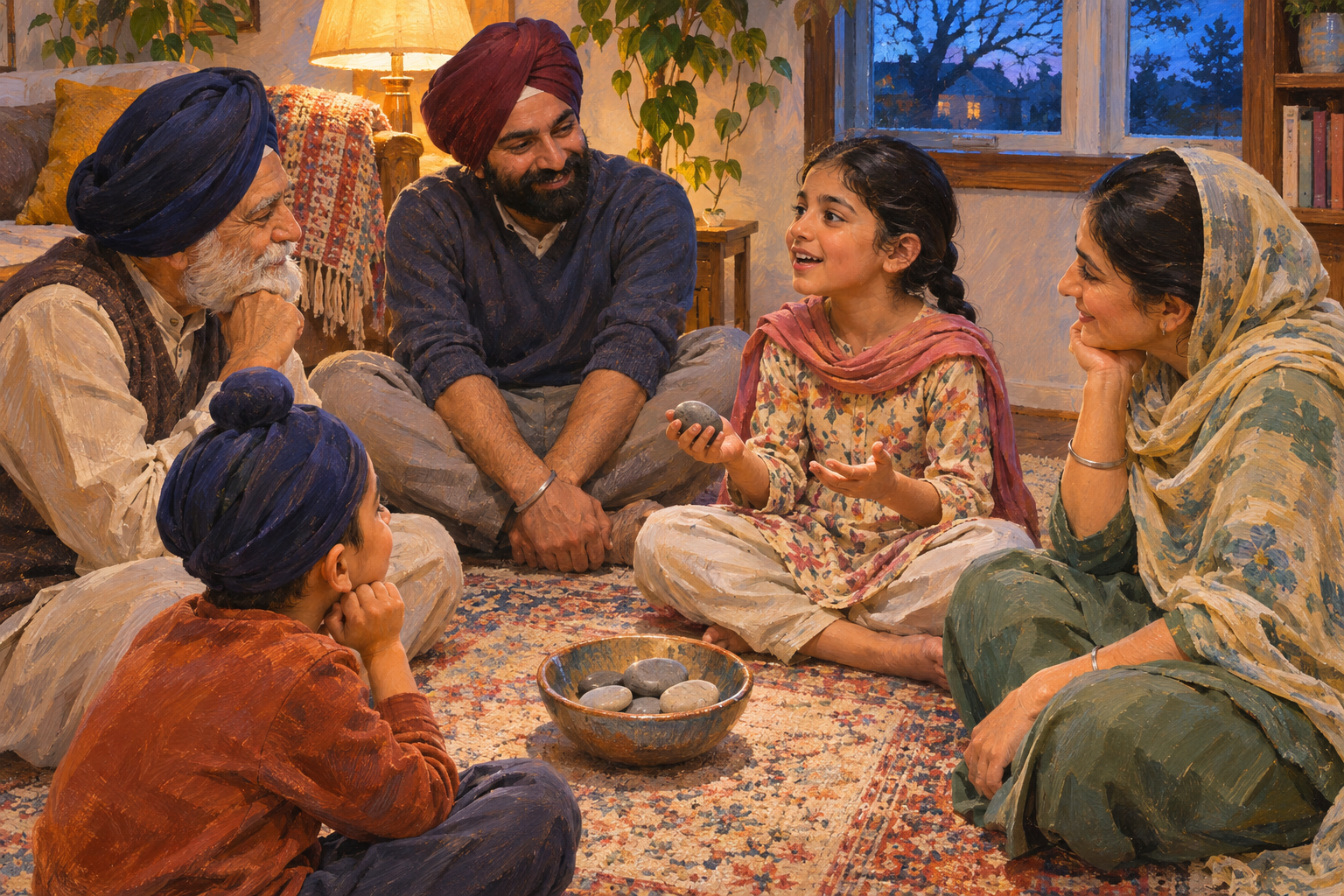
You do not need to turn the home into a classroom. Attach a short conversation to a routine your family already has: a shared meal, a drive, the return from the gurdwara, or the settling of a disagreement. Use an actual decision when it is appropriate, or a hypothetical situation when a child needs privacy.
Keep the questions stable enough that the child learns a way of thinking:
- What happened, without exaggeration or blame?
- What did each person notice, feel, or need?
- Which choice would be truthful?
- Which choice would preserve another person’s dignity?
- What harm needs repair?
- What would courage, compassion, or seva change here?
Let adults answer these questions too. If the child is always the case under examination, the practice will feel like disguised correction. When parents apply the same standard to their own decisions, wisdom becomes a family discipline rather than a demand imposed downward.
Key takeaways
- Treat wisdom as a capacity children can practise now, not a reward reserved for adulthood.
- Look for noticing, moral courage, honest responsibility, and repair – not just quiet obedience.
- Welcome difficult questions while keeping necessary boundaries clear.
- After teaching a Sikh value, connect it to a decision the child can recognise in ordinary life.
- Praise the wise choice rather than assigning the child a permanent identity.
- Model the same truthfulness, humility, and compassion you expect from the child.
Choose an upcoming family routine and add a question that makes judgment visible. Ask what is true, who is affected, and what repair or service is possible. Then listen long enough for your child to think. That small space between a question and an answer is where inherited Sikhi can begin to become lived wisdom.
References
- SikhNet – The Wise Child: The Story of Baba Budha Ji
- SikhNet – The Wise Child: Why Our Children Don’t Have to Wait

Leave a Reply
You must be logged in to post a comment.