
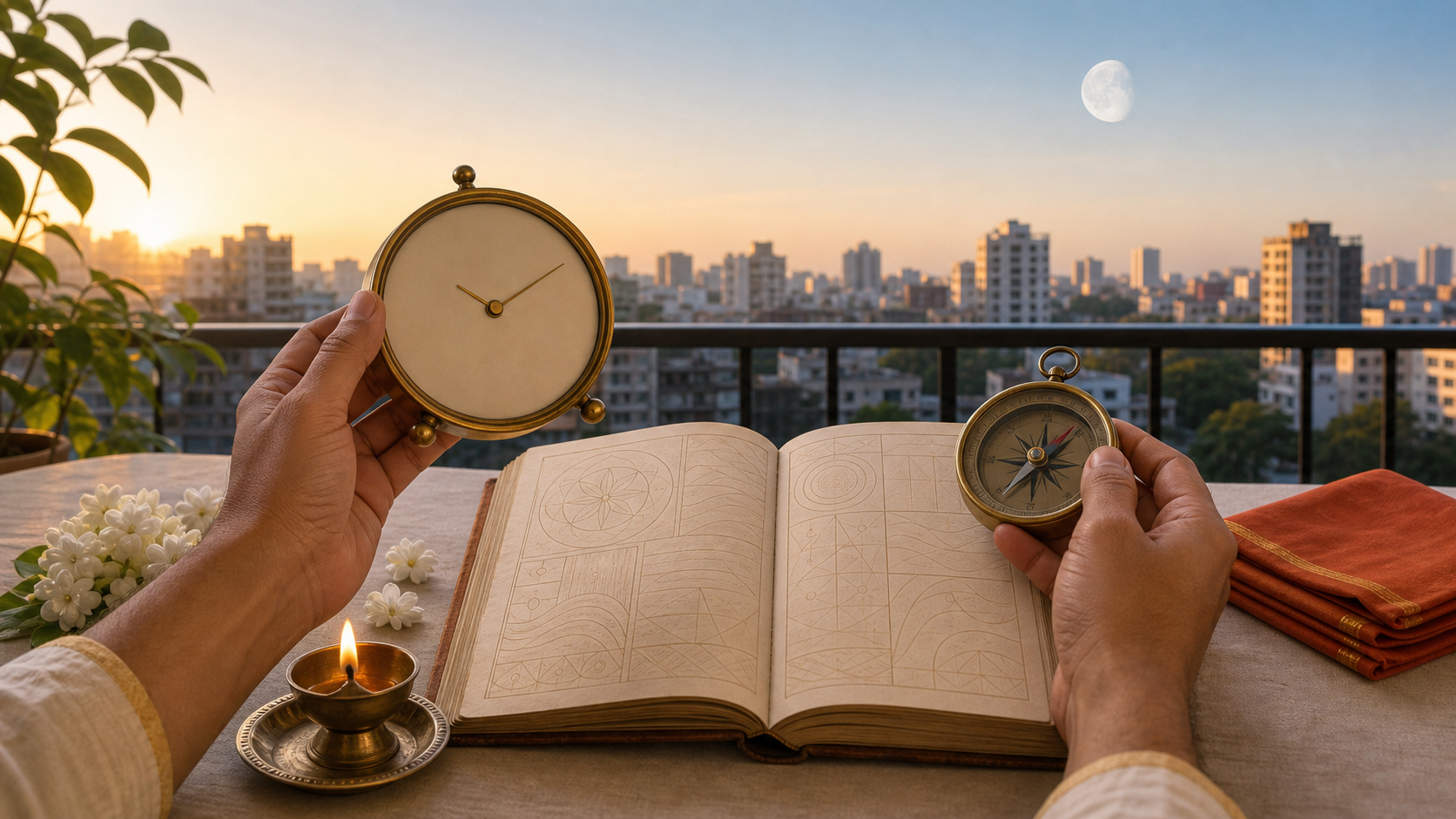
You have chosen a day in June 2026. Now you need the hour: when should you sign, submit, purchase, depart, publish, begin a course, or take the first formal step? The honest answer starts with your city. A clock time that is clean in Delhi may fall before sunrise, inside Rahu Kalam, or after a Nakshatra change somewhere else.
This method will help you turn a city-specific Panchang into a usable Shubh Muhurat without pretending that one universal timetable works everywhere. It is meant for ordinary, reversible undertakings. Marriage, Gruhapravesh, Namakaran, Upanayana, major consecrations, and other life-defining samskaras need an individualized assessment based on family tradition, location, and the relevant horoscopes.
Why a June date is not yet a Shubh Muhurat

A Panchang date contains five working parts: Tithi, Vara or weekday, Nakshatra, Yoga, and Karana. The calendar date merely holds them. It does not tell you whether one of them changes at 10:20 in the morning, whether Vishti Karana creates Bhadra during your proposed start, or whether a favorable period overlaps a daily avoidance interval.
Start by selecting a Panchang that accepts your city or local coordinates. Set the correct civil time zone and use the local sunrise shown for that date. For consistency, the June 2026 calculation framework uses a locally configured Panchang with Lahiri ayanamsa. If your family follows another established regional convention, retain that convention rather than mixing values from several calendars.
Three recurring time zones are especially useful once you know the local sunrise:
- Brahma Muhurta: approximately one hour and thirty-six minutes before local sunrise. Use it for japa, meditation, svadhyaya, planning, and the inward beginning of a study discipline. It is not automatically the best time for a bank transaction, public launch, or appointment that depends on other people.
- The clean period after sunrise: useful for correspondence, routine documents, calls, applications, and modest beginnings when it remains outside Rahu Kalam, Yamaganda, Gulika Kalam, and Bhadra. Check the actual intervals; do not assume that every early morning is clear.
- Abhijit Muhurat: a practical fallback centered on local solar noon, extending roughly twenty-four minutes on either side. Solar noon is not necessarily 12:00 on the civil clock, so use the value calculated for your location. Abhijit remains subject to the same basic checks for serious conflicts.
Cross out Rahu Kalam, Yamaganda, Gulika Kalam, Bhadra, twilight junctions, and unsuitable deep-night periods before comparing favorable windows. Vishti is the Karana associated with Bhadra and is generally avoided for inaugurations. Panchaka, the Moon’s passage through the sequence from Dhanishta to Revati, calls for extra scrutiny rather than casual selection. Gandanta junctions also deserve care when the proposed undertaking is delicate.
This ordering matters. Amrit Choghadiya inside Rahu Kalam is not made clean merely because Amrit sounds favorable. Nor does a supportive Nakshatra erase Bhadra. Treat the avoidance checks as gates, then use the positive factors to rank what remains.
A seven-step method for selecting your exact local window

- Name one action, not a whole project. Write down the act that constitutes the beginning. For an application, it may be the final submission. For a website, it may be making the site public. For travel, it is the actual departure rather than packing the previous evening. For a course, it may be the first formal lesson or sankalpa.
- Enter the correct city. Confirm the date, time zone, local sunrise, and solar noon. If the action will occur in a different city from the one where you live, calculate for the place where the initiating act occurs.
- Record transition times. Note when the Tithi, Nakshatra, Yoga, and Karana begin or end. A favorable label attached to the civil date is insufficient if that quality ends before your appointment.
- Choose the lunar character that fits the work. Shukla Paksha is normally preferred for constructive, growth-oriented starts. Krishna Paksha is often better used for audit, reduction, repair, repayment, pruning, and completion. This is a task distinction, not a declaration that half the month is unusable.
- Match Tithi, Nakshatra, and weekday to the action. Use the task table below to make a shortlist. When the Nakshatra is mixed rather than clearly supportive, a strong weekday alignment or a clean Abhijit window can improve an otherwise ordinary choice.
- Remove every conflicting interval. Mark Rahu Kalam, Yamaganda, Gulika Kalam, Bhadra, and any relevant Panchaka or Gandanta concern on the same timeline. Keep only the portions that do not overlap. If a transition falls inside your proposed window, either finish the initiating act before it or move entirely beyond it.
- Rank the surviving windows by Choghadiya. Prefer Amrit, Shubh, or Laabh. Chaal is serviceable for movement and travel. Avoid using Udveg, Rog, or Kaal for a fresh beginning. If no daylight Choghadiya is ideal, compare the remaining clean periods with Abhijit Muhurat and the weekday appropriate to your task.
Put the result into one sentence before you commit: On this date, in this city, we will perform this initiating act between these two local times. Also record which Panchang you used. That small note prevents a common family problem: one person quoting a date-only calendar while another checks a different city or tradition.
Do not use muhurta selection to miss a legal filing deadline, delay urgent medical care, postpone an essential payment, or ignore a safety requirement. An auspicious time disciplines a beginning; it does not make an unsafe, unaffordable, unlawful, or medically delayed decision sound. For a time-sensitive obligation, meet the real-world deadline first and use muhurta for the earliest safe action available.
Match the June window to the work you are beginning

The best general muhurta is not simply the window with the largest number of favorable labels. It is the clean window whose qualities fit the action. Use the following combinations as filters, then verify their actual occurrence and transition times in your local June 2026 Panchang.
| Action | Factors worth preferring | The initiating act to time |
|---|---|---|
| Study, certification, or mentoring | Panchami; Pushya, Rohini, Mrigashira, or Hasta; Wednesday or Thursday; Brahma Muhurta for personal study | Make the sankalpa, open the first formal lesson, or attend the first scheduled session |
| Routine paperwork, an account, or financial organization | Dwitiya, Tritiya, or Dwadashi; a steady Nakshatra; Wednesday or Thursday; Laabh, Shubh, or Amrit Choghadiya | Sign, submit, open the account, or begin the budgeting session |
| Planned travel | Panchami; Mrigashira or Revati; Chaal, Amrit, or Shubh Choghadiya; a clean period outside the daily avoidances | Begin the journey from the place of departure |
| A health checkup or sustainable wellness routine | Saptami; Monday for caregiving and wellness; a calm, clean morning period | Attend the checkup or begin the planned routine, without delaying necessary care |
| A website, portfolio, job application, or public announcement | Dashami for administrative assertion; Sunday for public-facing leadership; Wednesday for communication and networking; a stable Nakshatra | Publish, submit, announce, or formally assume the role |
| Repair, cleanup, debt reduction, or structural organization | Krishna Paksha; a Rikta Tithi when the purpose is removal or repair; Tuesday for vigorous repair; Saturday for structure and long-horizon order | Start the repair, remove the first obstruction, make the planned payment, or open the formal review |
| Relationship-building, aesthetics, or client experience | Friday; Swati for a delicate relational or artistic beginning; Shubh or Amrit Choghadiya | Hold the first meeting, present the work, or send the opening communication |
Tithi gives you another useful distinction. Dwitiya and Tritiya suit moderate beginnings and skill-building. Panchami supports learning and journeys. Saptami has an affinity with vitality and health routines. Dashami can support leadership and administration. Ekadashi is better directed toward spiritual discipline, restraint, or detoxification than a commercial inauguration. Dwadashi can suit orderly financial and organizational work.
Rikta Tithis – Chaturthi, Navami, and Chaturdashi – are lean choices for an opening whose purpose is expansion. They can be well matched to fixing, finishing, removing, or clearing. Amavasya similarly favors introspection, remembrance, and clearing rather than an outward launch. The practical lesson is not to fear these Tithis, but to give them the right work.
For steady professional and household undertakings, Rohini, Mrigashira, Uttara Phalguni, Hasta, Anuradha, and Revati are useful Nakshatras to look for. Pushya deserves special attention for learning, mentoring, and provisioning. Ashwini or Chitra can fit energetic and transformational work, while Swati may support relational or artistic beginnings that need flexibility. These are task matches, not permission to ignore an adverse Karana or daily avoidance period.
The weekday can break a tie between two otherwise similar windows. Sunday supports authority and public communication; Monday, caregiving and home-centered routines; Tuesday, disciplined training and repair; Wednesday, documents, commerce, learning, and networking; Thursday, teaching, ethical finance, policy, and compliance; Friday, relationships, beauty, and client experience; and Saturday, maintenance, legal organization, property structure, and long-range planning.
Use June’s lunar rhythm without forcing exact civil dates
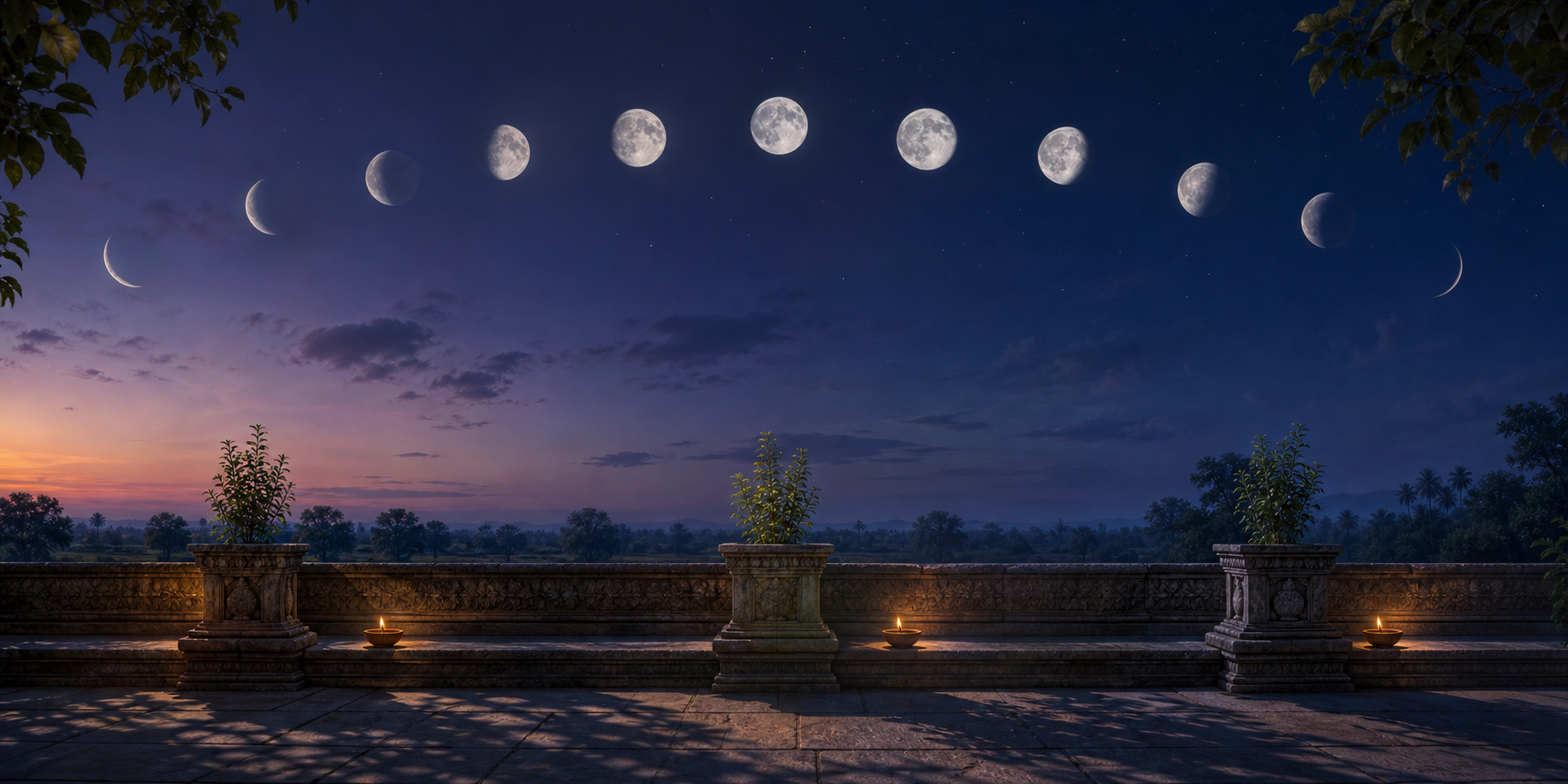
June 2026 generally moves through Jyeshtha and, in many regional almanacs, Adhik Jyeshtha Maas before Ashadha. The month also sits near the transition from late Grishma toward the monsoon threshold. That makes systemization, study, fiscal order, maintenance, and the clearing of accumulated disorder natural priorities.
Adhik Maas is treated differently across regions and family paramparas. Many people emphasize study, devotion, reflection, dana, and charitable action while approaching major worldly inaugurations with greater care. Do not convert that caution into the claim that no useful work may begin. Routine study, organization, necessary purchases, practical applications, health appointments, and well-scoped professional tasks can still be placed in a clean local window. Ceremonial or irreversible commitments belong with an acharya who understands your tradition.
- In the earlier Shukla-oriented portion shown by many local calendars: prioritize education plans, light commercial beginnings, tool upgrades, applications, and improvements to household systems.
- When your Panchang shows Krishna Paksha: switch the emphasis to reconciliation, audit, pruning, repair, debt reduction, document cleanup, and completion. Do not force an expansion-oriented launch merely because the civil calendar is convenient.
- When Shukla Paksha returns later in the month: restore momentum with a defined start that can be completed cleanly inside the chosen window, such as publishing a portfolio, beginning a course, or putting a new operating routine into effect.
These are orientation points, not a date list. The civil date on which a phase or limb changes can differ by location and almanac convention. Check the exact Tithi at the time of action instead of copying an early-, middle-, or late-month label into your calendar.
No eclipse is expected in June 2026, so there is no monthly eclipse interval to remove from the schedule. That does not remove the daily checks for Rahu Kalam, Yamaganda, Gulika, Bhadra, Panchaka, Gandanta, or Tithi and Nakshatra transitions.
Key takeaways
- There is no reliable all-city clock time for June 2026. Calculate from the city where the initiating act will occur.
- Start with local sunrise and Panchang transition times, then remove Rahu Kalam, Yamaganda, Gulika Kalam, Bhadra, and any relevant junction concerns.
- Use Brahma Muhurta mainly for spiritual practice, planning, and personal study. Use a clean post-sunrise period for modest practical work and Abhijit Muhurat as a general fallback.
- Prefer Amrit, Shubh, or Laabh Choghadiya after the avoidance checks. Chaal can serve travel; Udveg, Rog, and Kaal are poor choices for a fresh beginning.
- Match the time to the task: Shukla Paksha for constructive growth, Krishna Paksha and Rikta Tithis for repair or reduction, and suitable Nakshatra and weekday qualities for the actual work.
- Use personalized guidance for marriage, Gruhapravesh, samskaras, consecrations, or other life-defining decisions. Do not let muhurta delay urgent care, legal compliance, safety, or an essential deadline.
Before you reserve a June hour, open your local Panchang and write down the action, city, sunrise, limb transitions, avoidance periods, and final window on one page. Then perform the first meaningful act within that verified interval. That turns muhurta from vague calendar optimism into a disciplined, dharmic beginning.
References
