
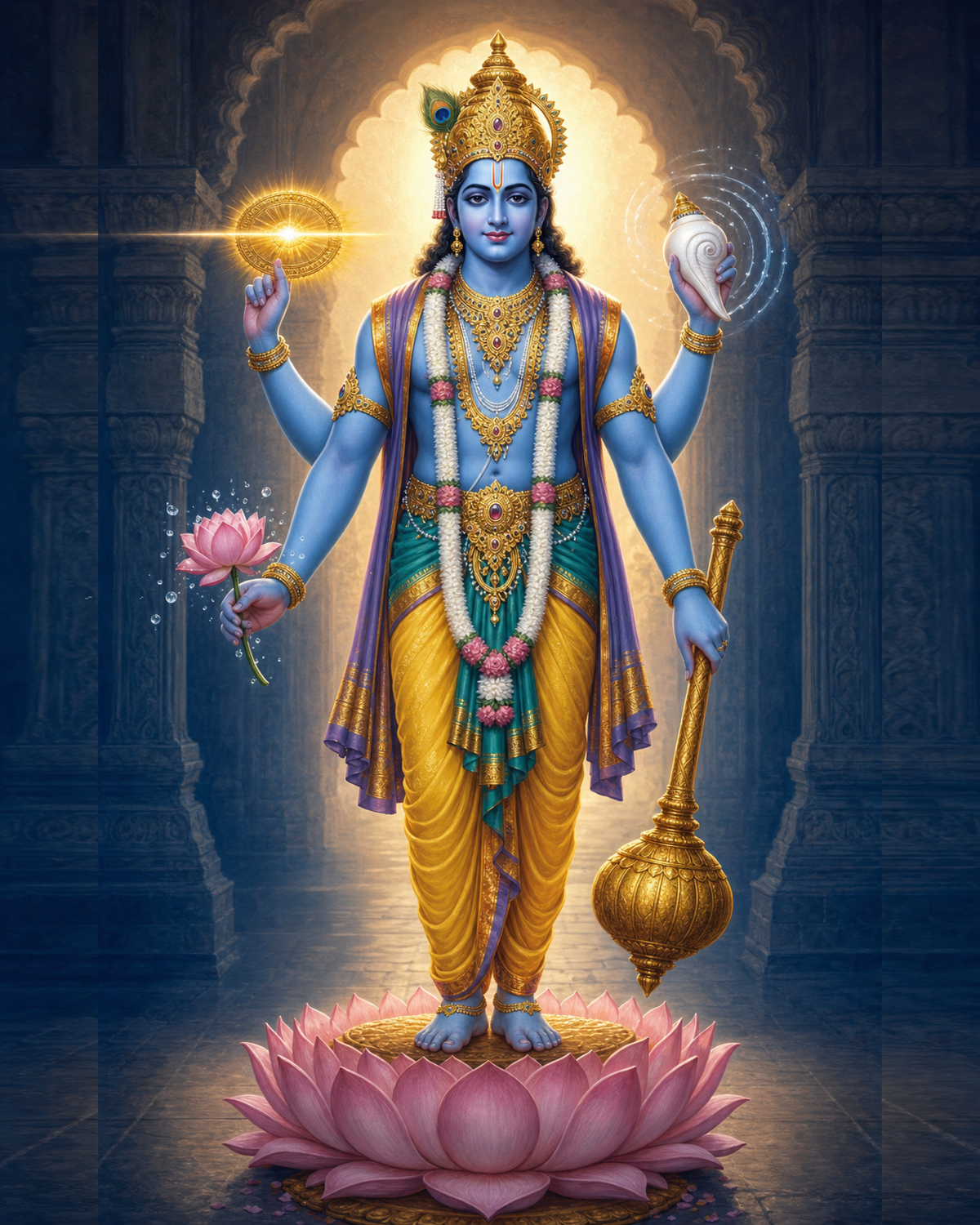
If you have looked at a four-armed murti of Vishnu and wondered why the preserver carries weapons when the spiritual goal is mokṣa, you have noticed a real tension in the image. The discus and mace can appear to threaten, while the conch and lotus seem to belong to an entirely different visual language.
The tension disappears when you stop treating the four objects as an inventory and read them as a coordinated account of liberation. Vishnu’s hands call the soul, correct its vision, defend dharma and reveal purity. A conspicuous absence sharpens that message: the pāśa, or noose, is not a standard identifying attribute of Vishnu or his avatāras.
Begin with what each hand does
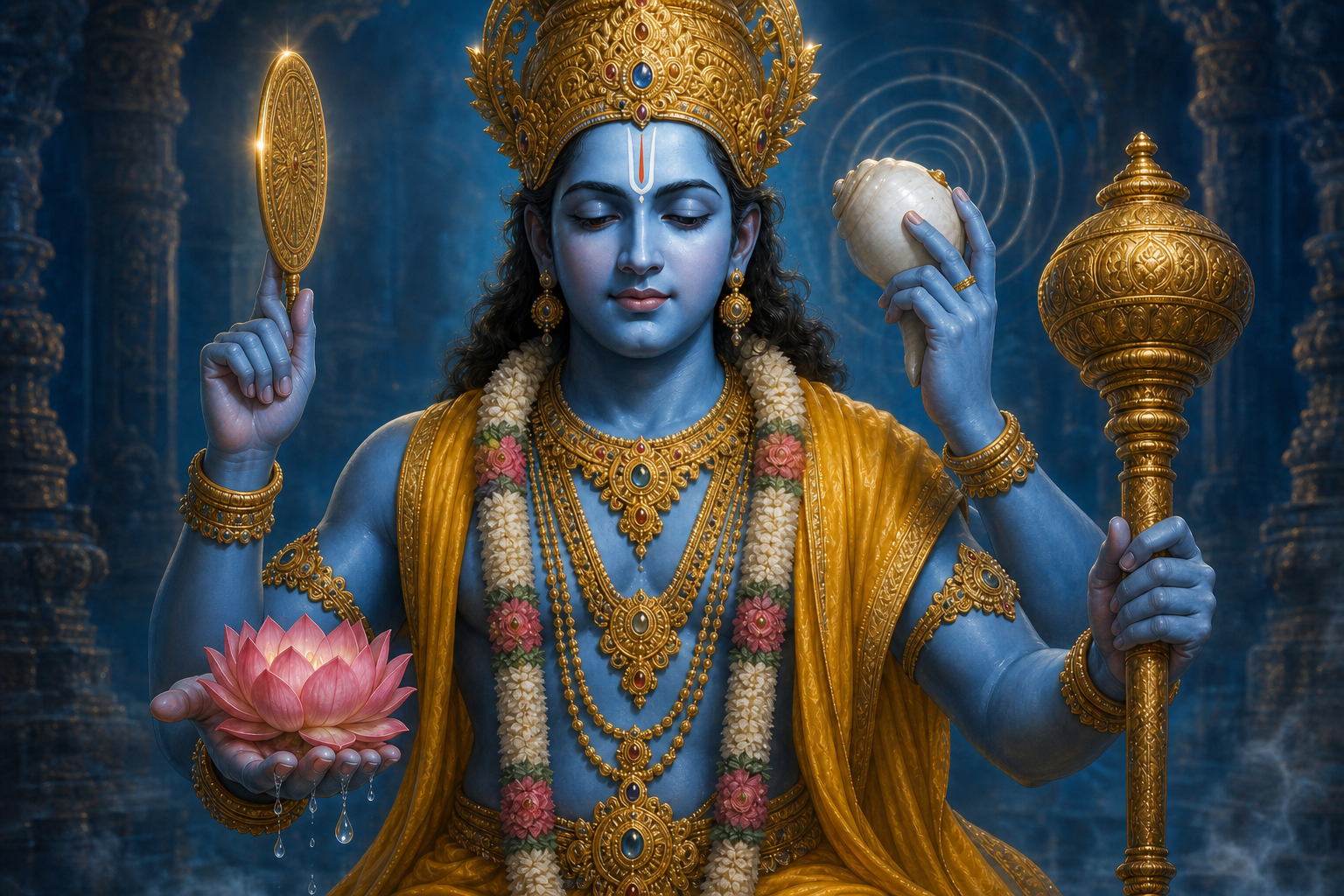
The English word “weapon” is too narrow for āyudha in this setting. A lotus does not strike an enemy, and a conch does not imprison one. Treat an āyudha as a divine implement: an object through which the murti makes a theological action visible.
The first mistake is to interpret one attribute in isolation. A cakra by itself may look like overwhelming force. Beside the padma and accompanied by gestures of fearlessness or generosity, it becomes force placed within a larger relationship of protection, grace and refuge.
When you look at a Vishnu murti, ask four concrete questions:
- What action does this object perform: calling, cutting, correcting, supporting or flowering?
- What form of bondage does that action answer: forgetfulness, confused perception, adharma, fear or attachment?
- Which other attribute or mudrā qualifies its meaning?
- Are you looking at canonical Vishnu, a particular avatāra or a scene from a narrative?
This last distinction matters. Agamic and Purāṇic systems of mūrti-lakṣaṇa stabilize the śaṅkha, cakra, gadā and padma as Vishnu’s characteristic quartet. The placement of those attributes can vary among forms, but the visual vocabulary remains recognizable. Do not turn the hand arrangement in one temple into a universal sequence.
Abhaya and Varada mudrās provide an equally important interpretive frame. Abhaya answers fear; Varada communicates giving and blessing. When these gestures appear with Vishnu’s āyudhas, they tell you how divine power is being exercised. Its aim is not domination for its own sake but the restoration of a relationship in which refuge becomes possible.
Four ayudhas describe four movements out of bondage

The quartet can be used as a practical contemplative sequence, although it is not a canonical ladder that must always be read in this order. Each emblem answers a different obstruction to freedom.
| Ayudha | Liberating action | Bondage it answers | What to notice |
|---|---|---|---|
| Śaṅkha, the conch | Calls, announces and awakens | Spiritual forgetfulness and failure to respond to dharma | Liberation begins with hearing the call and turning toward refuge |
| Sudarśana cakra, the discus | Illuminates, distinguishes and cuts | Avidyā and distorted vision | Freedom requires clear discernment, not merely strong feeling |
| Kaumodakī gadā, the mace | Corrects, protects and supplies strength | Adharma, disorder and moral weakness | Grace does not exclude disciplined force when protection is required |
| Padma, the lotus | Flowers without being stained by its surroundings | Attachment and the assumption that worldly conditions must define the inner life | The aim is purity and auspicious participation, not perpetual combat |
The śaṅkha comes first in this practical reading because liberation cannot begin while the soul remains inattentive. Its blast is a summons to dharma and an announcement of protection. The image therefore asks something more demanding than admiration: once you have heard the call, what response does dharma require from you?
Sudarśana means “good vision.” The cakra can signify knowledge, law and the movement of time, but its most useful liberating meaning is discernment. It cuts because confusion must be separated from clarity. It turns because spiritual understanding cannot remain an inert possession. If your reading reduces the discus to destructive power, you have missed the transformation of sight encoded in its name.
The gadā prevents a different error: imagining liberation as passivity. Kaumodakī represents the strength to correct adharma and protect the order within which spiritual life can flourish. Strength becomes dharmic when it is governed by purpose. The mace is therefore not permission to sanctify anger; it asks whether power is disciplined enough to defend rather than dominate.
The padma reveals what the other three are for. A lotus grows from mire without taking the mire as its identity. In Vishnu’s iconography it carries associations of purity, sattva, prosperity and Śrī. Liberation is not pictured as sterile withdrawal from everything auspicious. It is the capacity to remain inwardly unsoiled while living and acting within conditioned existence.
Read together, the four attributes prevent one-sided spirituality. The conch without the cakra could become enthusiasm without discernment. Discernment without the mace could remain powerless. Force without the lotus could harden into severity. The complete image moves from awakening through clarity and protection toward an unentangled, auspicious life.
Why the missing pasa changes the message
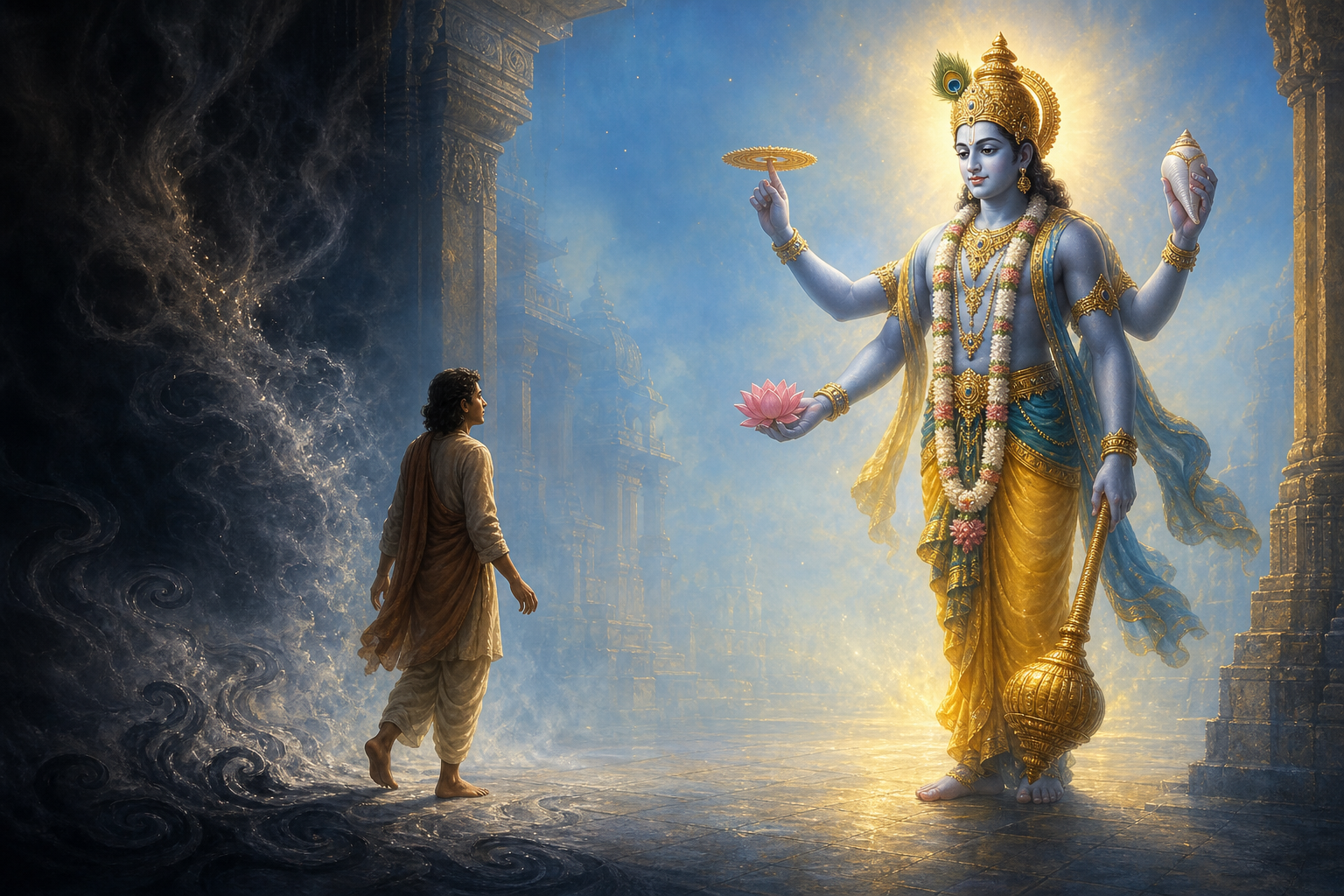
A pāśa is a noose used to bind, restrain or arrest movement. It can be made from rope, sinew or a serpent, and its symbolic force comes from tightening around its object. Varuṇa’s pāśa binds transgressors of ṛta, while Yama’s noose draws the jīva from embodied life. In Śaiva and Śākta settings, the same form can represent the bonds of karma, māyā and attachment.
Against that background, the absence of a standard pāśa from Vishnu’s hands is meaningful. Vaishnava iconography does not normally present salvation as the Lord taking the soul into custody. It emphasizes anugraha, śaraṇāgati and the removal of the knots that keep the soul in saṃsāra. The cakra cuts; the conch calls; the mace corrects; the lotus opens. None depends on a loop that grows tighter.
Iconographic norm is not the same as mythic inventory
The careful claim is not that no Vaishnava narrative can ever mention a noose. Epic and Purāṇic worlds contain large arsenals of astras, including serpent bonds such as the nāgapāśa. Those narrative devices do not automatically become identifying attributes in the sanctum.
Mūrti-lakṣaṇa answers a narrower question: which visible features allow worshippers to recognize a divine form and contemplate its theology reliably? A weapon available during a particular episode and an emblem regularly held by a deity perform different jobs. When you encounter an unusual regional sculpture, first identify the figure, the narrative setting and the other attributes. One local variation should not be used to erase the broader canonical pattern.
The Rāmāyaṇa’s nāgapāśa episode makes the contrast especially vivid. Indrajit binds Rāma and Lakṣmaṇa with serpent bonds, while Garuḍa’s presence dissolves those bonds. Within that scene, binding belongs to the obstruction and release belongs to the Vaishnava intervention.
The noose is not an inherently negative symbol
Do not turn Vishnu’s lack of a pāśa into a condemnation of every deity who carries one. Hindu iconography is contextual. Gaṇeśa’s noose can restrain obstacles and draw a devotee toward auspicious conduct. The Śaiva Siddhānta triad of paśu, pāśa and pati distinguishes the bound soul, bondage and the liberating Lord. A symbol that depicts bondage can also make liberation intelligible.
The variation extends across Dharmic traditions. Amoghapāśa forms of Avalokiteśvara use a compassionate noose to draw beings from suffering. Sikh Gurbani can invoke the noose of Yama as an image of mortality and attachment. Jain thought describes bandha as karmic bondage that must be shed for kevala-jñāna. These are not interchangeable doctrines, but they share a practical warning: freedom cannot be understood until you can recognize what binds.
The reliable method is to translate a symbol as a verb within its own theological setting. Ask what the noose binds, whom it draws and toward what end. Ask what the cakra cuts and whom it protects. A universal dictionary in which every serpent, rope or blade always means the same thing will misread Dharmic art.
Ananta Śeṣa illustrates the point. His coils beneath Vishnu are not a concealed noose. They signify infinite time and sustaining support: Ananta serves as foundation rather than fetter. Shape alone does not settle meaning. Function and relationship do.
The avatars change instruments without changing the direction
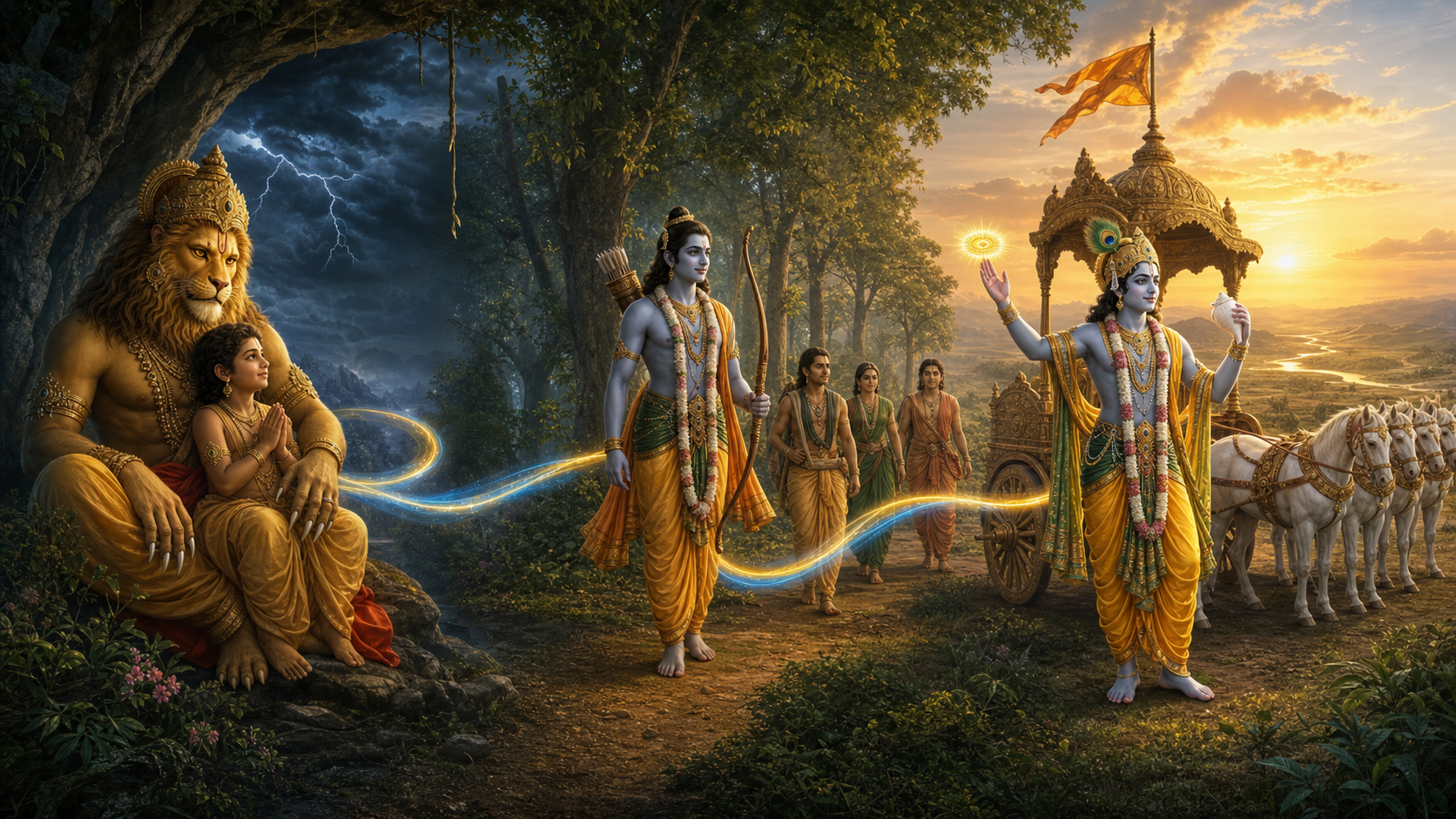
Vishnu’s avatāras do not all carry the same objects, because each confronts a different form of disorder. Their characteristic implements nevertheless preserve a recognizable direction: power removes an obstruction, restores dharma and makes refuge possible.
- Rāma’s Kodanda bow restores order; it does not make captivity his defining relationship with the world.
- Kṛṣṇa’s flute attracts the heart, while Sudarśana protects dharma when protection is required.
- Narasiṃha’s nails tear through tyranny and rescue the devotee whom that tyranny threatens.
- Vāmana’s umbrella accompanies a form whose steps encompass the cosmos rather than enclosing a captive.
- Paraśurāma’s axe chastens unrighteous power.
- Balarāma’s plough and pestle evoke the force needed to realign the furrows of social life.
This pattern does not make every divine intervention gentle. Liberation is not the same as avoiding conflict. The sharper claim is that force is directed against the obstruction to dharma rather than against the soul for whom refuge is intended. The image asks you to distinguish protection from possession and correction from cruelty.
Three narratives provide a useful test. In Gajendra-mokṣa, Vishnu frees an elephant trapped in a crocodile’s grip, with Sudarśana functioning as an instrument of rescue. In the nāgapāśa episode, Garuḍa undoes the serpentine bonds holding Rāma and Lakṣmaṇa. In the account of Ambarīṣa and Durvāsā, the cakra protects devotion and confronts ascetic pride. The recurring movement is from helplessness or disorder toward release, protection and instruction.
Whenever you interpret an avatāra’s āyudha, ask two questions: what precisely is being broken, and who receives safety when it is broken? If the answer glorifies force but cannot identify the bondage being removed, the interpretation is incomplete.
Key takeaways for your next darshana
- Identify the form before interpreting the object. Canonical Vishnu, an avatāra and a narrative figure may carry different attributes.
- Read each āyudha as an action: the conch calls, the discus clarifies and cuts, the mace corrects and protects, and the lotus flowers without defilement.
- Read the four together. Their balance keeps awakening, discernment, strength and purity from becoming isolated virtues.
- Notice Abhaya and Varada mudrās. They place divine force within a relationship of reassurance, generosity and refuge.
- Treat the absence of the pāśa as a canonical theological pattern, not as an absolute claim about every text, workshop or regional image.
- Never assume that a noose, serpent or blade has one fixed meaning across Hindu, Buddhist, Jain and Sikh settings. Meaning follows function, relationship and theological context.
At your next darśana, choose one hand before trying to decode the entire murti. Name the action it performs, identify the bondage that action answers, and then look at the other hands to see what limits and completes its meaning. Vishnu’s āyudhas become a spiritual discipline when they help you see which bond must be cut, which call must be answered and which strength must be placed in the service of dharma.
References
