

If you intend to observe Pavai Nombu in 2026-2027, the most important planning fact is easy to miss: the vrata crosses both a calendar-month boundary and a calendar-year boundary. Put the full period in your diary now, rather than relying on a reminder for the opening day alone.
The observance lasts 30 days, from 16 December 2026 through 14 January 2027. What you do during those days should come from your family, temple, or sampradaya—not from a generic ritual checklist detached from your tradition.
The Pavai Nombu dates to mark

For 2026-2027, Pavai Nombu begins on 16 December 2026 and concludes on 14 January 2027. It is a month-long vrata observed during the Tamil month known as Margazhi or Margali.
| Calendar point | Date or duration |
|---|---|
| First day | 16 December 2026 |
| December portion | 16-31 December: 16 days |
| January portion | 1-14 January: 14 days |
| Final day | 14 January 2027 |
| Total observance | 30 days, counting both the first and final days |
The inclusive count matters. There are 16 observance days in December and 14 in January, making 30 altogether. Do not calculate 30 days by treating 16 December as day zero; that would incorrectly push your final reminder to 15 January.
Understand the traditional intention before making the vow
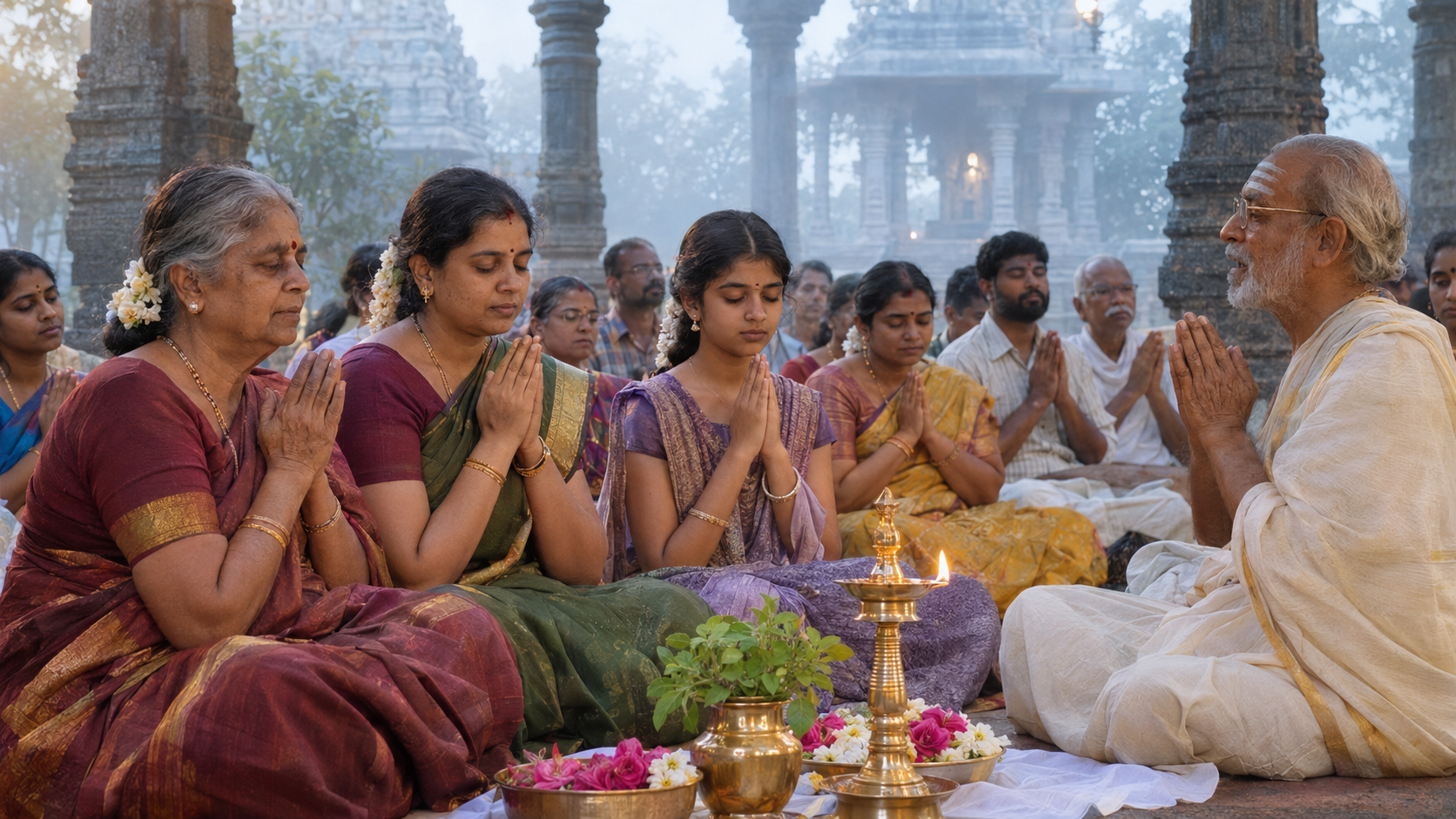
Pavai Nombu is traditionally observed mainly by kanyas—girls or young women before marriage—who pray for good husbands and pleasant married lives. The word “mainly” is worth noticing. It identifies the central traditional constituency without answering every question about who may participate in every family or temple.
If you are married, male, or approaching the vrata with another intention, do not declare yourself either included or excluded on the strength of a short calendar entry. Ask the elder, acharya, or priest responsible for the form of practice you follow. That preserves the observance rather than silently redefining it.
The marriage intention also should not be treated as a promise that completing 30 days guarantees a particular outcome. A vrata is a disciplined devotional commitment, not a mechanism for controlling another person or the future. If parents are arranging the observance for a daughter, they should seek her willing participation. Devotion cannot replace her consent, sound judgment, or a careful assessment of any eventual marriage proposal.
Set your form of observance before the first morning

The calendar tells you when Pavai Nombu occurs, but it does not by itself establish your ritual procedure. Before 16 December, resolve the practical questions that commonly cause uncertainty after a vrata has already begun.
- Identify the tradition you are following. Ask whether your procedure comes from your household, a particular temple, or a sampradaya. This tells you whose guidance should settle differences.
- Request the complete daily instructions. Confirm the prayer or recitation to be used, the expected time, required worship materials, any restrictions, and whether temple attendance forms part of your observance. Ask rather than assembling unrelated practices from several places.
- Clarify what happens if a day is disrupted. Illness, travel, examinations, work, or family responsibilities can interfere with a 30-day routine. Ask your religious guide beforehand how your tradition handles an unavoidable missed or delayed practice.
- Reserve one repeatable daily period. Put all 30 dates in your calendar and choose a time you can protect. A modest routine you can maintain is more workable than an elaborate schedule that collapses after the opening days.
- Confirm the concluding procedure. Find out what your tradition expects on 14 January and obtain anything needed for it before the final week. The closing day should not become a last-minute search for instructions or materials.
Write your commitment in one plain sentence: the dates, the devotional intention, and the practice you have been instructed to maintain. You do not need to invent formal wording. The purpose of writing it down is to prevent your plan from changing casually halfway through the month.
Avoid the mistakes created by a 30-day calendar

- Treating Pavai Nombu as a one-day festival: the opening date begins a month-long discipline; it is not the whole observance.
- Dropping the routine at the New Year: 1 January 2027 is day 17, not a new beginning. Keep one continuous checklist across December and January.
- Confusing spelling variants with different observances: Pavai Nombu and Pavai Nonbu are transliterations of the name encountered in English. Margazhi Nombu and Margali Nombu identify the observance through variant spellings of the Tamil month.
- Assuming every household follows one universal procedure: the dates can be shared while the prescribed daily practice still comes through a particular family, temple, or sampradaya.
- Presenting the vrata as a marriage guarantee: keep its traditional intention intact without turning devotion into pressure, prediction, or a substitute for wise decision-making.
A simple paper checklist can be more reliable than memory. Draw 30 boxes, label the first “16 December” and the last “14 January,” and mark each only after completing the practice prescribed for that day. Keep any temple programme times on a separate line so that an event schedule is not confused with the vrata’s full date range.
Key takeaways
- Pavai Nombu runs for 30 days, from 16 December 2026 through 14 January 2027, with both boundary dates included.
- The observance belongs to the Tamil month of Margazhi, also written Margali.
- Its traditional intention centres mainly on kanyas praying for good husbands and pleasant married lives.
- The calendar dates do not create a universal ritual manual; obtain the actual daily procedure from the family, temple, or sampradaya you follow.
- Plan the final day before beginning, and use one continuous checklist across the change from 2026 to 2027.
Before 16 December arrives, confirm your procedure, place all 30 dates in your calendar, and prepare for the concluding day. Then you can enter Margazhi with a settled commitment instead of spending the first week deciding what you meant to do.
References

Leave a Reply
You must be logged in to post a comment.