

You open two Panchangs for the same date and find different tithi end times, different month names, or a Rahu Kalam that does not match the familiar timetable. Which one should you trust before beginning a puja, journey, vrata, purchase, or family ceremony?
The answer is not to search for one universally lucky clock time. A sound muhurta begins with the place where the action will occur, the astronomical limbs relevant to that action, and the rule by which the observance is assigned to a date. Once those are fixed, the apparently conflicting entries become much easier to understand.
Start with the action you are actually timing
A daily Panchang contains several layers of time. They do not all answer the same question. Tithi may determine when a vrata or festival belongs. Nakshatra and karana may refine a ritual start. Rahu Kalam removes a daytime interval from consideration. Choghadiya helps with ordinary activities such as a departure or a practical new beginning. Abhijit Muhurat can provide an action-supporting window when a more specialized muhurta is unavailable.
That hierarchy matters. A favorable Choghadiya cannot tell you whether a vrata requiring Ashtami at sunrise belongs on one civil date or the next. In the same way, knowing that Ashtami is present does not automatically tell you the best minute for an unrelated business opening.
Before reading the clock, classify the decision:
- A tithi-bound observance: a vrata, festival, deity observance, or ancestral rite governed primarily by a lunar day and a prescribed part of the day.
- An ordinary beginning: starting a journey, sending an important communication, commencing routine work, or making a modest household decision.
- A specialized samskara or major ceremony: an event whose rules may extend beyond a daily Panchang and depend on sampradaya, family practice, and additional astrological factors.
For the first category, establish the observance rule before selecting a muhurta. For the second, the daily avoidance periods and Choghadiya may be sufficient. For a marriage, griha pravesha, naming ceremony, or similarly consequential samskara, use the daily Panchang as the foundation and ask a qualified acharya or purohita to apply the rules of your tradition. A generic green interval on an app is not a complete ceremonial determination.
Write down five inputs before proceeding: the exact action, the city where it begins, the local date and time zone, the family or temple calendar convention, and any required ritual interval such as sunrise, pradosha, nishita, or arunodaya. This small discipline prevents most Panchang mistakes.
Understand what the five Panchang limbs calculate
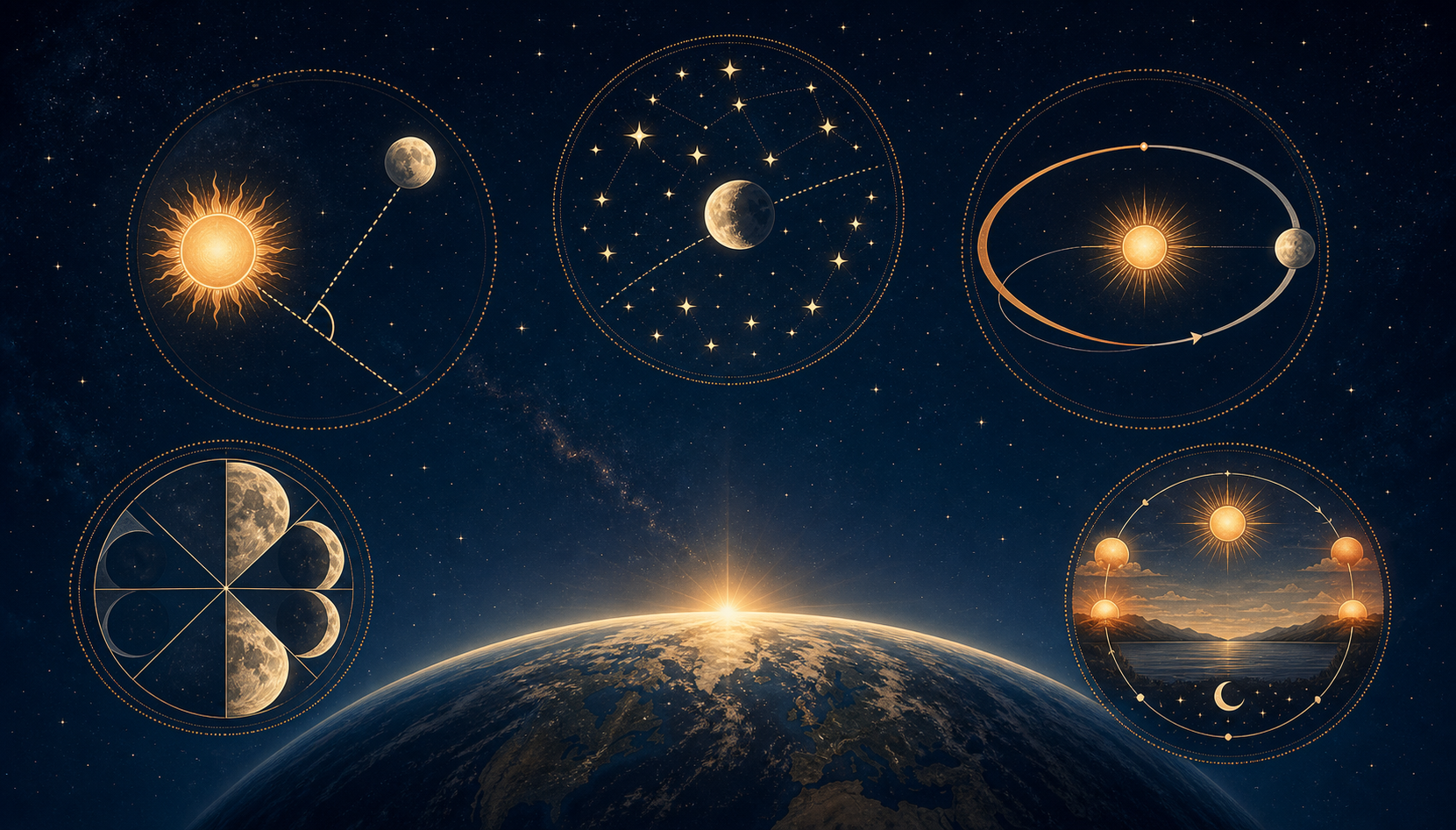
The word Panchang refers to five classical limbs: vara, tithi, nakshatra, yoga, and karana. Each describes a different relationship within the same flow of time.
| Limb | Astronomical or calendrical basis | What you use it for |
|---|---|---|
| Vara | The local weekday and its traditional planetary association | Provides weekday context and controls weekday-based sequences such as Rahu Kalam and Choghadiya |
| Tithi | The directed angular separation of the Moon from the Sun, divided into 12° portions | Determines the lunar day and many vrata, festival, and deity-observance rules |
| Nakshatra | The Moon’s sidereal longitude within 27 sectors of 13°20′ each, beginning with Ashwini | Describes the lunar mansion operating at the chosen moment and refines event selection |
| Yoga | The combined longitudes of the Sun and Moon, mapped through 27 yoga sectors | Adds another quality of time to a full Panchang judgment |
| Karana | One half of a tithi, equivalent to 6° of Sun-Moon separation | Provides finer timing for the opening, performance, or completion of an act |
For tithi, let the Moon’s longitude be M and the Sun’s longitude be S. Normalize M minus S to a value from 0° up to, but not including, 360°. Each advance of 12° begins the next tithi. Because that angle changes continuously, a tithi can begin in the afternoon, end after sunset, or cross civil midnight. Midnight is not an astronomical boundary.
The waxing and waning halves must also be retained. The first half of the angular cycle belongs to Shukla Paksha, progressing toward Purnima; the second belongs to Krishna Paksha, progressing toward Amavasya. Saying Ashtami without saying Shukla or Krishna leaves out information needed to identify the lunar day correctly.
Nakshatra is calculated differently. Apply the selected ayanamsa to obtain the Moon’s sidereal longitude, then divide the ecliptic into 27 equal portions. Each portion is 13°20′, and each nakshatra is further understood through its padas. Rashi uses the same sidereal lunar longitude but divides the circle into twelve signs of 30° each. One rashi therefore covers two and one-quarter nakshatras.
Yoga uses the sum rather than the difference of the solar and lunar longitudes. Normalize that sum around the circle and place it within the 27-yoga sequence. Karana simply gives the tithi calculation twice the temporal granularity because every tithi has two halves.
This also explains why changing calculation conventions can change a displayed nakshatra or rashi near a boundary. Contemporary drik Panchangs generally use astronomical ephemerides in a sidereal framework, often with Lahiri ayanamsa. Traditional vakya calculations continue in parts of South India. Do not combine a tithi from one system, a nakshatra from another, and a muhurta table from a third without checking that their location and conventions agree.
Calculate daylight windows from local sunrise and sunset
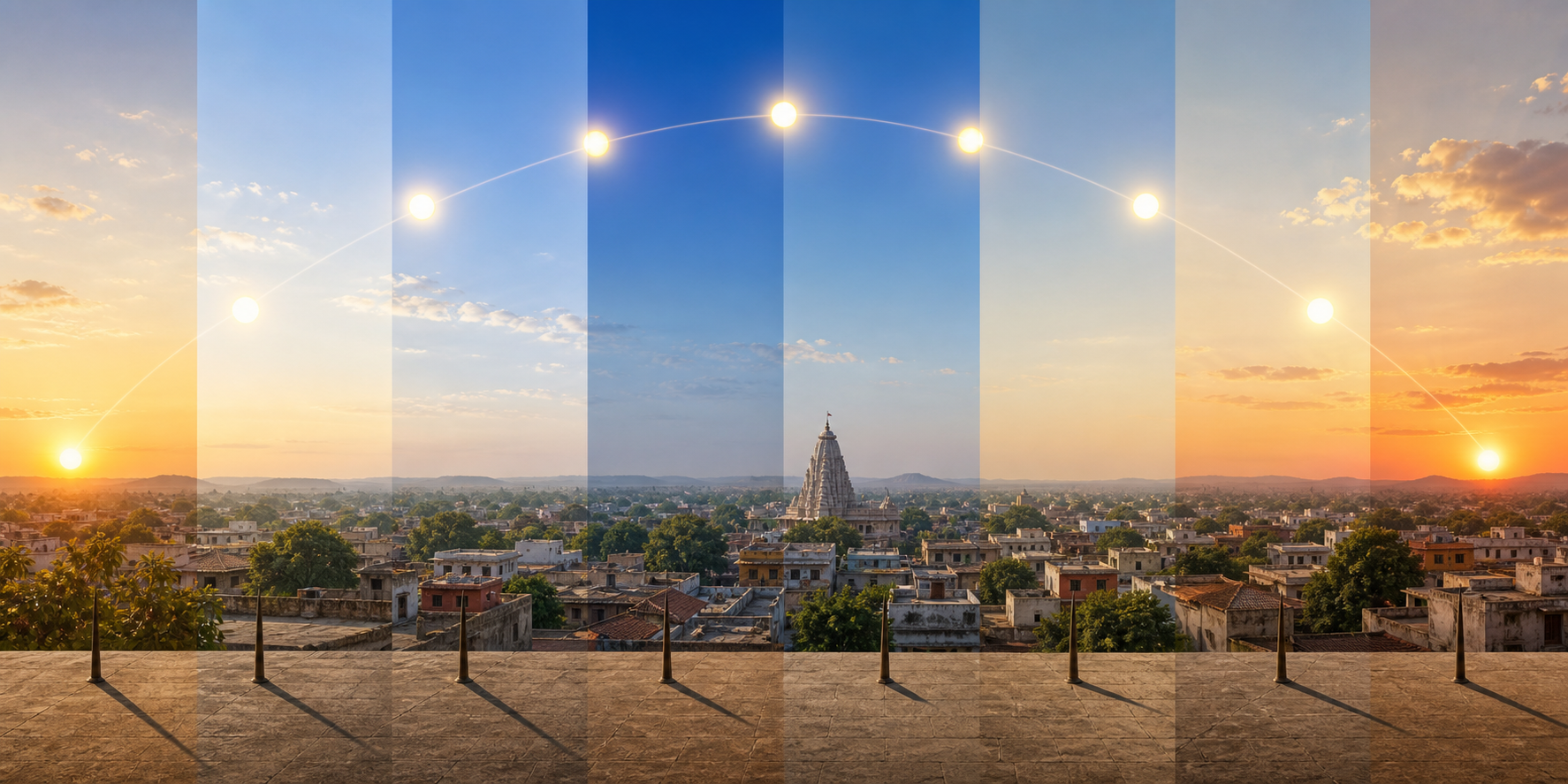
Rahu Kalam, Yamaganda, Gulika Kalam, and daytime Choghadiya are not fixed ninety-minute appointments. Their clock boundaries move because the interval from local sunrise to local sunset changes with latitude and season.
Use this calculation for any city:
- Obtain the local sunrise and sunset for the date and place of the action. Use one time zone throughout the calculation.
- Subtract sunrise from sunset to obtain the total daytime duration.
- Divide that duration by eight. The result is the length of one daytime segment.
- Beginning at sunrise, mark eight consecutive segments of exactly that length. Sunset is the end of the eighth segment.
- Apply the weekday’s Rahu Kalam, Yamaganda, Gulika, and Choghadiya positions to those locally calculated boundaries.
In symbolic form, if sunrise is A, sunset is B, and the segment length is Q, then Q equals (B minus A) divided by eight. Segment n begins at A plus (n minus 1) times Q and ends at A plus n times Q. This formula is more reliable than copying clock slots designed for a theoretical 6:00 AM sunrise and 6:00 PM sunset.
For Friday, or Shukravara, Gulika occupies the second daytime segment, Rahu Kalam the fourth, and Yamaganda the seventh. Calculate those three segments from the actual Friday sunrise and sunset. The commonly circulated Friday Rahu Kalam of 10:30 AM to noon works only as an approximation for a twelve-hour day beginning at 6:00 AM; it should not be transplanted to every season or city.
Choghadiya follows the same division principle but attaches a rotating quality to all eight segments. The generally favorable names are Amrit, Shubh, Labh, and Char. Udveg, Rog, and Kal are normally avoided when initiating a critical activity. On Friday, the first daytime Choghadiya beginning at sunrise is Shubh. Use the Friday sequence supplied by the same Panchang to label the remaining locally calculated segments.
Night Choghadiya requires a fresh calculation. Measure from sunset to the following sunrise, divide that night interval into eight equal parts, and then apply the night sequence. Do not continue using the daytime segment length after sunset.
Abhijit Muhurat is centered on local solar noon and is useful when an undertaking is urgent or a more specialized muhurta is unavailable. Local solar noon is not automatically 12:00 on the civil clock. Use locally calculated Abhijit boundaries rather than assigning it a universal clock range. If Abhijit overlaps another period that your tradition avoids, do not assume that one label automatically cancels the other; follow the applicable ritual rule or obtain guidance.
Use the reference moment required by the observance
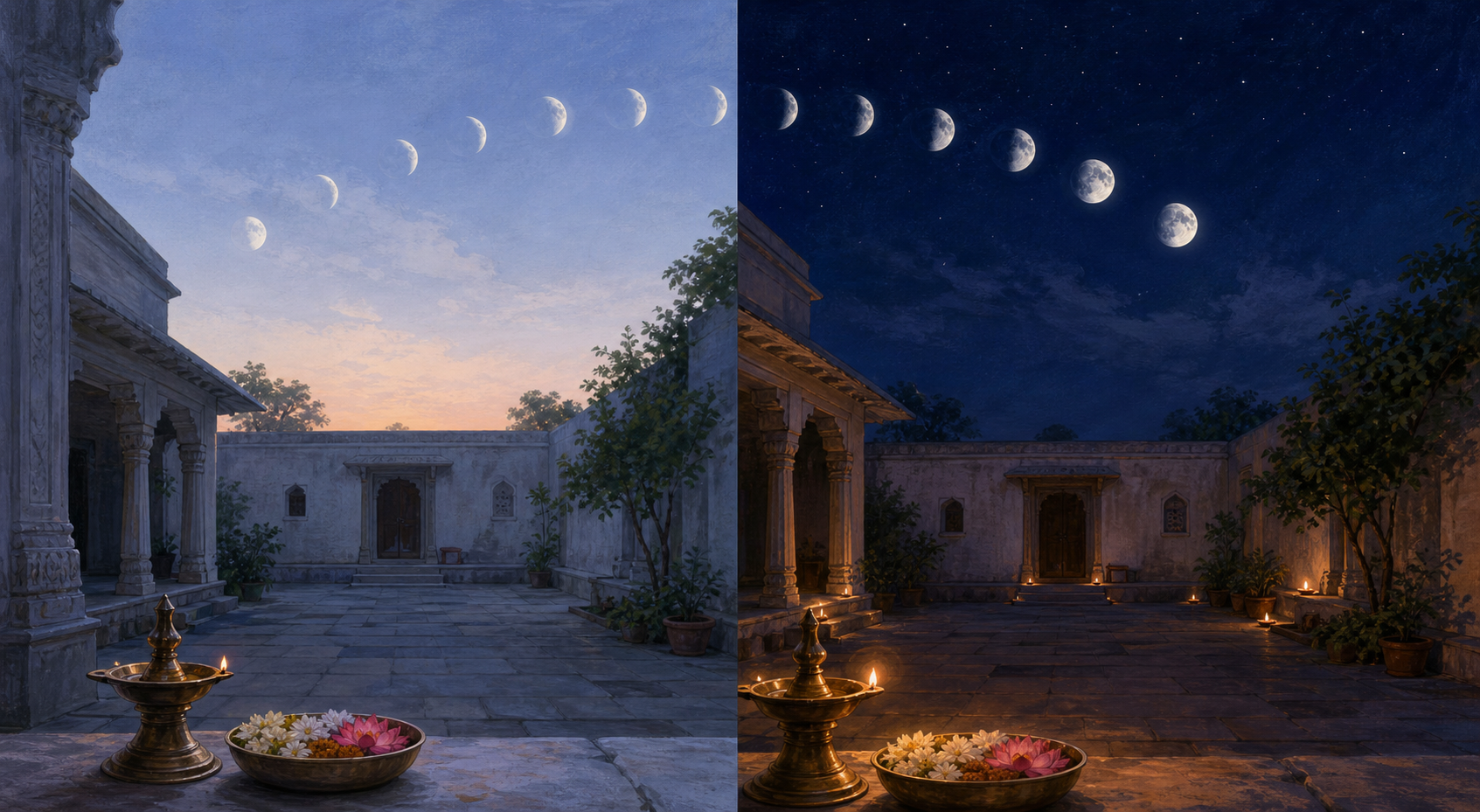
A list of daily tithi transitions still does not decide every observance. You must ask when the governing tithi is required to prevail.
- Sunrise-based observance: many daily and festival determinations use the tithi or nakshatra present at local sunrise.
- Pradosha-based observance: the relevant tithi must cover the prescribed dusk interval rather than merely exist somewhere during the civil date.
- Nishita-based observance: the decisive test is the required midnight interval, as in rites whose rules specifically invoke nishita.
- Arunodaya-based observance: the pre-sunrise interval becomes the controlling reference.
- Ordinary tithi-aligned action: the tithi at the actual start may be enough when no more specific ritual rule applies.
This is the difference between an astronomical transition and a dharmic observance rule. The transition tells you when the limb changes. The rule tells you which part of that astronomical span determines the vrata, festival, or ceremony.
Consider Friday, April 10, 2026: Krishna Paksha Ashtami prevails until 7:34 PM IST in most Indian regions, followed by Krishna Paksha Navami. For a simple act intentionally aligned with Ashtami, the start belongs before the local transition; a Navami-aligned start belongs after it. But a vrata governed by the tithi at sunrise, pradosha, or nishita cannot be assigned from 7:34 PM alone. You must test the specified ritual interval.
Do not reuse that 7:34 PM time outside the location context for which it was calculated. Obtain a local drik Panchang for the city where the observance will occur, especially when you live outside India. The same astronomical instant appears under another civil clock time in another time zone, while local sunrise, sunset, and solar noon can differ substantially.
Month names can create a second apparent disagreement. Amanta calendars end the lunar month at Amavasya, while Purnimanta calendars organize the month around Purnima. The same astronomical tithi can consequently carry a different monthly label in different regions. Do not discard a calculation merely because the month name differs; compare the tithi, paksha, location, transition instant, and calendar system first.
Follow one repeatable workflow before committing to a time

You do not need to perform every astronomical calculation by hand. You do need to know what to verify. Use the following workflow whether your Panchang comes from a temple calendar, printed almanac, website, or application:
- Define the beginning: decide whether you are timing the sankalpa, departure, signing, first transaction, entry into a building, or another precise act. A vague event produces a vague muhurta.
- Fix the place: use the city where that beginning physically occurs, not the city where the calendar was printed and not necessarily the home of a distant participant.
- Fix the convention: record whether the Panchang uses drik or vakya calculation, which ayanamsa it applies, and whether its month naming is Amanta or Purnimanta.
- Write every relevant transition: note the start and end of the required tithi, nakshatra, yoga, and karana. A label shown only at sunrise can hide a change later in the day.
- Apply the observance rule: test sunrise, pradosha, nishita, arunodaya, or the actual start time as required. Do this before looking for an attractive Choghadiya.
- Calculate the exclusions: divide local daylight into eight parts and mark Rahu Kalam, Yamaganda, and Gulika for the weekday.
- Find the usable remainder: within the required astronomical span, prefer an appropriate Amrit, Shubh, Labh, or Char Choghadiya, or use the locally calculated Abhijit Muhurat when it suits the undertaking.
- Verify the final interval: confirm that the whole intended start fits inside the selected window and does not merely touch a transition boundary. For a specialized samskara, have the result checked under your sampradaya’s rules.
Keep the final result in one compact line: purpose, city, local date, start window, governing tithi and paksha, relevant nakshatra or karana, excluded periods, and calculation convention. That record makes it possible for a family priest or another Panchang reader to check your reasoning without reconstructing the entire search.
Three warning signs deserve an immediate recheck: every day’s avoidance period is shown as exactly ninety minutes; a calendar gives no location or time zone; or an observance date is justified only by the civil date without stating whether sunrise, pradosha, nishita, or another interval controls it.
Key takeaways
- A tithi is an astronomical 12° Sun-Moon relationship, not a date running from midnight to midnight.
- Vara, tithi, nakshatra, yoga, and karana answer different timing questions; no single limb replaces the others.
- Rahu Kalam, Yamaganda, Gulika, and Choghadiya must be calculated from local sunrise and sunset rather than copied as universal clock slots.
- The reference interval required by the observance decides how a tithi transition is used.
- Location, time zone, ayanamsa, calculation method, and regional month system must remain consistent from the first calculation to the final muhurta.
Before your next observance, begin by writing its governing rule and the city in which it will occur. Then calculate or retrieve the local transitions and daylight divisions. That order turns the Panchang from a page of auspicious labels into what it is meant to be: a disciplined way of aligning intention, action, and time.