
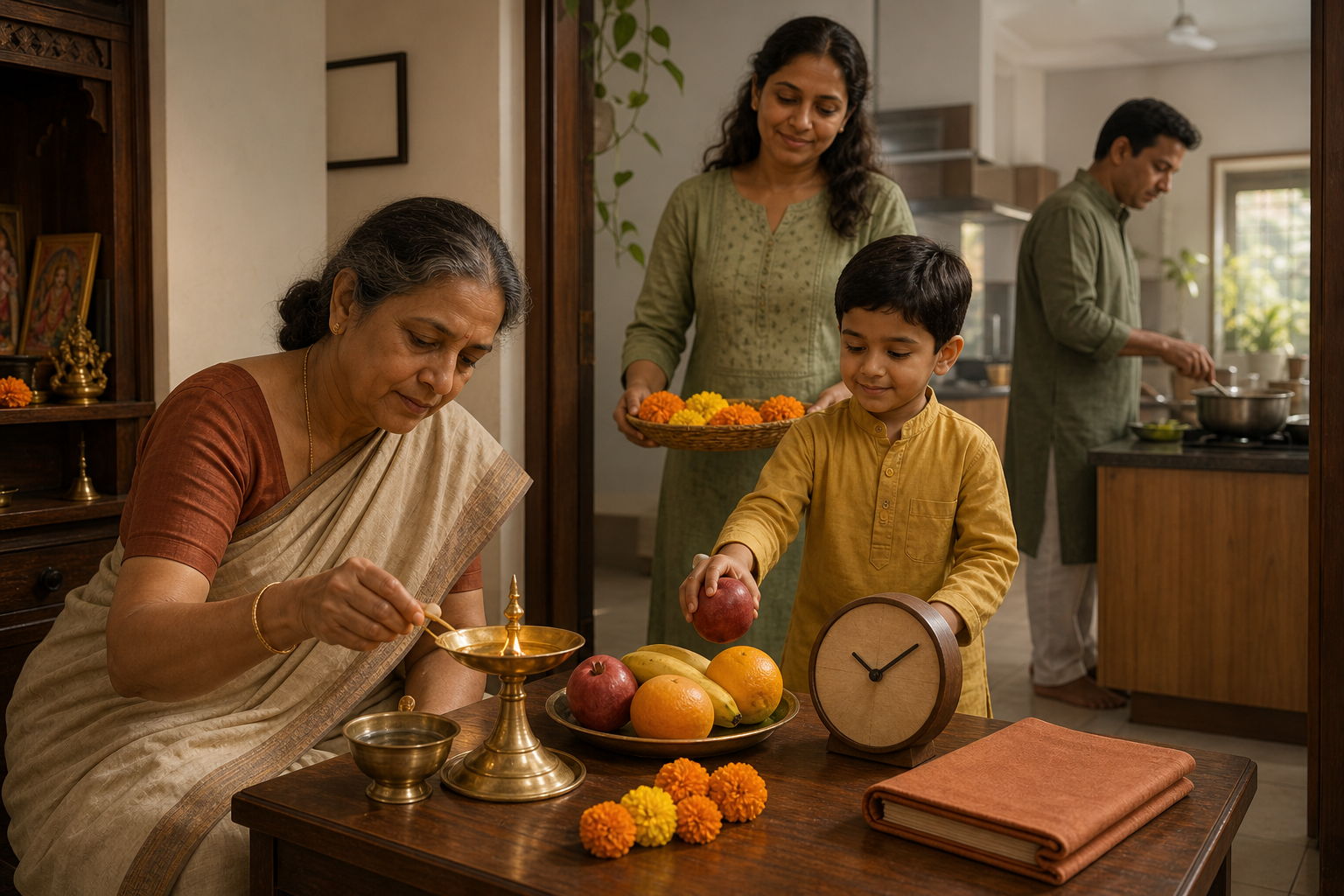
You have the local Panchang open, the household is already moving, and the tithi changes partway through the day. The practical question is not whether everyone can stop for an elaborate ritual. It is how to let sacred time shape what your family actually does.
Use the Panchang as a rhythm-setting tool. Confirm the local timing, choose one intention suited to the active tithi, and join that intention to a visible action. This makes the observance sincere enough to matter and simple enough to repeat.
Read the transition time before planning the ritual

A calendar date is only the starting point for a tithi-based observance. A tithi may end during the morning, afternoon, or evening, so the lunar day active at breakfast may not be the one active when the family gathers later.
Before choosing a puja, vrata, reading, or household task, extract these details from a trusted regional Panchang:
- Your locality: Use timings calculated for where you will perform the observance. Do not copy the clock time from a calendar prepared for another city.
- The active tithi: Identify the tithi in effect when you intend to begin, not merely the tithi printed most prominently beside the civil date.
- The transition time: Mark when the current tithi ends and the next begins. If the transition divides the day, decide whether your household will observe one phase or give each phase a distinct expression.
- Only the additional details you need: Check sunrise, moonrise, Nakshatra, Rashi, and a suitable muhurta when your particular vrata or temple practice depends on them. More calendar data is not automatically a better household plan.
Tuesday, December 23, 2025, gives a clear example: Shukla Paksha Tritiya continued until 10:33 AM local time, after which Shukla Paksha Chaturthi began. That split turns a vague question – “What should we do today?” – into two manageable decisions: what belongs before the transition, and what belongs after it?
The words local time matter. Do not carry 10:33 AM into your own calendar unless your regional Panchang gives that time. Sunrise, moonrise, Nakshatra, and Rashi can also vary with location, so use a regional calendar or trusted temple calendar when exact timing affects your sankalpa, vrata, or visit.
Turn a changing tithi into two household modes
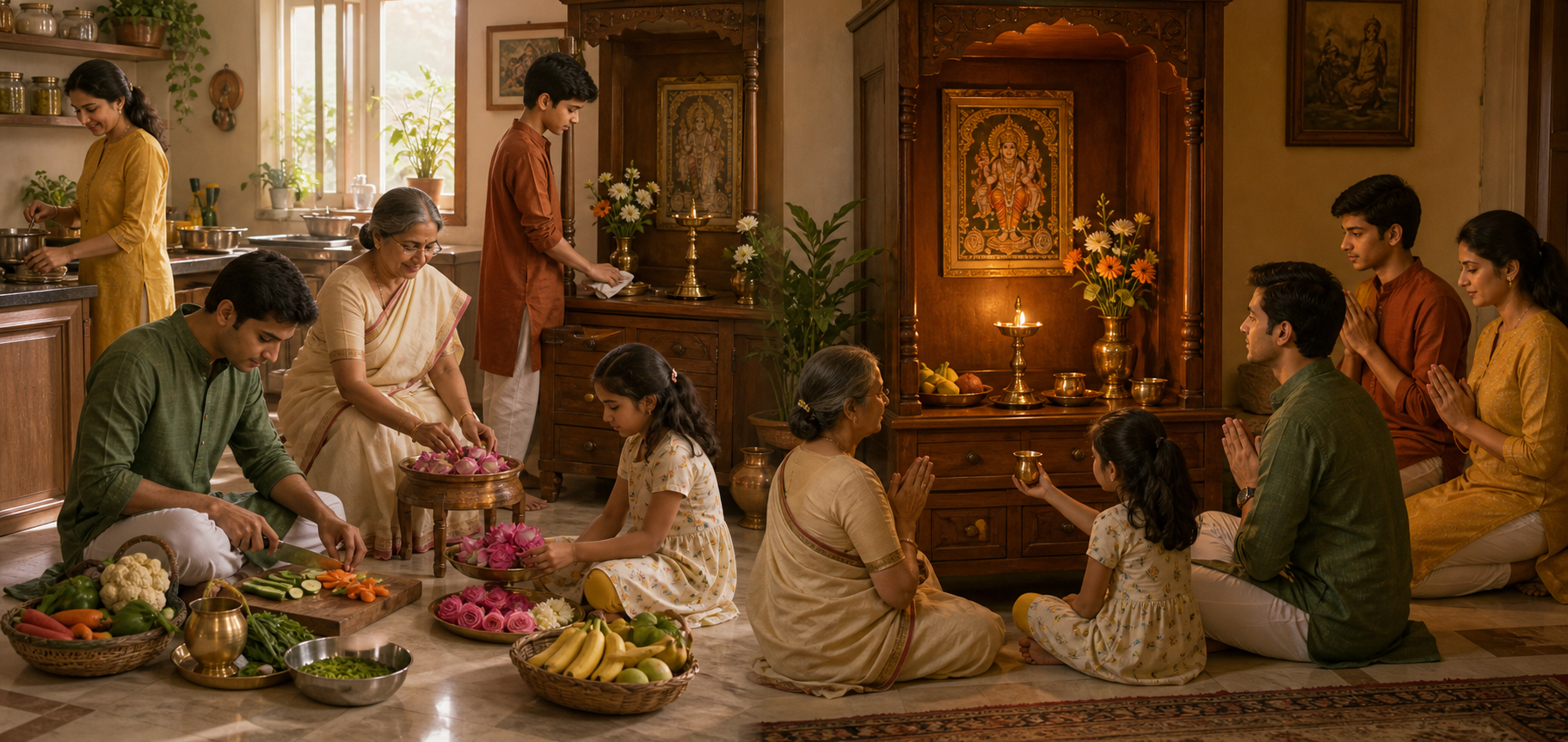
A mid-day transition does not require two elaborate ceremonies. Give each phase one clear emphasis. The December 23 example can be translated into household practice like this:
| Phase | Household emphasis | Concrete expression |
|---|---|---|
| Shukla Tritiya before the transition | Constructive beginnings, learning, gratitude, and household harmony | Clean the sacred space, begin a study schedule, organize family commitments, or hold a careful financial-planning session |
| Shukla Chaturthi after the transition | Sri Ganesha, clarity, steadiness, and the removal of obstacles | Perform a simple Ganesha puja, chant a familiar mantra, and offer modaka or durva if these belong to your custom and are available |
The important move is from symbolism to conduct. If Tritiya is associated with constructive work, do not stop after lighting the lamp: open the book, write the family plan, or begin the schedule. If Chaturthi turns attention toward obstacles, name the obstruction honestly and take the next responsible step after the prayer.
Keep offerings proportionate. Modaka and durva can carry devotional meaning in Ganesha worship, but the household does not need to turn a simple monthly observance into a shopping project. Use what is customary and respectfully available. Cleanliness, attention, and a truthful sankalpa matter more than an inflated checklist.
A repeatable sequence for an ordinary day
- State the timing aloud. Tell the family which tithi is active and when it changes. This prevents the calendar from remaining private knowledge on one person’s phone.
- Name one intention. Use a short sankalpa connected to the phase: steadiness in study, harmony in family duties, clarity about an obstacle, or gratitude for what has been received.
- Prepare one clean place. Arrange the sacred image, text, or other focus your tradition uses. Light a lamp only where it can be attended safely.
- Choose one devotional form. Puja, mantra, collective reading, kirtan, or quiet contemplation can each provide a clear center. Follow your sampradaya and established family practice rather than improvising claims about what is mandatory.
- Complete one matching action. Begin the study plan, settle a household commitment, organize the records needed for a decision, or address the first practical part of the obstacle named in prayer.
- Let the observance move outward. Add an act of seva or dana suited to your means. Sacred time should refine how the household treats people beyond its own walls.
Give the family roles without flattening traditions
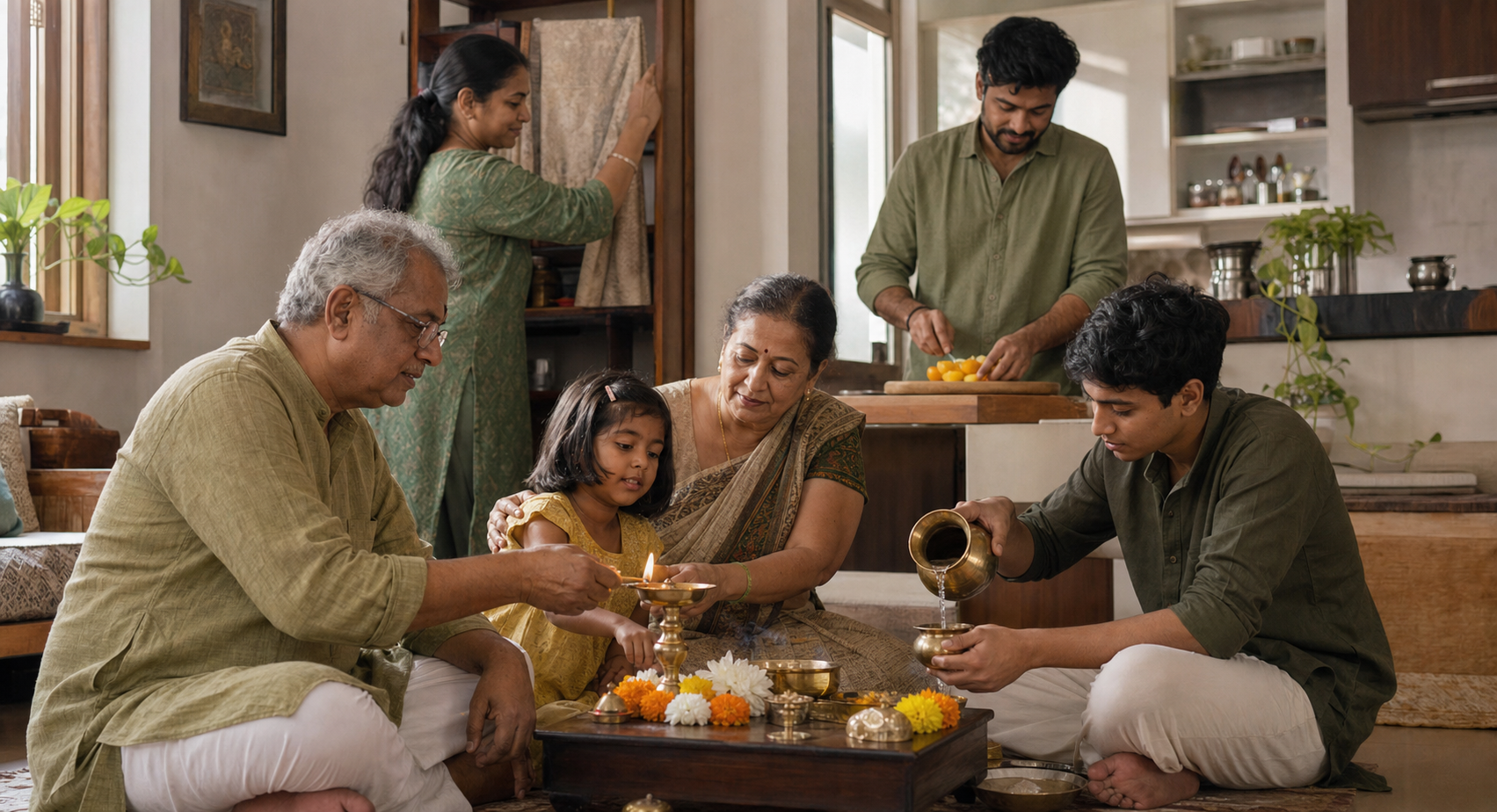
If one person must find the timing, clean the space, lead the practice, explain its meaning, and remember the practical follow-through, the observance becomes fragile. Distribute small responsibilities so that the Panchang enters family memory rather than remaining one adult’s private burden.
- The timekeeper checks the regional Panchang and announces the transition in plain language.
- The space keeper helps clean and prepare the place of worship.
- The reader or singer leads the chosen passage, mantra, or kirtan according to the family’s tradition.
- The action keeper names the practical task connected to the day’s intention and makes sure it is begun.
- The seva keeper identifies a modest act of service, generosity, or care that the household can complete.
Children do not need a dense lesson in calendrical calculation every time. Give them one intelligible connection: “We are cleaning before prayer because attention begins with care,” or, “We are asking Ganesha for clarity, so afterward we will start the task we have been avoiding.” The link between prayer and behavior is easier to retain than a list of unexplained observances.
Dharmic unity does not require ritual sameness. Hindu, Buddhist, Jain, and Sikh family members may not use the same deity forms, vows, or calendars. Do not force every path into one ceremony. Build the shared household layer around non-harm, self-discipline, contemplation, gratitude, service, and social harmony, while allowing each person to retain the forms proper to their own tradition.
This distinction is especially useful in an intergenerational or mixed-practice home. One person may perform Ganesha upasana; another may participate through quiet reflection or the act of seva. The household can be united in ethical purpose without pretending that its disciplines are interchangeable.
Avoid the mistakes that make observance brittle
- Treating the civil date as one uninterrupted tithi: Read the end time first. When a transition occurs, schedule the practice for the phase you actually intend to honor.
- Borrowing another city’s clock time: A beautifully designed calendar is still the wrong calendar if its calculations are not local to you. Confirm the locality before organizing the family around an exact minute.
- Collecting details without a decision: Nakshatra, Rashi, sunrise, moonrise, and muhurta data have particular uses. If none changes your intended practice, do not let the search for more data displace the observance itself.
- Confusing auspicious timing with guaranteed success: A supportive time can focus attention and strengthen resolve. It does not replace preparation, skill, ethical judgment, or accountability.
- Making material abundance the measure of bhakti: A simple lamp, a clean place, a familiar mantra, and a completed duty can form a coherent observance. Do not make an unavailable offering the reason the family does nothing.
- Using vrata as a test for everyone else: State what the household is doing, explain why, and offer suitable roles. Coercion defeats the stated aim of harmony.
Be particularly clear when money is involved. An auspicious period may be used to begin financial planning, organize accounts, or discuss family commitments. It does not establish that a purchase, loan, investment, or contract is sound. Check the cost, obligation, risk, and relevant professional advice on their own merits.
The same principle applies to urgent duties. Panchang guidance can order discretionary activity; it should not become a reason to neglect safety, care, or an obligation that cannot responsibly wait. Dharma includes the quality of the action, not only its timing.
Key takeaways
- Use a regional Panchang and verify that its clock times apply to your location.
- Read the tithi transition before deciding when the household will gather.
- Give each active phase one devotional emphasis and one matching practical action.
- Keep the ritual proportionate enough to survive workdays, school days, and limited resources.
- Build unity around shared Dharmic values while respecting distinct ritual disciplines.
- Let auspicious timing support judgment and effort, never substitute for them.
For your next household observance, open the regional Panchang the night before. Mark the transition, choose the intention, place what you need near the sacred space, and tell the family what will happen before and after the change. Then do exactly what you chose. A modest practice joined to a real duty is how the Panchang becomes part of household life.
References
