
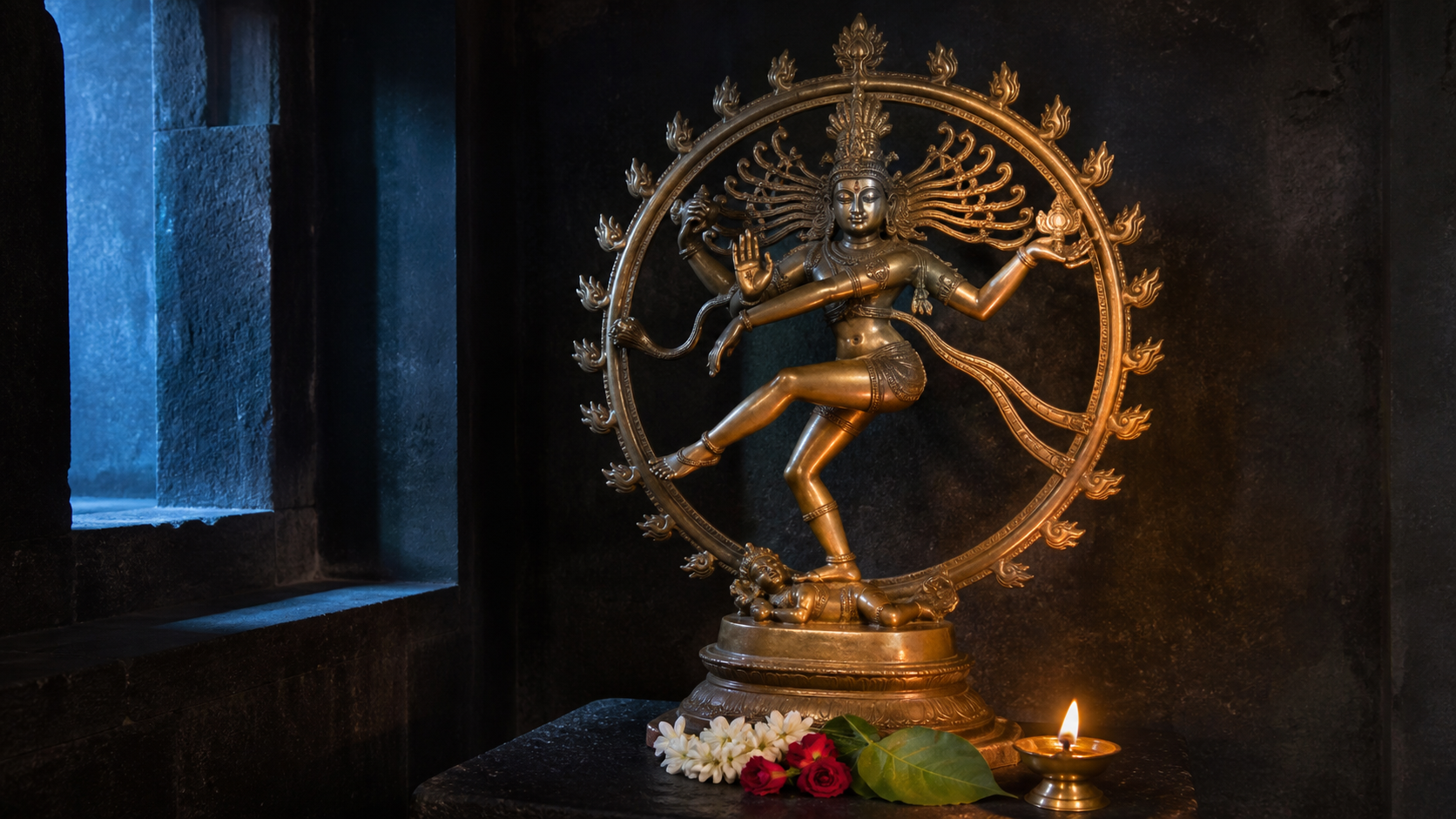
If you want to observe Arudra Darshan but cannot reach Chidambaram, or you are unsure how much ritual is enough, you do not need to reproduce a temple festival at home. Fix the correct local time, choose a small sequence you can perform attentively, and let Nataraja’s dance guide one concrete change in how you meet movement and uncertainty.
You have two sound ways to approach the day. You can attend a temple’s scheduled worship and receive darshan with the gathered community, or establish a quiet home observance around a lamp, mantra, sacred reading, Bilva leaves, and silence. The decisive element in either setting is sustained attention rather than ceremonial scale.
Read Nataraja’s dance before performing the ritual
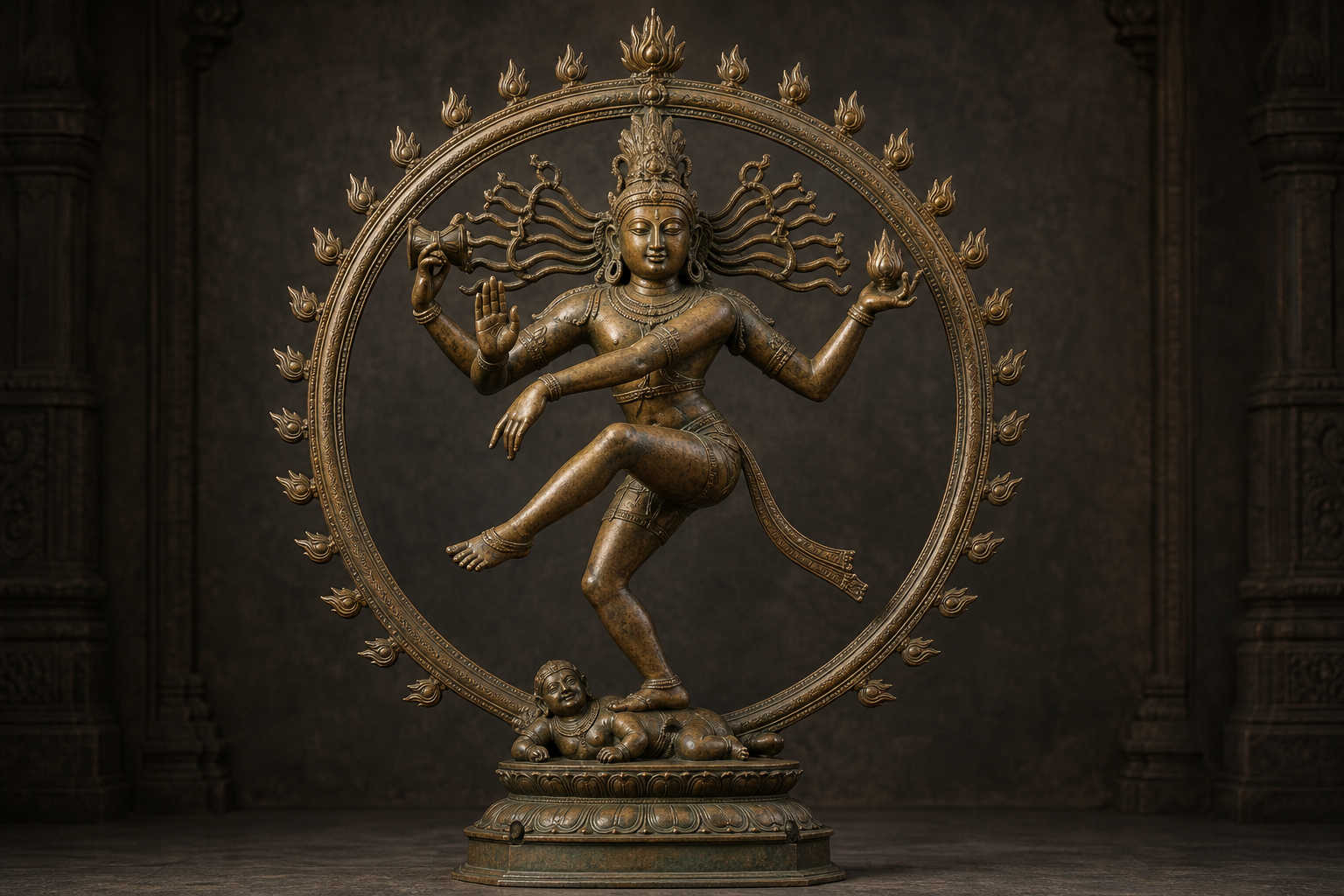
Arudra Darshan honours Shiva as Nataraja, the Lord of Dance. His Ananda Tandava presents existence as rhythm rather than disorder: creation, preservation, and dissolution unfold within the cosmic dance. Yet the consciousness at its heart remains composed. That conjunction of movement and stillness is the festival’s most useful teaching.
This is not an invitation to withdraw from ordinary life. Work, family duties, loss, renewal, and change continue. Nataraja worship asks whether your awareness must be thrown about by everything that moves around it. Darshan becomes practical when you begin to notice the difference between necessary action and automatic reaction.
Before selecting offerings, apply the three movements of the dance to your own conduct:
- Creation: Name one wholesome action you have postponed and take its first definite step.
- Preservation: Identify one duty, relationship, or spiritual discipline that needs steady care rather than another burst of enthusiasm.
- Dissolution: Release one resentment, distraction, or unhelpful habit that you keep carrying after its purpose has ended.
These are reflection prompts, not a substitute for Shaiva theology or instruction received through your family, guru, or temple. Their purpose is to stop the cosmic dance from remaining only a beautiful idea. If worship does not reach your choices, it has not yet reached the part of life where you need it.
Darshan also calls for more than visual appreciation of a murti. Present yourself before Nataraja without treating the sacred form as an object to be consumed. Look, chant, listen, and then become quiet enough to notice what your mind does when it is not being entertained.
Set the local time and place before choosing practices
Arudra Darshan is observed during Margazhi, or Margali Masam, when Thiruvathira, also called Arudra, nakshatra prevails. The Gregorian date therefore cannot simply be copied from one year into the next. The 2026 observance fell on January 3, while the precise ritual window depended on local panchang calculations and temple practice.
Spellings can vary across calendars and announcements. Arudra Darshan, Arudra Darisanam, Aruthra Darshanam, and Thiruvathira may point you toward related observances, but local customs are not automatically identical. Kerala’s Thiruvathira traditions, for example, have distinctive cultural and dance expressions. Use the name recognised by the community whose worship you plan to join.
Make these decisions before the festival morning:
- Check a regional panchang. Use one calculated for your location rather than assuming that a distant city’s timing applies unchanged.
- Check the temple announcement separately. The panchang gives calendrical guidance; the temple notice tells you when its abhishekam, deepa aradhana, procession, and public darshan will actually occur.
- Choose temple or home as your primary setting. Trying to complete a home sequence while rushing toward an early temple rite usually weakens attention in both places.
- Prepare what that setting requires. For home worship, place the lamp, Bilva leaves, mantra, and selected hymn where they will be ready. For temple worship, know the opening time, local rules, and travel time before you sleep.
Pre-dawn worship is prominent in temples, while a home practice can be centred on lighting a lamp at sunrise. Do not create a conflict between the two merely to accumulate rituals. If you plan to attend the main temple worship, let that be the centre of the morning and keep any home prayer brief and settled.
Build a home observance you can complete with attention
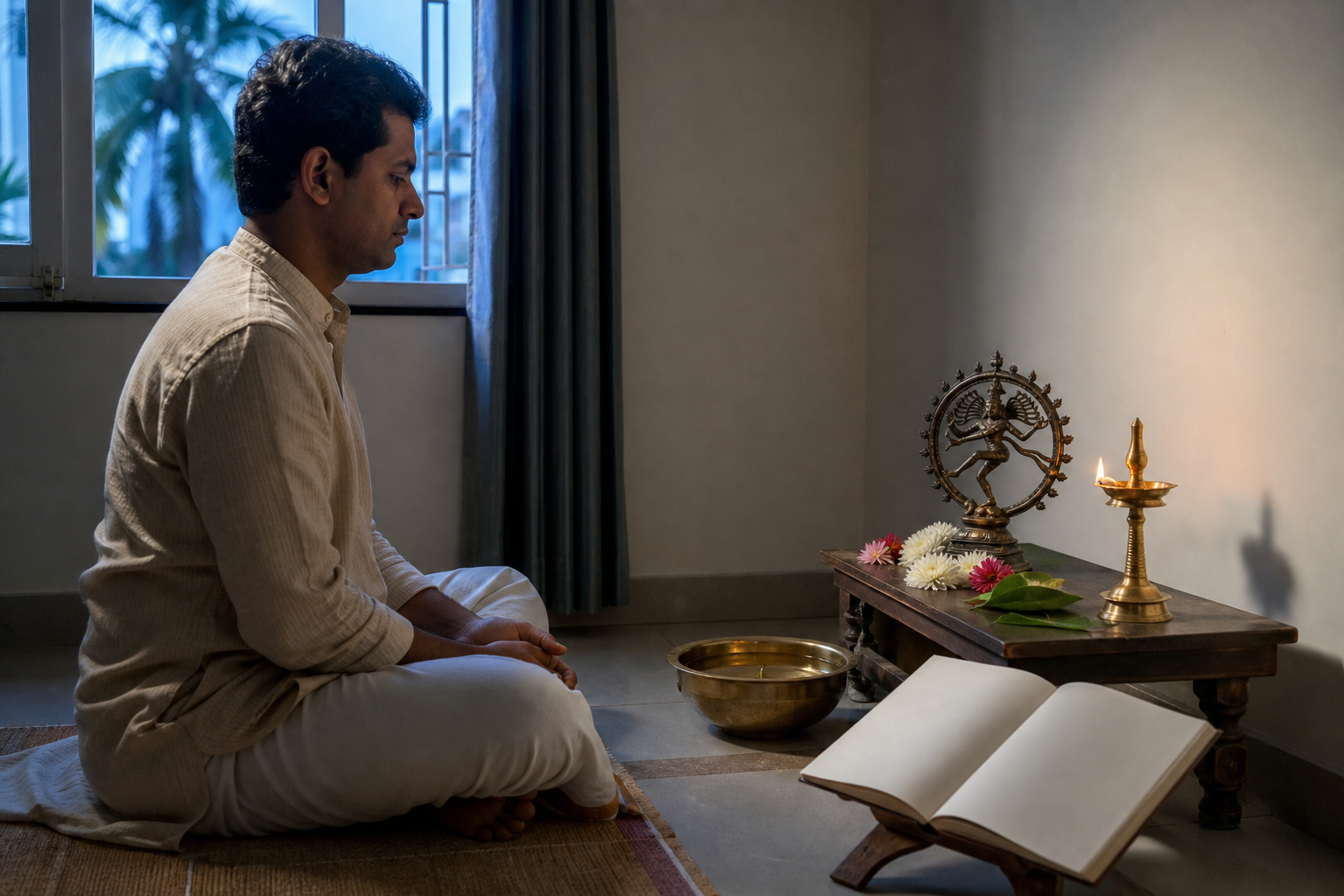
A coherent home observance does not require elaborate equipment. The traditional elements available to most devotees are already enough: a lamp, the Panchakshara mantra Om Namah Shivaya, Bilva leaves, verses from the Thevaram or Tiruvempavai, and a period of silence.
Use the following order if you do not already have a family paddhati or guidance from a guru. Where an established tradition gives you a different sequence, preserve that tradition.
- Prepare a clean, quiet place. Set out the lamp, offering, and text beforehand so that searching for items does not break the worship.
- Light the lamp at sunrise. Let this mark a deliberate transition from ordinary morning activity into attention before Shiva.
- Chant Om Namah Shivaya steadily. Do not race toward a large count. Clear pronunciation and recollected awareness matter more than turning the mantra into a numerical task.
- Offer Bilva leaves. Make each offering without haste. If Bilva is not available, do not allow the missing item to become the entire meaning of the day; continue with the practices you can perform sincerely.
- Read or sing a selected passage. A short portion of the Thevaram or Tiruvempavai read attentively is more useful than a long recitation performed while your mind is elsewhere.
- Sit without adding another activity. Use the silent period to observe where agitation, resistance, or needless speed has taken hold in your life.
- Close with goodwill. Extend the benefit of the observance beyond yourself by consciously wishing clarity and well-being for other beings.
Do not imitate an unfamiliar temple abhishekam
Special Nataraja abhishekam is central to temple observance, but that does not mean you must improvise the same rite at home. If murti abhishekam is already part of your household tradition, follow the method you have received. If it is not, a lamp, mantra, Bilva offering, sacred reading, and meditation form a more responsible practice than guessing at ritual details.
Choose a vrata that clarifies rather than distracts
Many devotees keep a vrata through fasting or dietary restraint. Treat it as a discipline of attention, not a public measure of devotion. Decide in advance what you will observe, keep it quietly, and avoid spending the day comparing your austerity with someone else’s.
If fasting would be unsafe for you or conflict with a medical need, do not fast. Choose an appropriate form of dietary restraint or a non-food discipline, such as a deliberate period of silence and freedom from avoidable distraction. The useful question is not how uncomfortable you became, but whether restraint made the mind clearer and conduct gentler.
When children participate, give them one understandable role: tending the unlit worship space with an adult, placing an offering, listening to a short hymn, or describing what it might mean to remain calm while life changes. This transmits more than asking them to sit through unexplained actions.
Receive temple darshan without turning it into spectacle
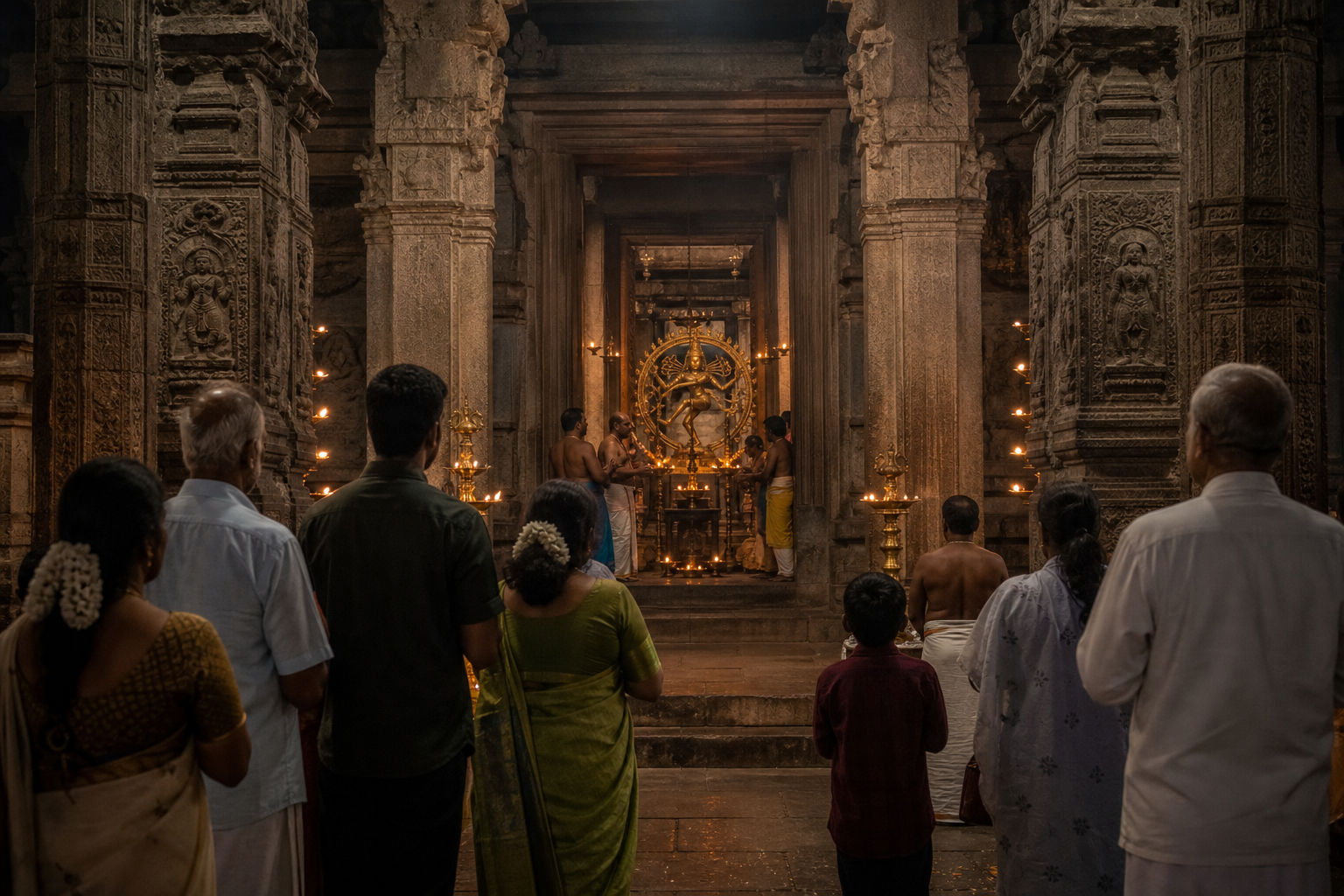
Temple worship offers something a solitary observance cannot: the sound of Shaiva hymns, the shared focus of devotees, deepa aradhana, ceremonial abhishekam, and, where arranged, a procession of Nataraja. Chidambaram holds a special place in Nataraja devotion, while temples across Tamil Nadu and communities in the wider Hindu diaspora also hold special observances.
The main rites may occur before dawn, so arriving at your usual daytime darshan hour can mean missing the very worship you intended to attend. Confirm the programme directly with the temple. A general festival date does not tell you when doors open, when abhishekam begins, or when public darshan is available.
Once there, use a simple discipline:
- Enter with one intention you can remember when the space becomes crowded: to behold Nataraja with steadiness.
- Follow the temple’s queue, dress, offering, and photography rules without treating them as interruptions to worship.
- Choose one mantra or hymn to hold your attention instead of trying to document every stage on a phone.
- During abhishekam and deepa aradhana, watch the rite being offered rather than mentally evaluating your view, position, or convenience.
- If there is a procession, receive it as mobile darshan. The deity’s movement among devotees is not merely a cultural performance.
- If you bring children, explain beforehand what they will see and identify one moment at which you want them to become especially attentive.
A large temple and a modest home are not rival measures of grace. The temple gives you liturgy, lineage, sacred space, and community. The home gives you quiet, continuity, and the chance to make every action intelligible. Choose according to your circumstances without belittling either form.
Carry the still point of the dance into the rest of the day
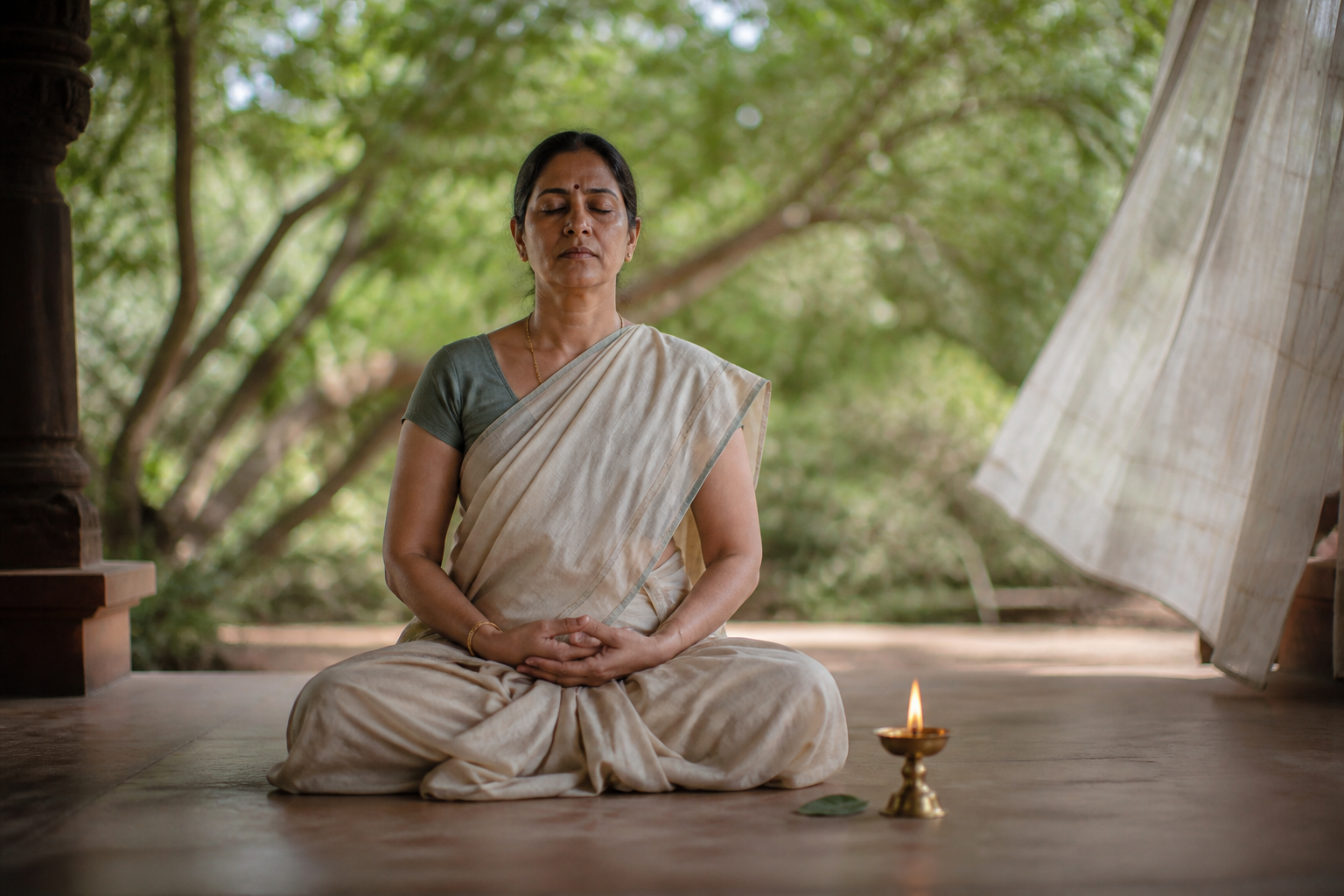
The test of the observance begins after the lamp is lowered or you leave the temple. Pick one situation in which you usually react too quickly: a family disagreement, an unwelcome change, an anxious decision, or a duty you resent. When that situation returns, pause before answering. This is where contemplation of Nataraja becomes conduct.
You can make the commitment precise by completing one sentence before the day ends: When this part of my life moves, I will remain steady enough to do this. Fill the last word with an observable action, such as listen, speak truthfully, continue the duty, or let the grievance go. Avoid vague promises to become more spiritual.
Nataraja worship remains distinctly Shaiva, but its discipline of stable awareness has recognisable resonances elsewhere in the dharmic family. Buddhist mindfulness, Jain Samayik, and Sikh simran and kirtan also cultivate collected attention and inner equilibrium through their own paths.
Use those parallels to build understanding, not to erase difference. Mindfulness is not another name for Nataraja worship; Samayik is not a Shaiva ritual; simran and kirtan retain their Sikh meaning. The honest common ground is disciplined remembrance amid the pressures that scatter the mind. You can affirm that shared aspiration while allowing each tradition to speak in its own vocabulary.
Key takeaways
- Arudra Darshan belongs to Margazhi and is aligned with Arudra, or Thiruvathira, nakshatra; verify the date and ritual window through a local panchang.
- Check the temple’s own programme because pre-dawn abhishekam, deepa aradhana, procession, and public darshan follow local schedules.
- For home worship, a lamp, Om Namah Shivaya, Bilva leaves, selected Thevaram or Tiruvempavai verses, and silence provide a focused sequence.
- Follow an established household method for murti abhishekam rather than inventing one from an unfamiliar temple rite.
- Let vrata support clarity. If food fasting is unsafe, choose an appropriate dietary or non-food restraint.
- Turn the cosmic dance into conduct by beginning one wholesome action, sustaining one duty, and releasing one burden.
Before your next observance, save the local temple schedule, select the hymn you will read, and decide what restraint you will keep. Then, when the morning comes, give those few practices your full attention. Nataraja’s dance does not ask you to stop life’s movement; it asks you to discover whether you can meet that movement without losing your centre.
References
