
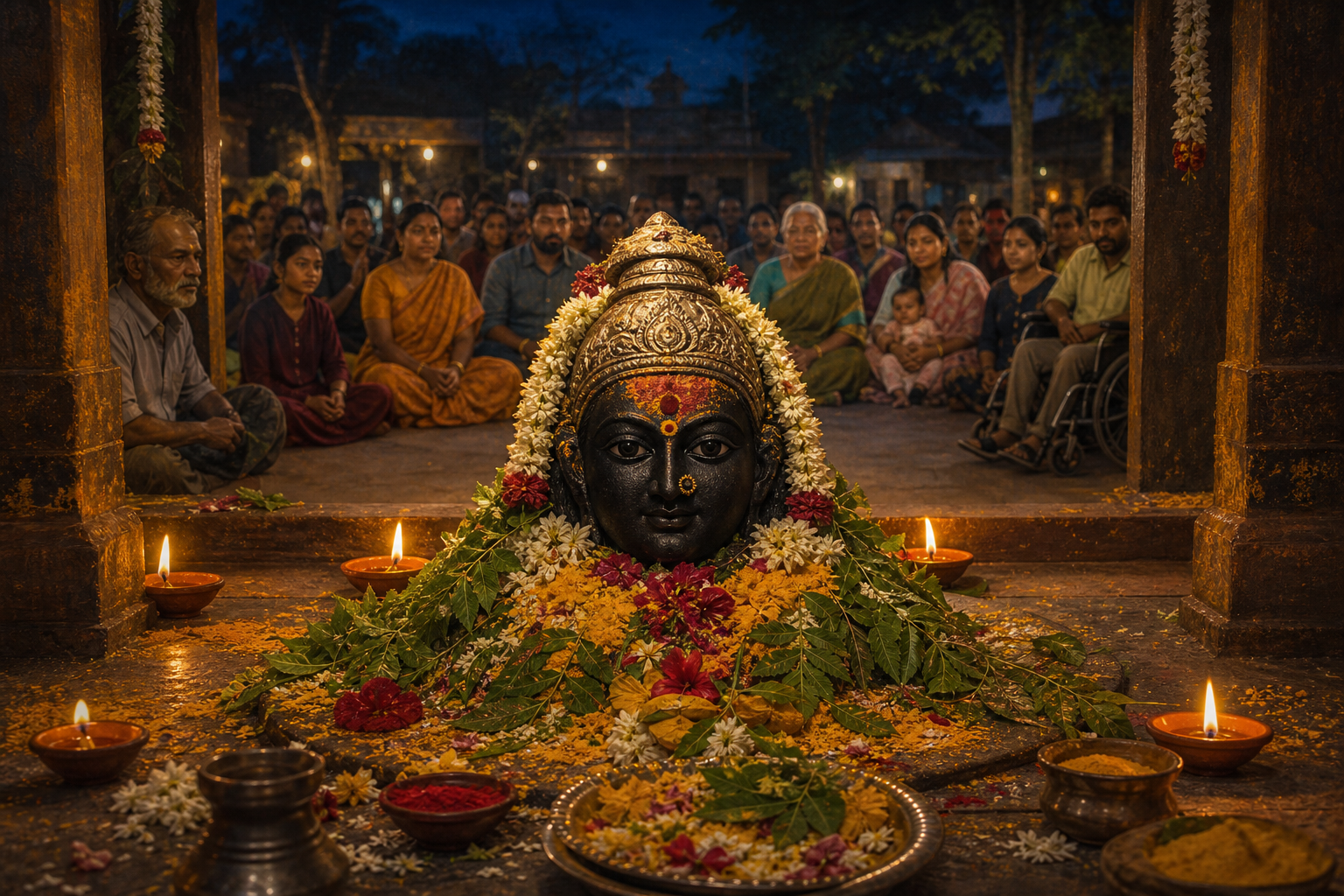
You may come before Yellamma with a direct question: why is the Mother worshipped as a black head, and what does that form ask of you? The answer matters when people invoke the Goddess as a symbol of equality. A sacred image does not become socially inclusive merely because devotees describe it that way. Its meaning has to alter how people are seen, welcomed, and treated.
Yellamma is revered as Renuka Devi across Karnataka, Maharashtra, and Telangana. Her head-focused form, its black hue, the stories of rupture and restoration surrounding her, and her embrace of socially stigmatized devotees all point toward the same demanding principle: no inherited label can exhaust a person’s dignity. For you, the practical test is simple. After receiving her darshan, whose face can you no longer permit yourself to dismiss?
Key takeaways
- Yellamma’s head-focused form directs attention toward the face, where a person is encountered before clothing, occupation, wealth, or social rank.
- Black functions here as an all-receiving and protective symbol. It gathers difference without demanding sameness.
- Renuka’s beheading and restoration should be read as a story of rupture and repair, not as a reason to glorify violence or unquestioning obedience.
- A shared shrine does not automatically abolish hierarchy. Inclusion must become visible in access, speech, service, food, consent, and the treatment of marginalized devotees.
- The most faithful response is not admiration alone. It is a repeatable discipline of recognizing dignity before applying a social label.
Begin with the face rather than the social label
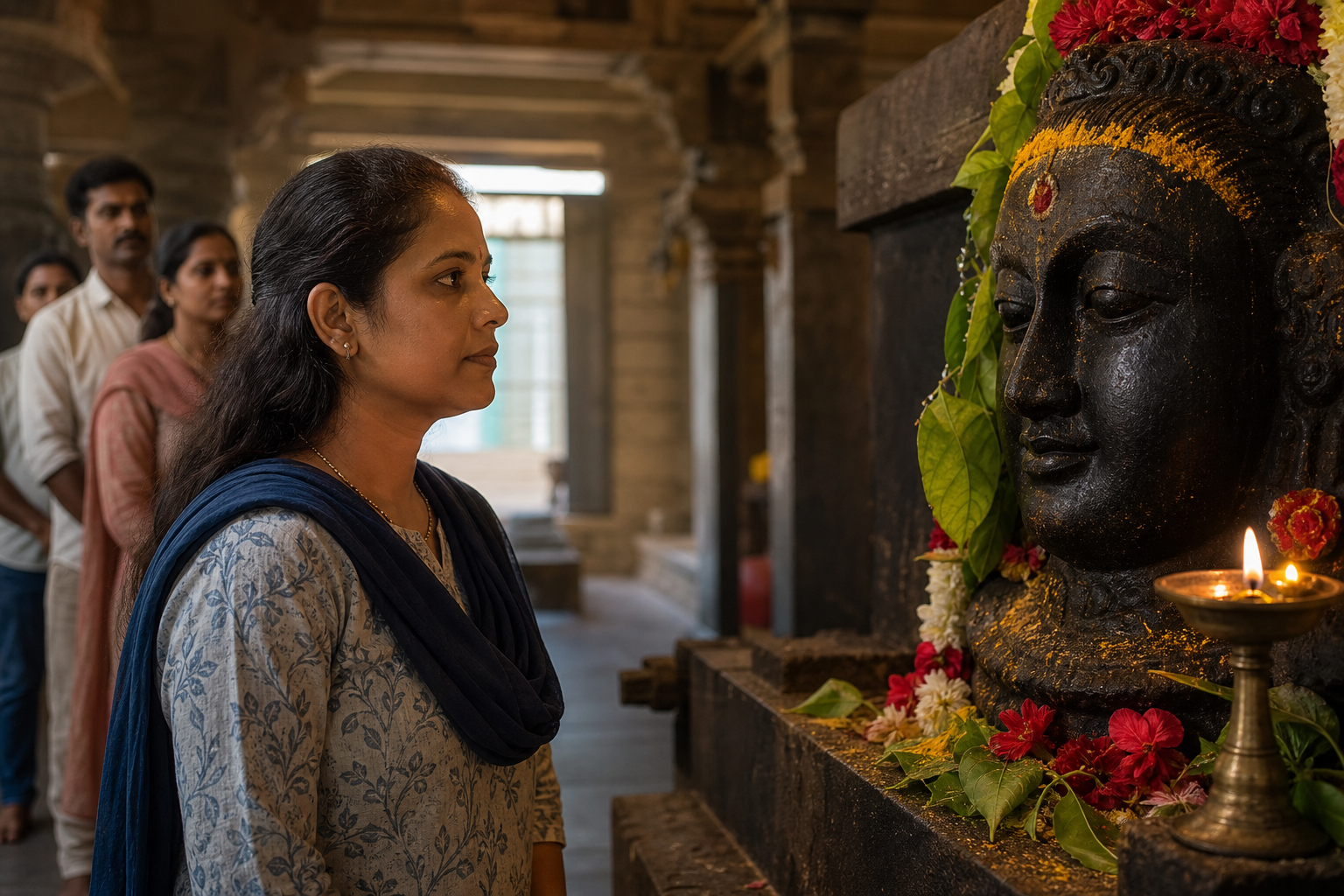
The head is not an incomplete body waiting to be explained away. In Yellamma worship, its concentration on the face changes the terms of the encounter. Full-body iconography can communicate through posture, garments, ornaments, weapons, attendants, and other attributes. When most of those signals recede, the devotee has fewer visual cues from which to construct a hierarchy. Attention returns to presence, expression, and gaze.
This matters because ordinary social judgment often moves in the opposite direction. We notice dress, accent, work, family background, gender expression, or community affiliation and then decide how much courtesy a person deserves. Yellamma’s form interrupts that sequence. You meet the face first. Status is denied the privilege of introducing the person.
Darshan deepens the lesson. You do not only look at the Goddess; you stand within her regard. That reverses the usual social gaze. The person accustomed to judging others must now imagine being fully seen by a Mother who is not impressed by rank. Karuṇā, or compassion, kṣamā, or forbearance, and śakti, or sacred power, become standards by which the devotee’s own conduct is measured.
The black hue adds another layer. Within this symbolism, black is all-receiving: it can hold every color without arranging colors into a ladder. It can also signify fierce protection. These meanings belong together. Inclusion is not passive niceness. A mother who receives everyone must also be willing to defend those whom society humiliates, excludes, or treats as disposable.
Do not reduce this symbolism to the claim that all differences are unreal or irrelevant. People bring different histories, duties, vulnerabilities, and forms of devotion. Yellamma’s black face does not erase those distinctions. It teaches you not to convert difference into diminished worth.
Read Renuka’s rupture and restoration with care
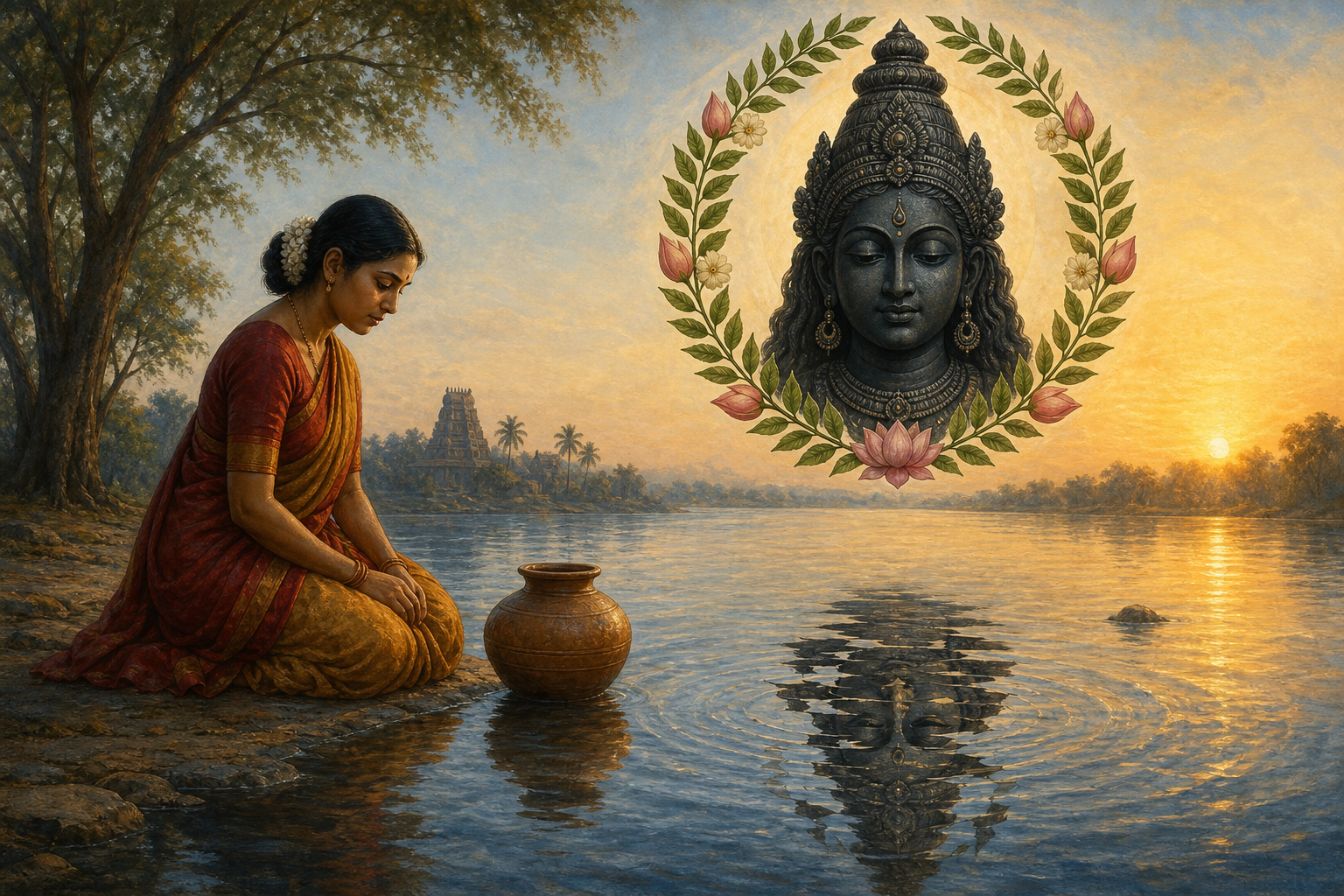
In the classical narrative, Jamadagni commands Parashurama to behead Renuka, and she is subsequently restored. Some regional retellings add a transposition of head and body, producing a restored form that crosses the very boundaries by which society tries to classify identity.
The violence in this story should not be hurried past. If the account is told only as a test of obedience followed by a miraculous reset, Renuka’s suffering becomes a disposable step in someone else’s spiritual achievement. A more responsible reading keeps rupture and restoration in view at the same time. Something terrible happens; restoration follows; and the restored Mother can no longer be confined within the categories that existed before the rupture.
The head-body motif therefore works best as symbolic instruction rather than literal social anatomy. Its force lies in the refusal of a narrow identity: which inherited category could claim exclusive ownership of a divine form joined across boundaries? The story does not require you to pretend that social divisions have disappeared. It asks whether those divisions have been granted authority over belonging.
When you teach this narrative at home, in a temple group, or to younger listeners, make three distinctions clear:
- Name the version. Regional retellings need not be forced into a single standardized account. Variation is part of the living tradition.
- Separate event from instruction. Describing Renuka’s beheading is not the same as endorsing violence. The ethical question concerns what rupture does and what genuine restoration demands.
- Carry restoration into the present. If a community praises the restored Mother while refusing dignity to wounded or stigmatized people, it has preserved the plot but missed the teaching.
This approach also prevents an easy misuse of the phrase mother to all. It is not proof that equality has already been achieved. It is an obligation placed upon anyone who claims Yellamma as Mother.
Make inclusion visible at darshan, prasāda, and the jātre
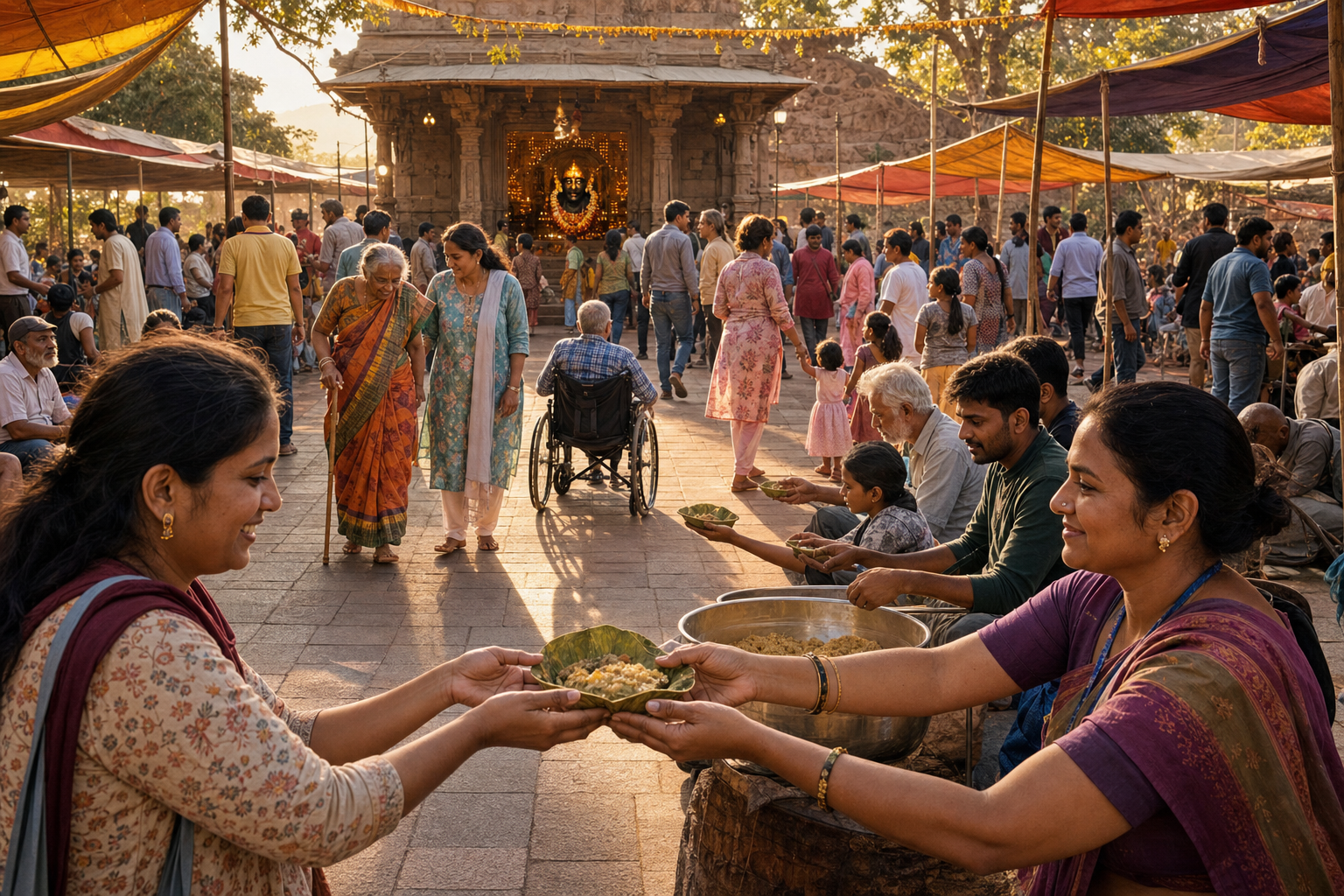
At the Yellamma temple in Saundatti, people from varied communities participate in common prayer, vows, and prasāda. Turmeric, kumkum, and water give devotees direct, accessible ways to make an offering. Annual jātre, processions, songs, and drumming carry the theology beyond private contemplation and into shared culture.
That shared sacred space can weaken inherited barriers, but physical proximity alone is not equality. People may stand before the same deity while still being separated by tone of voice, assumptions about purity, access to service, or the expectation that some must remain invisible. The right question is therefore not only who is present. Ask what happens to each person after they arrive.
If you help organize a pilgrimage, worship gathering, cultural program, or communal meal, use the following checks:
- Darshan: Are first-time visitors, poor devotees, elderly people, and socially unfamiliar groups guided with the same patience offered to respected patrons?
- Speech: Are honorifics, instructions, and corrections applied consistently, or does courtesy rise and fall with perceived status?
- Prasāda and meals: Who prepares, serves, receives, sits, and cleans? Inclusion becomes credible when service is respected and food does not reproduce humiliation.
- Participation: Are folk singers, drummers, vow-keepers, and other tradition-bearers treated as participants in sacred culture rather than as decorative entertainment?
- Repair: If someone is mocked, excluded, or addressed contemptuously, is the harm corrected openly and promptly? A welcome sign means little if nobody will defend the welcome.
This test is especially important in relation to jogappas and other communities historically associated with Yellamma who have also faced stigma. Recognition cannot mean turning a person into a curiosity, a photograph, or an object of pity. It means ordinary courtesy, consent, a respected voice, and the ability to participate without surrendering dignity. Sanctuary is real only when the people being welcomed have some say in what welcome looks like.
The same standard applies to simple offerings. Turmeric, kumkum, and water can reduce the pressure to display wealth, but modest ritual materials do not guarantee a modest social ego. Watch for the moment when a richer offering begins to purchase attention, precedence, or moral prestige. Yellamma’s head-focused form calls attention back to the one thing money cannot improve: the worth of the person standing before her.
Carry Yellamma’s gaze into your ordinary conduct
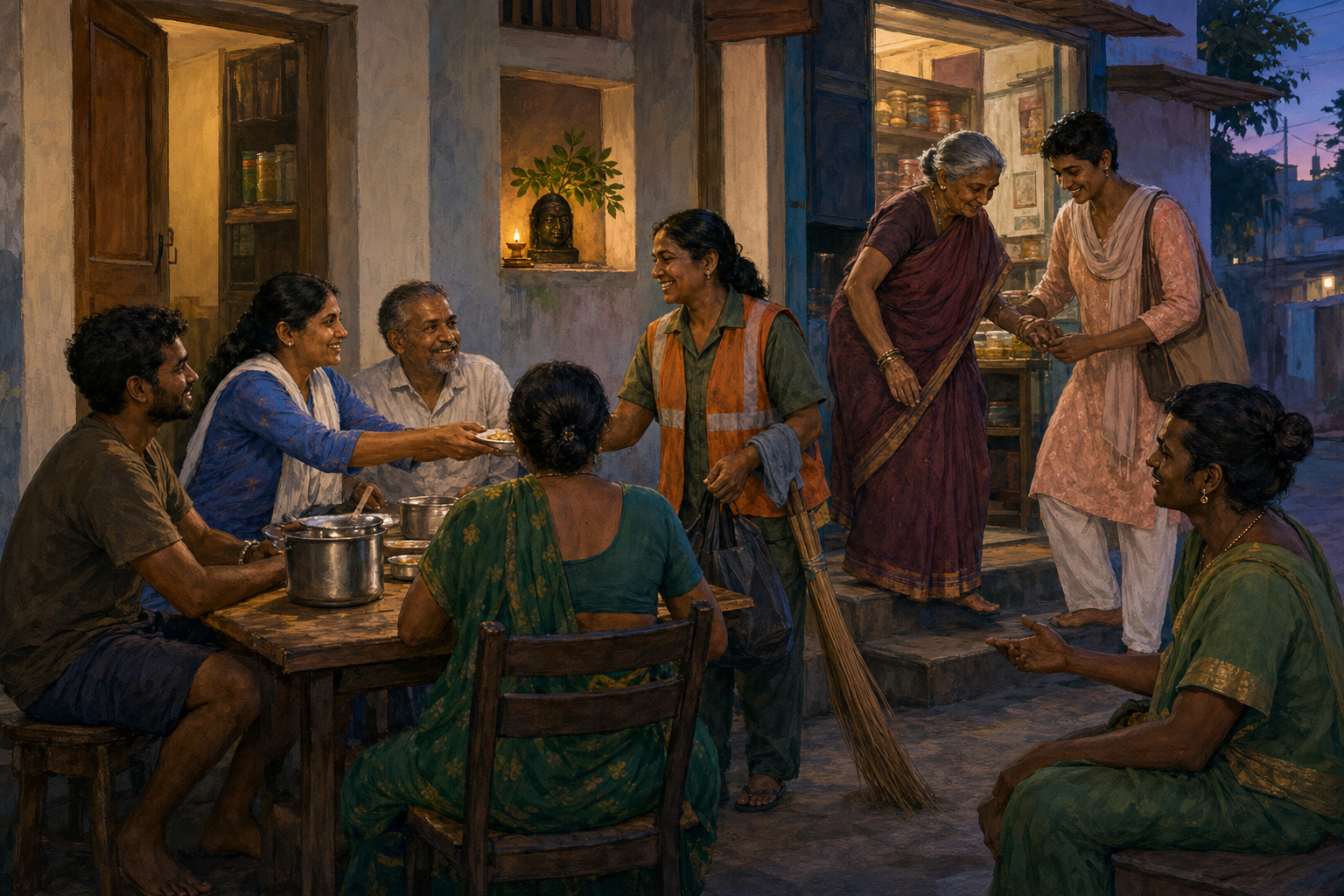
Yellamma’s inclusive motherhood resonates with values found across the Dharmic family: mettā and karuṇā in Buddhism, ahiṃsā and anekāntavāda in Jainism, and sevā and sarbat da bhala in Sikhism. Within Hindu practice, devotion to an iṣṭa allows a person to approach the Divine through a form that speaks intimately to their nature. These are parallels, not interchangeable doctrines. Their shared practical demand is that spiritual depth must become discernible in conduct toward living beings.
You can turn that demand into a daily discipline:
- Notice the label arriving. When caste, class, occupation, appearance, or community identity becomes your first thought about someone, do not pretend the thought did not occur. Refuse to let it make the decision.
- Return to the face. Address the person directly, use the name and form of address they accept, and listen before assigning a story to them.
- Change one material practice. Adjust seating, food service, invitations, speaking order, volunteer roles, or access to information so that belonging is experienced rather than merely announced.
- Protect without patronizing. Intervene when dignity is attacked, but do not make the affected person perform gratitude or helplessness in exchange for support.
- Repair a failure. If you participated in exclusion, name the act, correct what can be corrected, and change the condition that allowed it. Private regret is not social restoration.
This is where the symbolism becomes demanding. Compassion without protection leaves the vulnerable exposed. Protection without tenderness can become domination. Unity without respect for difference becomes forced conformity. Yellamma holds the three requirements together: receive the person, defend the person’s dignity, and do not erase the person’s particular life.
At your next darshan, choose one ordinary practice by which the Goddess’s gaze will follow you home. It may concern where someone sits, who is invited to serve, how a worker is addressed, or whether a stigmatized devotee is treated as a full bearer of sacred tradition. Correct that practice while the encounter is still fresh. Then let every later visit ask whether the correction endured.
References
