
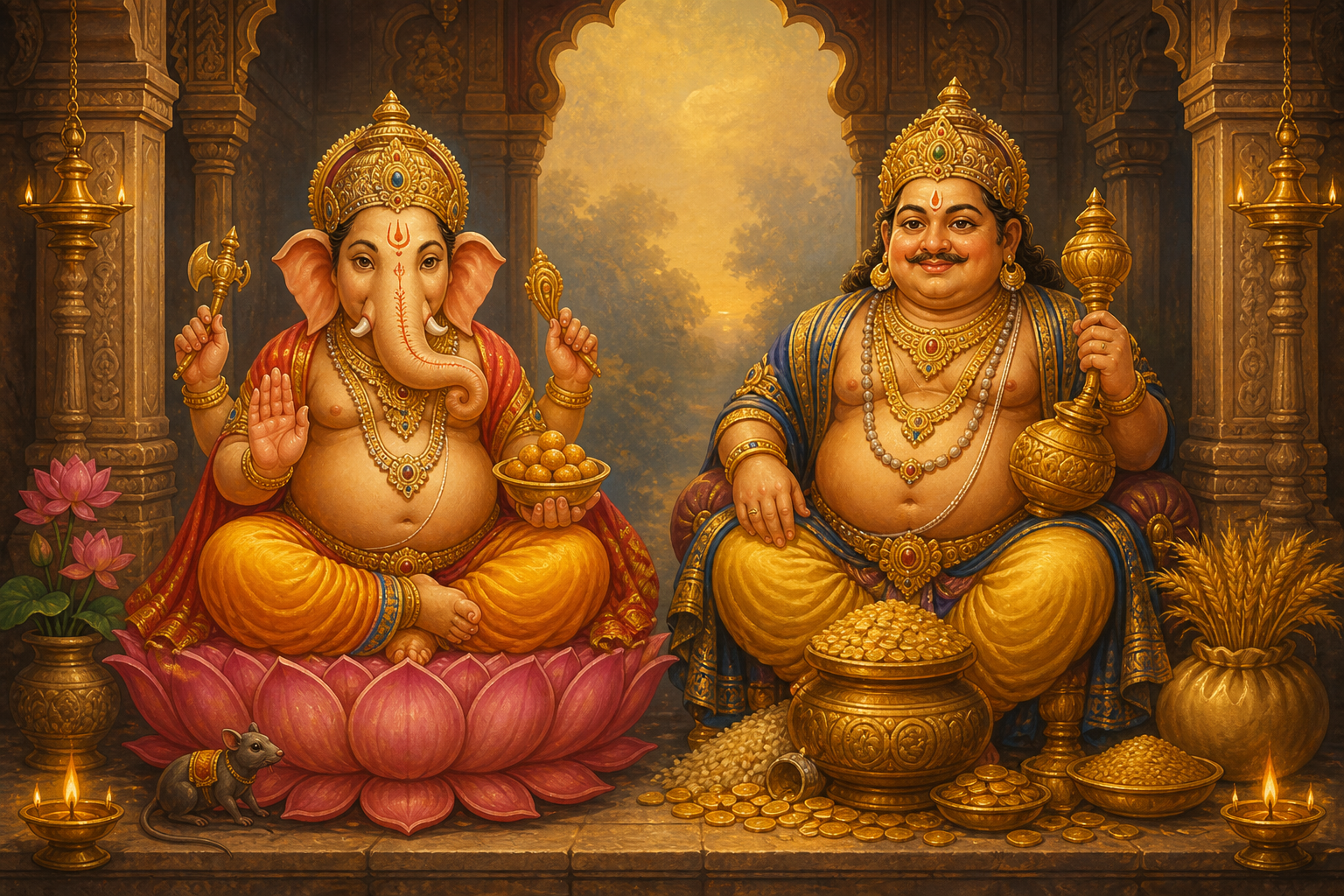
If you have ever paused before a murti of Ganesha or Kubera and wondered why the deity has a large, rounded abdomen, begin by setting aside the modern assumption that the body is either a joke or a comment on weight. In sacred art, the belly is doing philosophical work.
The useful question is not simply why the deity looks well fed. Ask what the form can hold. With Ganesha, it points toward contentment, restraint, and the power to assimilate experience. With Kubera, it speaks more directly of abundance, sovereignty, and the responsibilities that accompany wealth. The same shape changes meaning according to the deity, the surrounding attributes, and the lesson being conveyed.
Read the deity before interpreting the belly
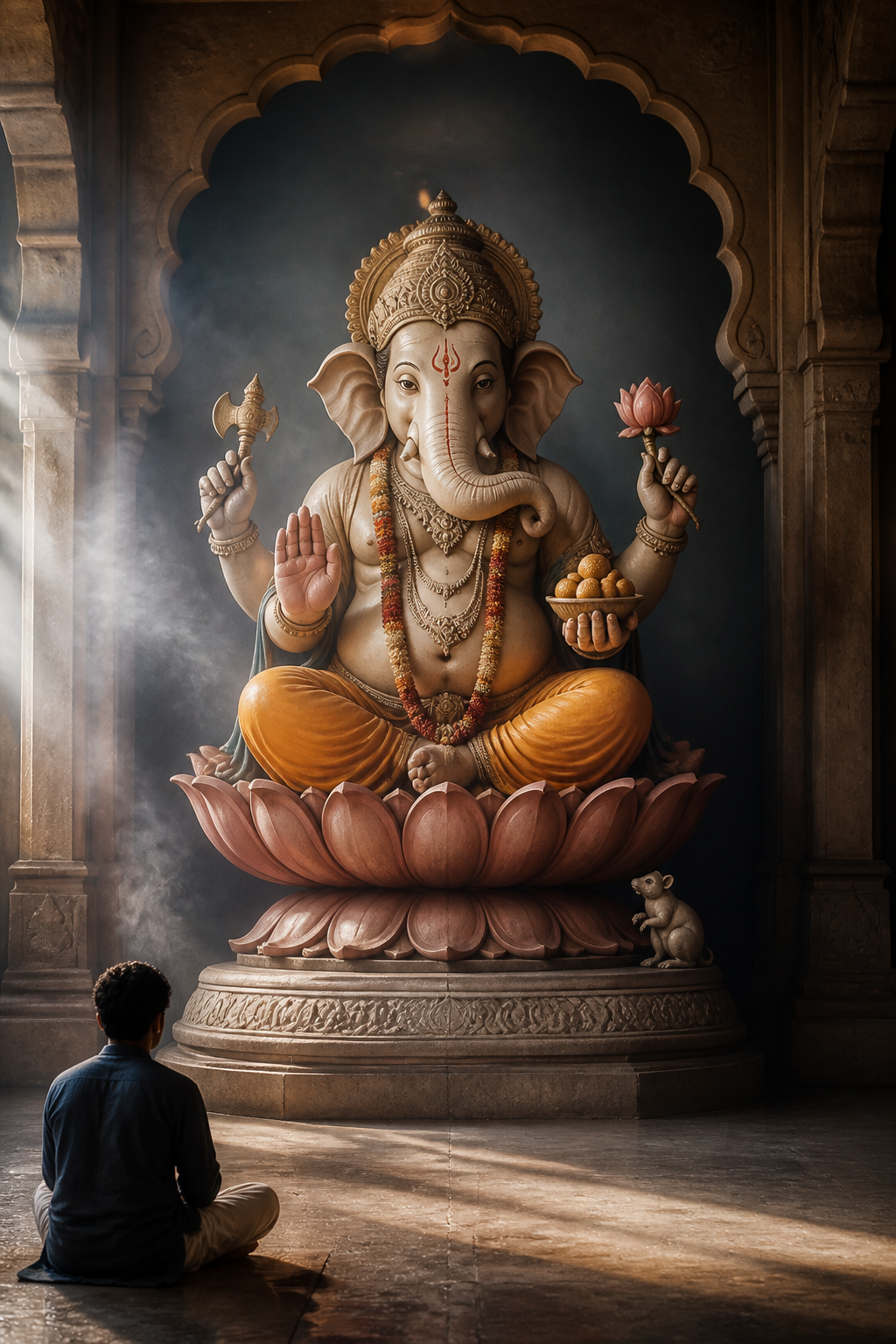
Hindu iconography is read as a composition. No isolated feature works like a universal dictionary entry. A rounded abdomen may evoke plenitude in one setting, groundedness in another, and creative potential in a third. The identity and function of the deity tell you which meaning should come first.
- Identify the deity. Ganesha and Kubera do not carry identical meanings merely because both can be shown with prominent bellies.
- Notice the accompanying cues. Ganesha’s modaka directs attention toward sweetness, desire, and contentment. Kubera’s guardianship of wealth places abundance and stewardship in the foreground.
- Look for the value paired with fullness. Hindu sacred art rarely leaves plenitude without a counterweight: enjoyment is joined to restraint, wealth to generosity, power to responsibility, and stability to compassionate action.
- Ask what the image requires of you. A sound interpretation should lead toward conduct, not stop at identifying a symbol.
This method prevents two common mistakes. The first is treating a divine body as literal portraiture. The second is turning sacred imagery into a judgement about human bodies. A person with a similar body shape is not thereby indulgent, wealthy, contented, or spiritually advanced. The icon teaches through form; it does not authorize ridicule or bodily stereotyping.
Ganesha’s belly represents the capacity to contain desire
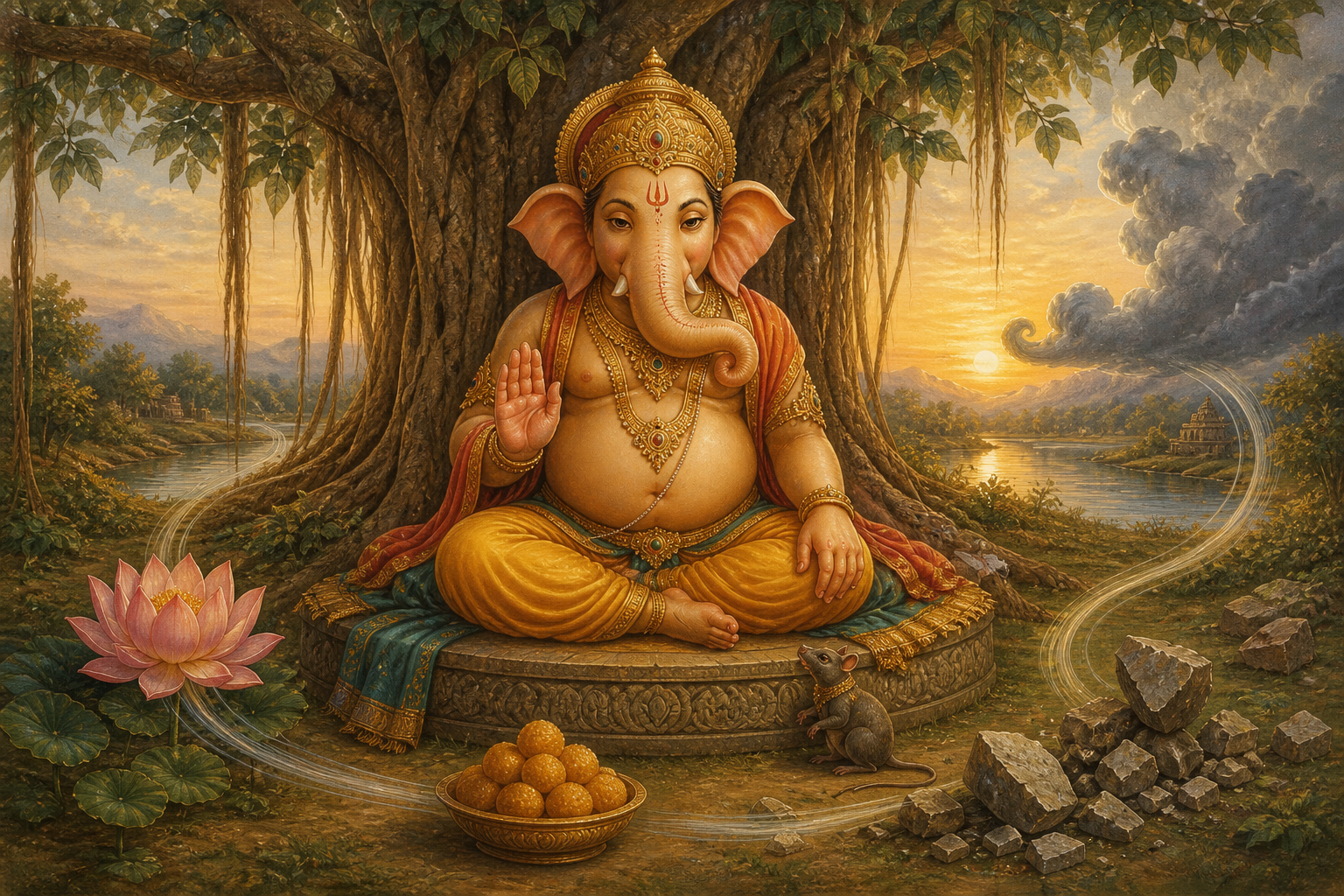
Ganesha’s rounded abdomen should not be read as a failure of appetite. Paired with the modaka, it presents a subtler relationship with pleasure. Sweetness can be received without becoming a master. Desire can be acknowledged without being obeyed immediately. This is santosha, or contentment, expressed not as deprivation but as freedom from restless dependence on the next acquisition or sensation.
Containment is not the same as suppression. Suppression refuses to admit that anger, disappointment, hunger, ambition, or pleasure is present. Containment makes room for the experience while preserving the freedom to choose a dharmic response. Ganesha’s belly therefore suggests inward capacity: life can enter without throwing the whole person into disorder.
The yogic idea of jatharagni, the inner digestive fire, deepens this reading. Digestion is not only an image of processing food; it becomes a metaphor for assimilating emotion, knowledge, praise, failure, and change. Accumulating experiences is not wisdom. Wisdom appears when experience has been digested well enough to guide clear action.
You can turn that symbolism into a brief practice when an impulse is about to make a decision for you. Let the diaphragm move naturally rather than holding the abdomen rigid. Allow the inhalation to create space and the exhalation to settle the reaction. Then ask:
- What am I wanting or resisting right now?
- Can I hold this desire without acting from it immediately?
- What response would remain right after the emotion has passed?
The point is attentive discernment, not a medical claim about breathing or digestion. The practice gives an experience enough room to become intelligible before it becomes speech or action.
The modaka offers an equally practical discipline. Receive sweetness gratefully, recognize the point of sufficiency, and share before reaching automatically for more. Enjoyment is not rejected. It is placed under awareness.
Kubera’s fullness places wealth under dharma
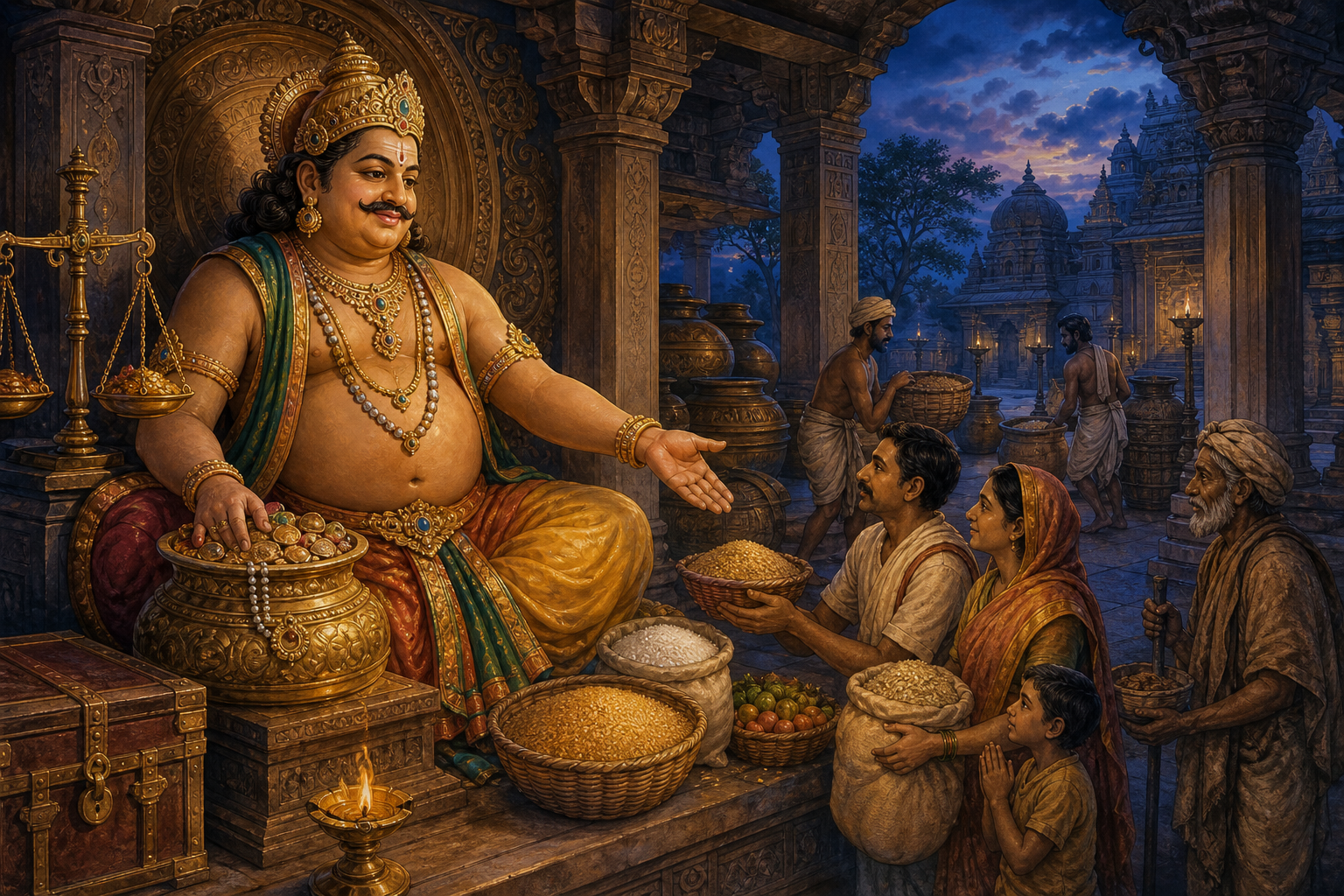
With Kubera, the prominent belly changes register. Kubera is the guardian of wealth, so bodily fullness conveys plenitude, security, and sovereign command over resources. Yet guardianship is different from absolute ownership. A guardian holds something valuable with duties attached.
This is where the image corrects both greed and a shallow rejection of prosperity. Wealth is not condemned merely for being wealth. Nor is possession treated as proof of virtue. Resources become auspicious when they support legitimate obligations, remain under disciplined management, and circulate through dana, annadana, and other forms of social nourishment. The connection with Lakshmi’s principle of auspicious prosperity reinforces this ethical orientation without making Lakshmi and Kubera interchangeable.
If you want to apply Kubera’s symbolism, conduct a dharmic wealth audit rather than admiring abundance in the abstract:
- Acquisition: Are your means of earning consistent with the duties and relationships you claim to honor?
- Sufficiency: Can you identify what is enough for the present purpose, or does every gain merely enlarge the appetite for another?
- Stewardship: Which resources must be preserved for dependants, future obligations, and work that needs continuity?
- Circulation: What can move outward through dana, feeding, community support, or service instead of remaining an inert hoard?
The icon does not supply an arbitrary percentage for giving, and it should not be used to invent one. It supplies a principle: greater plenitude creates greater responsibility. Choose a commitment that is deliberate and sustainable, then make it part of the way you manage resources rather than an occasional response to emotion.
The rounded abdomen is also a vessel of stability and potential
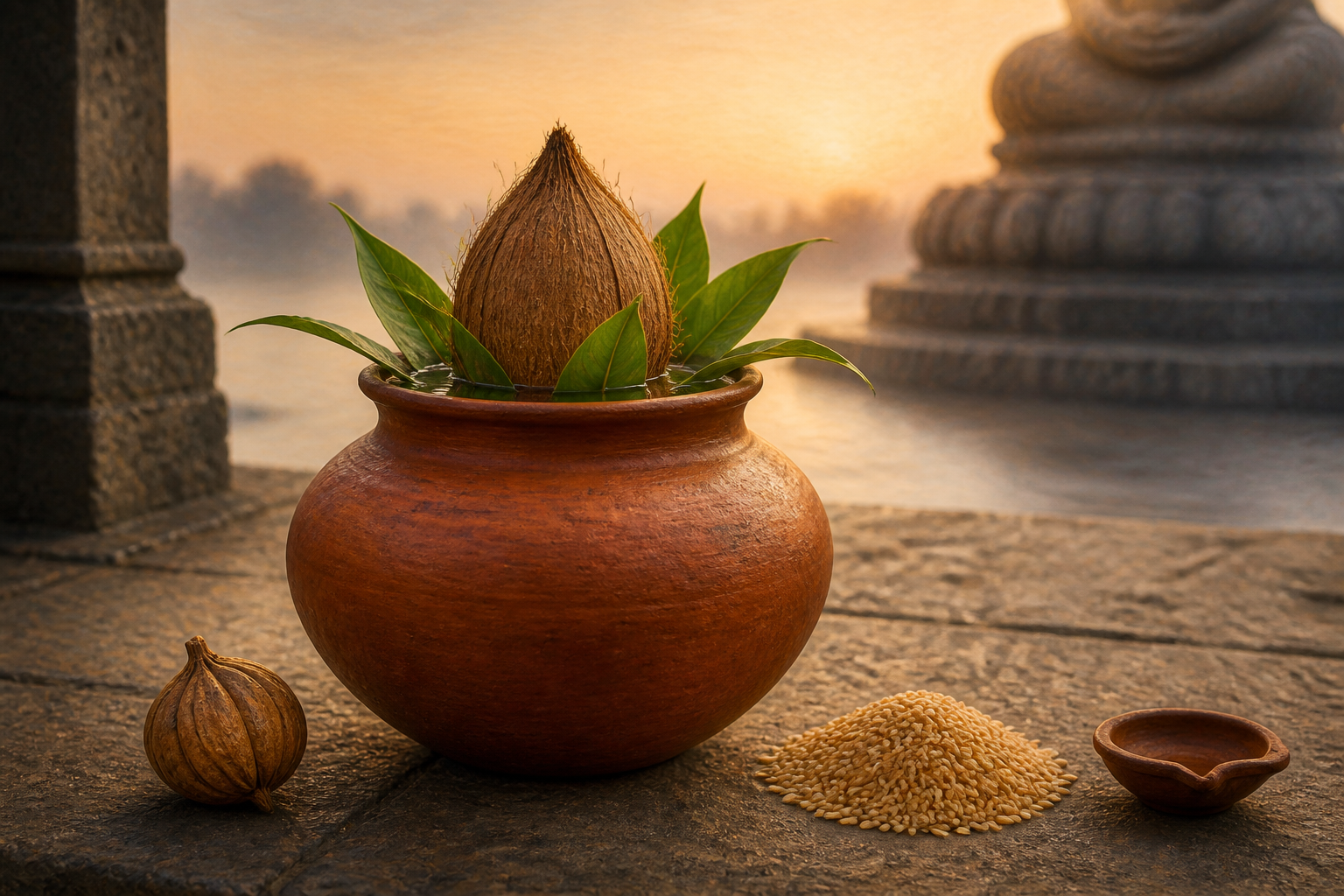
Not every layer of the pot belly concerns appetite or material wealth. The abdomen can be read as a vessel: a center in which energy is regulated, experience is integrated, and possibilities are carried until they are ready to take form.
- Assimilation through jatharagni: The inner fire represents the ability to process what has been received. The question is not how much food, information, or experience you can acquire, but what you can transform into nourishment and discernment.
- Groundedness: A pronounced visual center gives the figure an impression of stability. Associations with muladhara and svadhisthana place steadiness, resilience, and regulated energy beneath outward action. Before acting on a difficult decision, notice whether you are grounded or merely urgent.
- Creative fullness: The rounded abdomen can recall garbha, the womb, and Hiranyagarbha, the golden germ. Fullness then means latent creation rather than completed possession: many possibilities can be held without being forced prematurely into one outcome.
These meanings are related, but they should not be applied indiscriminately. If the setting emphasizes Kubera’s wealth, stewardship should lead your reading. If Ganesha and the modaka dominate, contentment and mastery of desire become more immediate. If a theological or cosmic setting brings creation into view, the vessel and womb metaphors may carry more weight. Context ranks the meanings even when several remain present.
Rounded sacred forms appear across works associated with the Gupta and Chola periods and in regional traditions including Maharashtra and Odisha. There they can operate as a visual language of joy, serenity, and the fullness of life. This does not mean that every sculptor assigned one fixed definition to every abdomen. It means the form belonged to a durable visual vocabulary through which philosophical qualities could be encountered before they were explained in words.
Carry the image into conduct without flattening traditions
Comparable ethical themes appear elsewhere in the dharmic family, but resemblance should not erase identity. Budai, the cheerful figure in Buddhist iconography who is often mistaken for the Buddha, can evoke plenitude, good fortune, and easy-hearted contentment. He is not the historical Buddha, and his image is not a substitute label for Ganesha or Kubera.
Jain aparigraha places non-possessiveness at the center of ethical discipline. Sikh teachings on santokh and seva join contentment with service. These ideas resonate with the restraint, generosity, and non-hoarding conveyed by Hindu pot-bellied deities, but each tradition has its own theology, practices, and iconographic language. We should recognize the shared ethical thread without turning distinct traditions into copies of one another.
When you next encounter one of these forms in a temple, manuscript, calendar image, or museum, use a simple sequence:
- Name the deity and notice the setting before assigning a meaning to the body.
- Describe the form respectfully, without importing mockery or modern assumptions about weight.
- Find the counterweight to fullness: restraint, giving, discernment, stability, or creative responsibility.
- Select one corresponding action for the same day: pause before a reactive reply, recognize sufficiency in consumption, support annadana, offer dana, or perform seva.
- Keep the symbolic lesson separate from judgements about the appearance, health, or character of real people.
Key takeaways
- Ganesha’s belly signifies the capacity to enjoy, contain, and assimilate without becoming ruled by desire.
- Kubera’s fullness presents abundance as a trust governed by stewardship, generosity, and dharma.
- Jatharagni turns digestion into a spiritual metaphor: experience must be integrated, not merely accumulated.
- Associations with grounding, garbha, and Hiranyagarbha add stability and creative potential to the symbolism.
- The image is not a celebration of indulgence and never justifies mockery or moral judgements about human bodies.
- Buddhist, Jain, and Sikh parallels illuminate shared values while remaining distinct from Hindu iconography.
The next time the rounded belly catches your eye, do not stop at the shape. Let it place a decision before you. Receive one pleasure without compulsion, allow one difficult experience to settle before you react, or make one resource circulate for the benefit of another person.
Then the sacred form is no longer an oddity to decode. It becomes a discipline: grow capable of holding more without being possessed by more.
References
