
You are standing before a murti when one feature arrests your attention: a third eye, five faces, or three trunks. Is it a literal description, an artistic flourish, or a code you are expected to know? If you choose any one of those answers too quickly, you will miss how Hindu sacred art actually teaches.
The better approach is to treat altered anatomy as a deliberate disclosure of divine capacity. First notice what exceeds the ordinary human form. Then read the number, the rest of the image, its sacred narrative, and the kind of transformation it asks of the devotee. This lets you interpret iconography seriously without reducing a murti to either biology or a puzzle.
Start with the departure from ordinary anatomy
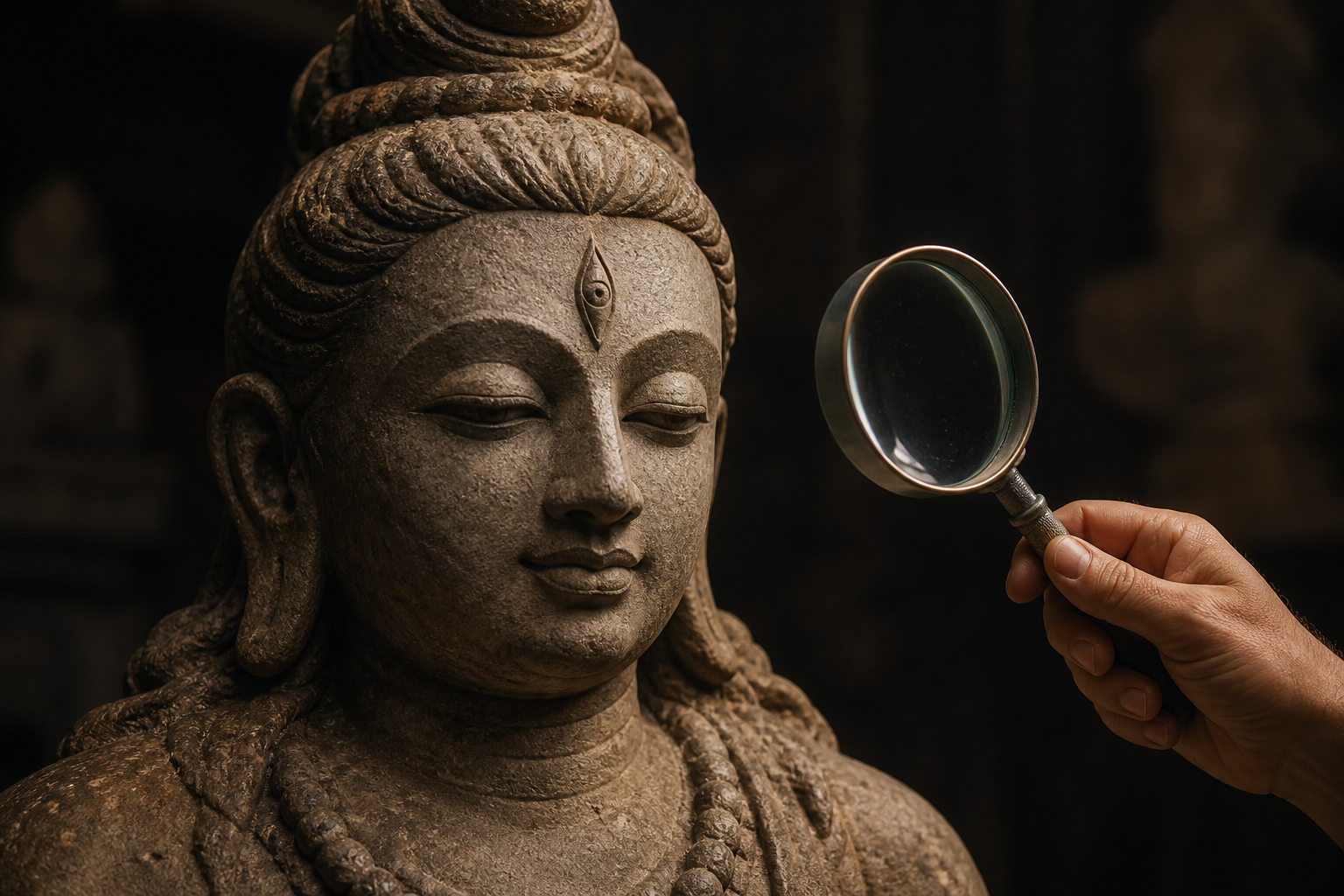
Symbolic anatomy begins with a simple question: what has the artist or sacred tradition changed? An additional eye enlarges the power of sight. Several faces expand identity beyond a single viewpoint. An unexpected number of trunks turns a familiar organ into a structured pattern. The departure is the first clue, not the complete interpretation.
There are three common mistakes at this stage. The first is crude literalism: treating divine anatomy as though it were a medical claim. The second is the opposite error: dismissing the unusual feature as fantasy or decoration. The third is using a universal decoder, as though every instance of the number three or five had exactly the same meaning.
A symbolic reading does not imply that a deity is merely a metaphor. A murti can be received in worship as divine presence while its visible form also instructs the mind. Symbolism describes how the form communicates; it does not exhaust what the form is for a devotee.
Consider the third eye. Ordinary eyes perceive appearances, but the inner eye signifies refined discernment, wisdom, and Self-realization. It is associated with the ajna center in yogic anatomy, yet it should not be mistaken for a physical organ or a promise of spectacular powers. Its essential function is clearer perception.
This distinction gives you a practical test. If an interpretation of the third eye leads mainly to fascination with visions, status, or supernatural display, it has become detached from the ethical meaning of the symbol. The more reliable signs are diminished impulsiveness, greater equanimity, clearer judgement, and compassionate conduct. Insight that enlarges ahankara contradicts the anatomy meant to expose it.
You can apply that test during an ordinary disagreement. Pause, steady your breathing, and separate what is actually happening from what fear, desire, or resentment is projecting onto it. That movement from reaction to discernment is a grounded way to understand what the third eye asks of you.
Read repeated organs as ordered plurality, not excess
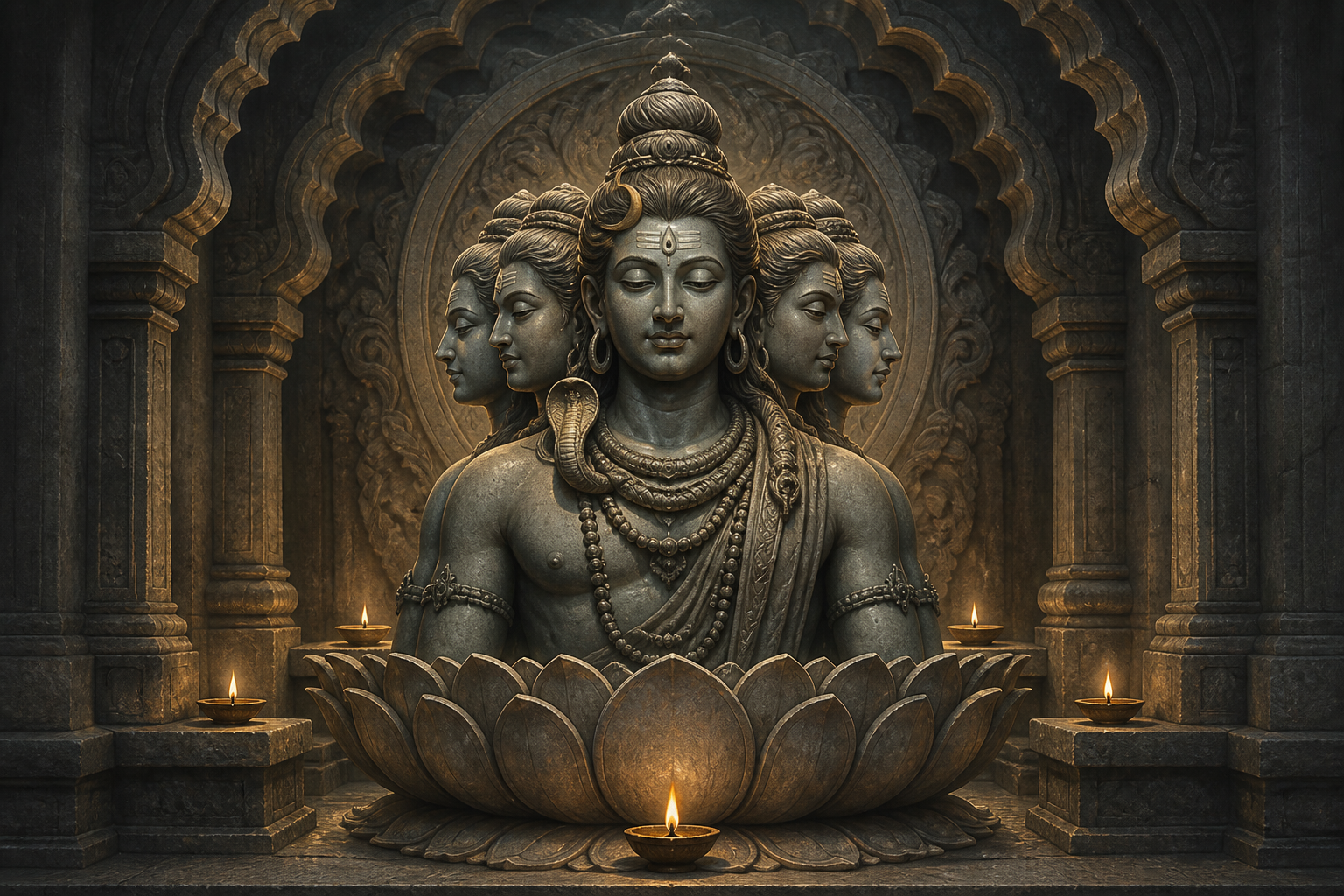
When an organ is repeated, do not translate repetition merely as more power. Ask how the number organizes reality. Hindu iconography often uses numerical anatomy to gather several functions, levels, or movements into one divine form. Multiplicity then expresses comprehensiveness rather than fragmentation.
Three trunks: several triads held in one Ganesha
The rare Trishunda form of Ganesha offers a clear example. Its three trunks can be approached through several complementary triads: the three gunas of sattva, rajas, and tamas; past, present, and future; or the three worlds. Another especially practical reading connects them with iccha-shakti, jnana-shakti, and kriya-shakti: the powers of will, knowledge, and action. The same anatomy can also evoke the three measures of AUM. These layered correspondences communicate integration and balance, not three unrelated personalities.
You do not have to declare one triad correct and all others false. Nor should you pile every possible group of three onto the image. Use the temple tradition, the deity’s name, the accompanying vahana, and the associated narrative to decide which layer is most relevant to the encounter in front of you. Where the context does not settle the question, preserve the meanings as possibilities rather than pretending to certainty.
The will-knowledge-action triad can become a compact decision discipline. Before a consequential choice, ask: What do I actually seek? What do I know rather than merely assume? What action am I prepared to take? An answer in only one or two columns exposes imbalance. Desire without understanding becomes impulse; knowledge without action remains inert; action without a clear aim scatters effort. This is a personal application of the iconographic triad, not a claim that it is the only canonical interpretation.
Five faces: a complete cycle rather than five separate deities
Panchamukha Shiva organizes divine activity through five faces: Sadyojata, Vamadeva, Aghora, Tatpurusha, and Ishana. In the Shiva Purana’s theophany before Parvati, the five faces express manifestation, preservation, dissolution, concealment, and grace. They disclose a single divine reality operating through a complete cycle.
| Face | Primary movement | Question for contemplation |
|---|---|---|
| Sadyojata | Emergence and creative potential | What needs to be brought into being? |
| Vamadeva | Preservation, beauty, and harmony | What deserves patient care? |
| Aghora | Dissolution and transformation | Which limiting form must be released? |
| Tatpurusha | Inward contemplation | What becomes visible when attention turns inward? |
| Ishana | Revelation and grace | What cannot be forced, but can be received? |
The fivefold form also corresponds with the five elements, five senses, five sheaths, and the five syllables Na-Ma-Shi-Va-Ya. These correspondences are useful only when they organize attention. Choose one coherent fivefold map for a period of contemplation. Trying to juggle every map at once turns a sacred structure into a memory exercise.
The sequence can also help you locate yourself within change. You may be trying to create something that first needs preservation, clinging to something whose form has completed its work, or attempting to control an outcome that calls for receptivity. The five faces train you to notice that dharmic action is not the same action in every phase.
Let the whole icon decide between possible meanings
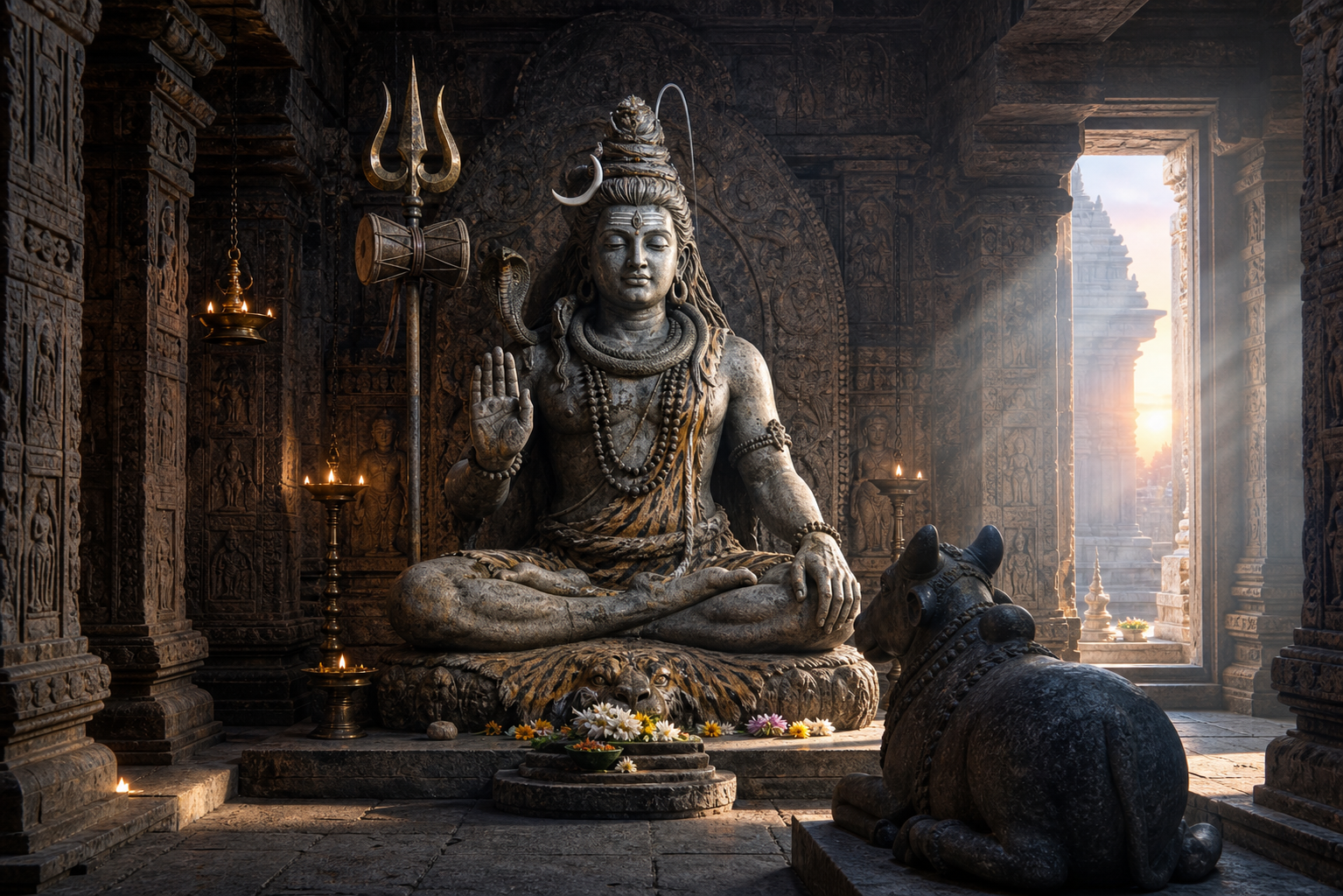
No anatomical feature stands entirely alone. A vahana, companion, name, narrative, and ritual setting can narrow or deepen its meaning. If you interpret an isolated organ while ignoring the rest of the composition, you may produce an ingenious explanation that does not belong to that form.
Trishunda Mayureshwar demonstrates why the whole matters. This Ganesha has three trunks and rides a peacock rather than the familiar mouse. The peacock brings refinement, vigilance, and radiance into the composition. It also suggests the conquest of pride and obscurity: beauty and brilliance are not rejected, but made vehicles of wisdom. Narratives linked with the Ganesha Purana and remembered in the Ashtavinayak tradition place Mayureshvara on a peacock in the defeat of the asura Sindhu. The mount and narrative therefore keep the three trunks from becoming an abstract number game.
Read the three trunks alone, and you see mastery of triads. Read them with the peacock, and the lesson becomes sharper: will, knowledge, and action must govern radiance rather than serve pride. The image asks not whether you possess ability, beauty, or confidence, but whether those qualities have become instruments of dharma.
Relationship matters just as much in Panchamukha Shiva. The five faces describe cosmic functions, but their manifestation before Parvati also affirms the inseparability of Shiva and Shakti. The anatomy does not present power as solitary. Consciousness and creative potency, wisdom and love, form and the reality beyond form belong within one theological vision.
The same principle protects the third eye from sensationalism. Yogic anatomy places insight within a larger discipline of meditation, mantra, breath regulation, moral restraint, study, service, humility, and compassion. When the organ is detached from that ethical body, the interpretation becomes distorted. The visible eye may attract attention, but the invisible disciplines tell you what kind of seeing it represents.
A useful reading sequence is therefore: anatomy, number, relationship, narrative, and ethical fruit. Anatomy tells you which human limitation is exceeded. Number shows how the capacity is organized. Relationship and narrative establish context. Ethical fruit tests whether your interpretation leads toward clarity and dharma or toward spectacle and self-importance.
Use this field method in a temple, book, or museum
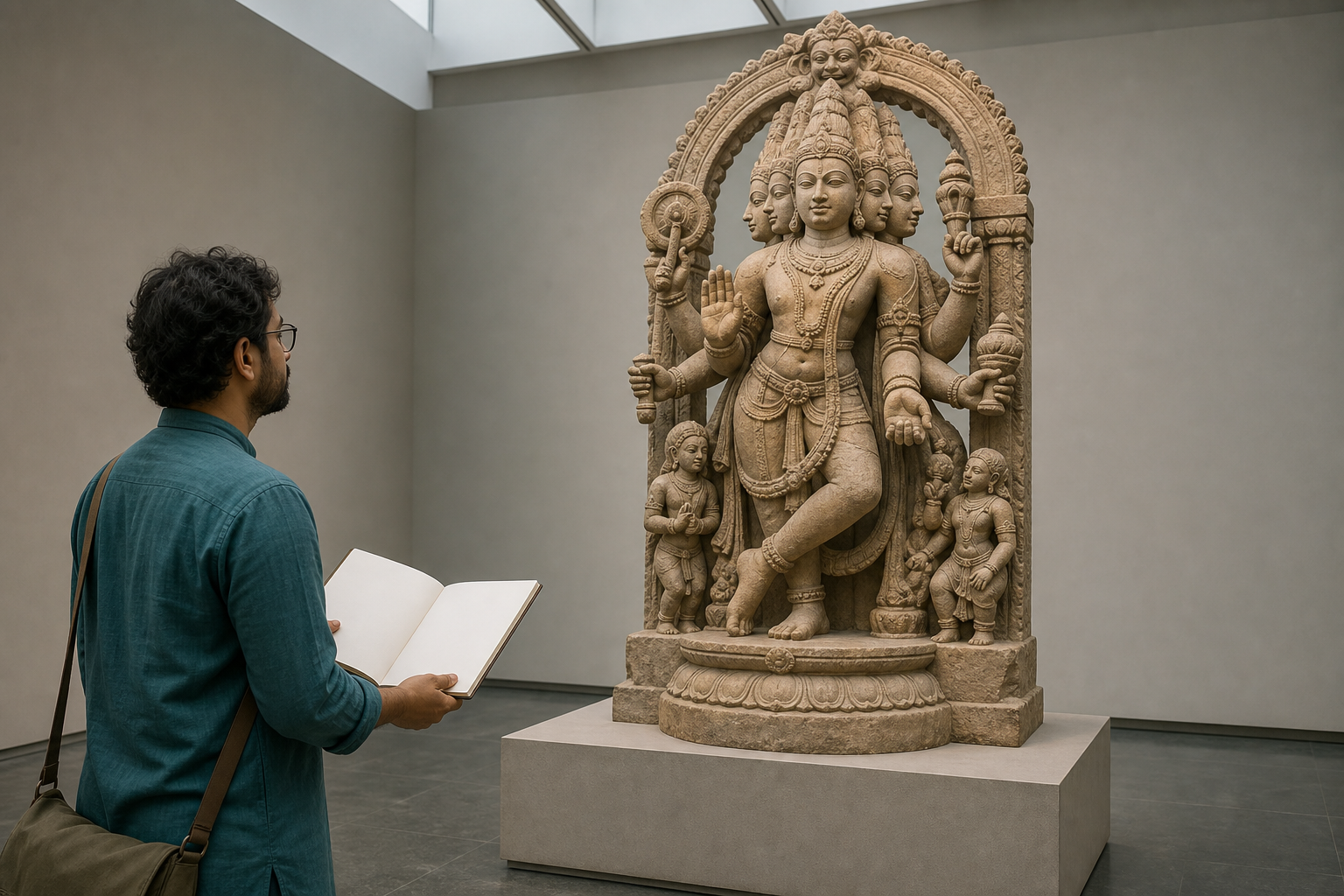
The quickest way to avoid confident nonsense is to keep three levels separate: observation, inherited interpretation, and personal application. Confusion begins when a private association is presented as though it were scriptural teaching, or when a traditional correspondence is treated as the only possible meaning in every context.
- Observe before decoding. Record only what is visible: the number of eyes, faces, or trunks; their direction; the vahana; accompanying figures; and any feature that departs from a more familiar form.
- Name the capacity of the organ. An eye concerns perception. A face concerns presence, identity, or viewpoint. A trunk acts, reaches, senses, and clears a path. This establishes the semantic field without yet fixing a final meaning.
- Look for an organizing number. Ask whether the repetition corresponds to a known triad or fivefold structure in the tradition. Do not retrofit an unrelated set merely because its number matches.
- Check the complete form. Use the deity’s specific name, mount, sacred narrative, temple tradition, and relationship with other figures. If those elements contradict your first interpretation, revise it.
- State the result at all three levels. Say what you see, identify the tradition-supported meaning, and only then name what it invites you to practise. Keep your personal reflection clearly marked as application rather than inherited doctrine.
Applied to the third eye, the three levels might read like this. Observation: an additional organ of sight is present. Traditional interpretation: it represents inner discernment rather than ordinary vision. Practice application: in conflict, I should separate fact from projection before responding.
For Trishunda Mayureshwar, the sequence could be: three trunks appear with a peacock mount; the form integrates triadic powers and brings radiance under wisdom; before acting, I should align what I want, what I understand, and what I will do.
For Panchamukha Shiva: five faces appear within one divine form; they disclose five cosmic movements while affirming unity; in my present situation, I should discern whether the dharmic task is to create, sustain, release, turn inward, or become receptive to grace.
In a temple, let this method serve darshan rather than replace it. See the whole murti first. Offer attention without immediately turning the image into an intellectual scavenger hunt. Study can follow reverence. If a local tradition gives the form a specific account, begin there instead of imposing a generalized meaning from elsewhere.
When no contextual information is available, stopping at a careful observation is better than inventing certainty. You can say that a feature appears to enlarge a divine capacity while leaving its precise sectarian or regional meaning open. Intellectual restraint is part of respectful interpretation.
Key takeaways
- Begin with the anatomical departure: identify exactly what exceeds an ordinary human or familiar divine form.
- Treat a repeated organ as an ordered structure. Ask what its number organizes rather than assuming it merely means greater power.
- Read the entire icon. A vahana, divine companion, name, and sacred narrative can decide which interpretation fits.
- Keep observation, inherited meaning, and personal application separate. A useful reflection should not be passed off as scripture.
- Test interpretation by its fruit. Clearer judgement, disciplined action, humility, and compassion fit the symbolism better than fascination with power.
The next time an unusual murti catches your eye, write three short lines: what you can see, what the form traditionally communicates, and what it asks you to practise. That small discipline turns looking into attentive darshan while leaving room for the mystery no interpretive scheme can contain.
References
- DharmaRenaissance Blog — Awaken the Third Eye: Hindu Teachings for Inner Clarity, Compassion, and Liberation
- DharmaRenaissance Blog — Trishunda Mayureshwar Ganpati, Pune: Unveiling the Three-Trunk Ganesha’s Symbolic Power
- DharmaRenaissance Blog — Shiva’s Five-Faced Epiphany before Parvati: A Sublime Vision of Wisdom, Love, and Dharma
