
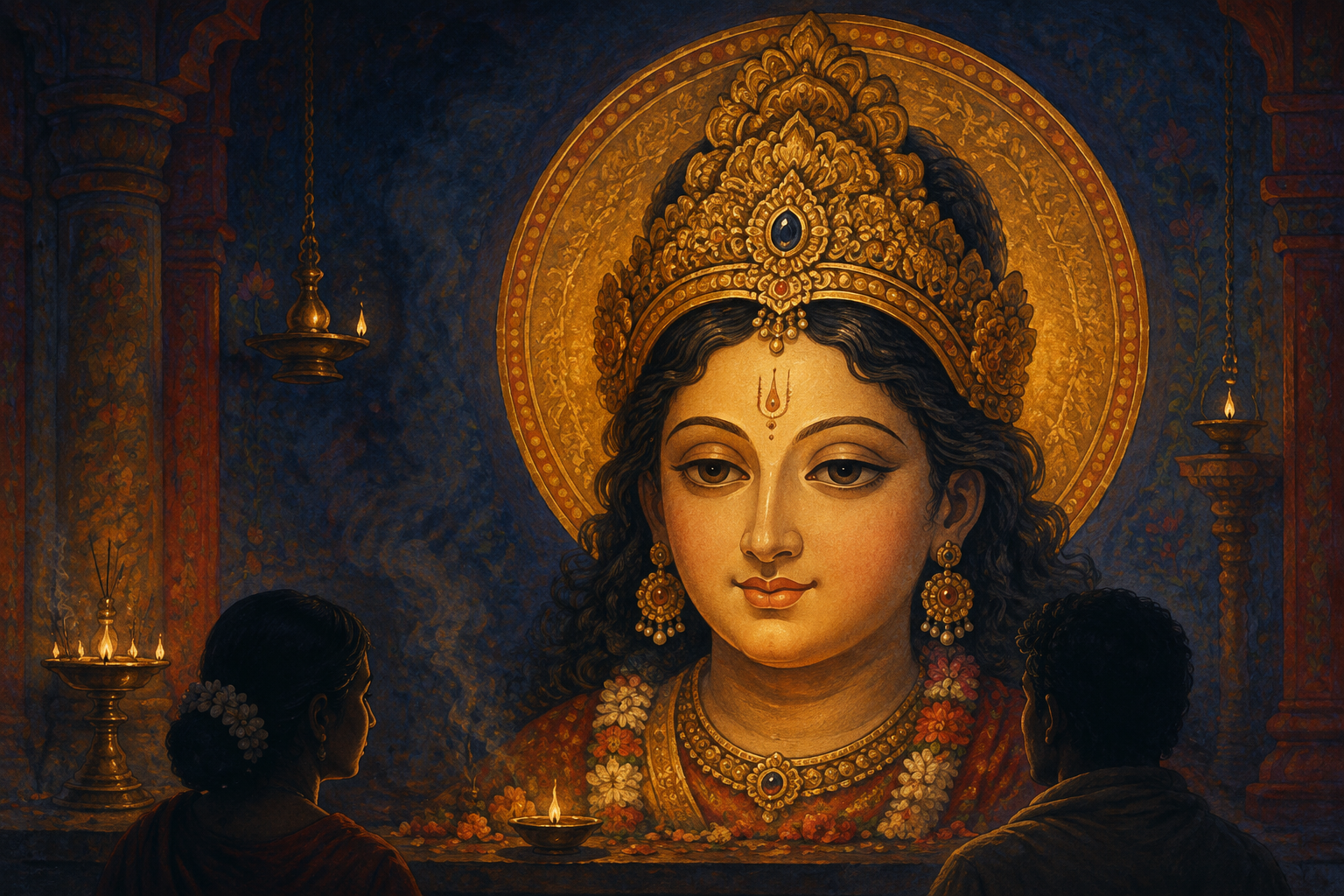
You recognize the deity’s face, yet something around the head resists quick reading. Is it hair, a crown, flame, ornament, or a radiance behind the figure? If you guess too quickly, you can turn a sacred image into either a costume study or a rigid symbol puzzle.
A better approach begins with what is visibly present, then asks how the feature shapes your attention, and only then considers what it may mean in that particular devotional setting. This method will help you look more carefully at a murti, temple sculpture, painting, calendar image, or newly commissioned work without pretending that every form has one context-free translation.
Decide what kind of seeing the image asks from you
Before decoding the head, separate three questions that are often collapsed into one:
- What can you actually see?
- What does that feature do to the composition and to your attention?
- What might it signify in this deity’s form, tradition, narrative, and place of worship?
The first is observation. The second is aesthetic judgment. The third is interpretation. Keeping them separate prevents an attractive guess from hardening into an alleged iconographic rule.
You should also distinguish iconographic identification from darshan. Iconography helps you recognize attributes and forms. Darshan is a devotional encounter, not merely an exercise in identifying visual data. A worshipper may dwell on a feature because it discloses beauty, tenderness, majesty, protection, or overwhelming energy, even when that feature does not function as a simple label.
This distinction is especially important when the detail seems small. In devotion to Sri Radha, the forehead itself can become a stimulus for ecstatic love. Its devotional force does not depend on being the largest or most unusual element in the image.
When you first meet an image, therefore, delay the glossary. Form a plain description before assigning meaning: the hair rises; the forehead is open and luminous; an ornament sits above the brow; a circular field appears behind the head. That one discipline will improve every interpretation that follows.
Read the head from the face outward
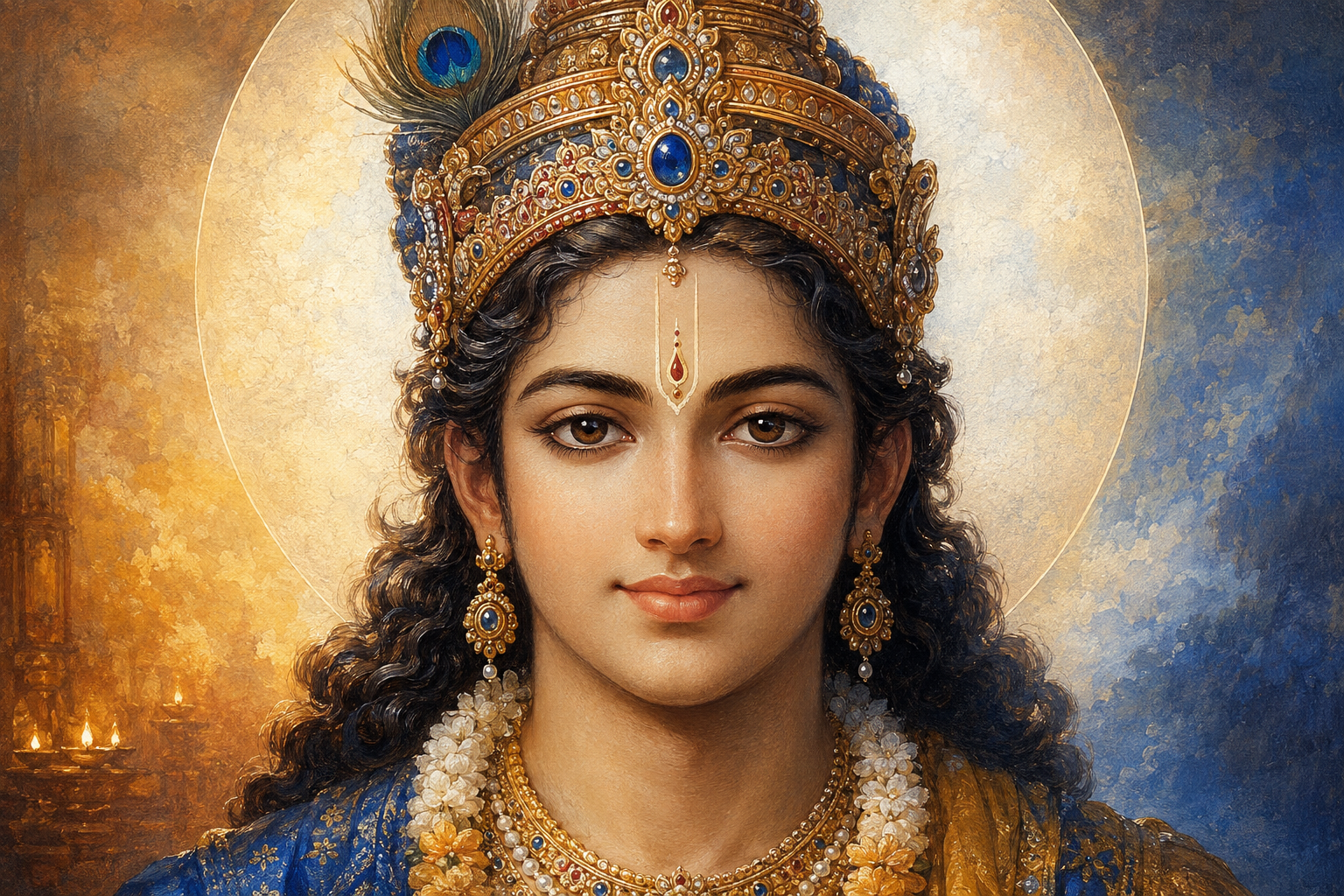
The head is not one undivided symbol. Read it as a set of related zones. Moving from the face outward makes it easier to distinguish anatomy, adornment, headdress, energy, and background.
- Face and gaze: Notice whether the expression settles your attention, confronts it, redirects it, or remains deliberately difficult to read. Do not infer a complete theology from facial expression alone.
- Brow and forehead: Look at width, contour, color, marks, jewels, tilaka, and the relationship between the forehead and the eyes. Record what is present rather than filling in what you expected to find.
- Hair: Follow the strands from the hairline. Are they bound, loose, piled, flowing with gravity, rising against it, or transforming into another kind of shape?
- Crown or head covering: Look for construction. Repeated bands, tiers, borders, inset forms, and balanced ornament usually behave visually like something made or worn.
- Surrounding field: Determine whether a disc, ring, arch, or radiating area belongs behind the head rather than growing from it. A background radiance and flame-shaped hair can occupy similar space without being the same motif.
Then ask how the zones interact. A high crown can make the figure feel vertically ordered. Loose or outward-moving hair can break that order. A quiet forehead can become the visual resting place between an elaborate headdress and an expressive gaze. The meaning is not located only in the object; it also arises from the relationship among the parts.
A useful classification is body, adornment, energy, and field. Organic strands point toward hair. Repeated crafted patterns point toward an ornament or crown. Forms that seem to exceed ordinary gravity may depict an intensified bodily feature, an emanation of force, or both. A disc or radiance that continues behind the silhouette belongs more naturally to the surrounding field. These categories are prompts, not sealed boxes: Hindu sacred imagery can intentionally join body and divine power in one form.
If a carving is weathered, photographed from an angle, partially concealed, or separated from its original setting, lower your confidence. Missing edges can make a crown resemble flame, while a shallow background field can appear attached to the hair. Uncertainty is part of careful looking, not a failure of it.
Recognize Jwala Kesha without reducing it to anger

Jwala Kesha means flame-hair and is also called Agni Kesha. In this convention, the deity’s locks rise upward or spread outward in tongue-shaped forms resembling leaping flames. It is hair represented through the visual behavior of fire.
The first thing to notice is direction. Ordinary loose hair tends to descend. Jwala Kesha rejects that expectation. Upward movement gives the head lift and intensity; outward movement expands the deity’s presence beyond the stable outline of the body. Repeated flame tips also create a sharp rhythm around the face. You can see the fierce register before deciding exactly how it functions in a particular image.
Do not translate fierceness directly into evil, uncontrolled temper, or hostility toward the devotee. Fierce appearance and moral malevolence are not equivalent categories. Flame can invite associations with heat, illumination, consuming force, purification, or transformation, but those are interpretive possibilities rather than a universal glossary. The deity’s identity, posture, other attributes, narrative setting, and ritual context must decide which associations are warranted.
To distinguish Jwala Kesha from neighboring forms, trace the contour instead of relying on an overall impression:
- If the pointed forms originate where locks would begin and repeatedly behave like animated strands, flame-hair is a strong reading.
- If a continuous disc or patterned field remains behind the head, you may be looking at a halo or surrounding radiance.
- If the form is tiered, symmetrical, and constructed from repeated ornamental units, test the possibility of a crown.
- If hair, flame, and crown appear to merge, describe that merger before forcing the image into only one category.
A responsible note would say that flame-shaped locks intensify the figure and may express a fierce divine presence. An irresponsible note would declare that flame-hair always means one emotion or doctrine. The first statement preserves what the image visibly supports; the second outruns it.
Let Sri Radha’s forehead teach you the intimate scale
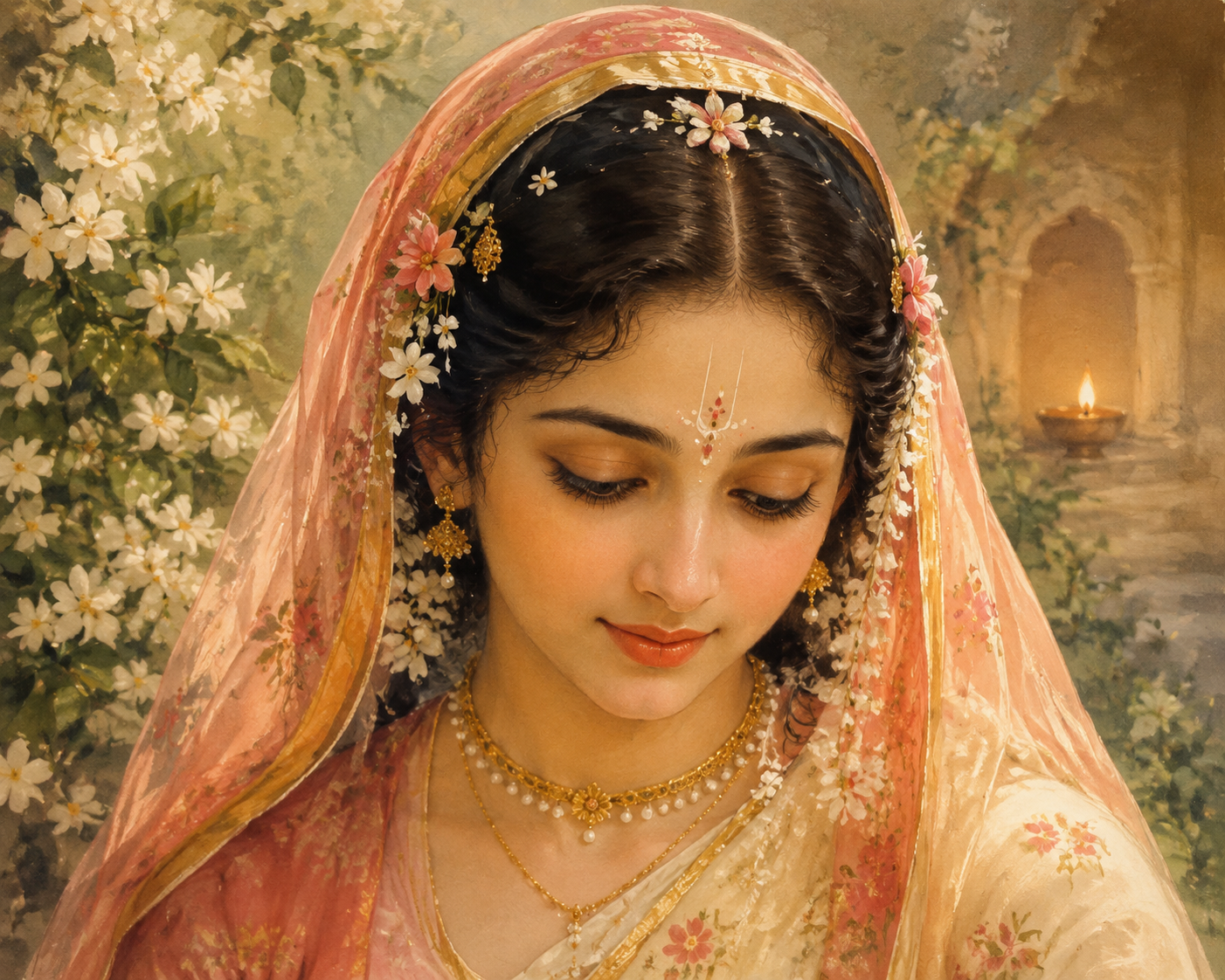
Not all divine head imagery announces itself through height, fire, or an elaborate crown. The forehead of Sri Radha shows how devotional aesthetics can work through intimacy. A feature that looks secondary to a hurried observer may become central when loving attention rests upon it.
Here the useful question is not merely, What symbol is placed on the forehead? Ask how the forehead frames the eyes and brows, meets the hairline, receives color or ornament, and gives the face visual openness. A bare surface, a centered mark, a jewel, and a change in color would affect attention differently. Describe the actual representation in front of you; do not import a detail from another image of the same divine person.
This kind of looking corrects a common imbalance. Modern viewers often grant theological importance to weapons, multiple arms, crowns, and spectacular emanations while treating beauty as decoration. Bhakti does not require that hierarchy. The beloved form can disclose itself through proportion, softness, luminosity, adornment, or the contemplative attention given to one feature.
At the same time, a devotional meditation on one forehead should not be turned into a rule for every image of Sri Radha. It demonstrates how concentrated love can inhabit a detail; it does not eliminate variation among artists, communities, media, or devotional settings. Preserve the difference between the power of a particular contemplation and a general claim about iconography.
Jwala Kesha and Sri Radha’s forehead therefore train two complementary habits of sight. One asks you to follow force as it moves beyond the head. The other asks you to remain with a quiet feature until its relational beauty becomes perceptible. Divine head imagery can project presence outward or gather attention inward. You need to determine which movement the image in front of you is making.
Use context to turn close looking into a sound interpretation
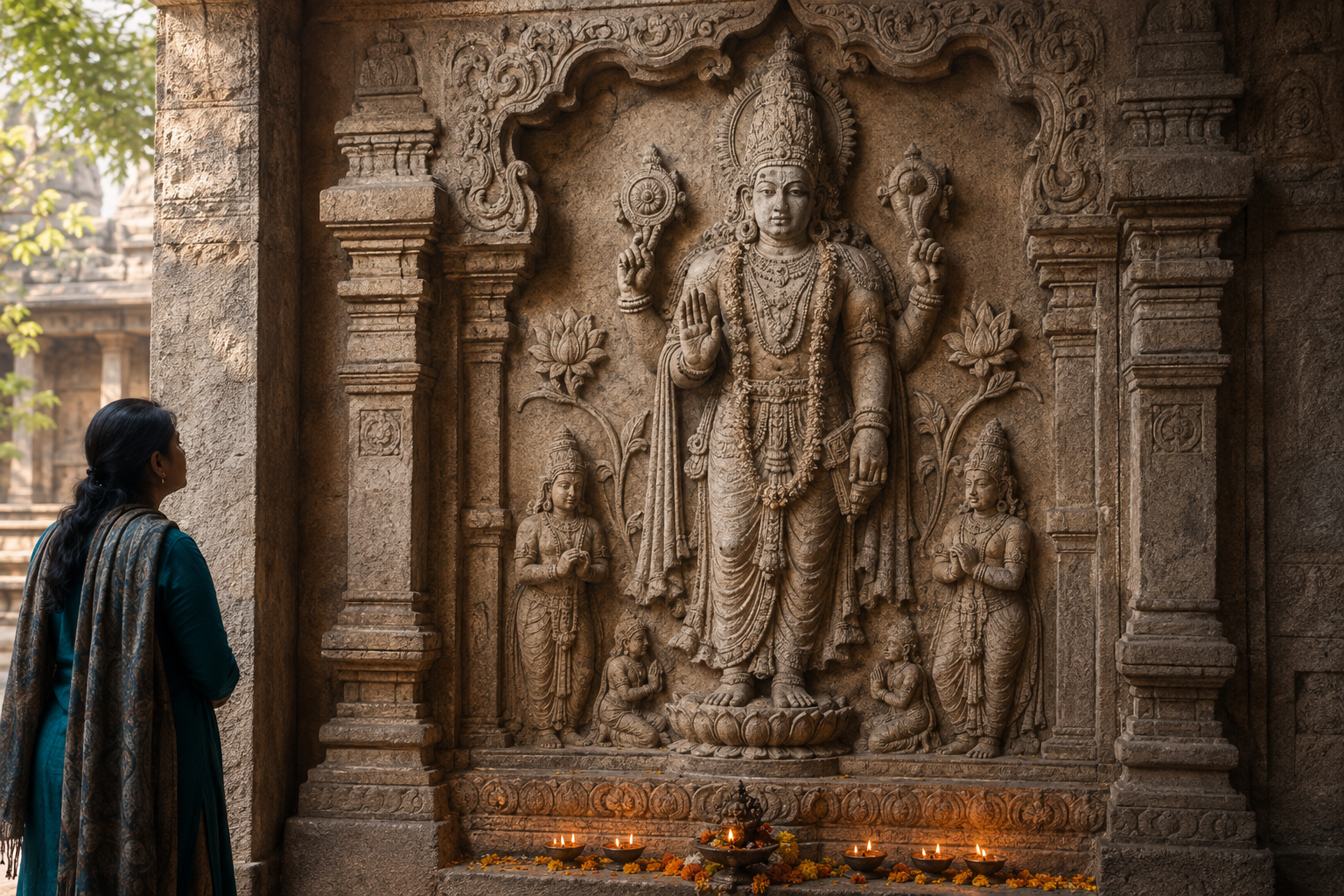
Visual resemblance begins an interpretation; it does not finish one. Before you publish a caption, teach a class, commission an image, or repeat a symbolic claim, identify the context that can confirm or limit your reading.
Misreadings to rule out
- The one-motif, one-meaning error: The same visual family can perform differently across divine forms and traditions. State an association as a possibility until the local context supports more.
- The crown-everything error: Separate hair, flame, headdress, ornament, and background radiance by following their points of origin and material behavior.
- The mood-equals-morality error: Do not treat a fierce visual register as proof that a deity is malevolent. Read expression and energy within the sacred form’s identity and purpose.
- The caption-without-context error: A confident internet label cannot supply a missing date, region, tradition, deity, or ritual setting. If those facts are absent, disclose the limit.
- The sterile-decoding error: Correct terminology does not exhaust devotional meaning. After identifying a motif, return to what it does to attention, relationship, and worship.
A repeatable method for viewing or documenting an image
- Observe before naming. Write a literal description of direction, shape, symmetry, color, texture, and placement.
- Map the zones. Separate face, forehead, hair, headdress, and surrounding field. Note where one zone appears to merge with another.
- Classify provisionally. Ask whether each feature behaves like body, adornment, energy, background, or a deliberate combination.
- Read the whole form. Test your interpretation against the deity’s identity, expression, posture, accompanying attributes, and narrative setting.
- Verify locally. Consult the temple tradition, lineage-based explanation, catalogue record, or knowledgeable custodian connected with the image. Record what remains uncertain.
- Return to devotional function. Ask whether the feature steadies attention, intensifies presence, evokes intimacy, communicates majesty, or marks a fierce mode. Use the answer as an aesthetic observation, not as an unsupported universal doctrine.
For your notes, use four short fields: observed feature; probable identification; context supporting the reading; confidence and unresolved questions. This format makes the boundary between sight and inference visible. It is especially useful when several people are cataloguing objects or preparing captions together.
If you are commissioning sacred art for worship, add another checkpoint before approving the head. Confirm the precise divine form, the tradition in which it will be worshipped, the intended ritual setting, and the convention your temple or lineage expects. A visually impressive head treatment is not automatically appropriate merely because it appears elsewhere in Hindu art.
Key takeaways
- Describe a head feature before assigning it a symbolic meaning.
- Read the face, forehead, hair, crown, and surrounding field as related but distinguishable zones.
- Jwala Kesha depicts locks behaving like flame; its fierce intensity should not be reduced to ordinary anger or malevolence.
- Sri Radha’s forehead shows that a quiet bodily feature can carry profound devotional attention without functioning as a fixed code.
- Use deity, tradition, narrative, medium, and worship context to confirm or limit an interpretation.
At the next murti or sacred image you encounter, choose one feature of the head and follow it carefully from visible form to devotional effect. Do not rush to solve it. Let precise observation carry you far enough that reverence and understanding begin to support each other.
References
- Dandavats – Stimulation for Ecstatic Love Part 194 – Sri Radha’s Forehead
- Hindu Blog – Jwala Kesha: The Flame-Crown of the Fierce Divine in Hindu Sculpture
