
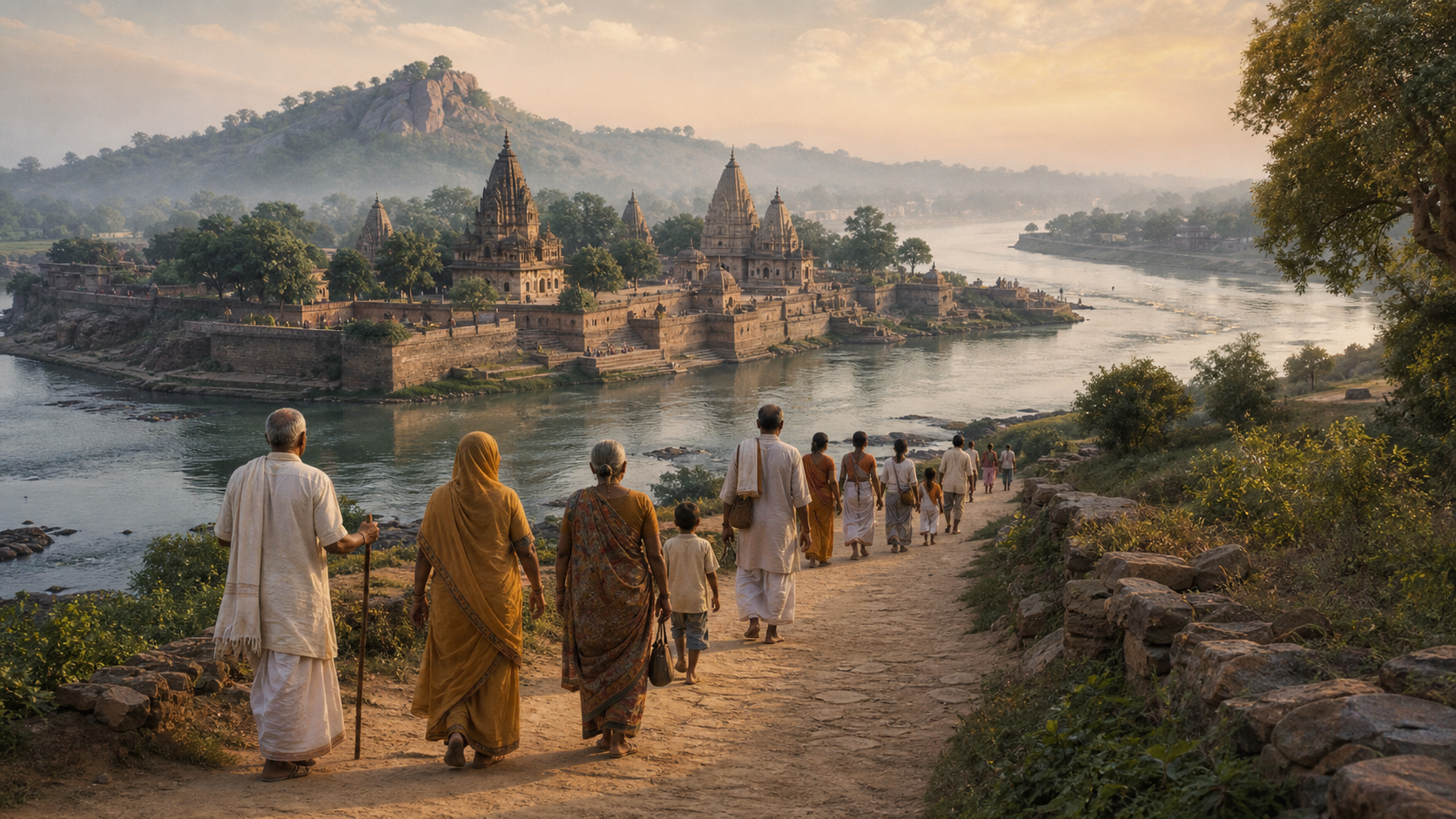
Pilgrimage makes a distinctive claim about place: a hill, river island, temple street or dusty path can be encountered as more than terrain. That claim becomes intelligible when geography is considered together with the bodies, narratives and communities that continually approach it.
An account of dandavats parikrama examines sacred geography at the scale of each prostration, while an account of Srirangam presents an island temple-town shaped by rivers, enclosures, worship and inherited memory. Read together, they show that a tirtha is not simply found on a map. It is made experientially present through movement, attention, discipline and shared custodianship.
Key takeaways
- Sacred geography is relational: place, story, ritual practice and community give meaning to one another.
- The manner of movement matters. Prostrating, circumambulating, entering successive enclosures and waiting for darshan each produce a different understanding of sacred space.
- The body is not merely transportation for the mind; touch, fatigue, sound, pace and posture can become forms of religious knowledge.
- Austerity should not be confused with recklessness. Intention, capacity, preparation and care remain part of responsible practice.
Two geometries of devotion: circling and entering
Parikrama organizes movement around a sacred center. In the form described by the dandavats account, the pilgrim lies flat in full-body prostration, marks the point reached by the fingertips, moves to that point and repeats the act. The route is therefore measured through successive offerings of the body rather than through ordinary steps. At Govardhan, the account connects this circular movement with the devotional memory of Krishna lifting the hill to shelter the people of Vraja. The landscape remains physically present as hill, stone, dust and pathway, yet the remembered narrative determines how those features are approached.
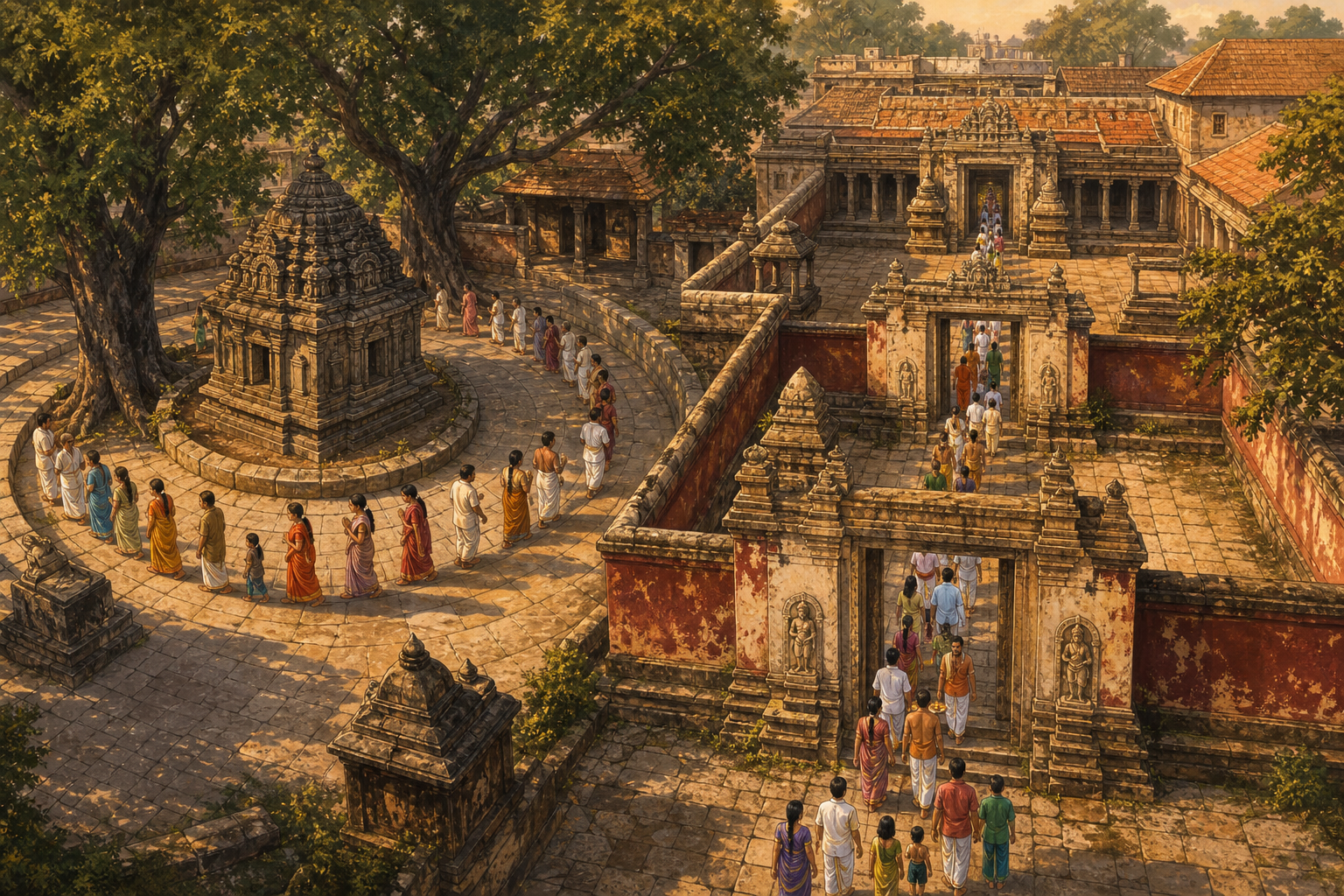
Srirangam gives sacred movement a different geometry. The source describes the Sri Ranganathaswamy temple-town on an island between the Kaveri and Kollidam rivers and reports that its complex is organized through seven concentric enclosures. Movement toward the reclining Ranganatha passes through spaces of residence, commerce, preparation and worship before reaching the sanctum. The account interprets these enclosures as more than architectural boundaries: they stage an inward passage from the everyday world toward an increasingly concentrated encounter with the divine.
The circular route and the nested temple are not interchangeable forms. One repeatedly reorients the pilgrim around a center; the other makes the pilgrim cross a succession of thresholds. Their shared principle is decentering. The sacred presence, rather than the traveler’s convenience or viewpoint, determines direction, pace and sequence. Geography consequently becomes theological without ceasing to be material.
The body turns distance into spiritual knowledge
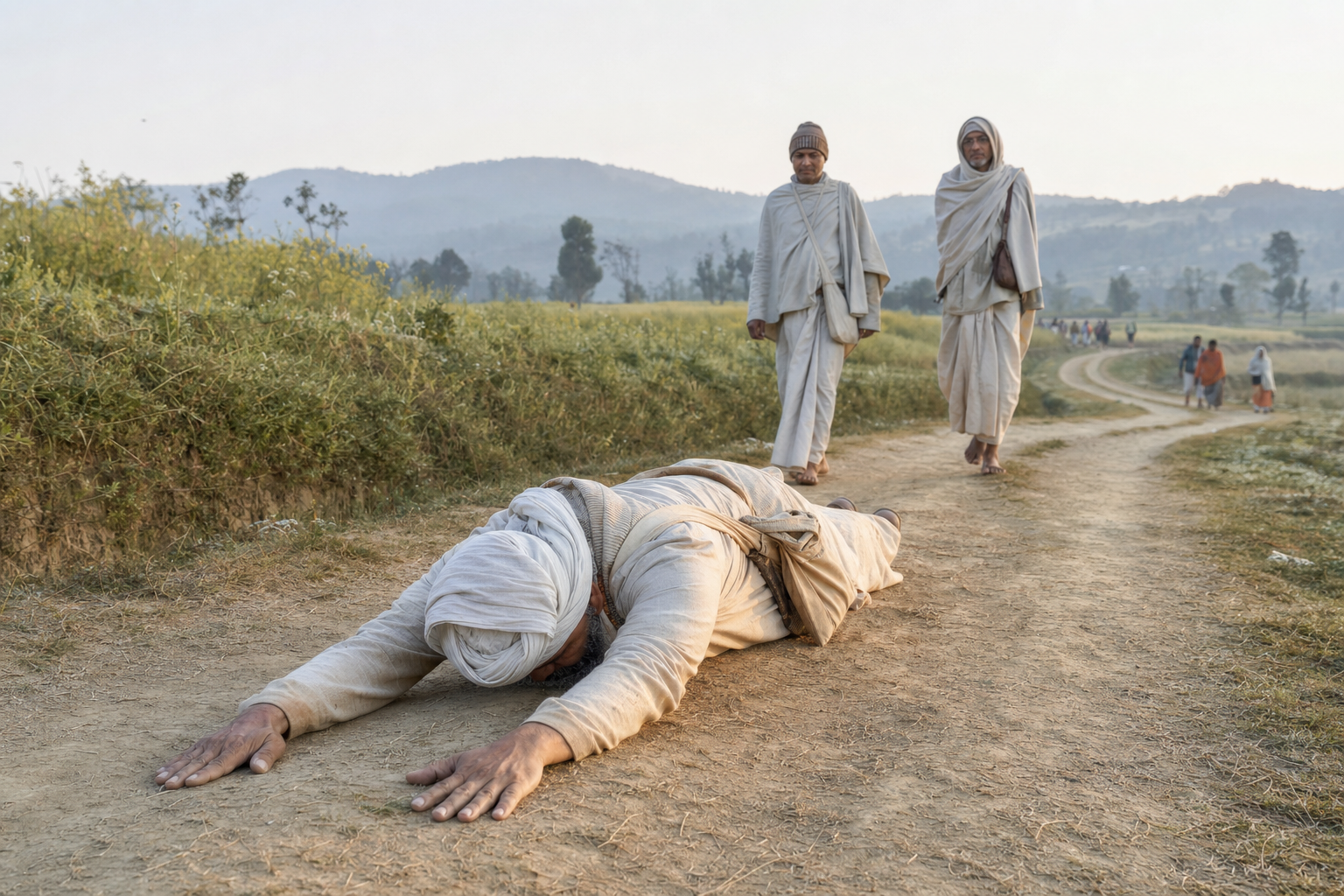
The dandavats account offers the clearest example of the body becoming a medium of interpretation. A distance that might otherwise be covered quickly is broken into prostration, rising, marking and advancing. The source recalls aching knees, measured breathing, dust-covered clothing, changing ground temperatures and water offered by others. Such details are not incidental travel color. They explain how the pilgrim learns the route through direct contact and repetition.
Srirangam embodies pilgrimage less dramatically but no less meaningfully. Its account describes transport uncertainty, heat, walking through the temple complex, joining a queue and waiting with pilgrims from different regions and backgrounds. Chanting, temple activity and the gradual approach to darshan form part of the experience. Here the body learns through anticipation and restraint: it cannot command immediate access but must accept sequence, proximity to others and the discipline of waiting.
Both accounts therefore challenge the idea that religious knowledge is confined to belief or explanation. The prostrating pilgrim knows distance through effort; the temple pilgrim knows a threshold by crossing it and knows anticipation by waiting. The body does not merely illustrate an idea already understood. Its posture, pace and vulnerability help produce the understanding.
This also clarifies the role of slowness. In dandavats parikrama, slowness is intentionally built into every unit of progress. At Srirangam, it emerges through approach, enclosure and queue. In both settings, delay can expose impatience and the desire to control the encounter. Yet the sources do not imply that inconvenience automatically becomes holy. Slowness acquires devotional meaning when it is joined to attention, intention and an orientation toward the sacred center.
Story, ecology and community keep a tirtha alive
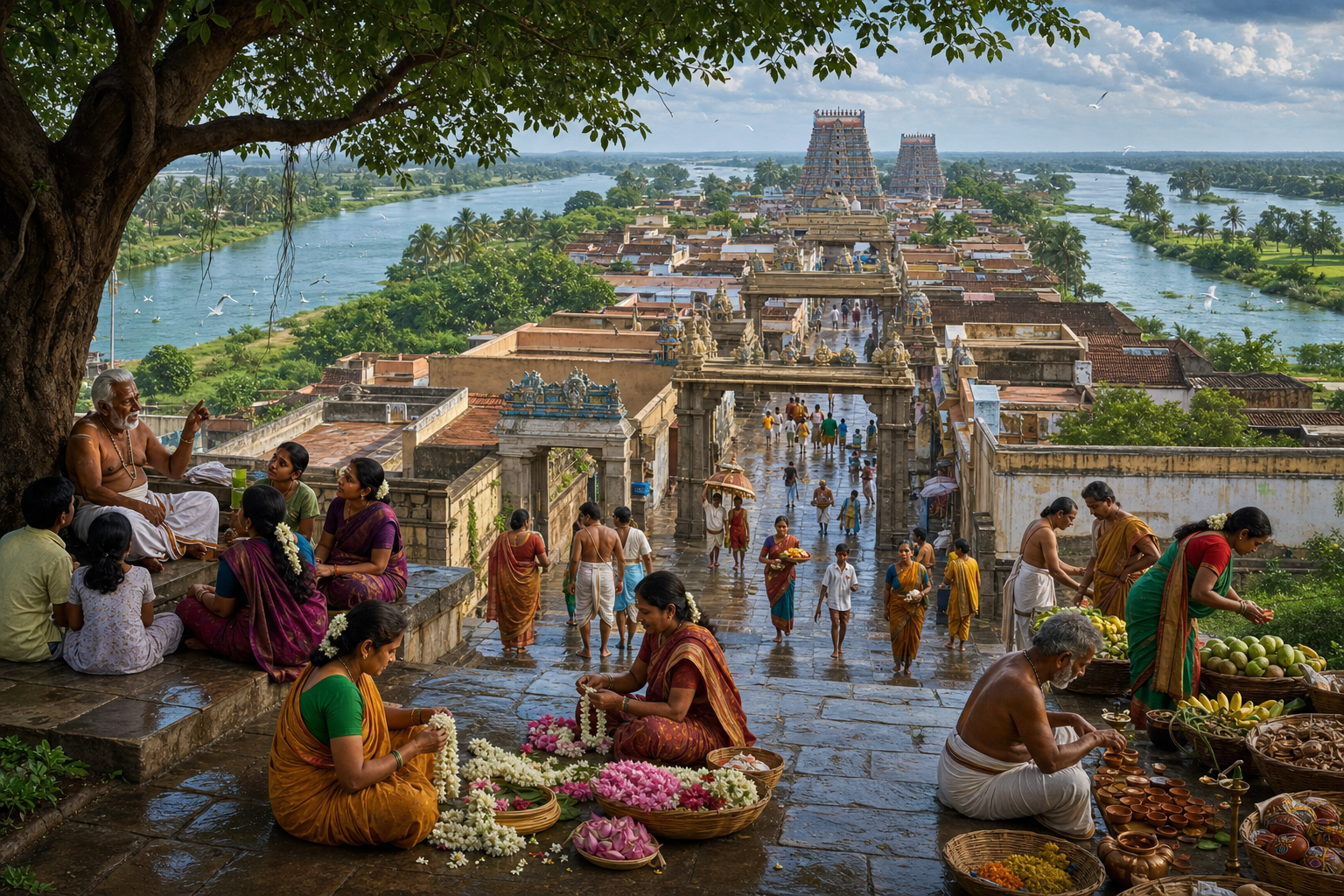
Sacred geography depends on remembered narratives, but the two sources show that memory works through different media. The Govardhan account situates trees, ponds, village paths, stones, dust, shrines and temple sounds within Krishna-centered devotional memory. The Srirangam account reports a temple tradition connecting Ranganatha with the Ikshvaku lineage, Sri Rama and Vibhishana, while the island’s rivers and built enclosures give that tradition a particular spatial form.
These theological narratives should not be silently converted into modern historical claims. Their immediate significance in the source accounts is devotional and interpretive: they tell pilgrims where they are, whom they are approaching and why a particular route or site matters. Narrative makes the landscape legible, while repeated pilgrimage gives narrative a physical setting in which it can be enacted.
The two places also preserve memory on different scales. Around Govardhan, the account emphasizes a sacred ecology encountered at ground level. At Srirangam, the source presents a layered temple organism of shrines, processional routes, inscriptions, mandapas and enclosures developed through the work of rulers, teachers, artisans, administrators and devotees. One landscape is remembered through repeated bodily contact with a route; the other is also articulated through monumental architecture and an inhabited temple-town. Neither, however, is presented as an inert relic.
Community makes that continuity possible. The dandavats article mentions people who chant nearby, guide newcomers, maintain paths or offer water. The Srirangam article describes temple staff, residents, recitation, festivals and pilgrims sharing the discipline of entry and waiting. Although devotion may be inwardly personal, its material conditions are collective. Paths must remain passable, rituals must be transmitted, sacred spaces must be served and newcomers must learn how to participate.
Approaching embodied pilgrimage without romanticizing hardship
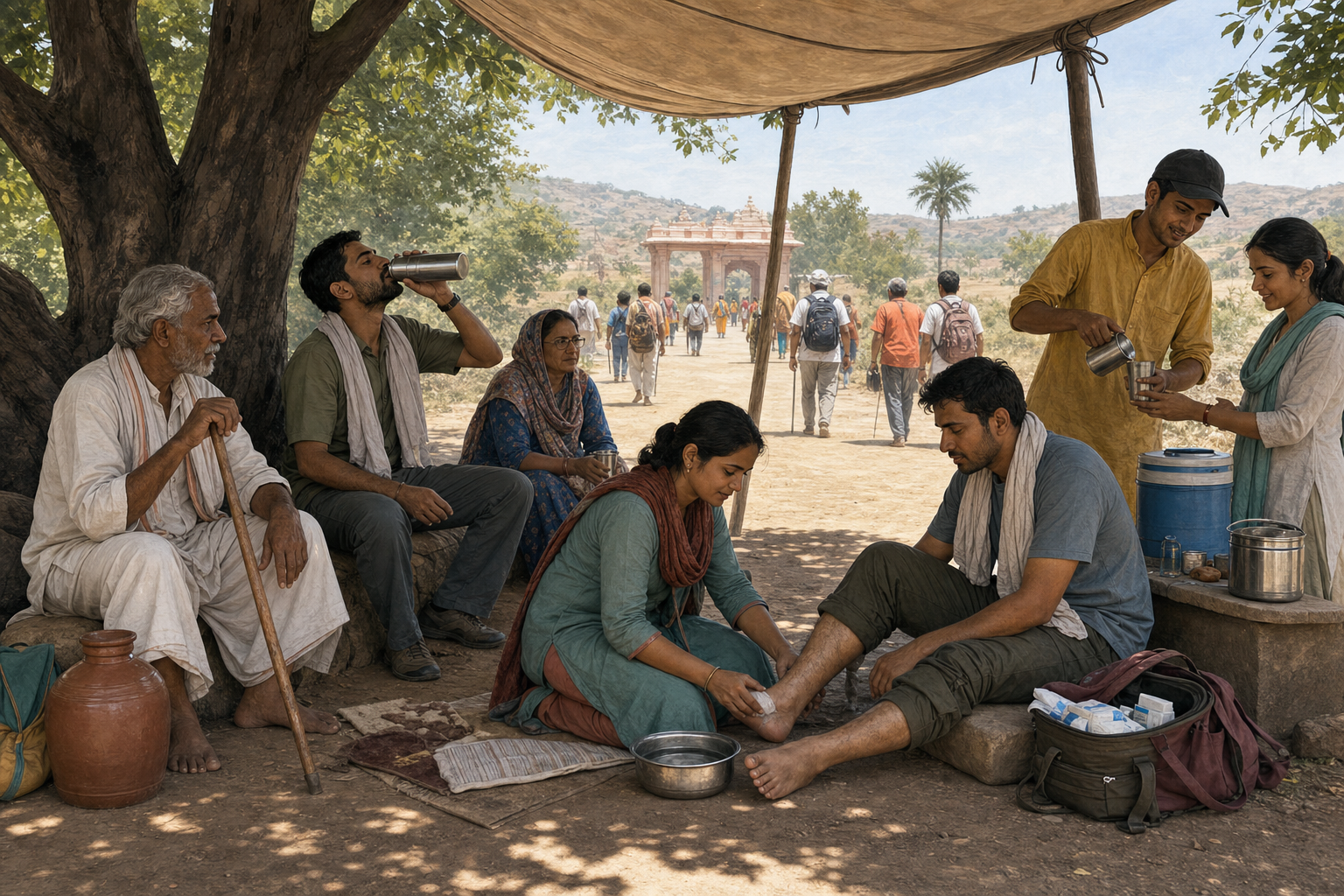
The intensity of dandavats parikrama can invite admiration, but the source explicitly warns against careless romanticization. It identifies hydration, seasonal conditions, cleanliness, suitable clothing and the state of the route as practical considerations. It also notes that older people, injured pilgrims and those with medical concerns may require modified participation, invoking the dharmic importance of intention, capacity and adhikara.
This qualification matters for interpreting embodied religion more broadly. Difficulty can serve as tapas when it reveals impatience, pride or the desire for recognition, as the dandavats account argues. Preventable injury, coercion or disregard for bodily limits is a different matter. A modified practice need not represent weaker devotion when it preserves the underlying orientation of reverence and surrender.
The Srirangam narrative adds another caution. Its author retrospectively understands a redirected journey, transport confusion and other ordinary disruptions within a pattern of grace. That devotional reading gives contingency meaning, but it does not erase the practical reality of buses, language, heat or queues. Embodied pilgrimage holds both dimensions together: material conditions must be managed, while the pilgrim remains open to meanings that an efficient itinerary cannot fully predetermine.
A responsible reading of sacred geography therefore asks several connected questions. What presence organizes the route? How does the chosen form of movement cultivate attention? Which stories enable the place to be recognized as sacred? Which communities and forms of labor sustain access? Does the practice suit the participant’s actual capacity? These questions distinguish meaningful embodiment from hardship pursued for display.
For future pilgrims and custodians, the task is to preserve more than destinations. Safe access, living ritual, ecological attentiveness and intergenerational memory must remain connected, so that sacred geography continues to be encountered as a relationship rather than consumed as scenery.
References
- DharmaRenaissance Blog – Dandavats Parikrama Memories: Powerful Lessons in Devotion, Endurance, and Sacred Humility
- Indica Today – Srirangam’s Sacred Power: Ranganathaswamy, Ramanujacharya and Living Bhakti