
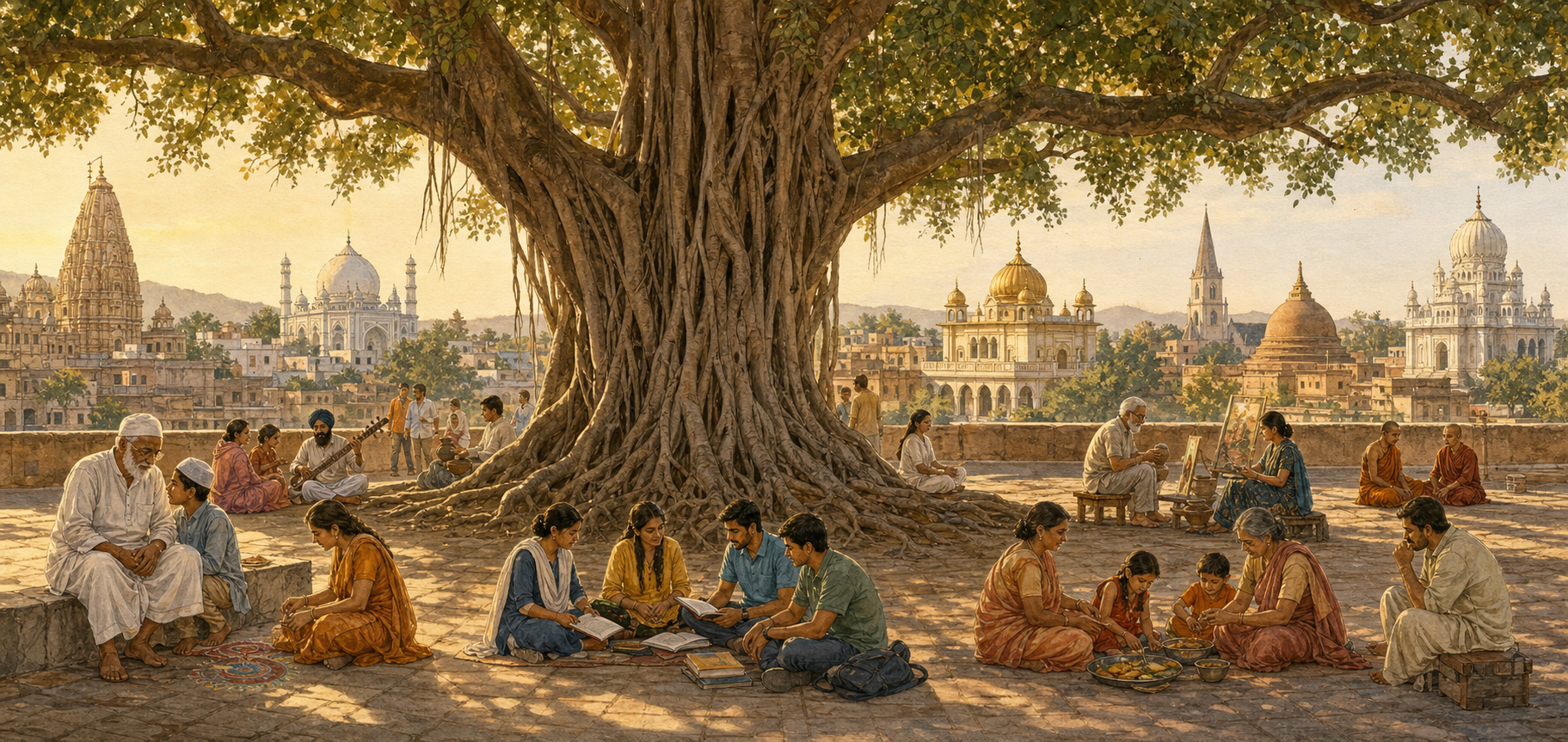
Someone in your family, campus group, or public forum says that every person rooted in Bharat is Hindu. Another person hears an attempt to overwrite Muslim, Christian, Buddhist, Jain, or Sikh identity. If you want to defend Hindu civilization without turning the conversation into a loyalty test, the argument can appear trapped between surrender and overreach.
It isn’t. The way through is to separate religious identity, civilizational inheritance, and civic belonging. Once you keep those layers distinct, you can affirm Bharat’s Hindu civilizational character, invite every community to help preserve it, and still leave each person free to name and practise their own religion.
First identify which layer of identity is being discussed
Most disputes about this subject begin with one word doing three jobs. Hindu may name a religion, a broad civilization, or a proposed national-cultural identity. A speaker moves from one meaning to another without warning, and a listener answers a claim that was never clearly stated.
Before you agree or object, ask what kind of belonging is at issue:
| Layer | The question it answers | Useful language | Necessary boundary |
|---|---|---|---|
| Religious identity | What faith, path, or community do you profess? | Hindu, Buddhist, Jain, Sikh, Muslim, Christian, or another self-description | No civilizational theory should cancel a person’s religious self-identification. |
| Civilizational belonging | Which inherited memories, places, customs, languages, and public traditions do you help carry? | Bharatiya civilization; Hindu civilization in an explicitly broad cultural usage | Participation in a civilization does not require assent to one theology. |
| Civic belonging | To which political community do you belong as an equal citizen? | Indian or Bharatiya | Civic equality cannot depend on adopting a religious label or demonstrating cultural enthusiasm. |
One prominent formulation, associated with RSS chief Mohan Bhagwat, treats Bharat and Hindu as synonymous and extends Hindu in a cultural sense to Muslims and Christians who honor the country’s civilizational legacy. That formulation has two possible readings. It can invite every community to share guardianship of a common home. It can also sound as though one group has the authority to rename everyone else. The difference is not cosmetic. It determines whether the thesis produces affiliation or resentment.
The clean rule is that no layer silently overrides another. A Muslim or Christian can belong to Bharat civically, participate deeply in its culture, and remain Muslim or Christian confessionally. A Buddhist, Jain, or Sikh can recognize a shared civilizational field without accepting that the name of another religion replaces the community’s own name. A Hindu can affirm this plurality without abandoning the specifically Hindu meaning of Hindu.
This distinction does not weaken the shared-culture thesis. It makes the thesis coherent. It tells you what is being shared, what remains distinct, and what no speaker is entitled to confiscate.
Shared culture is learned participation, not biological sameness
The phrase same DNA is rhetorically powerful because it conveys inheritance, kinship, and continuity in two words. It is also easy to misuse. A claim about shared civilization is a claim about historical memory and cultural formation, not a biological test of authentic belonging. The inclusive interpretation therefore treats same DNA as a metaphor for civilizational origins and participation, not as a scientific classification of citizens.
You can test the language by replacing same DNA with shared inheritance. If the claim still makes sense, it is probably cultural: people inherit overlapping memories, institutions, sacred geographies, social habits, artistic forms, and ways of arguing about ultimate questions. If the claim depends on ancestry, purity, or blood, it has left the civilizational argument behind.
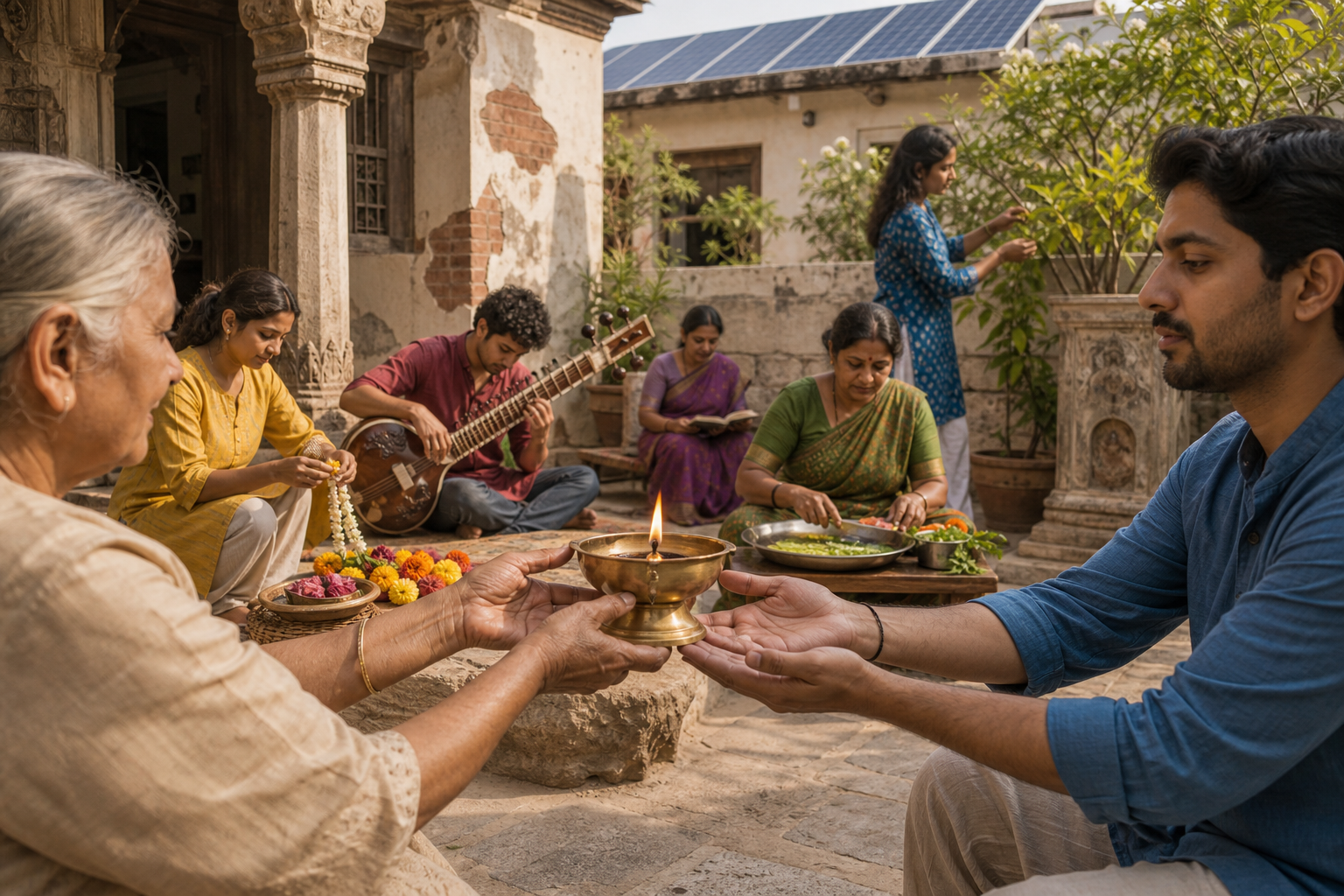
Culture is better recognized through verbs than labels. People learn a language, preserve a monument, join a festival, feed a neighbor, study a philosophical tradition, protect another community’s sacred place, or transmit a story. None of those acts requires identical worship. They show participation in a common world.
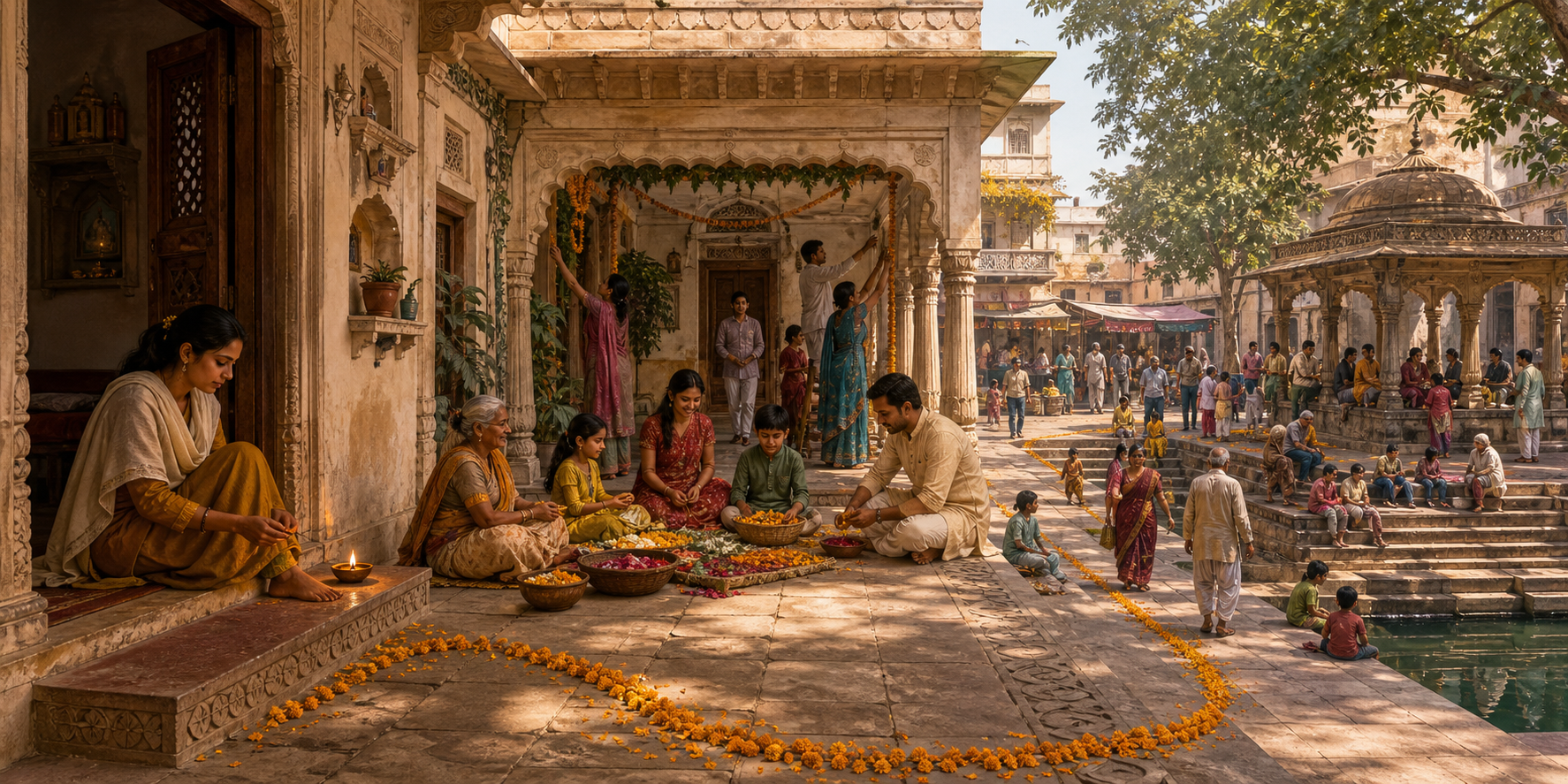
The ordinary examples are often more convincing than slogans. Neighbors may exchange prasad and seviyan. Colleagues may support langar, iftar, or annadanam. Students can encounter Nalanda, Kashi, Amritsar, and Bodh Gaya as parts of one civilizational landscape without pretending that the sites have identical religious meanings. The shared element is not a blended creed. It is the habit of recognizing each place and practice as part of the inheritance for which the wider society bears responsibility.
This is especially important within the dharmic family itself. Hindu, Buddhist, Jain, and Sikh traditions cannot be reduced to interchangeable doctrines. They contain distinctive scriptures, authorities, disciplines, histories, and understandings of liberation. Their civilizational relationship becomes more credible when those differences are stated accurately. Unity that survives precise description is stronger than unity produced by vague language.
The cultural umbrella needs three non-negotiable boundaries
An umbrella is useful because it covers distinct things. If it dissolves every distinction beneath it, it is no longer an umbrella; it is an instrument of absorption. Three boundaries keep the shared-culture thesis inclusive and recognizably dharmic.
Religious self-description remains with the person
You may invite someone to recognize a shared civilization. You cannot make that person’s religious identity conditional on accepting your vocabulary. If a Sikh identifies as Sikh, a Jain as Jain, a Buddhist as Buddhist, a Muslim as Muslim, or a Christian as Christian, a cultural thesis should not be used to correct that self-description.
This does not prevent you from explaining a broad civilizational use of Hindu. It requires you to mark that use honestly: Hindu in this sentence names a civilizational inheritance, not your religion. That single clarification prevents an argument about shared history from becoming an argument over who has the right to name another human being.
Common inheritance must be cared for in full
Shared culture creates obligations, not merely claims. If temples are part of the civilizational inheritance, so are gurdwaras and viharas. A genuinely capacious Bharatiya stewardship can also protect dargahs and other sites through which communities have formed their lives in Bharat. Preserving these places together does not declare their teachings identical. It recognizes that damage to one part of the country’s inherited landscape impoverishes the whole.
The practical test is reciprocity. Are people asked only to honor the symbols of the majority, or is everyone expected to understand and protect the sacred inheritance of neighbors as well? The first model demands cultural performance. The second builds trust. Heritage education and preservation become persuasive when temples, gurdwaras, viharas, and dargahs are treated as parts of a civilizational landscape while their distinct ritual ownership and meanings remain visible.
Public belonging cannot depend on cultural performance
A person does not lose civic belonging by declining a festival invitation, questioning a historical interpretation, or preferring a different religious vocabulary. Cultural affection may deepen solidarity, but it is not a qualification for equality. Any public version of the shared-culture thesis must therefore remain anchored in freedom of conscience and constitutional pluralism.
This is where Bharatiya or Bharatiyata often does cleaner work. In a civic sentence, it identifies a common national belonging without asking listeners to decide whether Hindu is being used religiously or civilizationally. Hindu can then retain both its specific religious meaning and its broader civilizational use, provided the speaker says which meaning is intended. Using Bharatiyata for civic affiliation and defining Hindu carefully is not a retreat from Hindu identity. It is semantic discipline.
Turn civilizational unity into habits and institutions
A thesis about shared culture earns confidence when it changes what people learn, preserve, and do together. The useful question is not only, Who belongs under the umbrella? It is also, What responsibility follows from belonging?
| Setting | Make the shared culture concrete | Keep the boundary visible |
|---|---|---|
| Family or neighborhood | Exchange festival food, help with practical arrangements, and learn what a celebration means to the people observing it. | Do not treat attendance as conversion, agreement, or proof of loyalty. |
| School or university | Teach Nalanda, Kashi, Amritsar, and Bodh Gaya within a connected civilizational history; compare dharmic philosophies and study other Indian faith communities. | Name each tradition accurately instead of presenting every path as a version of the same doctrine. |
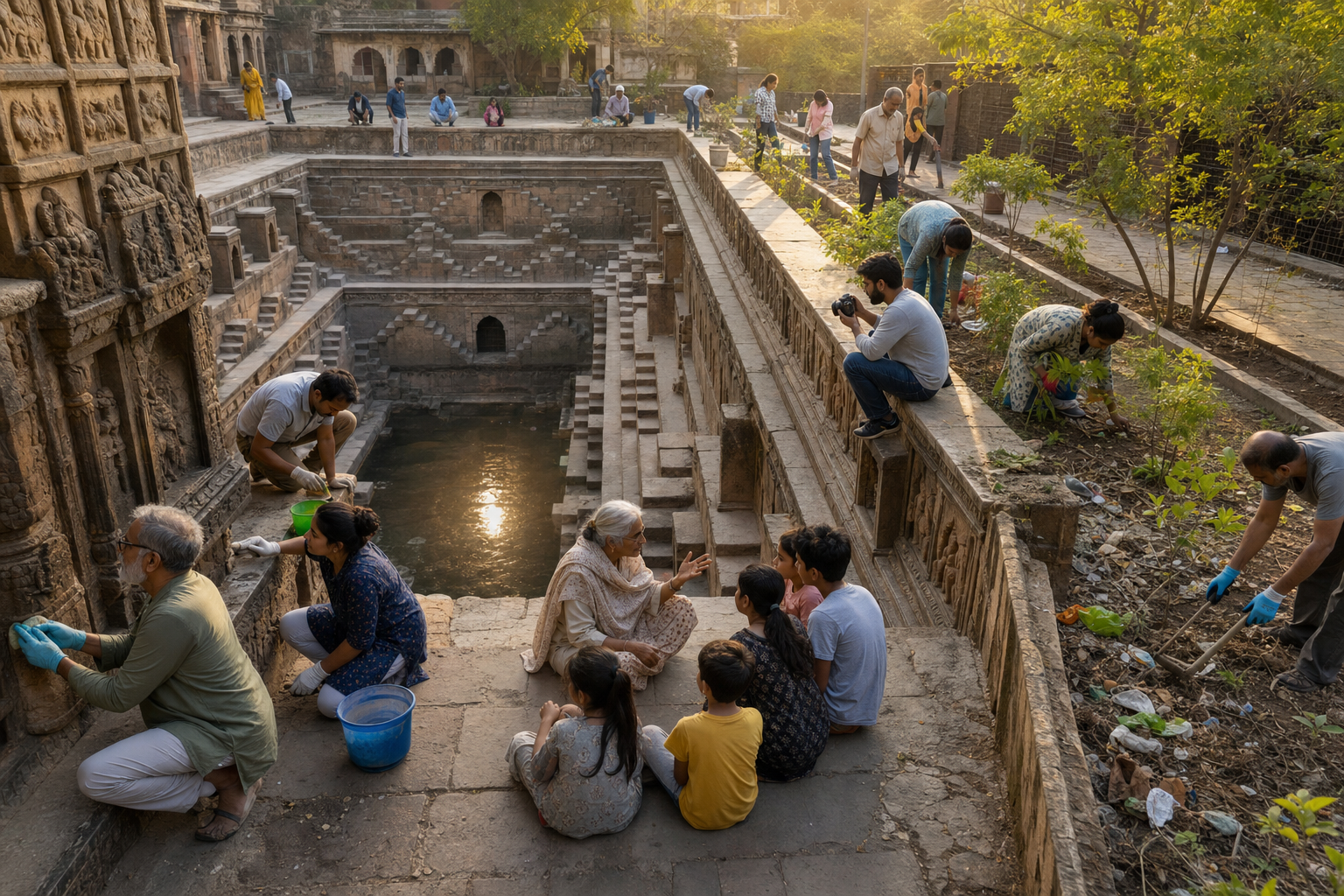
| Heritage work | Support the preservation of temples, gurdwaras, viharas, dargahs, manuscripts, languages, and local customs. | Respect the ritual rules, community authority, and distinct sacred meaning attached to each inheritance. |
| Public discussion | Use Bharatiya when the point is equal civic belonging; define Hindu when the point is civilization. | Do not switch between religious and civilizational meanings midway through an argument. |
| Interfaith activity | Choose a shared task such as food service, heritage care, language learning, or study of a local sacred landscape. | Let every community describe its own beliefs; cooperation does not require a synthetic theology. |
If you organize a school event, heritage walk, or interfaith gathering, state three things before it begins: the common purpose, the freedom of each participant to retain a distinct faith, and the rule that every tradition will be described in terms its adherents recognize. This small act of framing prevents most of the later confusion about whether participation amounts to religious endorsement.
Education deserves particular care. A weak curriculum lists communities in isolation and never explains the civilizational exchanges among them. An equally weak curriculum blends them into a pleasant but inaccurate sameness. A better approach puts shared geography, languages, institutions, ethical concerns, and historical contact beside clearly named differences in doctrine and practice. Students can then recognize connection without being trained to mistake connection for uniformity.
Heritage preservation should follow the same method. First identify what is being protected: a structure, manuscript, ritual tradition, language, pilgrimage route, or public memory. Then identify who has authority over its living religious use. Wider society can accept responsibility for preservation without taking ownership away from the community that sustains the tradition.
Key takeaways: test the thesis with five questions
Before you endorse or reject a statement about Hindu identity and Bharat’s shared culture, run it through this test:
- Which layer is being named? Decide whether the claim concerns religion, civilization, or citizenship. If the speaker cannot say, the argument is not ready for agreement.
- Is Hindu being used religiously or civilizationally? Both usages can be discussed, but they cannot be exchanged without notice. Ask for one plain sentence defining the intended meaning.
- Can every person retain their own religious name? If participation requires a Muslim, Christian, Buddhist, Jain, or Sikh to surrender a chosen identity, the proposal has crossed from inclusion into absorption.
- Does shared stewardship work in every direction? A credible umbrella asks people to value the full civilizational landscape, not only the sites and customs favored by one community.
- What practice follows from the claim? Look for a concrete commitment to education, preservation, hospitality, dialogue, or cooperation. A label that creates no reciprocal duty is unlikely to create durable unity.
A durable shared-culture thesis should pass all five questions. Failure does not always require abandoning the civilizational idea. It may require narrowing a word, acknowledging a religious distinction, or replacing a demand for identification with an invitation to stewardship.
Hindu civilization does not become stronger merely by making its verbal boundaries as wide as possible. It becomes stronger when people can see what it asks them to preserve, understand, and transmit while knowing that participation will not erase them. Confidence and precision make the invitation believable.
The next time this debate begins, ask one question before taking a side: When you say Hindu here, do you mean a religion, a civilization, or civic belonging? Keep the answer in its proper layer, defend religious self-description, and turn common inheritance into common work. That is how shared culture moves from a contested slogan to a trustworthy public ethic.
References
