

You may sincerely want to become calmer, less distracted or more disciplined, yet find that the resolve disappears as soon as an ordinary day becomes difficult. The problem is often not a lack of aspiration. It is that the aspiration has never been translated into an action you can perform at the moment of choice.
Dharmic transformation starts at that moment. A pause before a harsh reply, a return to neglected duty or an act of service without a demand for recognition can redirect the mind. Through small and consistent choices, daily life becomes a field of spiritual practice. You do not need to wait for a dramatic breakthrough. You need a clear direction, a reliable cue and the willingness to return after failure.
Choose a dharmic direction, not a fantasy self
A vague promise such as becoming a better person gives you nothing definite to do. A sankalpa is more useful when it names the quality you intend to embody and the situation in which you will embody it. It should guide conduct, not merely describe a preferred future identity.
Start with the part of life that repeatedly pulls you away from dharma. It may be anger during family conflict, avoidance of difficult work, compulsive distraction, possessiveness, discouragement or indifference to another person’s need. Then write an intention that remains within your control.
- When my voice begins to harden, I will take three conscious breaths before replying.
- When I notice myself escaping into distraction, I will return to the duty already in front of me.
- When recognition becomes more important than usefulness, I will complete a needed task without advertising it.
- When I want to acquire something unnecessary, I will pause and examine whether the impulse serves a real need.
- When a mistake becomes clear, I will correct what I can instead of defending my image.
A workable sankalpa has several features. It is observable, available during an ordinary day, beneficial rather than harmful, and small enough to resume after a lapse. It also distinguishes action from outcome. You can choose to speak truthfully and with restraint; you cannot guarantee that another person will respond well.
This distinction is central to karma-yoga. The Bhagavad Gita directs attention toward intentional action without dependence on the result. That does not mean becoming indifferent to consequences. It means placing your effort where agency actually exists: in preparation, conduct, attention and response. Choose the sankalpa that addresses your present disorder, not the one that makes you sound most spiritual.
Build a daily rhythm that survives a difficult day
A practice becomes dependable when it has a place in the day. Use a three-part rhythm of intention, action and reflection. Each part has a different job, and omitting any of them weakens the whole cycle.
- Set the direction in the morning. Before the day’s demands scatter your attention, identify the situation most likely to test you. State one concrete response: when this cue appears, I will perform this action. Keep the sentence close to lived duty rather than an abstract spiritual ideal.
- Interrupt one habitual reaction during the day. Attach your practice to a threshold that already exists: before sending a tense message, entering a meeting, answering a child’s complaint, abandoning study or opening a distracting application. At that threshold, pause. Three conscious breaths may be enough to create room for a less reactive choice.
- Review the day honestly. Ask where you remembered the sankalpa, where you forgot it, what followed from each choice and what requires repair. Carry one adjustment into the next day. Reflection should produce a clearer action, not a verdict on your worth.
The minimum version matters. On a crowded or painful day, you may have no appetite for a long meditation, a complete yoga routine or extended scriptural study. You can still state the intention, pause at one decisive moment and review what happened. Preserving the thread of practice prevents temporary difficulty from becoming abandonment.
This is the practical relationship between abhyasa and vairagya. Abhyasa is the steadiness of returning. Vairagya loosens the demand that today’s effort must immediately produce the feeling or result you wanted. Together they protect you from two familiar errors: practicing only when inspired and quitting when progress is untidy.
Turn friction and failure into part of the discipline
The real test of a habit is not the peaceful moment in which you planned it. It is the instant when anger, craving, fatigue, pride or distraction presents the old reaction as the easiest option. Treat that friction as the practice itself.
- Notice the cue. Learn the early signs of the reaction: a tightening jaw, a rehearsed accusation, the urge to reach for the phone, a rush to justify yourself or the thought that duty can wait.
- Interrupt the sequence. Pause before the reaction becomes speech or action. Breathe, become quiet or physically step back when that is appropriate. The pause does not solve the situation; it restores your ability to choose.
- Select the next dharmic action. Ask what is truthful, least harmful and consistent with your responsibility now. The answer may be to speak, remain silent, finish the task, decline an excess or help someone.
- Repair actual harm. If you spoke cruelly, acknowledge it without disguising the apology as an argument. If you neglected a duty, complete what remains possible. If another person was affected, inner regret alone is not a complete response.
- Resume without ceremony. Do not wait for a new week, a better mood or a symbolic restart. The next available choice is where abhyasa continues.
Do not measure transformation only by an unbroken streak. Also notice how quickly you recognize the old pattern, whether you can interrupt it earlier, whether your repair becomes more direct and whether you return without prolonged self-justification. These observations reveal changes that perfection-or-failure thinking misses.
Ahimsa does not require pretending that a lapse was harmless. Accountability does not require turning the lapse into a permanent identity. A review that ends with self-condemnation gives you no clear next action; a review that excuses the consequence teaches you nothing. Compassionate rigor holds both truths: harm should be repaired, and practice should resume.
Use each Dharmic tradition to expose a different blind spot
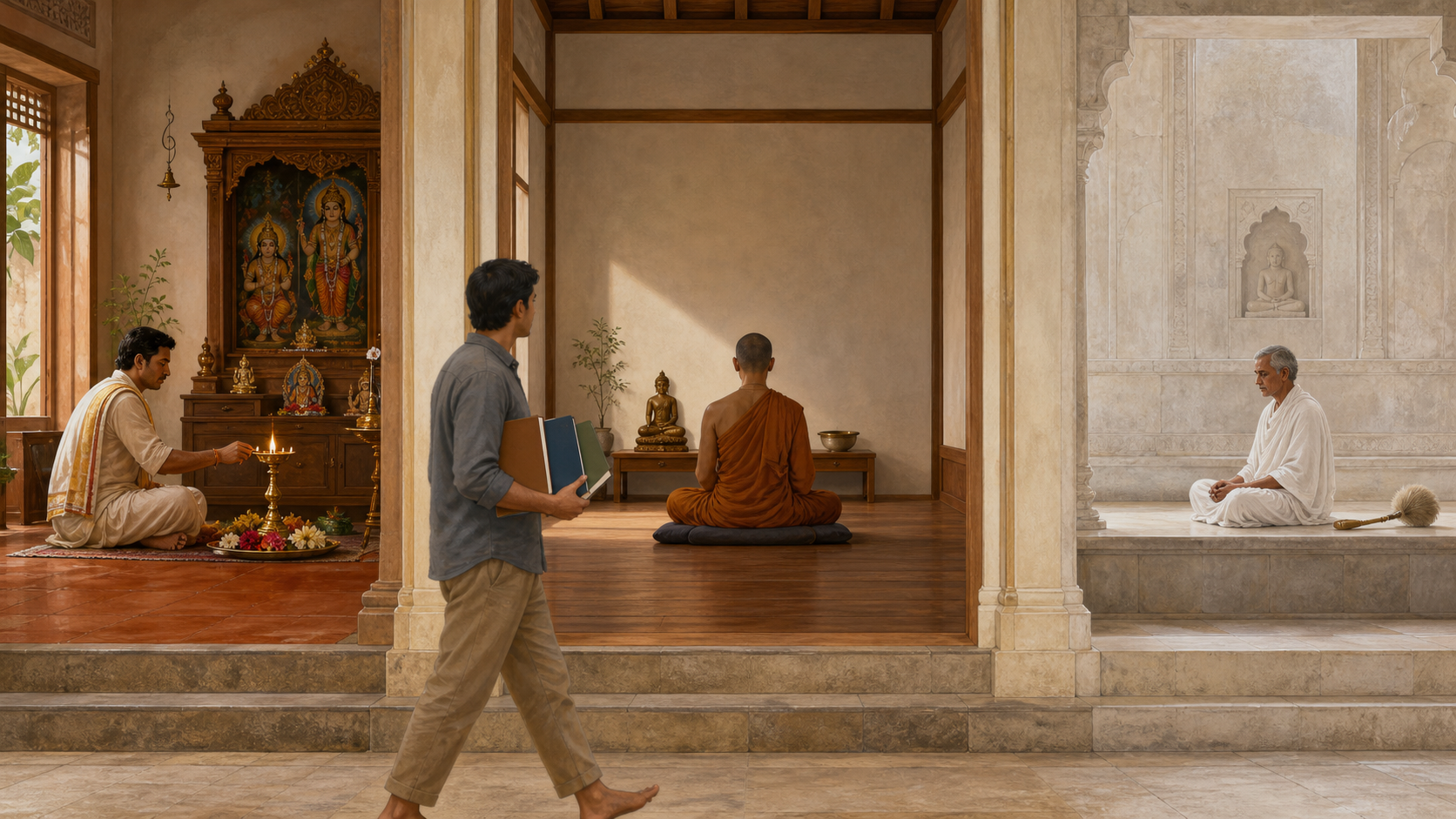
Hinduism, Buddhism, Jainism and Sikhism are not interchangeable systems. Their doctrines, lineages and understandings of liberation retain real distinctions. Yet their practical disciplines can illuminate recurring obstacles in daily conduct. Use the lens that most directly corrects your present imbalance.
| Dharmic lens | What to notice | Action to practise |
|---|---|---|
| Hindu karma-yoga, abhyasa and vairagya | Attachment to praise, control of results or avoidance of svadharma | Ask what action is yours to perform, do it attentively and release the demand to control every response. |
| Buddhist awareness of anicca | Treating an urge, mood or conflict as if it were permanent | Notice that the experience is changing and refrain from obeying the first impulse automatically. |
| Jain ahimsa and aparigraha | Harm caused by speech, consumption, possession or unnecessary grasping | Choose the less harmful response and relinquish an excess at the point where desire asks for more. |
| Sikh seva and chardi kala | Self-absorption, discouragement or the wish to serve only when appreciated | Perform a useful act for another person while sustaining a resilient and hopeful bearing. |
These lenses are especially helpful when a strength becomes distorted. Discipline without ahimsa can become harshness. Non-attachment without duty can become avoidance. Mindfulness without service can remain self-absorption. Service without reflection can conceal pride or resentment. Let the neglected value correct the imbalance.
You do not need to assemble every practice into an overloaded routine. If anger is causing harm, begin with ahimsa at the moment of speech. If distraction is eroding duty, begin with abhyasa and a reliable return cue. If spiritual effort has become self-centred, place seva inside the day. If disappointment controls your conduct, practise action without bargaining for a preferred result.
Key takeaways
- Translate aspiration into a sankalpa that names a recognizable cue and an action within your control.
- Use the daily rhythm of morning intention, mindful action and evening reflection.
- Keep a minimum version for difficult days so that reduced practice does not become abandoned practice.
- Treat the first signs of anger, craving, distraction or pride as invitations to pause rather than evidence that practice has failed.
- Repair consequences directly, then resume at the next available choice.
- Choose the Dharmic lens that addresses your actual blind spot instead of accumulating practices for appearance.
Before the next day begins, write a single sentence in this form: When this cue appears, I will take this dharmic action, whether or not I receive the outcome I prefer. Keep it where you will encounter it. Then let the next ordinary moment, not a future ideal, become the beginning of transformation.


References
