

You may meet a Yaksha in a story and wonder whether the figure is merely a spirit guarding buried gold. That reading catches the visible image but misses its Dharmic force. The more useful question is not, “Where is the treasure?” It is, “Why must this place, wealth, or knowledge be guarded at all?”
Follow that question and the Yaksha becomes easier to understand. The guardian stands where human desire meets a part of the world that cannot be treated as ordinary property. Forest, water, abundance, and wisdom belong together. Access therefore carries conditions.
A Yaksha belongs to a place before belonging to a plot
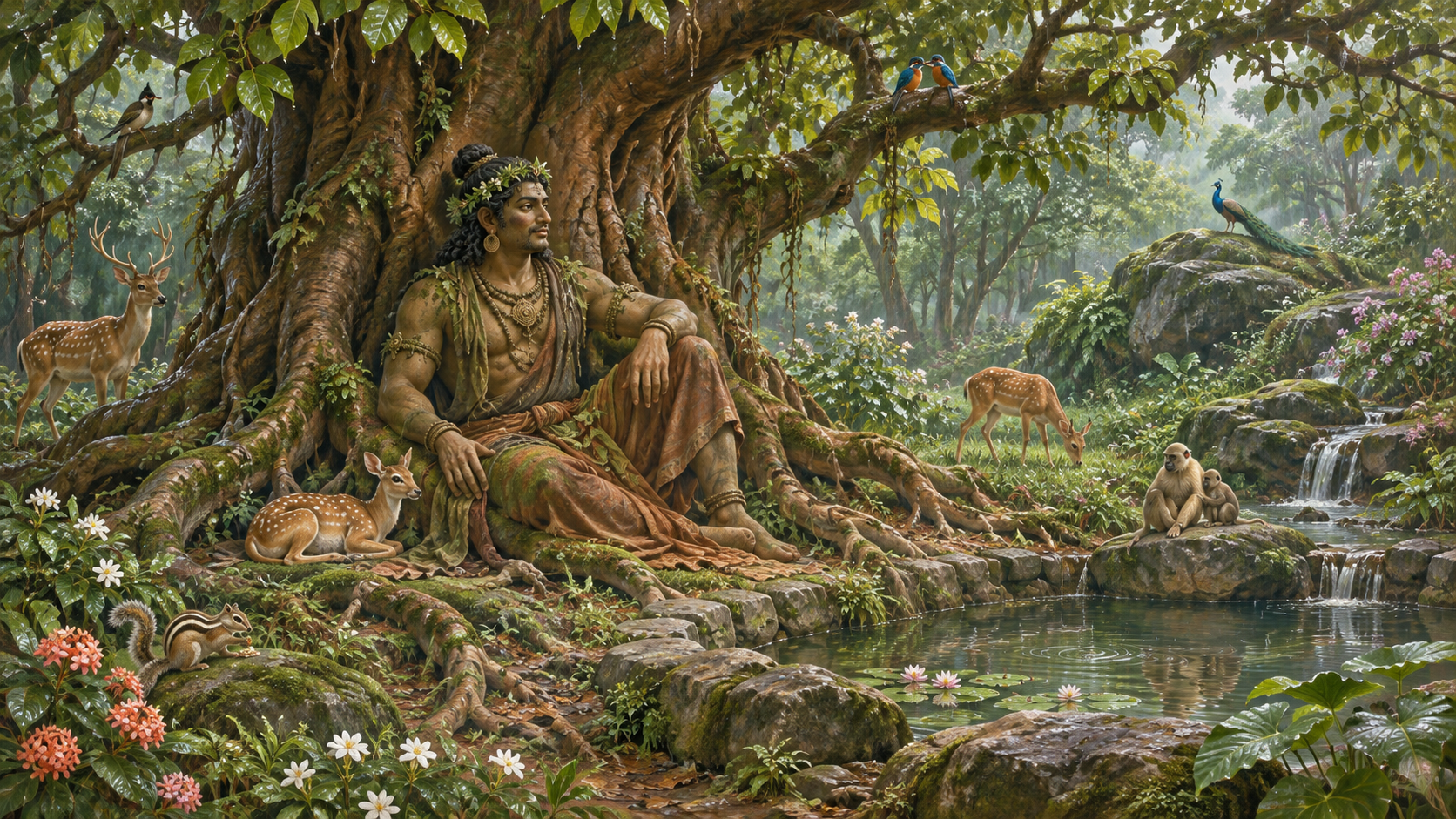
Begin with the setting. In Hindu belief, Yakshas are semi-divine nature beings associated with particular forests, groves, riverbanks, and concealed treasures. They occupy a boundary between the cultivated human world and the wild.
That location is not decorative scenery. A being attached to a particular grove differs from an abstract deity who can be discussed without reference to place. The grove is part of the Yaksha’s identity. Remove the place, and you remove much of what the figure means.
When you encounter a Yaksha narrative or image, pause before asking whether the being is benevolent or threatening. First identify the domain. Is it vegetation, flowing water, uncultivated land, or stored wealth? Then notice who is approaching and what that person wants. This reveals the moral tension more reliably than treating the Yaksha as a generic supernatural creature.
The boundary matters because it interrupts the assumption that everything visible is immediately available for human use. A riverbank may be crossed, a grove entered, and wealth uncovered, but none of those acts is morally empty. The guardian makes the threshold visible.
Why treasure is the right image for guarded wisdom

Treasure naturally attracts attention. It promises abundance while concealing its location, and it can awaken gratitude, fear, greed, patience, or restraint. That makes it an unusually precise image for something valuable that should not be seized merely because it has been found.
A literal reading is not necessarily wrong. Yakshas are indeed connected with hidden wealth. The mistake is to stop there. Gold and jewels are the outer vocabulary of value. The deeper treasure is a way of understanding the Earth as a bearer of memory, order, and knowledge rather than as inert material awaiting possession.
This distinction changes how you read the guardian. If the treasure is only a pile of valuables, the Yaksha appears to be an obstacle between a person and a prize. If the treasure also represents nature-bound wisdom, the guardian protects the conditions that allow the treasure to remain meaningful. The central problem is no longer how to defeat the guard. It is whether the seeker has learned how to approach what is guarded.
“Hidden” should not be confused with “nonexistent.” Some things are hidden because they require attention. Others remain hidden because careless access would destroy the very thing being sought. The Yaksha gives sacred form to that limit. Not every barrier is ignorance, and not every unopened chamber is an invitation to force the door.
Knowledge of nature is also a relationship with nature
Modern habits often separate information from its setting. We imagine that knowledge can be extracted, stored, and carried away while the place that produced it becomes irrelevant. The Yaksha image resists that separation. The guardian is tied to a living location, so the wisdom under protection cannot be reduced to detachable information alone.
This gives you a practical interpretive rule: when a Yaksha guards a natural place, do not look only for a secret statement that the story might reveal. Look for the relationship the seeker must establish. Does the encounter demand restraint rather than conquest? Attention rather than haste? Recognition rather than ownership? The guarded knowledge may lie in learning the correct posture toward the domain.
That is why abundance and prohibition can appear together without contradiction. Nature gives, but giving does not abolish limits. A place may sustain life and still resist unrestricted entry or extraction. A treasure may be real and still not belong to the first person capable of taking it. A guardian embodies this difference between receiving and appropriating.
This is also a sound way to avoid two opposite errors. The first is to dismiss the Yaksha as primitive fantasy. The second is to turn the figure into a vague modern environmental mascot. Both flatten the tradition. Read the Yaksha on Dharmic terms: as a semi-divine presence that joins place, power, wealth, mystery, and moral limits.
A five-question method for reading a Yaksha encounter
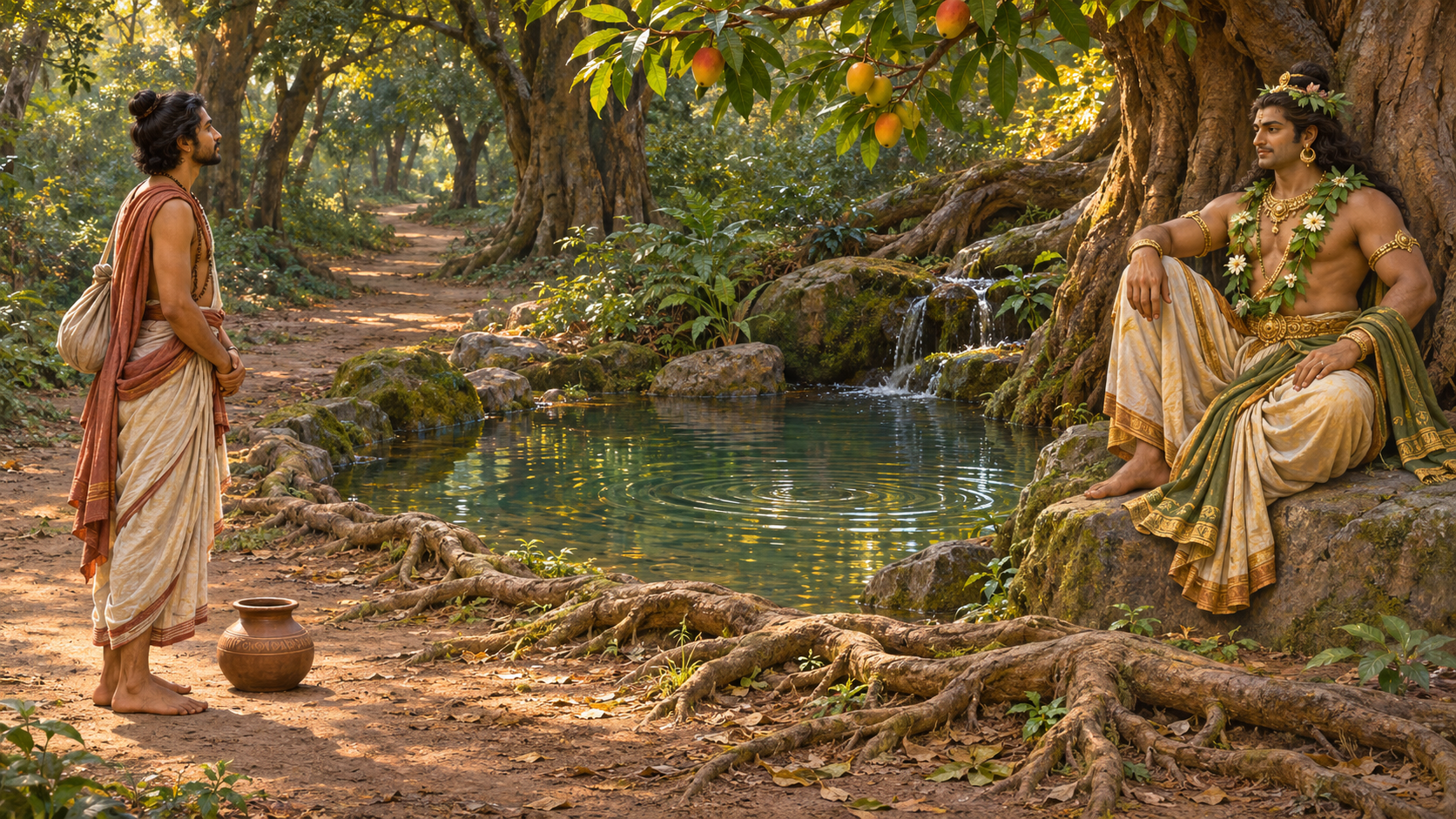
You do not need an elaborate theory every time a Yaksha appears in sacred art, folklore, or a retelling. Use five questions in order. They keep the setting and the ethical problem in view.
- What exact place is being guarded? Name the grove, forest, riverbank, wilderness, or concealed store of wealth. Do not replace the location with the vague word “nature.”
- What does the approaching person want? Curiosity, wealth, passage, mastery, or knowledge creates a different encounter in each case. Desire explains why the boundary has become active.
- What would be harmed by unrestricted access? Look beyond the seeker’s immediate goal. The protected good may include the integrity, secrecy, or sacred character of the place itself.
- What quality must the seeker develop? Ask whether the encounter calls for patience, humility, self-command, attentiveness, or respect. The guardian often makes the seeker’s inner condition as important as the outer prize.
- Does access produce ownership or responsibility? Receiving something valuable does not automatically grant the right to exhaust, expose, sell, or dominate it. The manner of receiving determines the obligation that follows.
Keep the order. If you jump immediately to symbolism, you may miss the concrete place. If you jump immediately to morality, you may turn the Yaksha into a simple reward-and-punishment device. Setting, desire, risk, discipline, and responsibility form one movement.
This method also helps when different depictions seem inconsistent. A guardian can appear generous in one encounter and formidable in another without changing its essential function. The relevant difference may be the seeker’s intention, the boundary being crossed, or the kind of access being demanded. Guardianship is not the same as permanent hostility.
Key takeaways for practice
- Notice the place first. A Yaksha’s connection to a specific grove, forest, riverbank, or treasure is central to the meaning.
- Read wealth at two levels. The guarded object may be materially valuable, while also pointing to wisdom and abundance that cannot be separated from the Earth.
- Treat the boundary as instruction. The guardian asks whether a person is prepared to approach, not merely whether that person is strong enough to take.
- Distinguish access from possession. Finding, entering, or receiving does not erase the duties of restraint and care.
- Carry the lesson into conduct. At a sacred or ecologically sensitive place, learn the local expectations, avoid needless disturbance, take nothing without permission, and leave the setting unharmed.
You do not have to claim that every forest contains a visible supernatural custodian in order to understand the discipline this vision creates. You do have to give up the idea that reverence is compatible with careless use. If a place is approached as guarded, your first act is attention rather than acquisition.
The next time you meet a Yaksha, resist the urge to hurry past the guardian toward the treasure. Stay at the threshold for a moment. Identify what is protected, what the seeker desires, and what right conduct would require. That pause is where the hidden knowledge begins.
References

Leave a Reply
You must be logged in to post a comment.