
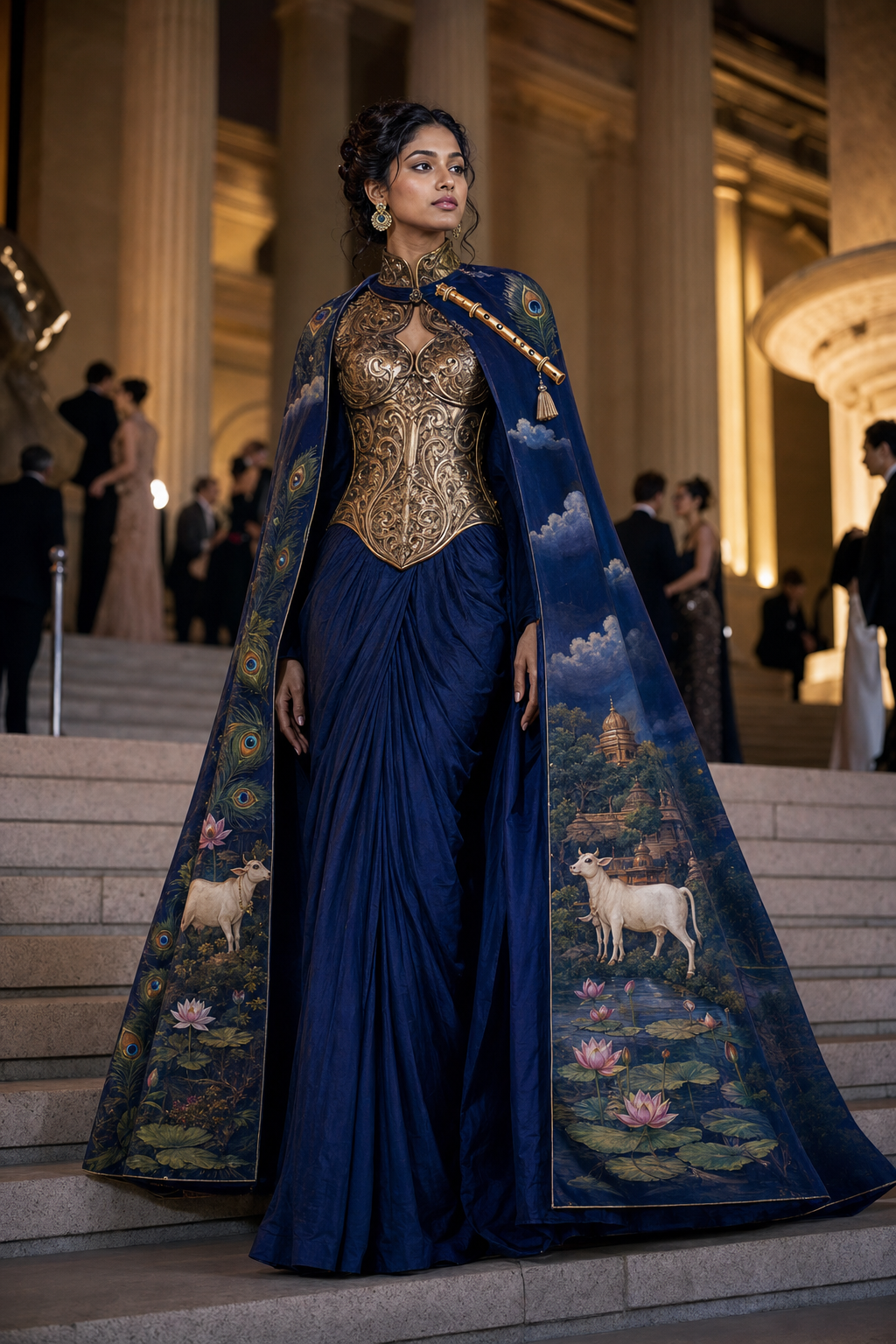
You see Krishna on a celebrity’s cape, a temple painting on a sari border, or the surface of a devi bronze translated into couture. Is this respectful representation, decorative borrowing, or something in between? The glamour alone cannot tell you.
You need to know what has crossed the red carpet with the wearer: a particular story, devotional tradition, sacred geography, ritual memory and community of makers. Once you can identify those layers, Hindu sacred art at the 2026 Met Gala stops looking like a vague Indian influence and becomes legible on its own terms.
Read the garment in four layers
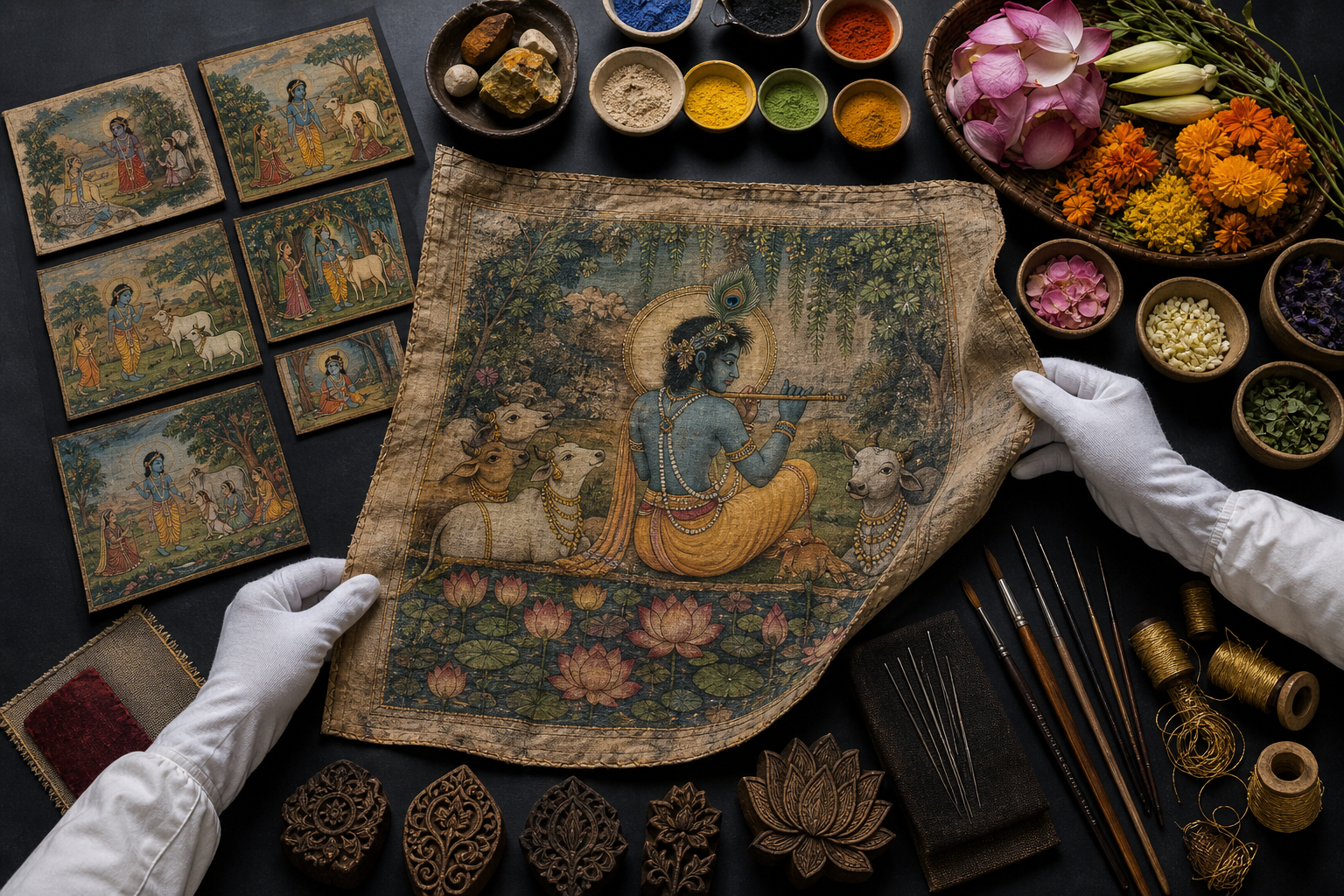
Hindu civilization is not one visual brand. Its paintings, textiles, sculptures and ornaments emerge from different regions, temples, festivals, lineages and devotional communities. Calling all of that Indian-inspired may sound complimentary, but it removes the information that makes an object meaningful.
When you encounter Hindu imagery in fashion, read it in this order:
- Identify the story or sacred figure. Ask whether you are seeing a deity, an episode from an epic, a royal genealogy, a ritual object or a cosmological symbol. A scene of Krishna negotiating in a royal court says something different from a repeated lotus used only as ornament.
- Locate the devotional tradition. Vaishnava, Shaiva and Shakta arts can share a stage without becoming interchangeable. Look for the deity, shrine, dynasty or sacred narrative that establishes the connection.
- Find the region and living practice. A form may belong to a temple town, a festival calendar, a wedding tradition or a family’s puja room. Place and practice often explain details that visual resemblance cannot.
- Name the material and maker. Kalamkari, pichwai, Kanjivaram silk, shola-pith carving and bronze-inspired couture are not synonyms. Each requires different knowledge and labor. Credit should reach the painter, embroiderer, carver or metal artist, not stop with the celebrity and lead designer.
This method also prevents a common mistake: treating sacred and beautiful as opposing categories. Hindu ritual arts are often visually magnificent precisely because beauty, disciplined workmanship and devotion meet within them. The relevant question is not whether fashion may display beauty. It is whether the translation preserves enough context for you to recognize what the beauty serves.
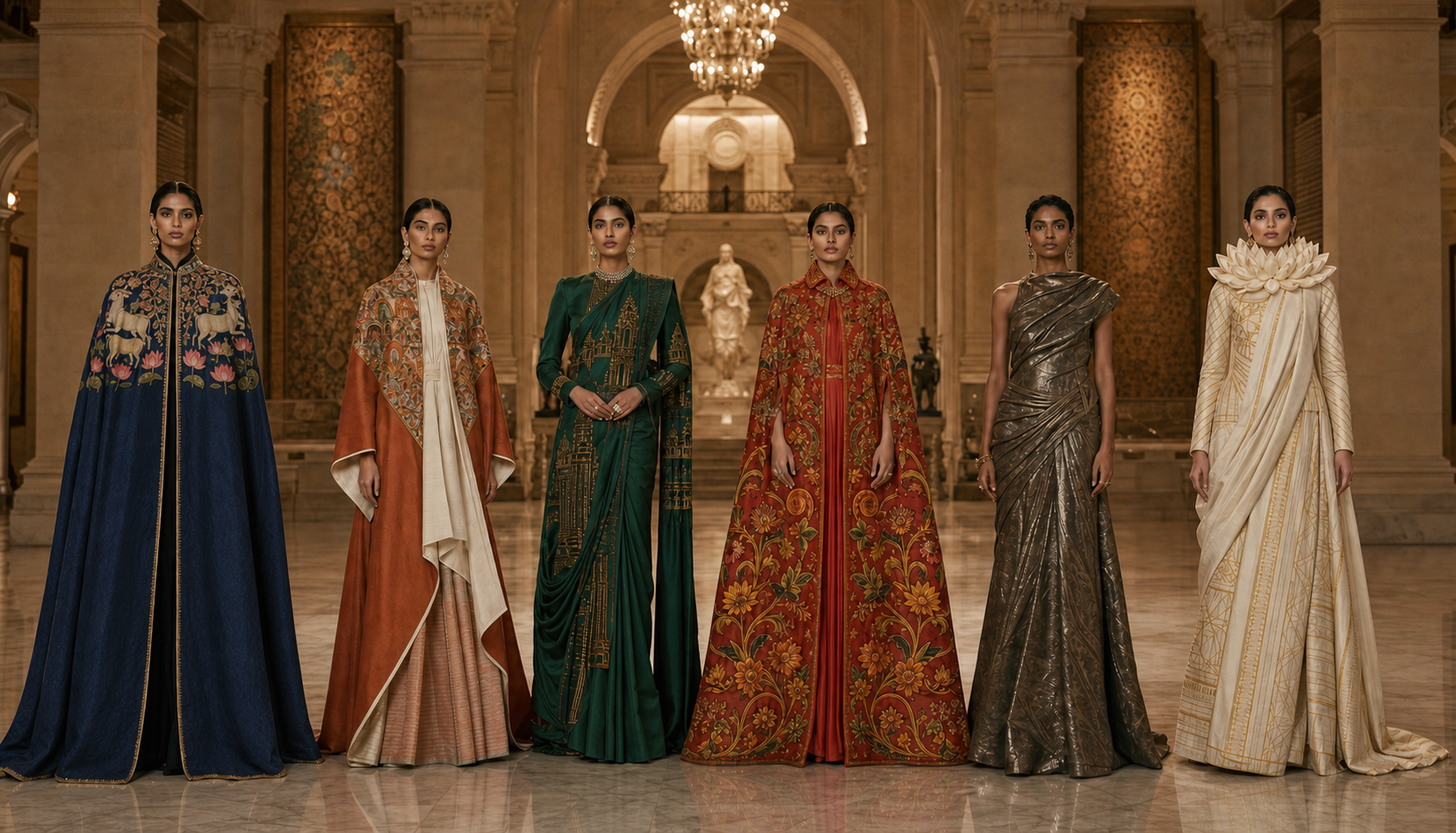
Six Met Gala looks, read beyond the silhouette
Karan Johar: a cape carrying several narratives
Karan Johar’s Met Gala debut offered the clearest case of clothing becoming a narrative surface. His six-foot, hand-painted Manish Malhotra cape drew upon Raja Ravi Varma, the Kerala painter who rendered Hindu subjects through a European oil-painting vocabulary and helped such imagery enter homes through mass reproduction.
The cape did not present one generic mythological tableau. It included Krishna Shishtai, Krishna’s peace mission to the Kaurava court; Arjuna and Subhadra; Damayanti receiving news of Nala through a swan messenger; and Urvashi leaving King Pururavas. These are distinct episodes with different emotional and ethical registers: diplomacy before war, love, separation, longing and departure.
If you caption this look, do not settle for Hindu gods painted on a cape. Name at least one scene. Krishna Shishtai immediately tells your reader that Krishna is appearing as an envoy attempting peace, not merely as an isolated divine figure. That one identification changes the garment from spectacle into storytelling.
Sawai Padmanabh Singh: lineage expressed through the sun
Sawai Padmanabh Singh’s Prabal Gurung coat worked through genealogy rather than a sequence of painted episodes. A mirror sun derived from Jaipur’s City Palace referred to his Suryavanshi heritage, connecting the royal line with Surya and the dynasty of Ram. Matsya and Gajraj brooches added Vaishnava and royal associations.
A sun on a garment could be read as a convenient emblem of radiance. Here, its placement and palace origin give it a more exact function: it carries a lineage claim. When you interpret an inherited symbol, ask whose history it marks before assigning it a universal meaning.
Sudha Reddy: a Telugu sacred and seasonal world
Sudha Reddy’s Manish Malhotra ensemble used Kalamkari to assemble a specifically Telugu Hindu cosmos. At its center stood the Kalpavriksha, accompanied by the Palapitta bird, Tangedu flowers, the Jammi Chettu or shami tree, and signs of the sun and moon. The combination connected the garment with Bathukamma, Goddess Gauri and Vijayadasami.
The practical lesson is to read clusters rather than isolated motifs. A tree, bird and flower may look like botanical decoration when separated. Seen together with solar and lunar signs, they locate the wearer within a festival rhythm, regional memory and sacred ecology. Describe the ensemble as Telugu and Kalamkari before reaching for broader labels such as Indian floral design.
Isha Ambani: shrine painting joined to family memory
Isha Ambani’s Gaurav Gupta sari carried a pichwai border associated with Shrinathji’s shrine at Nathdwara. The border was hand-painted by Trilok Prakash Soni. A sculptural jasmine gajra by Sourabh Gupta drew from the artist’s childhood memories of flowers brought into his family’s puja room.
Two kinds of devotional geography meet in this look. Pichwai points toward a named deity and shrine tradition; the gajra carries the intimate memory of domestic worship. If you discuss only the sari’s silhouette, both disappear. Name Nathdwara, Shrinathji and the two artists, because the sacred meaning resides as much in those relationships as in the finished surface.
Diya Mehta Jatia: regional unity without visual sameness
Diya Mehta Jatia’s Mayyur Girotra gown brought Kanjivaram silk together with Bengal’s hand-carved shola-pith work. The silk is associated with South Indian temple ritual and weddings, while shola-pith is used for ceremonial crowns and adornments familiar from Bengali Hindu life and Durga Puja.
This is a useful corrective to the idea that cultural unity requires one uniform style. The materials retain their regional identities even when placed in one composition. When two traditions meet, do not describe the result as a fusion and stop there. Name what each region contributes and check whether each form remains recognizable.
Ananya Birla: sacred metalwork translated into couture
Ananya Birla’s after-party ensemble, Ashi Studio’s The Bronze Woman – The Aftermath I, was modeled on an 18th-century Hindu devi figurine. Its oxidized appearance recalled processional figures marked by repeated anointing with oil and camphor. The surface therefore referred not only to the color of old metal but also to the ritual life through which sacred metalwork acquires its appearance.
Raniek jewelry extended the reference through Shaiva traditions associated with the Chola and Hoysala dynasties. Its gems evoked Surya, water and the earth of the Deccan. The wider visual vocabulary included the legacy of Chola devotional bronzes, including Nataraja, and the dense soapstone carving of Hoysala temples.
This is where description requires particular care. Bronze-inspired does not mean that the dress itself is a sacred image, and resemblance does not transfer ritual status automatically. The accurate claim is that couture translated the material character and devotional associations of a devi figurine. That distinction respects both the fashion object and the sacred tradition it invokes.
Cultural visibility passes five practical tests
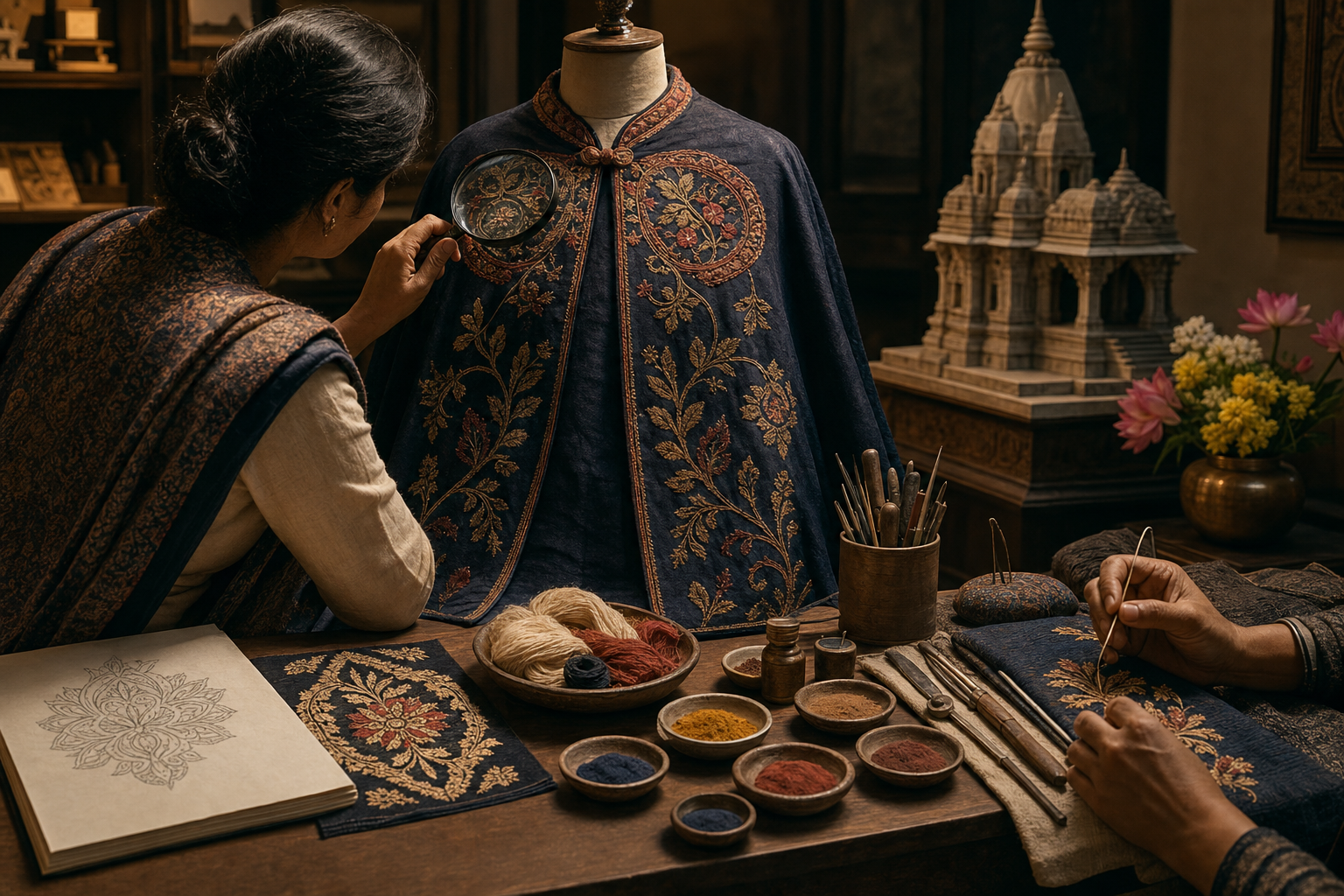
Visibility is not the same as understanding. Nor does the presence of sacred imagery produce an automatic verdict of reverence or appropriation. You cannot reliably infer a wearer’s private intention from a photograph. You can, however, examine what the public presentation preserves and what it erases.
- Specificity: Can the image, narrative, deity, lineage or symbol be named? If every explanation stops at Indian, exotic or spiritual, the tradition has been flattened.
- Sacred context: Does the presentation acknowledge a shrine, festival, puja practice, epic episode or ritual use where one is relevant? A motif can be visually accurate while its reason for existing remains invisible.
- Internal plurality: Are Vaishnava, Shaiva, Shakta, epic and regional traditions allowed to remain distinct? Hindu representation becomes less accurate when difference is treated as fragmentation that must be smoothed away.
- Material truth: Is the work actually painted, woven, carved, embroidered or sculpted in the named tradition, or does it merely imitate the appearance? The answer affects how you describe both the object and its labor.
- Authorship: Can you find the name of the artisan or specialist who made the sacred reference legible? Designer credit alone is incomplete when a hand-painted border, carved ceremonial material or embroidered narrative carries the central idea.
Use these tests to evaluate the presentation, not to conduct a purity trial. A contemporary garment does not need to reproduce a temple setting in order to engage Hindu art seriously. It should, however, give viewers enough truthful information to distinguish a living tradition from a free-floating aesthetic.
Key takeaways
- Begin with the exact story, deity, lineage or ritual association rather than the umbrella label Indian-inspired.
- Keep regional arts distinct: Kalamkari, pichwai, Kanjivaram silk, shola-pith work and bronze traditions do not carry the same history or function.
- Judge cultural presentation by observable context, material accuracy and maker credit, not by assumptions about a celebrity’s private motives.
- Remember that sacred meaning can travel through a temple town, a festival, a royal lineage or the memory of a family puja room.
- Treat the artisan’s name as essential cultural information, not an optional production detail.
Put the artisan back into the frame
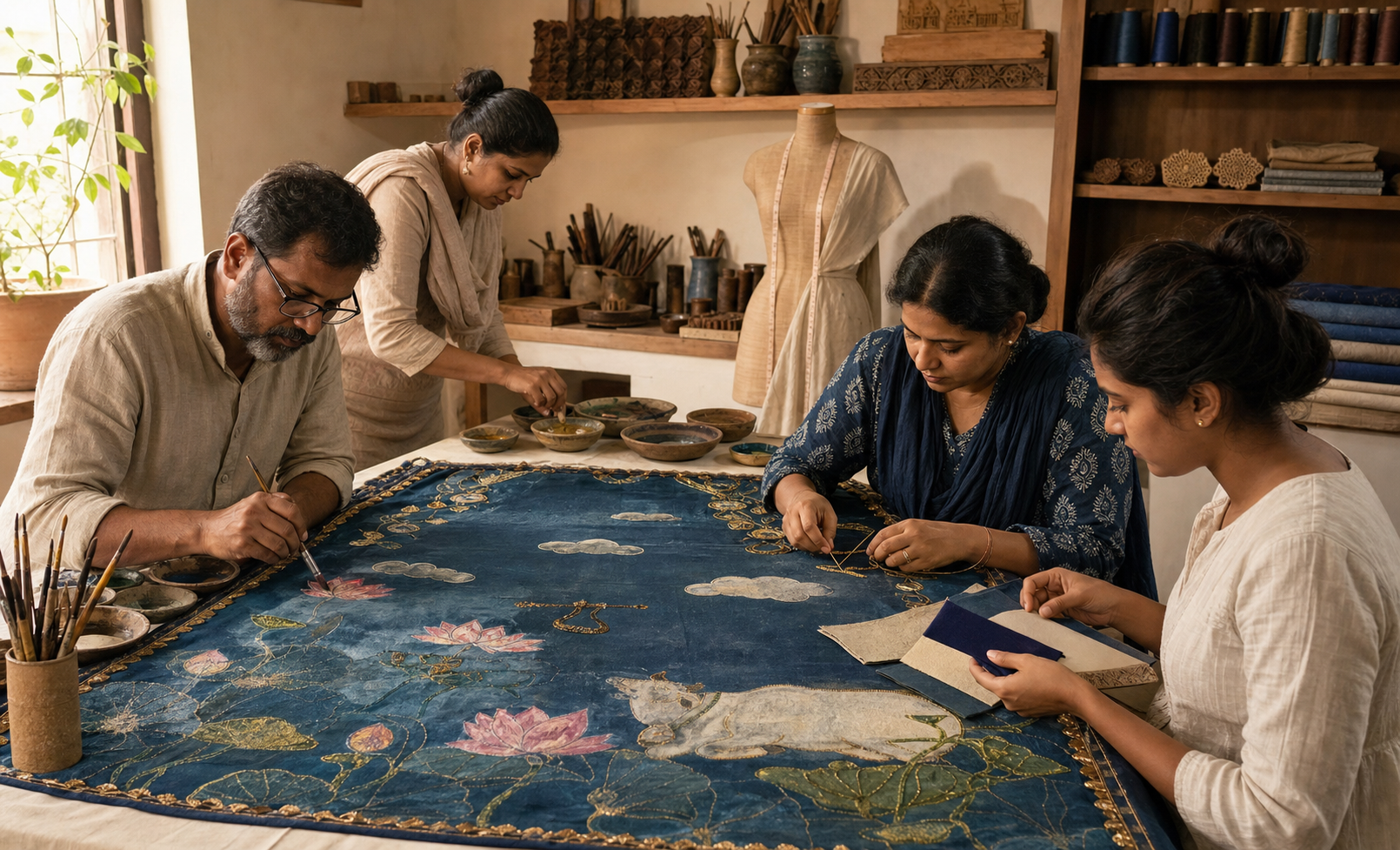
The most consequential red-carpet gesture may have appeared in the credits themselves. For his own cape, Manish Malhotra embroidered the signatures of artisans with whom he had worked across 35 years. The gesture redirected attention from a famous wearer and designer toward the human chain of skill that makes couture possible.
That recognition has a dharmic resonance. The Shilpa Shastras regard skilled makers as sacred practitioners, while Vishwakarma Puja honors artists and tradespeople. Hindu art remains alive because knowledge is transmitted through trained hands: how to prepare a surface, control a line, work a material, preserve an iconographic convention and understand the setting for which an object is made.
If you are writing a caption, sharing a photograph or discussing one of these looks, use a four-part credit:
- Name the art form or material: pichwai, Kalamkari, Kanjivaram silk, shola-pith or bronze-inspired design.
- Name the sacred referent: Shrinathji, Krishna’s peace mission, Goddess Gauri, Surya, a devi figurine or another specifically identified figure or narrative.
- Name the place or practice: Nathdwara, Bathukamma, Durga Puja, a South Indian wedding tradition, Jaipur’s City Palace or a family puja room.
- Name the maker where the information is available. If it is not available, say that the artisan is uncredited rather than guessing.
You can then deepen your reading with one precise search instead of a broad hunt for Indian fashion. Try pichwai with Shrinathji and Nathdwara, Kalamkari with Kalpavriksha and Bathukamma, shola-pith with Durga Puja, or Chola bronze with Nataraja. Each combination leads back toward a community of practice rather than outward into generic mood boards.
The next time Hindu sacred art appears on a global stage, pause before you praise or condemn the look. Identify one story, one living tradition and one maker. That small discipline turns visibility into cultural knowledge and keeps the dharmic inheritance at the center of the conversation.