
If you are deciding whether to support calls to pause large observances connected with the Rehan Malik Urs at Vishalgad, do not let the debate collapse into faith versus faith. Ask for the evidence that should exist before any vulnerable monument is opened to an unusually intensive use: the legal permission, the conservation assessment, the crowd plan, and enforceable conditions.
The useful question is not whether an Urs has spiritual meaning. It does. The question is whether the proposed scale, route, sound, structures, and footfall are compatible with this particular fort in its present condition. That distinction gives you a principled position: protect Vishalgad, respect lawful devotion, and apply the same heritage standard to every community.
Make the rule about use of the monument, not the worshipper
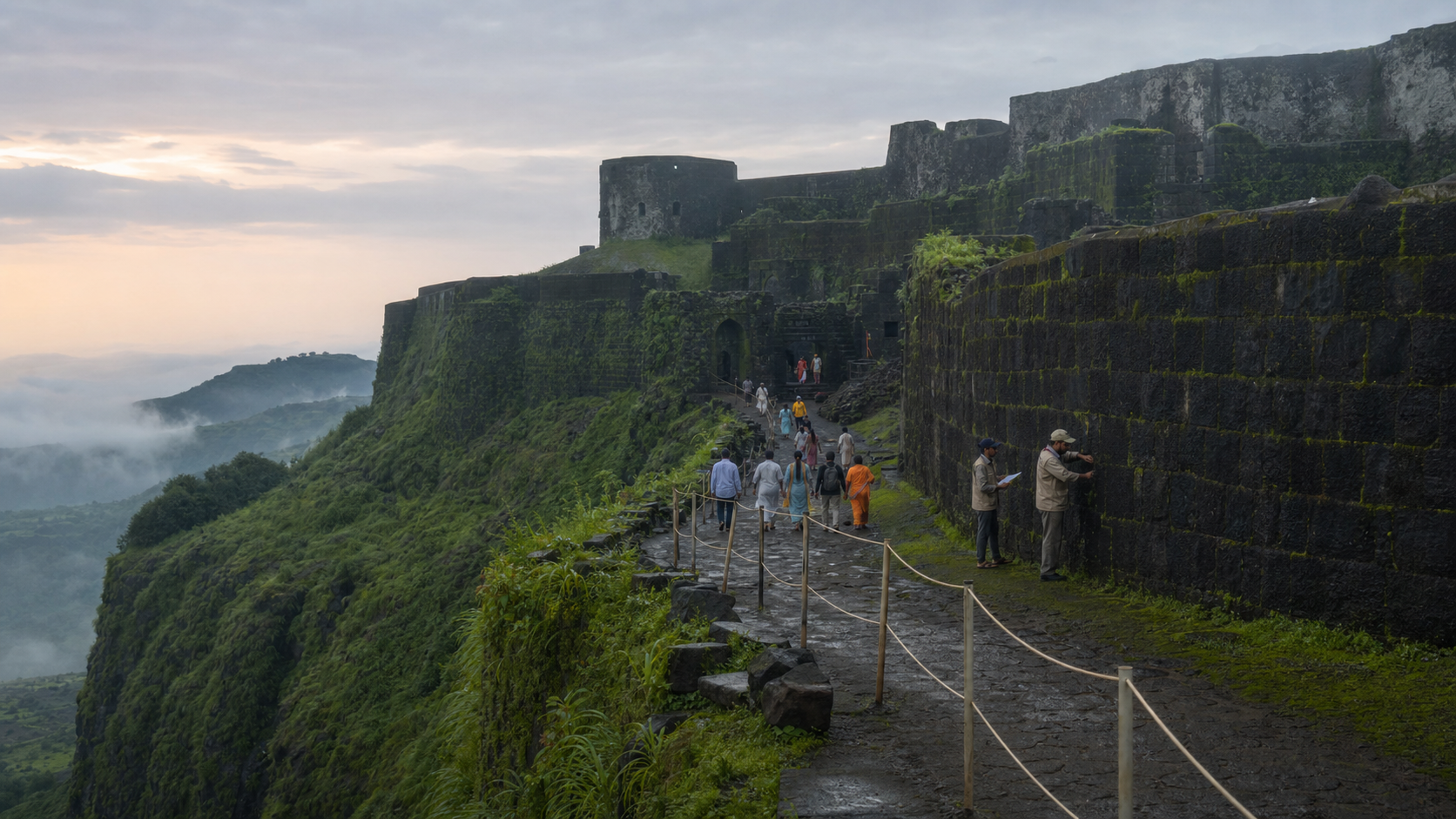
Vishalgad is not an interchangeable event ground. Historically known as Khelna, it is bound to the memory of Chhatrapati Shivaji and the 1660 passage from Panhala to Vishalgad. The stand at Ghodkhind, later revered as Pavan Khind, gives the fort a special place in Maharashtra’s civilisational memory. Its gateways, ramparts, water systems, shrines, and weathered masonry are physical evidence of that inheritance.
That inheritance deserves serious protection. But a conservation argument becomes weaker when it treats the identity of worshippers as proof of damage. An Urs commemorates the death anniversary of a Sufi saint and commonly involves devotional gatherings, processions, music, and charity. Its religious meaning neither creates an automatic entitlement to use a fragile monument at any scale nor proves that a proposed observance is harmful.
Use three distinct categories when you discuss the Vishalgad question:
- Individual, quiet devotion: low-intensity access conducted lawfully and without intrusive installations.
- A controlled gathering: organised access with assessed attendance, defined routes, fixed hours, and active supervision.
- A high-footfall event: a congregation involving amplified sound, stages, banners, lighting, processional movement, vending, or other infrastructure that increases pressure on the site.
These are not the same conservation proposition. The strongest interim case concerns the third category inside the vulnerable core. It does not require a blanket claim that every form of devotion is incompatible with the fort.
The rule must also be neutral. A high-footfall Urs, Hindu festival, political gathering, tourism programme, or civic celebration should face the same questions if it proposes the same load on the same historic fabric. Equal treatment does not mean permitting everything. It means using one defensible standard to decide what the fort can bear.
Ask for a decision file before accepting either side’s claims

A slogan cannot tell you whether the proposed event is safe, and a permission request cannot tell you whether it should be approved. You need the administrative and technical basis for the decision. Ask the competent authorities to identify or publish the following:
- Protected status and jurisdiction: the notification governing Vishalgad, the responsible heritage authority, and a map of the protected precinct, regulated areas, access routes, and any especially vulnerable zones.
- The event envelope: the activities for which permission is sought, expected peak attendance, route, duration, sound equipment, temporary structures, lighting, food or water distribution, and service access.
- Condition evidence: the latest structural inspection, known cracks or unstable elements, moisture problems, fragile masonry, and restrictions already imposed on visitors.
- Crowd and emergency planning: entry control, route capacity, emergency egress, medical response, real-time monitoring, and the official empowered to stop or reduce the event if conditions become unsafe.
- Environmental compliance: sound permission, applicable decibel and time limits, waste segregation, collection, water management, and post-event cleaning.
- Accountability: the named organiser, the officers supervising compliance, the pre-event condition record, the post-event audit, and consequences for violating permit conditions.
Do not assume a statute applies until the fort’s exact notified status and jurisdiction have been established. Where a monument is centrally protected, the Ancient Monuments and Archaeological Sites and Remains Act, 1958, as amended, may control works and activities in protected and regulated areas. A monument protected under Maharashtra’s framework may instead require state-level permissions and oversight. The legal and safety framework also includes crowd-management principles, noise controls, and solid-waste duties, but the competent authority must connect those rules to the actual proposal.
This distinction matters if you plan to submit a representation. Do not declare an event illegal merely because you have not seen its paperwork. A document missing from a public website may still exist. Ask for a dated copy, the conditions attached to it, the assessment relied upon, and the reasons for the decision. If litigation or a definitive interpretation of the fort’s legal status is being considered, have a lawyer verify the notification and jurisdiction rather than relying on social-media summaries.
A credible Heritage Impact Assessment measures the fort, not public sentiment
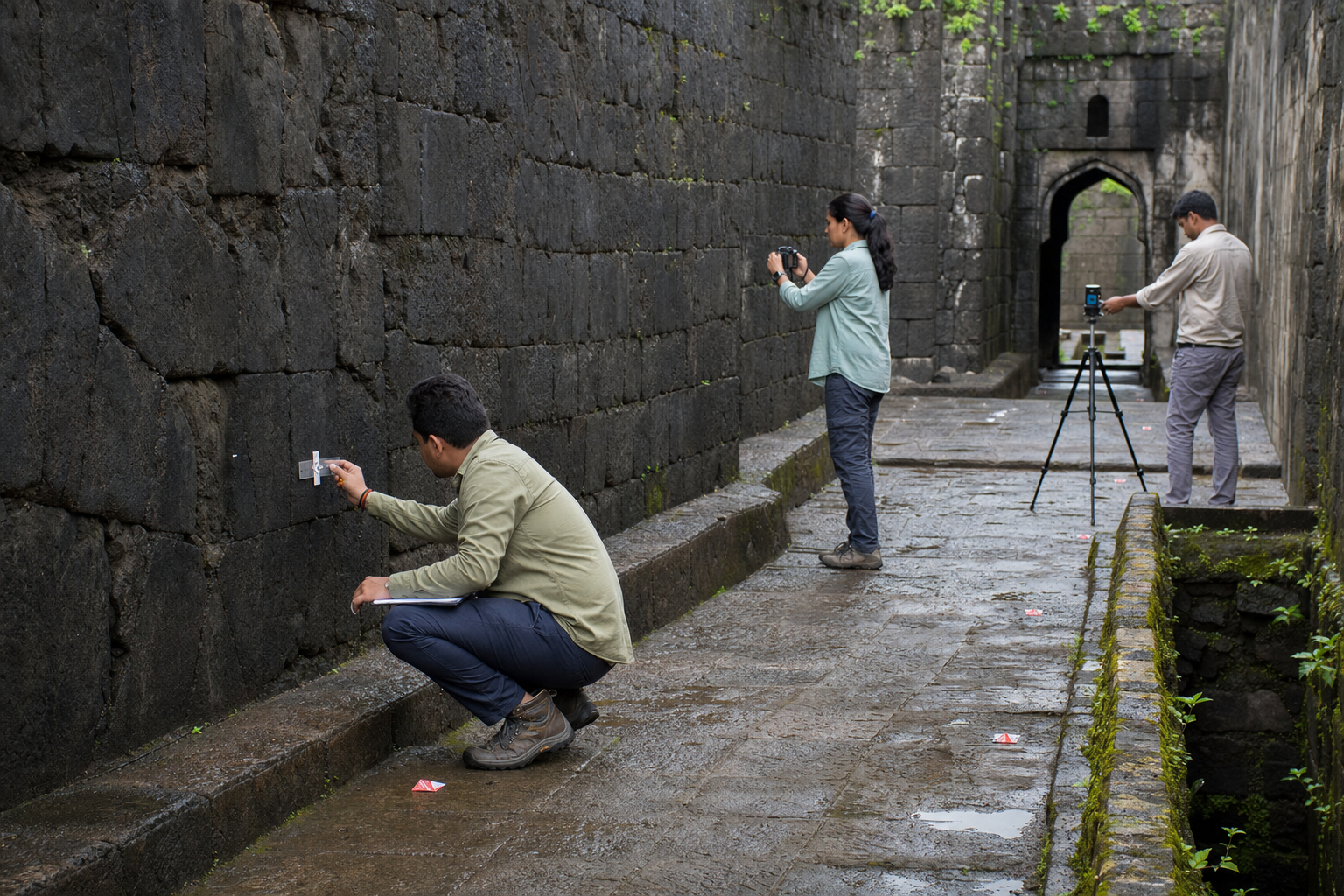
High attendance does not by itself prove that masonry will fail. It does create mechanisms that a competent Heritage Impact Assessment, or HIA, should examine. Repeated movement can introduce dynamic loading and micro-vibrations at gateways, stairs, narrow passages, and weakened spans. Dense crowds can increase local heat and humidity. Where salts and moisture are already present, repeated wetting and drying can contribute to efflorescence, joint deterioration, and surface loss.
Temporary installations create a different class of risk. Nails, drilled anchors, tied cables, abrasive banners, lighting fixtures, and improvised supports can scar old stone or pull at weak joints. On weathered laterite and basalt, apparently small contact damage can matter when surfaces are already delaminating or mortar has been lost. Waste, spilled water, and uncontrolled cleaning can add moisture or abrasion after the crowd has left.
None of these mechanisms should be used as a rhetorical shortcut. The HIA must connect an identified vulnerability to the proposed activity and then state what control would reduce the risk.
Establish the baseline before permission is granted
For a proposed high-footfall event, a proportionate technical package should include:
- Non-destructive testing where the condition of gateways, spans, steps, walls, or other load-sensitive elements is uncertain.
- High-resolution photogrammetry or LiDAR documentation so later change can be compared with a reliable pre-event record.
- Moisture mapping at vulnerable masonry, drainage paths, enclosed areas, and locations where water services are proposed.
- Footfall counters or another verifiable attendance method to establish peak-load profiles rather than relying on rough claims.
- Vibration monitoring at selected structural points where engineers identify a plausible risk from concentrated movement, sound equipment, or temporary installations.
The assessment should produce a site-specific carrying capacity, not a generic number borrowed from another fort. Capacity depends on the route, bottlenecks, structural condition, emergency access, surface durability, weather, and the type of activity. A crowd moving through a narrow gateway is a different load from the same number of people dispersed in an assessed open area.
Define controls and stop conditions, not just a final verdict
A useful HIA does more than say yes or no. It identifies permitted routes, occupancy limits, monitoring points, installation rules, and observable conditions that require access to be slowed or stopped. The pre-event scan and condition survey should be repeated afterward so that damage, if any, can be distinguished from pre-existing deterioration.
For continuing management, a periodically updated digital model of the fort can bring structural observations, moisture records, photographs, and footfall data into one system. It will not replace an engineer or conservation architect, but it can show whether cracks, damp zones, or surface loss are changing between events and monsoon cycles.
Conservation can accommodate devotion without sacrificing the core
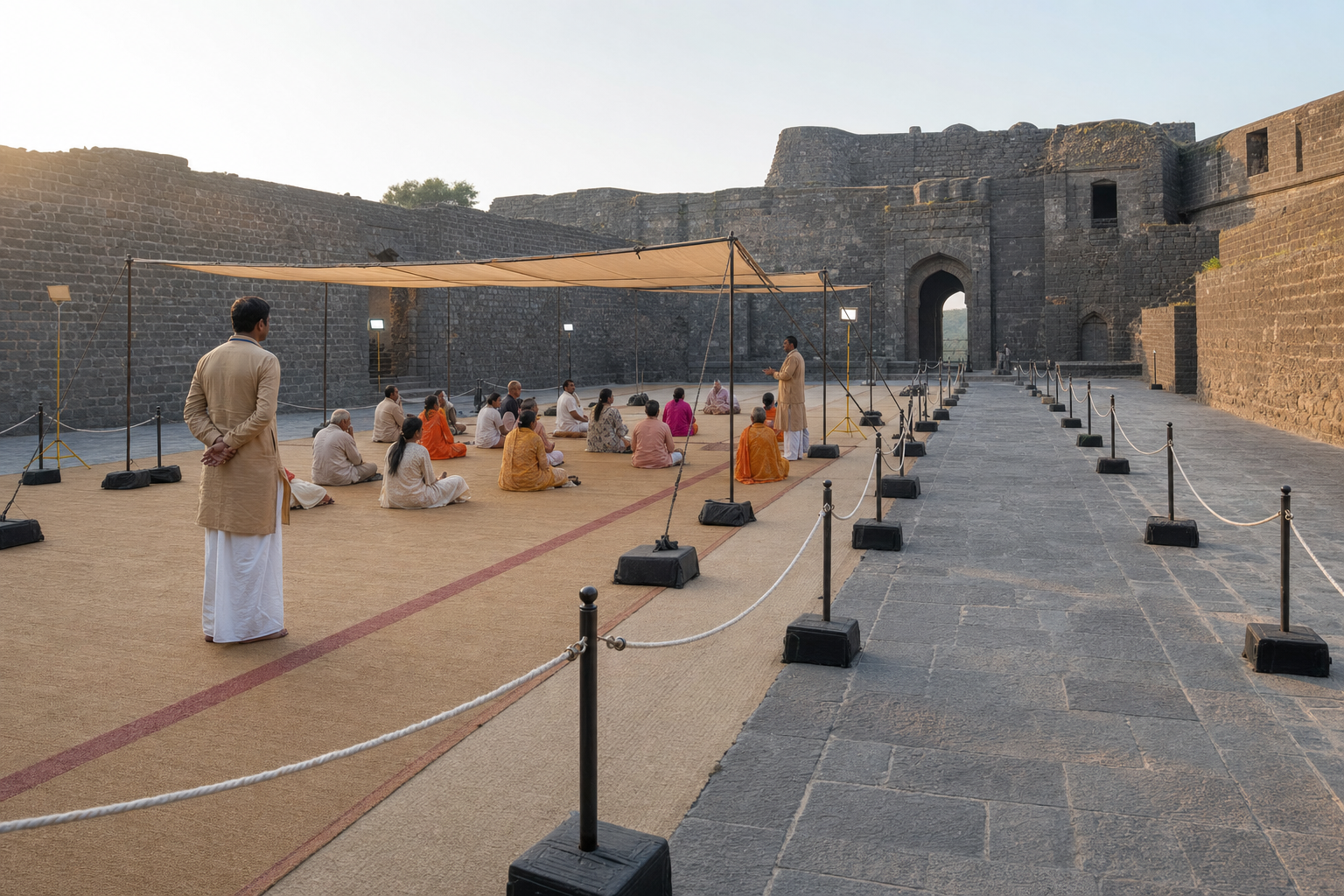
Until an independent assessment establishes what Vishalgad can safely carry, a time-bound pause on high-footfall components inside the vulnerable core is the most defensible interim measure. The pause should have a stated purpose, a responsible authority, and a path to a decision. An indefinite restriction without assessment invites distrust; immediate permission without a baseline leaves the fort and visitors exposed.
Relocation is often the practical middle path. Major congregational elements, amplified programmes, temporary stages, service stations, and designated vending can be placed in a suitable area outside the sensitive core when the HIA finds that their intensity exceeds the monument’s capacity. Lawful, quiet individual devotion can then be considered separately under controlled access. Relocation preserves the religious purpose while removing avoidable pressure from the most fragile setting.
If permission is granted for any organised activity in the protected precinct, the order should contain conditions that can actually be inspected:
- One-way or otherwise controlled routes where the assessment requires them, with monitored entry and no unmanaged crowd accumulation at gates or stairs.
- An attendance ceiling derived from site evidence, together with a method for counting admissions.
- Fixed operating hours, applicable sound limits, and a clear end time.
- A zero-fixation rule for historic fabric: no drilling, nailing, adhesive mounting, or tying equipment to old masonry.
- Freestanding or otherwise non-invasive signs, barriers, lights, and cables positioned away from fragile surfaces.
- Designated water and waste points, on-site segregation, scheduled collection, and a documented clean-up.
- Unobstructed emergency egress, a communication system, real-time supervision, and authority to suspend entry.
- Before-and-after condition records and a mandatory conservation audit, with consequences for non-compliance.
These conditions reflect the conservation principles of reversibility, minimal intervention, and compatibility associated with ICOMOS charters and the Nara Document on Authenticity. A temporary installation should leave the monument materially unchanged when removed. If it cannot do that, it does not belong on vulnerable historic fabric.
A standing heritage mediation council could reduce the cycle of accusation and last-minute administrative action. It should include conservation architects, state archaeologists, local government or panchayat representatives, crowd-safety specialists, and Hindu, Buddhist, Jain, Sikh, and Muslim community representatives. Its purpose would not be to negotiate away conservation standards. It would examine the same evidence, propose workable locations and routes, and review compliance before future congregations.
Local livelihoods need not be treated as collateral damage. Designated vending areas, managed visitor circuits, trained guides, clear interpretation, water points, and orderly waste services can improve the visitor experience while reducing improvised pressure on the monument. Heritage protection becomes more durable when local people can see a legitimate role and benefit in good stewardship.
Key takeaways for a credible public intervention
- Ask for a pause on high-load activity until the fort’s condition and carrying capacity are assessed; do not turn that request into a judgment against a faith.
- Demand the protected-status notification, permission order, HIA, event plan, crowd plan, sound permission, waste plan, and post-event audit arrangements.
- Separate quiet individual devotion from a controlled gathering and from a mass event with infrastructure. Each requires a different level of scrutiny.
- Support relocation of intensive elements outside the vulnerable core when the assessment shows that the monument cannot safely accommodate them.
- Insist that the same heritage rules govern every religious, political, civic, and tourism event at Vishalgad.
Build your representation around requests that can be answered
- Identify the exact proposed activity. Name the location, route, structures, sound arrangements, and high-footfall components you want reviewed. Avoid making claims about elements you cannot verify.
- Ask which authority has jurisdiction. Request the fort’s protection notification and the map defining the relevant precinct or regulated area.
- Request the decision documents. Seek the written permission or pending application, technical assessment, conditions, safety plan, and environmental arrangements.
- State the interim remedy. Ask for a time-bound pause on high-footfall activity inside vulnerable areas until an independent HIA and safety review are complete.
- Offer a workable alternative. Request assessment of an external congregation area, controlled routes, and continued lawful quiet access where conservation and safety allow it.
- Ask for measurable permit conditions. Attendance controls, no-fixation rules, sound limits, waste duties, emergency egress, monitoring, and a post-event audit should appear in writing.
- Keep your evidence disciplined. Use dated photographs and official documents where lawfully obtained. Do not enter restricted areas, touch historic fabric, obstruct worshippers, or repeat unverified allegations.
- Request a reasoned public response. Ask the authority to explain what evidence it relied upon and how the same standard will apply to future events.
Use language that protects both the fort and your case
A concise representation can say: I request that no high-footfall event or intrusive temporary installation be permitted within Vishalgad’s vulnerable heritage core until the competent authority publishes the applicable permission, an independent heritage-impact and safety assessment, and enforceable operating conditions. If the assessed carrying capacity is insufficient, please relocate intensive congregational activities outside the core while considering lawful quiet devotion through controlled access.
That wording does not prejudge a community, invent an illegality, or ask the authority to ignore devotion. It asks officials to perform their duty before exposing an irreplaceable fort to a load that may be difficult to reverse.
Vishalgad’s connection with Chhatrapati Shivaji makes its protection a profound civilisational responsibility. Dharma does not require us to choose between reverence for that memory and fairness toward another community. Your next useful step is to ask for the decision file, support an independent assessment, and insist that permission follow evidence rather than pressure.
References
