
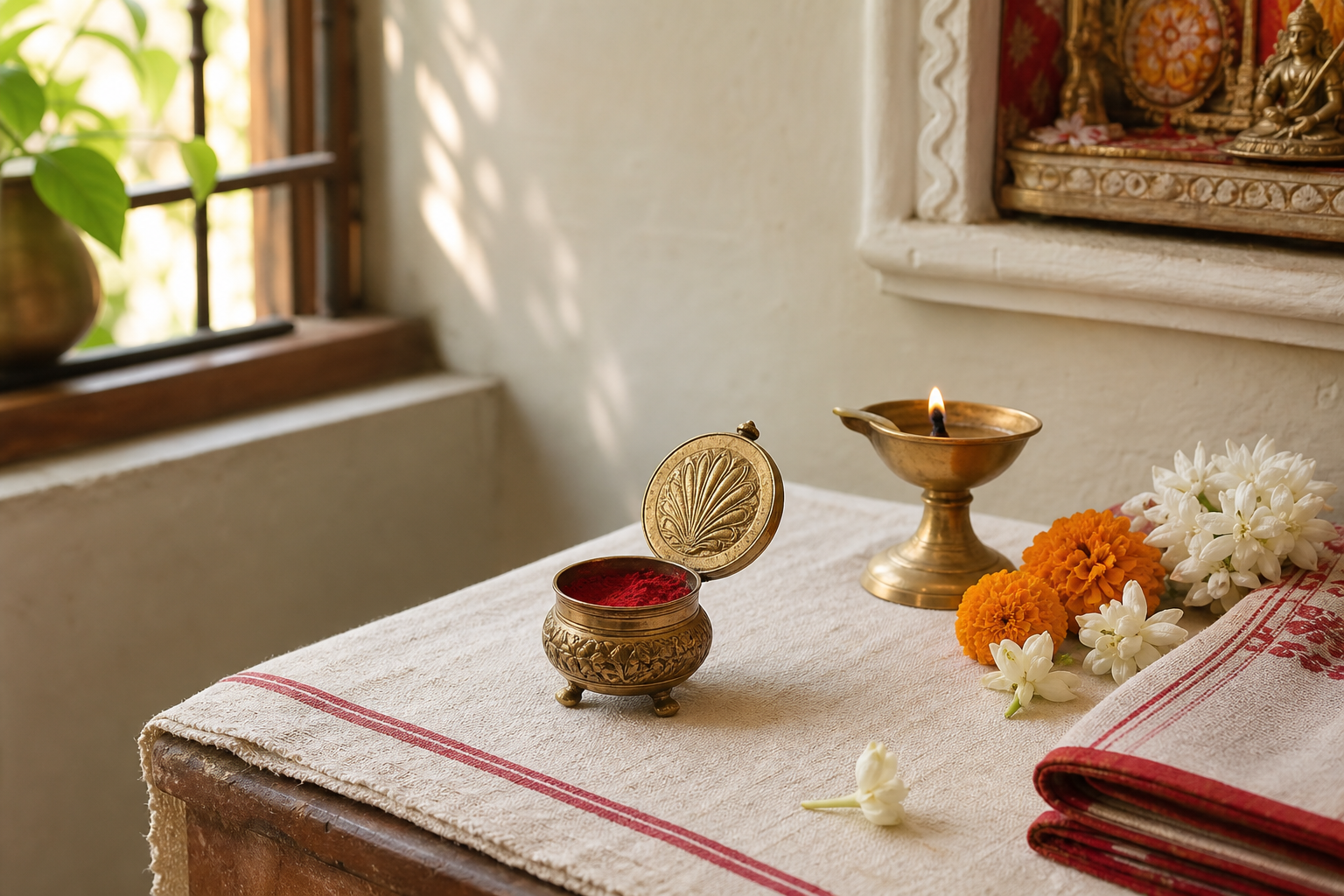
If a Sindoor Dabi has come to you through inheritance, marriage, a visit to Bengal, or the making of a new home abroad, your real question may be simple: how do you use it respectfully without inventing rules that your family never followed?
The answer begins with function. Keep safe kumkum, learn the household paddhati, offer it with attention, and preserve the story attached to the vessel. That is how a small vermilion box remains living heritage instead of becoming either an untouchable antique or an unexplained decoration.
Key takeaways
- A Sindoor Dabi belongs to the daily discipline of worship, not merely to festive display. It protects the powder used to mark a deity, pedestal, kalasha, lamp, or ritual vessel according to household custom.
- Its association with Goddess Lakshmi concerns auspicious, ethically directed prosperity: right livelihood, generosity, gratitude, and responsible care for resources.
- Family and regional paddhatis differ. Preserve the practice you have actually received; if none was transmitted, adopt a modest routine rather than presenting one arrangement as a universal command.
- Use a clearly labelled, trusted, tested, lead-free kumkum or sindoor. Do not apply unidentified old powder to the skin, even when it came in a treasured heirloom box.
- Record the vessel’s names, previous custodian, place of origin, motifs, and customary occasions. Without that information, the object may survive while much of its heritage disappears.
The ritual meaning worth preserving
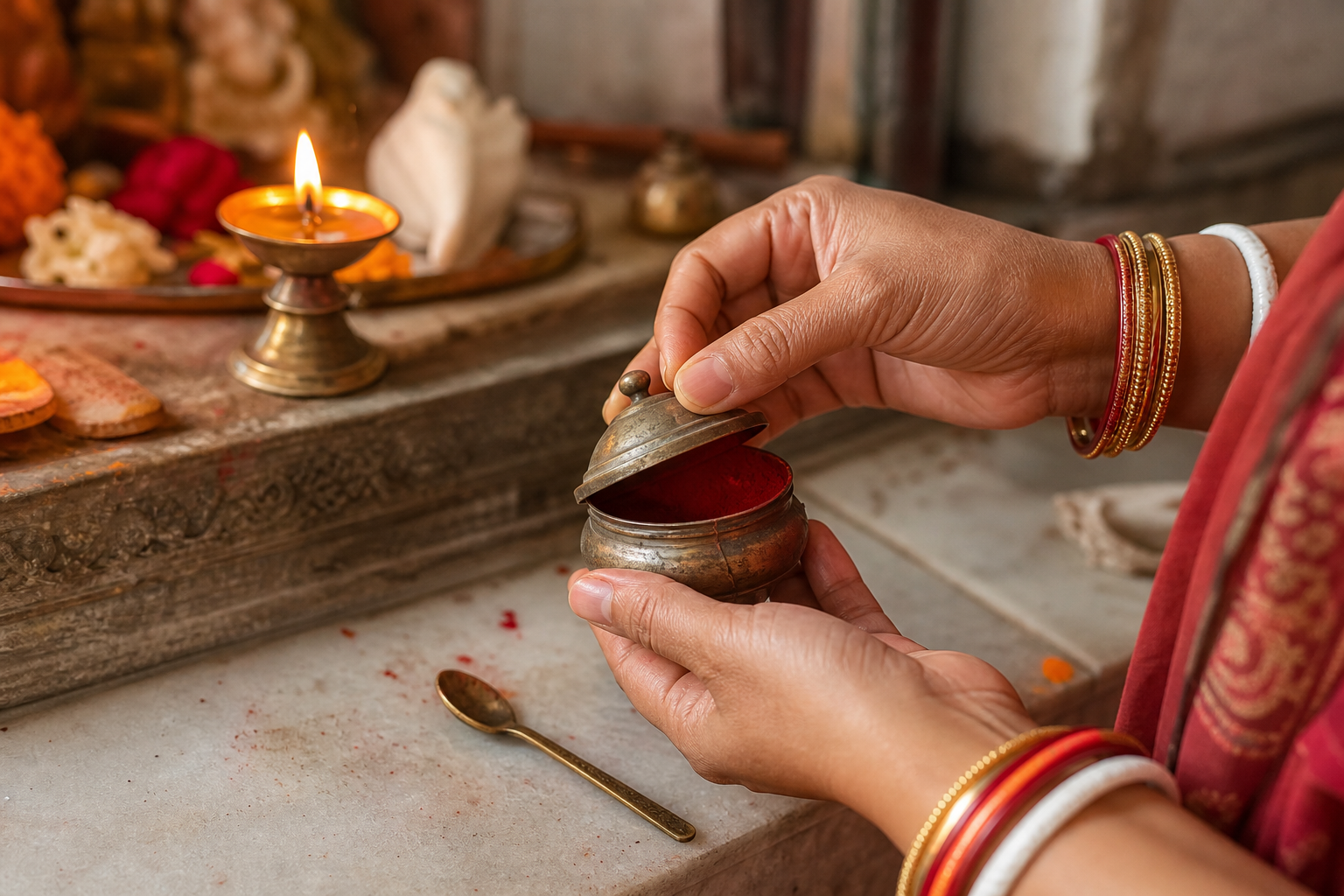
A Sindoor Dabi is neither a prosperity machine nor an ordinary storage jar dressed up as a sacred object. Its significance arises from repeated use. Opening it before the deity, taking only what is needed, making the offering, and returning it to an ordered shrine turn a household possession into part of sadhana.
In Lakshmi worship, red carries associations of vitality, fertility, auspicious activity, and the life-force sustaining a household. The deeper point is not accumulation for its own sake. The red mark calls prosperity toward dharma: wealth earned rightly, used with discernment, shared with generosity, and directed toward family and community well-being. The box therefore holds a practical ethical reminder alongside the powder.
This is why the Sindoor Dabi fits naturally into Lakshmi puja and the wider worship of the Divine Mother. In Panchopachara and Shodashopachara frameworks, fragrant or coloured substances have a recognised place among the offerings. Kumkum may be used during alankara and archana, while kumkumarchana turns repeated offerings into a material accompaniment to the names or praises of the Goddess.
Names and usages vary. A Bengali household may call the vessel Sindoor Dabi or Sindoor Kouto; another family may simply say kumkum box. Sindoor and kumkum may also carry different domestic associations in different regions. If you inherit a vessel, retain the name the family used and ask what substance it traditionally held. The local word is part of the inheritance, not an error that needs standardising.
The most important distinction is between meaning and rigidity. The sacredness of the practice does not depend on declaring every local arrangement mandatory for everyone. Its integrity comes from cleanliness, intention, continuity, and fidelity to the lineage or household custom you actually follow.
A simple home practice that respects family paddhati
If an elder, family priest, or lineage has given you a sequence, follow that sequence. Domestic worship is not improved by replacing received practice with a generic checklist. When no specific instructions survive, however, you can begin with a restrained routine:
- Prepare the vessel. Make sure the Sindoor Dabi is clean and completely dry. Fill it with a small quantity of suitable fresh kumkum rather than pouring in a large supply that may sit unused for a long period.
- Give it a stable place. Set it beside the Lakshmi image, invoked kalasha, or lamp. Placement to the deity’s right is common in some domestic arrangements, but the inherited order of your own shrine takes precedence.
- Begin worship as usual. Complete your customary purification, dhyana, and avahana. The box supports the puja; it does not replace the invocation, mantra, or inner attention.
- Take a small amount cleanly. Use a dedicated little spoon, applicator ring, or the clean finger reserved by your household practice. Avoid repeatedly reaching into the powder with wet or unwashed hands.
- Make only the appropriate marks. Apply kumkum to the deity’s image or pedestal. Mark the kalasha, lamp, or other vessels only where your custom permits it and where the material will not be harmed.
- Close the act deliberately. Replace the lid, return the box to its place, and conclude with gratitude. This closing gesture matters: it restores order and keeps the offering substance protected between observances.
Festival use can be more elaborate without changing this basic logic. During Kojagori Lakshmi Puja in Bengal, the box may sit near the deity among alpana designs and the small footprints showing Lakshmi’s auspicious arrival. Red accents can accompany the white rice-paste designs. In some households, married women exchange kumkum as a blessing for saubhagya and family well-being.
Keep related customs distinct. The communal use of red in sindoor khela after Durga Puja reinforces an association with auspicious continuity, but it is not identical to daily Lakshmi puja. Haldi-kumkum gatherings likewise add a social dimension of blessing, hospitality, and sisterhood. Knowing the setting prevents a memorable public custom from swallowing the quieter household discipline that sustains the Sindoor Dabi through the rest of the year.
You also need not force participation. Sumangali customs have historically emphasised the well-being of married women and their families, while many families now express the blessing more broadly as a wish for health, dignity, mutual respect, and household welfare. Explain the inherited meaning honestly, welcome respectful questions, and let devotion be transmitted without coercion.
Choose safe powder and care for the vessel
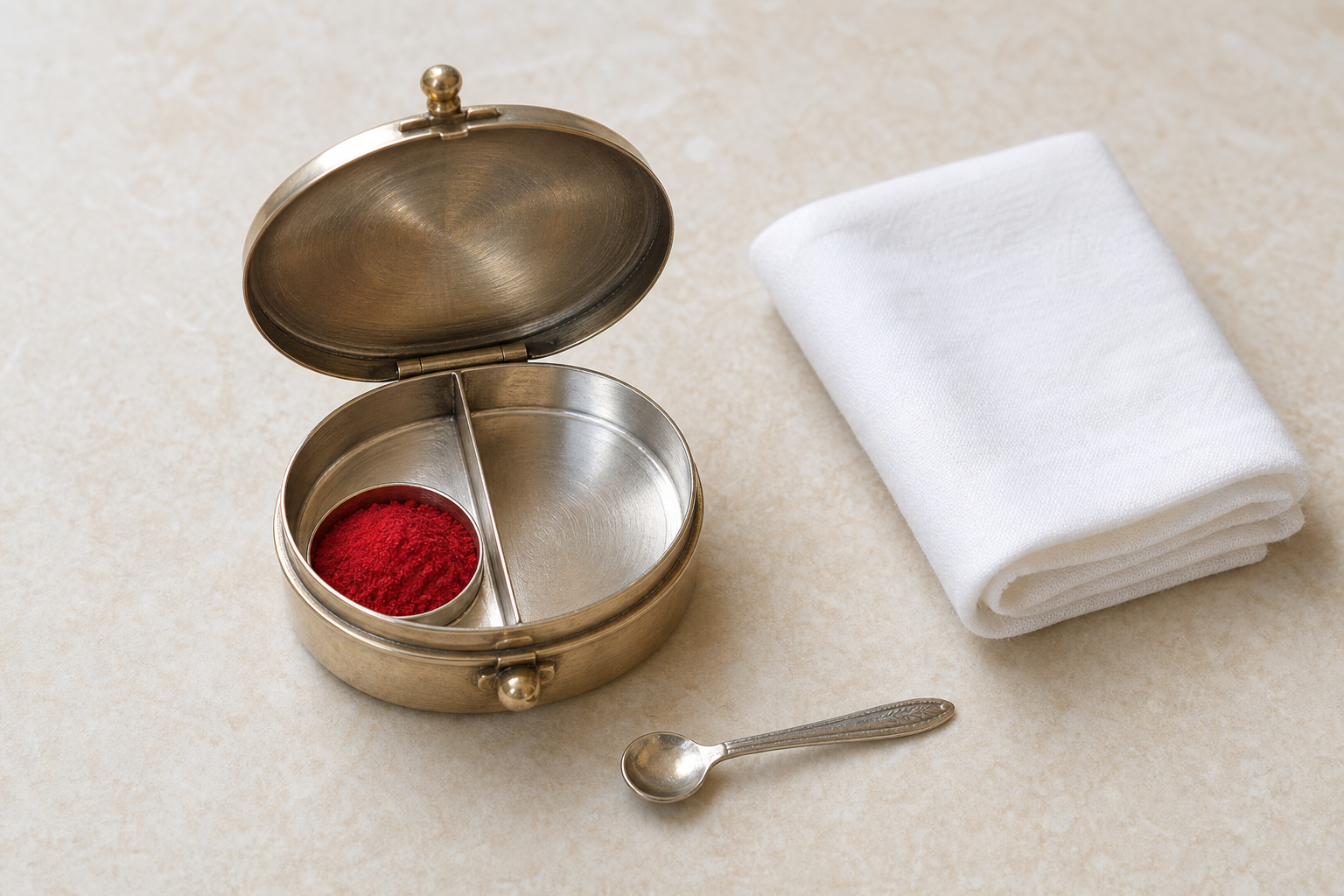
Ritual purity includes practical care. Historically, some vermilion was made from cinnabar, or mercuric sulfide, and unsafe contemporary powders can contain heavy metals. Appearance alone cannot tell you whether an old or unlabelled powder is suitable for contact with skin.
Choose a clearly labelled, trusted, tested product identified as lead-free. Plant-based kumkum made from turmeric and slaked lime is one available form, and certified lead-free formulations are another. If an inherited box still contains unidentified powder, preserve the vessel but do not treat the contents as usable merely because they are old. Dispose of questionable powder safely, clean the container in a way appropriate to its material, dry it fully, and refill it with a product whose composition you can verify. If safe disposal is uncertain, follow local household-hazard guidance.
The vessel itself may be brass, silver, bell metal, terracotta, or another material. None of these automatically makes devotion more sincere. Choose according to the way the box will be used:
- For daily use: favour a stable base, an opening wide enough for controlled access, and a lid that closes cleanly.
- For a humid shrine or kitchen-adjacent space: inspect the interior regularly and keep water, oil, incense residue, and damp flowers away from the powder.
- For terracotta: handle gently and keep it dry; a painted vessel may need more cautious cleaning than unpainted metal.
- For an inherited metal box: do not scrub away maker marks, fine repoussé work, or an old surface merely to make it look new. If the object appears valuable or fragile, seek material-appropriate advice before polishing it.
- For every material: remove the powder before cleaning and do not refill the box until the interior is entirely dry.
Keep only a manageable amount of powder in the box and replenish it periodically. A dedicated applicator reduces unnecessary contact and keeps moisture out. If the powder changes texture, becomes contaminated, or has been handled by many people during a gathering, replace it rather than trying to rescue it. These small habits protect both the people using it and the dignity of the offering.
Preserve the story as carefully as the object
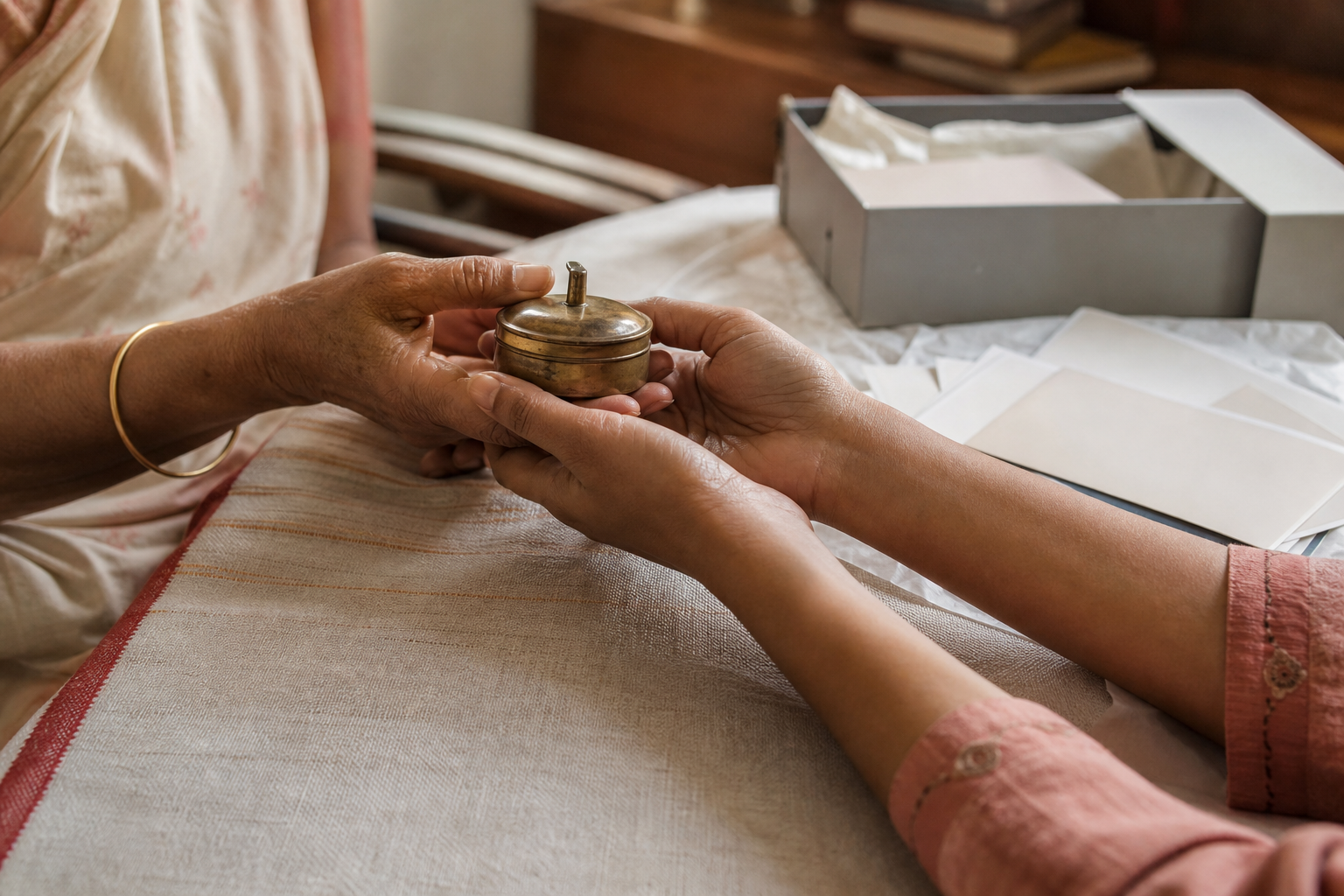
A Sindoor Dabi can tell you where devotion, craft, and family memory meet. Bengali and eastern Indian artisans have produced cylindrical, conical, lotus-shaped, and figurative vessels in brass, bell metal, silver, and terracotta. Common designs include lotus petals, overflowing pots, floral work, and Lakshmi’s owl. Before treating a motif as decoration, ask what it teaches.
The owl is especially instructive. In Lakshmi’s iconography it can represent alertness, discernment, and vigilant stewardship. On a vermilion box, that symbolism sharpens the household ethic of prosperity: guard resources wisely, do not let wealth produce blindness, and make compassion part of its distribution. A child who learns this meaning receives more than the name of an animal carved on a lid.
When you inherit a Sindoor Dabi, create a short record while people who know its history can still answer. Note the names by which it was known, who used it, the town or region associated with it, the festivals on which it appeared, the material, the visible motifs, and any special handling rule. Photograph the box from several sides and record maker marks without aggressively cleaning them first. Store that information with the object or in the family’s shared archive.
This step matters greatly in the diaspora. A compact ritual vessel is easy to carry into a new house and can help establish a recognisable sacred centre in an unfamiliar room. Yet portability can detach an object from the people who understood it. Pairing the physical box with its remembered words, gestures, and occasions keeps migration from reducing living practice to anonymous decor.
The wider Dharmic world also offers resonances without requiring us to erase differences. Red powders and tika appear in some Himalayan and Nepali Buddhist observances. Jain puja trays may include kumkum with chandan and akshata even while Tirthankara images remain unadorned to express transcendence. Sikh teaching centres the Name and ethical action, although red markings can occur within Punjabi family or social ceremonies. These are points of cultural relationship, not proof that every tradition assigns the same theology to red or uses a Sindoor Dabi in the same way.
Choose one concrete act now. Confirm that the powder is safely labelled, ask an elder what the box was called, identify one motif, or establish a clean place for it beside the shrine. Heritage survives when the next correct gesture is made and its meaning is passed to someone who can make it again.
References
