
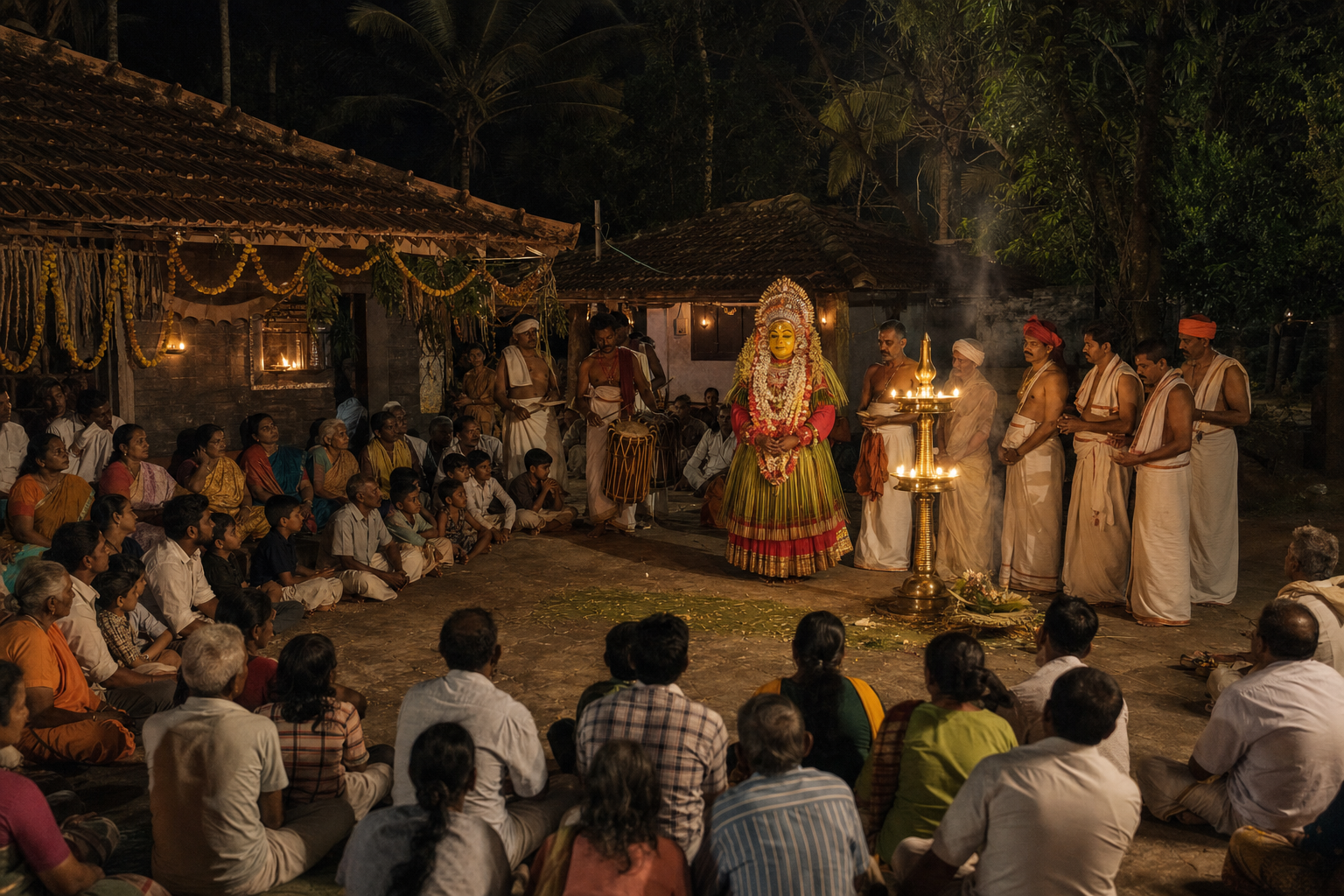
You may be planning to attend a Kallurti-Kalkuda kola, or you may have encountered its drums, lamps, painted ritual medium and public petitions in a recording. The immediate question is simple: are you looking at worship, theatre, an oracle, a village court, or an ancestral legend?
The clearest answer is that these elements belong together. Kallurti-Kalkuda worship is a living relationship among Daivas, hereditary ritual lineages, patron households and the wider community. If you understand that relationship before concentrating on the spectacle, you will know what to notice, how to behave and why justice occupies the centre of the ceremony.
Recognise worship before you interpret the performance
Begin with the local word Daiva. Describing a Daiva only as a character, ghost or folkloric spirit misses the relationship that makes the rite meaningful. Kallurti and Kalkuda are approached as guardian powers connected with place, lineage, vows and moral obligation. Their authority is not confined to a story told on one ceremonial night.
This is why Bhuta Kola should not be treated as a costume performance with a religious preface. Song, movement, ornament, drumming, offerings and embodied speech form one ritual progression. The visible artistry matters, but it serves an encounter. When the Daiva speaks through the medium, the gathering moves from recollection into counsel, accountability and, in some cases, restitution.
Nor does Daiva worship have to be placed outside the Dharmic life of the region. In Tulu Nadu it coexists with worship of Shiva, Durga and village deities, as well as with temple-centred Hindu practice. Dharmasthala offers an especially clear example of this layered religious culture: a Jain hereditary administrative family, Vaishnava priests, the Manjunatha temple and Daiva worship participate in the same sacred landscape. The point is not that every tradition becomes identical. It is that different ritual responsibilities can coexist without demanding a single institutional form.
The physical setting gives you an early clue. A Kallurti-Kalkuda daivastana may include an open area for the kola, a shrine or offering platform, a threshold associated with counsel, and a bhandara, or sacred chest, holding ritual implements. These are not backstage facilities. They define how sacred presence, public witness and community responsibility meet in one place. When you enter, read the courtyard as a ritual assembly rather than an auditorium.
Read the sculptors’ legend as an argument about dharma
The Tulu paddanas, the oral epics sung during the rite, do not preserve a single frozen script. Details vary across tellings and lineages. You should therefore be cautious when someone insists that one short online version contains the complete and universal biography of the Daivas.
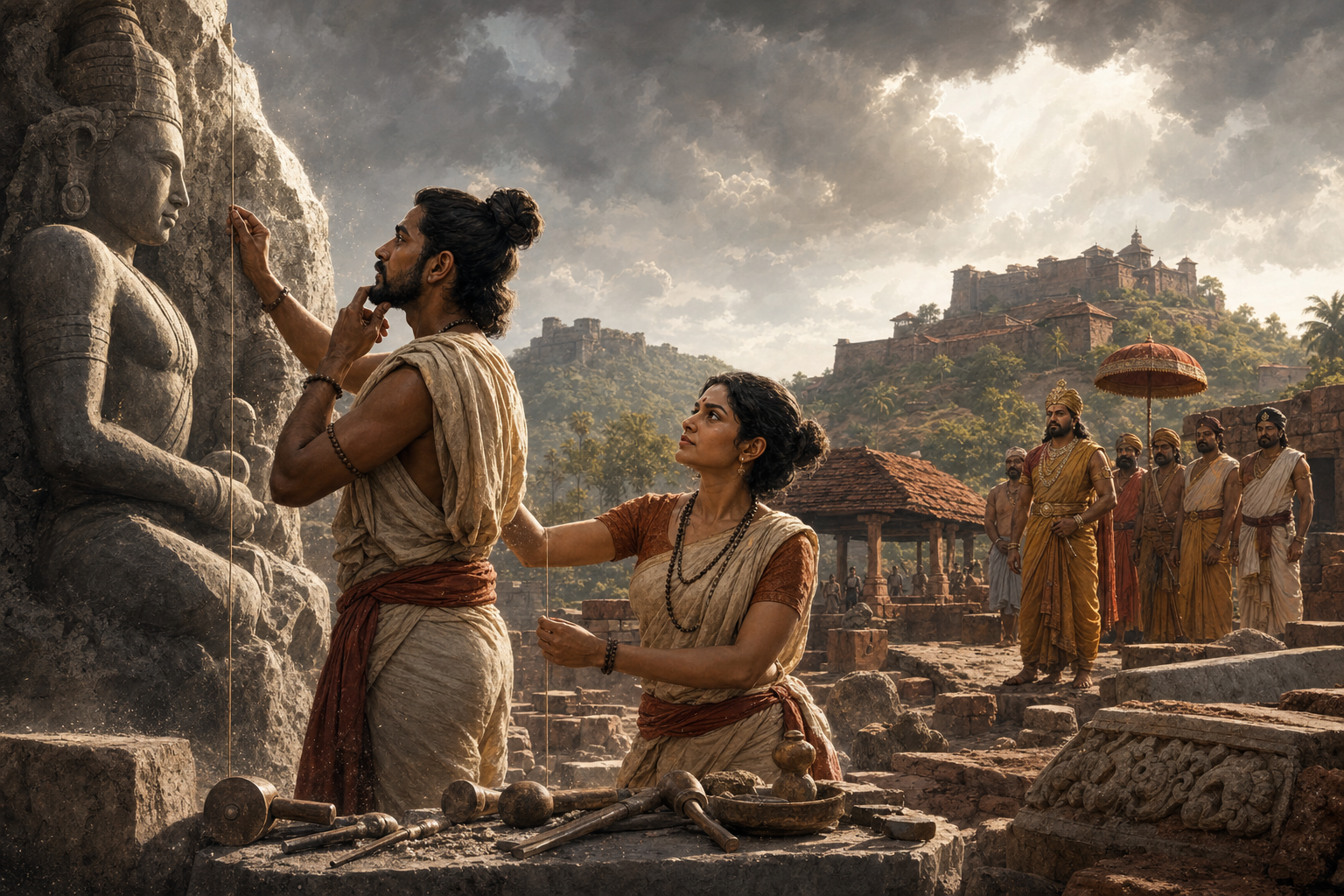
A stable moral pattern nevertheless runs through the variants. An artisan family of exceptional ability becomes entangled with a ruler and an ambitious work in stone. Power turns against the artisans. Depending on the telling, the wrong may involve violence, dispossession, jealousy, insecurity or the denial of rightful payment. The injured truth does not disappear with the victims. It returns through Kallurti and Kalkuda, who demand recognition and ethical conduct as Daivas.
This transformation is the key to the legend. Private suffering becomes a public standard. The community is asked to remember that skill does not cancel a ruler’s duty, authority does not make injustice lawful, and an unpaid or betrayed artisan is not morally expendable. The story is therefore about more than supernatural retribution. It converts the dignity of labour, the obligation to keep one’s word and the restraint of power into sacred memory.
The names have been tentatively connected with regional words for stone, including kallu and kal. That association fits the sculptor tradition, but it should be treated as an interpretive possibility rather than a settled etymological proof. Stone still offers a useful devotional image: it bears weight, retains marks and can receive form without losing substance. In the same way, the Daivas preserve obligations that temporary power would prefer the community to forget.
Kallurti is commonly presented with the commanding bearing of a guardian goddess, while Kalkuda stands as her vigilant masculine counterpart. Do not reduce one to the main figure and the other to an assistant. Their paired presence expresses balance: steadiness with force, restraint with action, memory with intervention. When you listen to the paddana, notice how the dyad prevents justice from becoming the unchecked will of a solitary avenger.
Follow the kola from preparation to embodied counsel
Each shrine and hereditary lineage carries its own ritual authority, so a visitor should not expect a universally standard programme. The local rite is nevertheless precise. Its movement can be understood through the following stages.
- The human calendar is made ready. Kola ceremonies commonly take place during the dry, post-harvest period, when agricultural work allows households and village groups to gather through the night. The actual date belongs to the shrine and its community, not to a generic festival calendar.
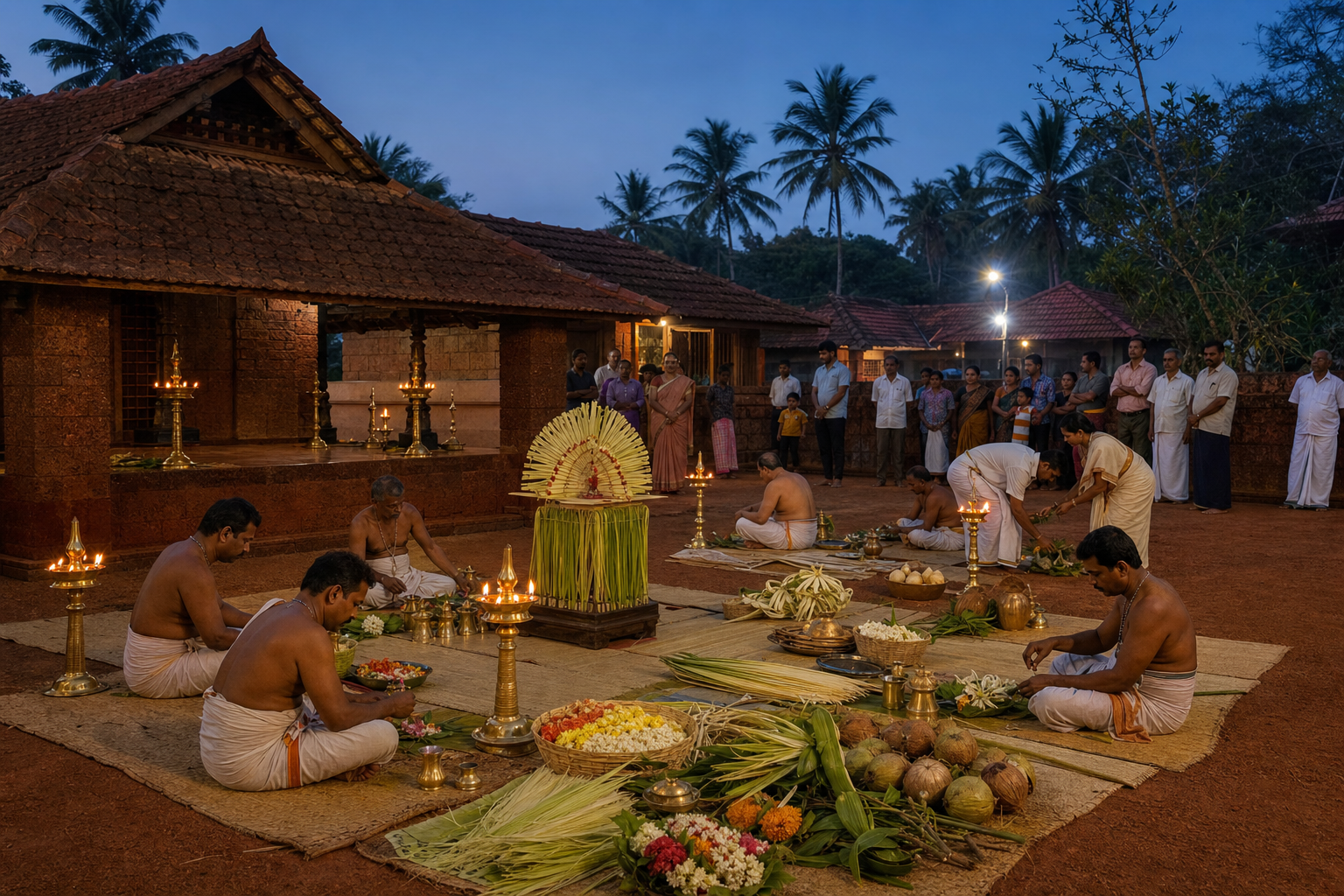
- The ritual ground is prepared. The shrine is cleansed, ceremonial structures may be made from coconut and areca fronds, lamps are established, and bali offerings mark the transition into sacred time. Preparation is already part of worship; the rite has begun before the most photographed figure appears.
- The Daivas’ claims are narrated. Hereditary singers recite paddanas recounting origin, suffering, violated obligations and the basis of the Daivas’ authority. This is the interpretive foundation for everything that follows. If you arrive only for the climactic appearance, you may see intensity without understanding its cause.
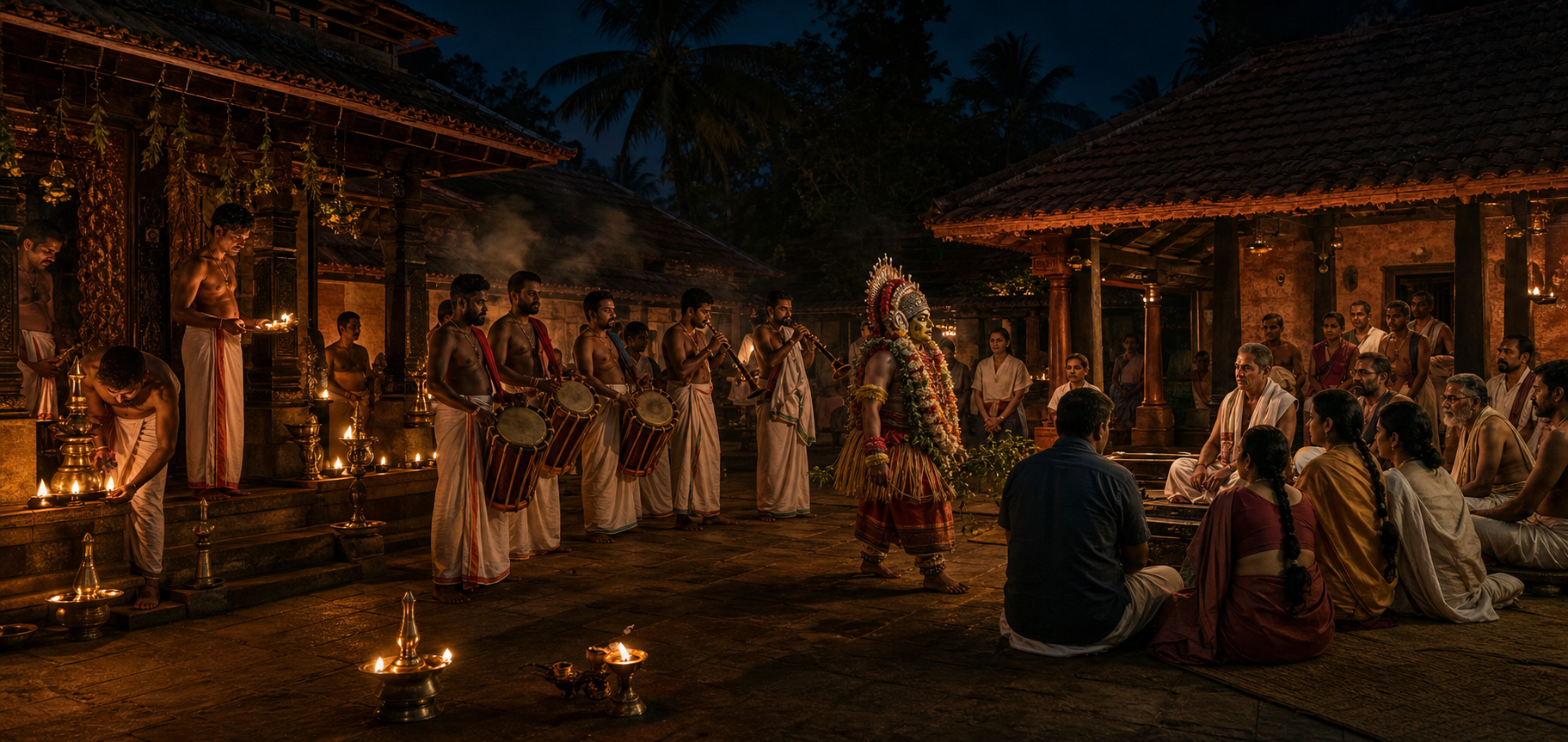
- The medium assumes the ritual form. Layered textiles, waist-bells known as kaggara, anklets, metal ornaments and facial designs made with pigments and rice paste participate in the embodiment. Drums, cymbals and wind instruments shape the change in attention as the rhythm intensifies.
- Narration becomes presence. The medium is no longer approached merely as someone representing a figure from the past. At the culmination of possession, the assembled community receives the speech as the Daiva’s counsel. This is the decisive shift from enacted memory to living authority.
- Petitions and obligations come forward. Matters involving land boundaries, inheritance, interpersonal injury or unfulfilled vows may be presented. The Daiva can question a petitioner’s account, reframe the conflict and direct an immediate or conditional form of amendment. The purpose is often to restore right relationship, not merely to identify someone for punishment.
The people carrying this rite are not interchangeable service providers. Hereditary communities associated with lineages such as Nalike and Parava preserve responsibilities of embodiment, song and ritual accuracy. Patron households provide offerings, hospitality and the material means of the ceremony. Shrine custodians and priests care for the sacred space and its implements. Musicians, metalworkers, textile specialists, food providers and makers of vegetal structures sustain the wider ritual economy. What appears to an outsider as one dramatic figure is actually the work of an interdependent community.
If your aim is to understand a kola, arrive early enough to hear the paddana and observe the preparation permitted to guests. The origin song tells you which injury is being remembered; the later oracle shows you how that memory is applied. Separating the two is like listening to a judgment after discarding the case.
Understand the justice function without turning it into a civil court
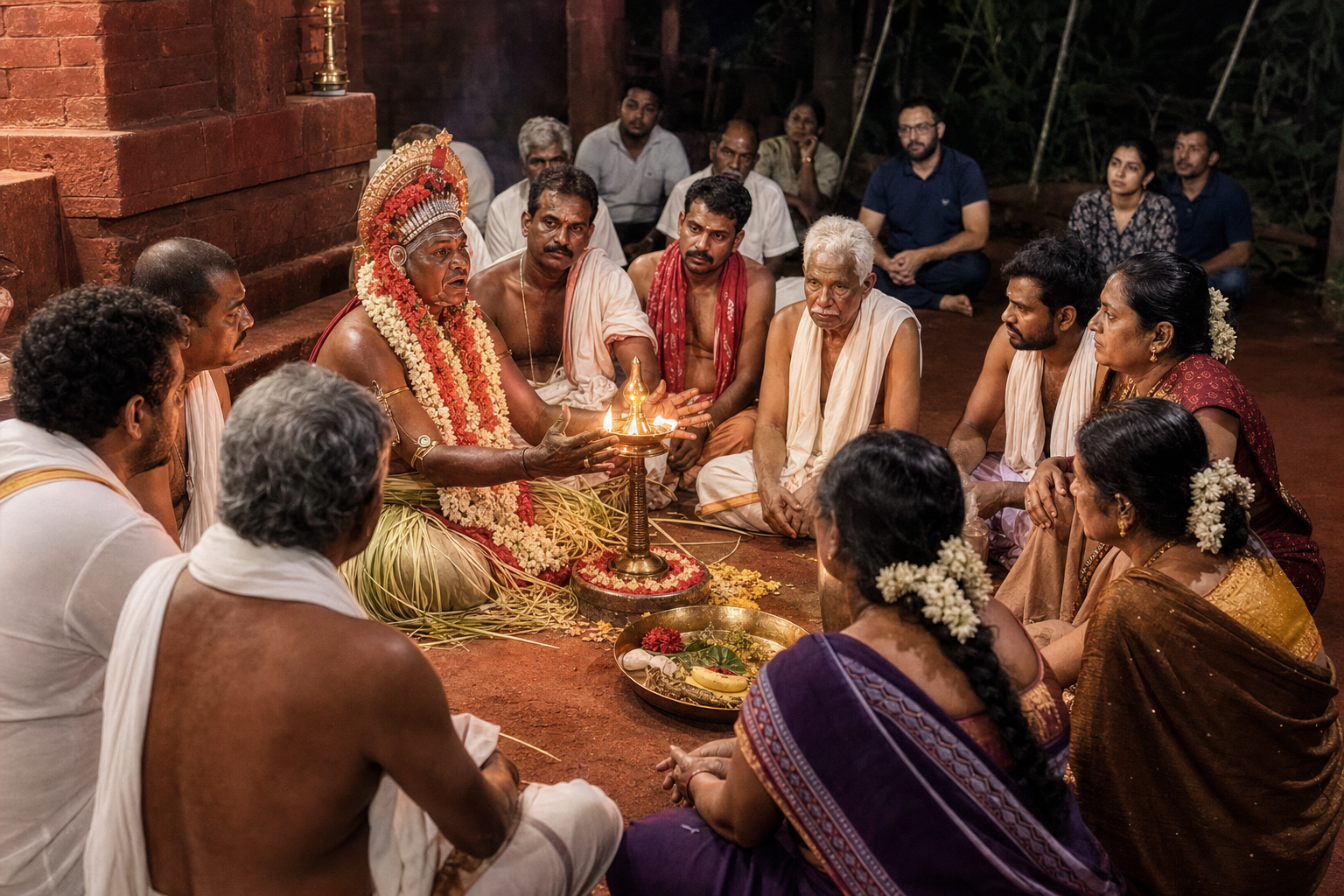
The justice associated with Kallurti-Kalkuda is neither an ornamental theme nor casual fortune-telling. A grievance enters a public, sacral setting. The petitioner speaks before the Daiva and witnesses. Questions can expose omissions, an oath places truth under sacred scrutiny, and a remedy becomes part of collective memory. The ceremony gives moral weight to words that might otherwise be evaded in a private quarrel.
Its closest modern description is restorative justice within a sacred frame. The desired result is not always a winner and a loser. A broken promise may need fulfilment, an injury may require acknowledgement, or a damaged relationship may require material and moral repair. Directions can also be conditional, allowing restitution to unfold over time rather than pretending that every conflict can be settled in one declaration.
Two opposite mistakes obscure this function. One is to dismiss the oracle as irrational theatre because its authority is not produced by a modern bureaucracy. The other is to romanticise it as a complete replacement for every legal institution. Kallurti-Kalkuda kola has historically complemented household councils and village assemblies, and its moral jurisdiction does not displace the court system.
If you are personally involved in a present dispute, keep those domains clear. You may regard ritual counsel as a serious communal and religious obligation while still preserving deeds, inheritance records and other lawful documentation. Where physical safety, property title or statutory rights are at stake, use the appropriate legal process as well. That does not belittle the kola. It recognises that sacred reconciliation and enforceable civil protection answer different parts of a conflict.
Treat a harake, or vow, with the same seriousness. It is not a fee paid to purchase a desired result. A vow creates an obligation remembered by the household and community. Before making one, ask the relevant shrine steward what is being promised, who is responsible for fulfilling it and what local form fulfilment takes. Clarity before the vow is more respectful than an impressive promise later forgotten.
Attend as a guest, not as a collector of spectacle
The safest etiquette is local, because the shrine, patron family and hereditary ritual community set the boundaries of their ceremony. Familiarity with another Bhuta Kola does not automatically give you permission or ritual knowledge here. Use this practical checklist before you attend:
- Confirm the place and occasion. Ask which Daivas are being invoked, who is hosting the kola and when the narrative recitation begins. Kallurti-Kalkuda traditions have local variants, so do not impose a version learned elsewhere.
- Ask before photographing or recording. Permission to stand in the courtyard is not automatically permission to film the medium, petitioners, sacred implements or oracular exchange. A public gathering can still contain intimate religious and family matters.
- Respect ritual boundaries literally. Do not touch the bhandara, ornaments, offerings or other implements, and do not cross a marked threshold unless someone responsible for the rite directs you to do so.
- Listen during the paddana. Conversation over the origin song removes the very context that explains the Daivas’ authority. If you do not understand Tulu, ask for a brief explanation before or after the recitation rather than demanding commentary while it is underway.
- Do not insert yourself into a petition. An oracular hearing may concern land, inheritance, injury or a broken vow. Observe the privacy and gravity that you would expect around any consequential family dispute.
- Use comparisons carefully. Bhuta Kola and North Malabar’s Theyyam share features such as night-long ritual, elaborate adornment and oracular counsel. Kallurti-Kalkuda worship nevertheless has its own Tulu paddanas, hereditary relationships, musical patterns and justice-making context. Similarity is a starting point, not an identity.
- Support through recognised channels. If you wish to contribute, ask the hosts or shrine custodians how to do so. Patronage sustains performers, musicians, craft knowledge, hospitality and the maintenance of the sacred place; it should follow the community’s arrangements rather than become a visitor’s display.
A short recording usually preserves the most visually intense minutes and removes the preparation, narrative and aftermath. Do not let the camera’s selection become your understanding of the religion. The drums and adornment draw attention, but the vow remembered, wrong named and relationship repaired explain why the community has assembled.
Key takeaways
- Kallurti and Kalkuda are worshipped as paired Daivas whose authority joins guardianship, ancestral memory and justice.
- The sculptor legend warns that artistic excellence does not protect workers when political power abandons dharma.
- The paddana is not a decorative opening. It establishes the remembered wrong and the basis of the later oracle.
- The kola aims at truth, accountability and restitution, but it is not a substitute for legal protection where safety, title or statutory rights are involved.
- The most respectful visitor asks local permission, observes shrine boundaries and stays attentive to the community carrying the rite.
If you attend a Kallurti-Kalkuda kola, choose comprehension over collection. Learn the Daivas’ names, arrive before the paddana, ask a responsible local guide what obligation the gathering is renewing, and remain for the counsel if guests are permitted to do so. You will then encounter not a surviving fragment of folklore, but a community making memory answerable to dharma.