
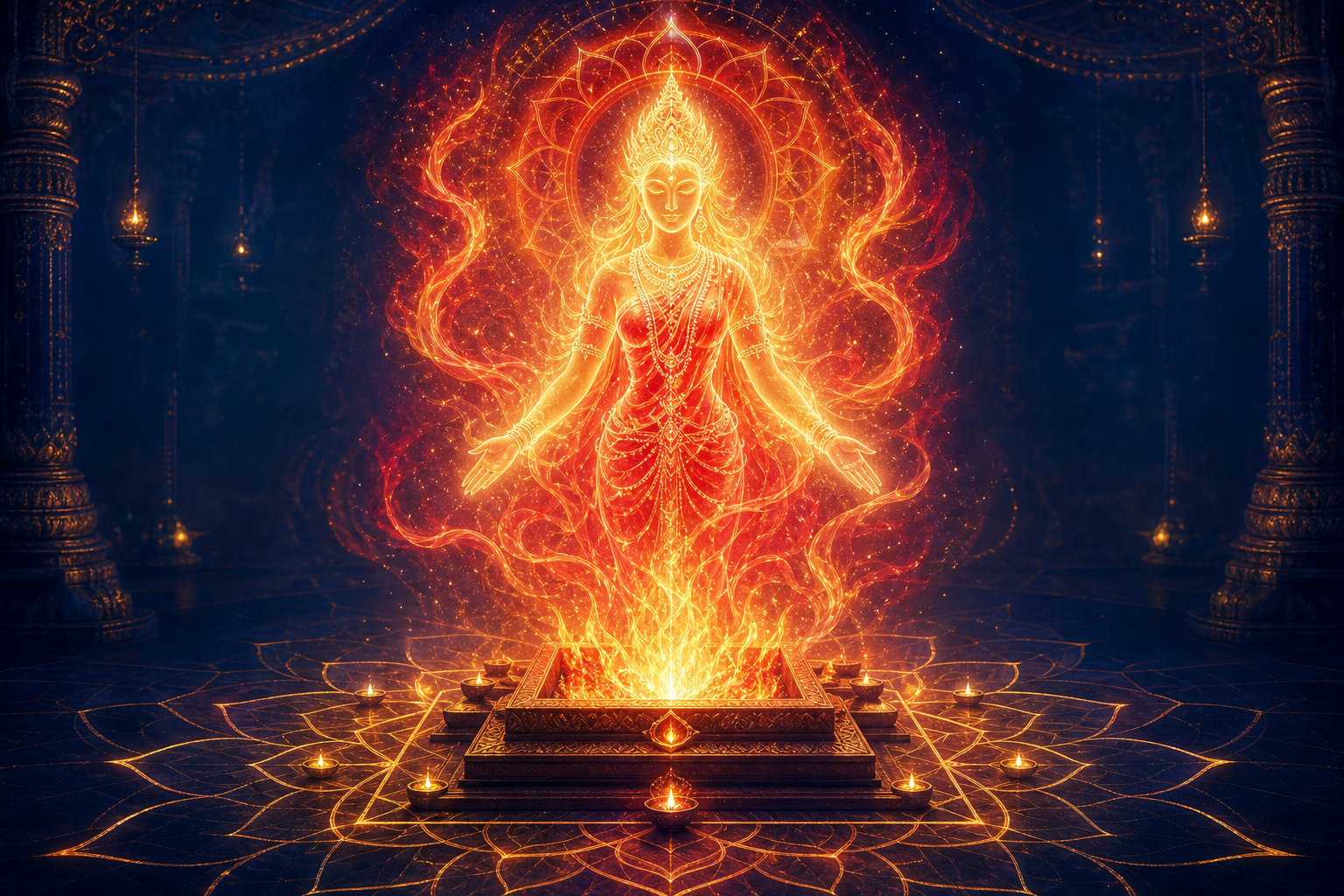
You may have reached Chitagnikunda Sambhuta in the Lalita Sahasranama, translated it as Devi arising from the fire-pit of consciousness, and still wondered what that means for your sadhana. Is it a scene of divine manifestation, a reference to yogic heat, or an instruction to burn away the ego?
Read the name together with the epithets around it and the answer becomes practical. Devi is recognized in lucid awareness; that awareness transforms whatever is placed before it; and the transformation must emerge as dharmic action. This reading lets you contemplate the name without reducing Srividya to either mythology or a search for unusual sensations.
Key takeaways
- Chitagnikunda Sambhuta joins four elements: consciousness, fire, altar-pit, and arising.
- The surrounding names move from the Divine Mother and sovereign presence to awakened awareness and purposeful action.
- Devi’s arising is not necessarily a birth in chronological time. In contemplation, it is the unveiling of a presence that was never absent.
- The outer homa and the inner homa teach the same structure: establish the altar, make a definite offering, and allow transformation to change what follows.
- Bodily heat, visions, and emotional intensity are not the test of chid-agni. Clearer perception, less identification with reaction, and more dharmic conduct are better measures.
The opening names tell you how to read the fire
Chitagnikunda Sambhuta is the fourth name in the commonly transmitted ordering of the Lalita Sahasranama. It does not stand alone. The opening sequence is:
Sri Mata Sri Maharajni Sri Mat Simhasaneshwari | Chitagnikundasambhuta Devakarya Samudyata ||
Lalita Sahasranama, opening verse
The sequence gives you an interpretive discipline. Sri Mata establishes Devi as Mother. Sri Maharajni reveals Her sovereignty. Sri Mat Simhasaneshwari places Her upon the auspicious throne. Only then does Chitagnikunda Sambhuta present Her as arising from the altar of consciousness-fire. The next name, Devakarya Samudyata, turns that manifestation toward the accomplishment of a divine purpose.
This order keeps two common distortions in check. If you isolate the fire from the first three names, contemplation can become an impersonal exercise in managing your mental state. The Mother, Queen, and enthroned Goddess disappear, leaving only a technique. If you stop at the fourth name and ignore Devakarya Samudyata, inward clarity can become a private refuge that never alters your responsibilities.
Srividya joins realization and responsibility. The awareness in which Devi becomes evident is not meant to produce spiritual self-absorption. It prepares the sadhaka to act with less confusion, vanity, and resistance. In daily practice, devakarya need not be converted into a grand personal mission. Begin with the rightful task already in front of you: telling the truth without cruelty, completing a neglected duty, correcting harm, serving someone without self-display, or declining an adharmic action.
When you recite the opening verse, therefore, hold the fourth and fifth names together. After Chitagnikunda Sambhuta, ask where awareness is being obscured by habit. After Devakarya Samudyata, ask what action would become possible if that obscuration loosened. The first question turns you inward; the second prevents you from remaining there.
The four parts of the name form one instruction

You will encounter both Chitagnikunda Sambhuta and Chidagnikunda Sambhuta in transliteration. They retain the same central meaning. The compound can be approached through four linked terms:
| Element | Working meaning | What to notice in practice |
|---|---|---|
| Chit | Consciousness or knowing awareness | Every perception, thought, and reaction becomes known within awareness. |
| Agni | Fire | Awareness illuminates what is present and transforms your relationship to what it reveals. |
| Kunda | A structured altar-pit | Transformation needs a stable field, a definite offering, and disciplined attention. |
| Sambhuta | Arisen, manifested, or brought forth | Devi becomes evident where consciousness is recognized as luminous. |
Together, the name identifies Devi as She who arises from the altar-pit of consciousness-fire. The movement of the compound is source-like: Her manifestation is from chid-agni-kunda. Yet the word arisen creates an important philosophical question. If Devi is boundless reality, how could She begin to exist at a particular moment?
For contemplation, the arising is best understood as a dawning of recognition. Devi does not move from non-existence to existence. What changes is the sadhaka’s capacity to recognize the luminosity that was already present. Sunrise offers a useful analogy: the appearance of light in your field of vision does not mean the sun was created at dawn. In the same way, sambhuta can name disclosure rather than manufacture.
This does not reduce Devi to a mental event. Your personality is not the creator of the Goddess, and an intense mood is not Her measure. The contemplative point is that consciousness is the place of recognition. Srividya directs attention through the mind while refusing to make the limited mind the ultimate reality.
The fire image also needs precision. Vedic Agni carries offerings, mediates between human and divine, and purifies both the offering and the one who offers. When joined with chit, fire is no longer merely a visible flame dependent on fuel. It becomes the incandescence of awareness: the capacity by which confusion is exposed, attachment is made visible, and avidya loses its unquestioned authority.
- Do not mistake consciousness-fire for ordinary heat. The manipura chakra is associated with the fire element, but a warm abdomen, a surge of energy, or another bodily sensation does not by itself establish realization. Chid-agni points beyond bio-energetic intensity to the awareness that knows every sensation.
- Do not turn ego-burning into hostility toward yourself. What becomes combustible is identification with ahamkara’s claims: the insistence that a passing role, reaction, possession, or opinion is the whole of what you are. The aim is not to erase a functioning personality or cultivate worthlessness.
- Do not confuse emotional force with purification. Anger can feel fiery while leaving delusion untouched. The transformative fire is the awareness that reveals the anger, its motive, its story, its likely consequence, and the possibility of a different response.
Vibhuti, the ash associated with sacred fire, sharpens this distinction. Ash is not a symbol of personal annihilation. It recalls what remains when combustible claims have lost their hold: clarity, simplicity, and equipoise. When you contemplate the name, the useful question is not whether you felt consumed. Ask whether a false certainty, defensive story, or compulsive reaction became easier to see through.
The outer homa teaches you how inner transformation works

A havan kunda is not an arbitrary container for fire. It is an ordered space in which offerings such as ghee, grains, and herbs pass through flame and are transformed. The ritual gives visible form to a movement from gross to subtle. Srividya interiorizes that movement without dismissing the outer rite: the heart becomes an altar, attention provides the field, and habits or identifications become offerings.
If you attend an outer homa, watch its structure rather than treating the flames as spectacle. Three features can guide your inner practice:
- The kunda establishes a boundary. Inner work also needs a defined field. Choose one reaction or attachment instead of vaguely trying to destroy the entire ego.
- The offering is concrete. A ritual does not offer an abstraction called everything. In contemplation, name the actual pattern: interrupting when corrected, postponing a duty, rehearsing resentment, seeking praise, or refusing to admit uncertainty.
- The offering does not emerge unchanged. Insight that leaves conduct exactly as it was has not completed the movement symbolized by fire. Your next response should carry some evidence of the transformation.
This structure also clarifies the relation between the heart and manipura. Manipura supplies a familiar yogic language of fire, will, and transformation. The heart-lotus supplies the image of an inner altar where awareness opens without obstruction. Chitagnikunda Sambhuta does not require you to choose one chakra as a literal furnace. It asks you to recognize that energetic change becomes spiritually meaningful only when it is illumined by consciousness and expressed through a refined intention.
The Sri Chakra extends the same principle. Its interpenetrating triangles form a cosmogram of consciousness, while Navavarana puja moves through nine enclosures. Those enclosures can be contemplated as successive refinements of attention, intention, and identity. The opening name supplies the orientation for that inward movement: every enclosure must be entered in awareness, and every refinement must loosen a more limited way of seeing.
This vocabulary belongs distinctly to Srividya, but the pattern has wider Dharmic resonances. Buddhist disciplines direct insight toward the transformation of kleshas. Jain tapas, especially internal austerity, is associated with purification from karmic accretions and the unveiling of knowledge. Sikh simran and seva oppose the separative hardness of haumai through remembrance and service. These are analogies, not interchangeable doctrines. Their shared grammar of purification, remembrance, insight, and ethical action helps you recognize why sacred fire is more than an image of destruction.
The practical test remains consistent: does the discipline make delusion easier to identify and compassionate responsibility easier to fulfil? If comparison merely produces a claim that all traditions are the same, it has flattened them. If it helps you notice a civilizational commitment to transforming egoic bondage into lucid conduct, it has served a useful purpose.
Use the name as an inner homa without chasing spectacle

The following exercise is a contemplative application of the name, not a replacement for a lineage-specific Srividya ritual. If you have received a formal method, keep its instructions intact. This simpler practice is for understanding the name and carrying its meaning into conduct.
- Name one offering. Choose a pattern that can be observed in behaviour. Write or state it as an action rather than a sweeping identity. I become dismissive when corrected is workable; I am an egoistic person is too broad and easily becomes self-condemnation.
- Establish the inner kunda. Sit steadily and let the exhale lengthen gently without force. Bring attention to the heart as the symbolic altar. The purpose is not to visualize an anatomical fire-pit. It is to create a stable field in which you can remain present to what is usually avoided.
- Kindle recognition. Recite Chitagnikunda Sambhuta slowly enough to distinguish chit, agni, kunda, and sambhuta. Notice the awareness in which the sound, breath, body, and thoughts are already appearing. Do not try to manufacture heat, light, or an altered state.
- Make the offering precise. Recall one recent instance of the chosen pattern. Identify the trigger, the story you told yourself, the action that followed, and its consequence. Hold each element in awareness without defending it and without turning it into a permanent definition of yourself. What is offered is the claim that the reaction must be obeyed because it is who you are.
- Read the ash. Let the remembered scene subside. Ask what becomes clear when the justification is no longer being fed. The residue may be a simple recognition: you were protecting status, avoiding discomfort, seeking control, or refusing responsibility. Convert that clarity into one cleaner response, such as listening before replying, making an apology, setting a truthful boundary, or completing the duty you postponed.
- Complete the movement with devakarya. State one dharmic action that follows from what you saw and carry it out. This step prevents contemplation from becoming a private performance. The fire has done its work when awareness changes participation in the world.
The model of the three gunas can help you choose the next action. When tamas dominates, the needed transformation may be movement: begin the duty you keep avoiding. When rajas dominates, more activity is not necessarily purification; refine haste, aggression, and self-display into steadier effort. When sattva becomes available, stabilize clarity through compassionate action rather than claiming spiritual superiority.
This is why transformation is usually rhythmic rather than theatrical. One habit becomes visible, one identification loosens, and one action changes. The process is repeated. Trying to burn everything at once often becomes another demand made by ahamkara, now dressed in spiritual language.
Evaluate the contemplation with direct questions. Did you see the pattern more accurately? Did it feel less identical with who you are? Did a concrete dharmic action follow? If the main result was bodily heat, vivid imagery, or emotional intensity, do not treat that intensity as proof. The opening verse places the fire of consciousness beside divine purpose, so lucidity and responsibility remain the sounder criteria.
At your next recitation, pause over the fourth and fifth names together. Offer one identifiable habit into clear attention, then complete the rightful action that clarity reveals. That is where Chitagnikunda Sambhuta ceases to be a difficult compound and becomes a living orientation for Srividya.