
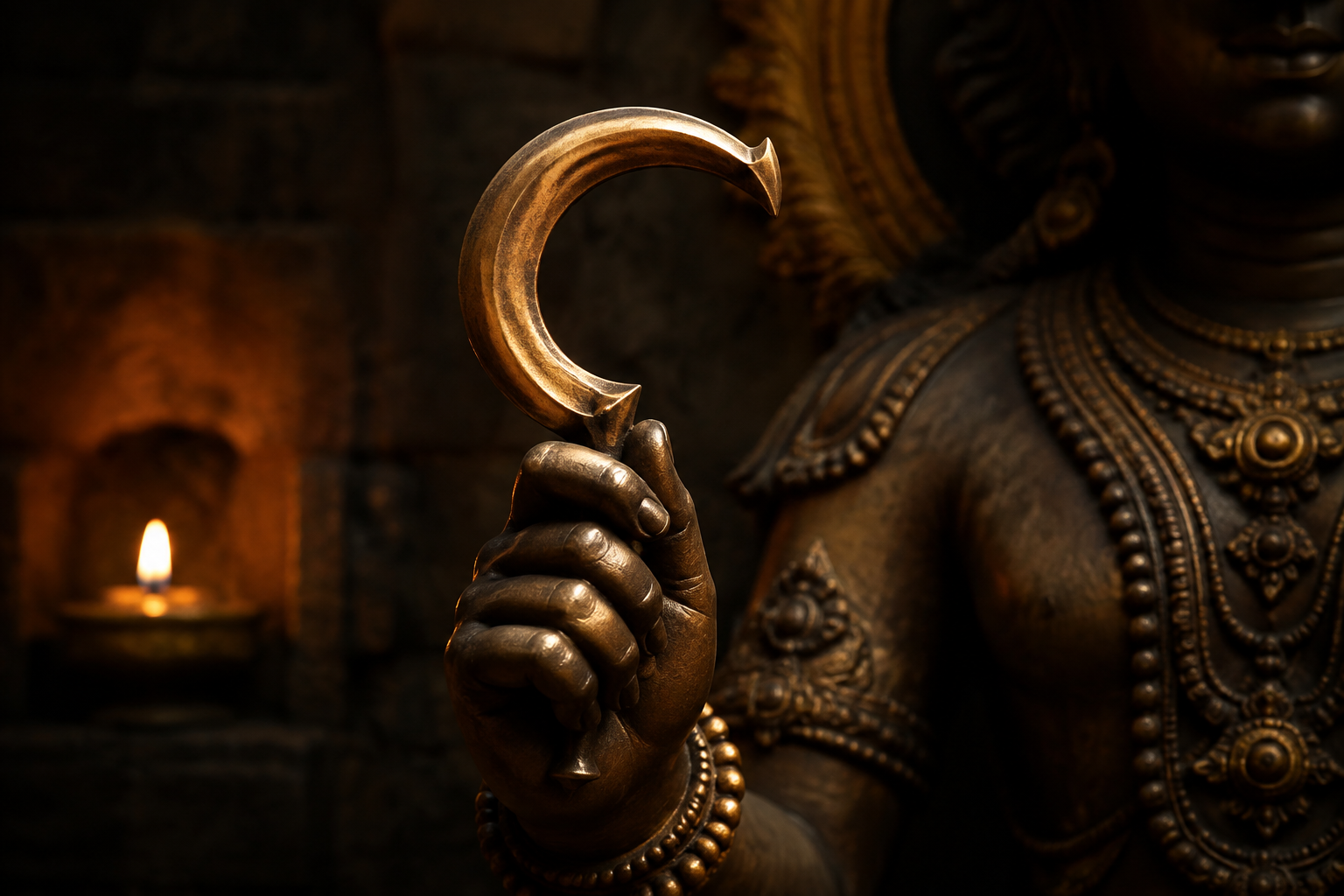
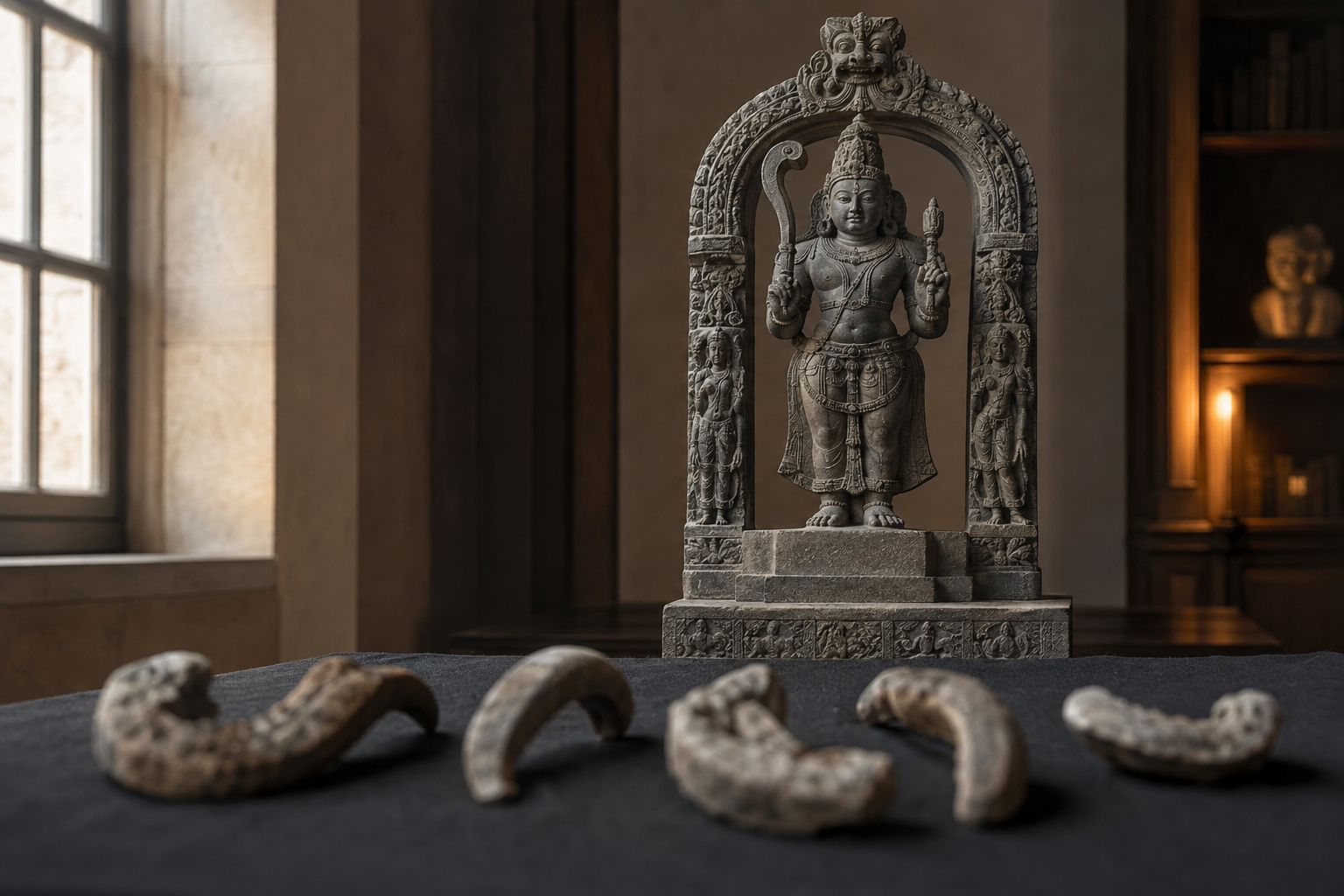
You notice a small curved object in the hand of a Hindu deity. It resembles a hook, a sickle, or perhaps a damaged blade. A label calls it the Srini, but that name alone doesn’t tell you what you are meant to see.
The useful question is not simply, “What object is this?” You also need to ask what the object does, how securely it can be identified, and what its action contributes to the sacred image. That method will help you read the Srini without reducing it to an ordinary tool or loading it with symbolism the sculpture cannot support.
Start with the curve before interpreting the symbol
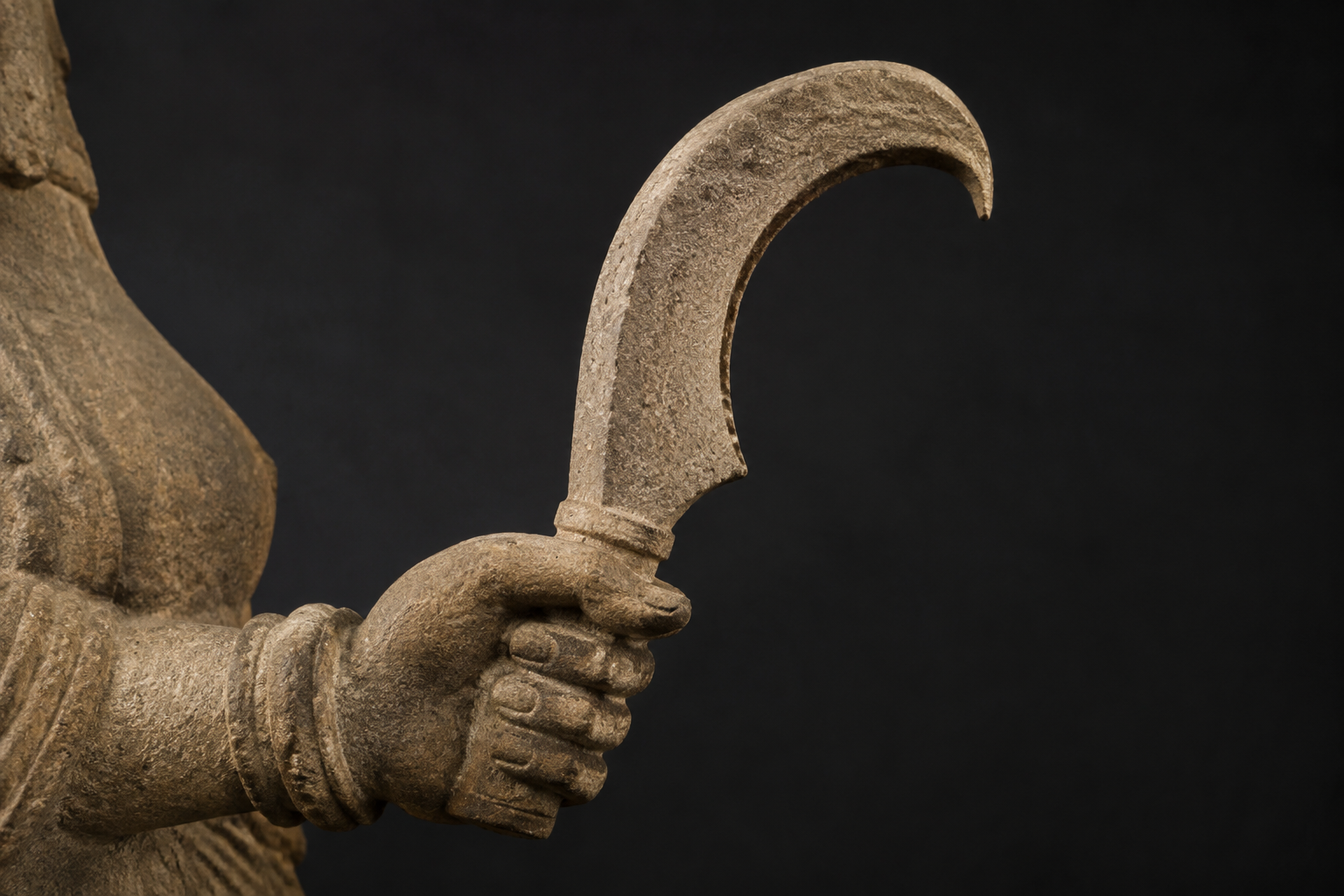
The Srini belongs to the curved or cutting class of Hindu sacred implements. Its form is described as hook-like or sickle-like, and it is counted among the ayudhas: the weapons and implements carried by divine figures in Hindu iconography.
That description gives you a sound starting point, not permission to call every crescent-shaped object a Srini. A worn blade, a hook, a looped ornament, and a decorative flourish can approach the same silhouette in a small or weathered carving. Begin by recording what is visible before assigning a name.
- Locate the object precisely. Determine whether it is held as an attribute, attached to another object, or merely part of the surrounding ornament.
- Trace the surviving outline. Look for a working form that bends like a hook or presents a sickle-like cutting curve. Note breaks and eroded areas rather than mentally completing them.
- Check the orientation. Record which hand holds it, where the curve faces, and whether the object points toward or away from the body.
- Preserve the uncertainty. If the carving supports “curved implement” but not “Srini,” stop at the broader description until the surrounding iconography supplies more evidence.
Where photography is permitted, take one image of the complete figure and one close view of the object. A tightly cropped photograph may preserve the curve while removing the very context needed to identify it.
Read the Srini through the actions of edge and hook
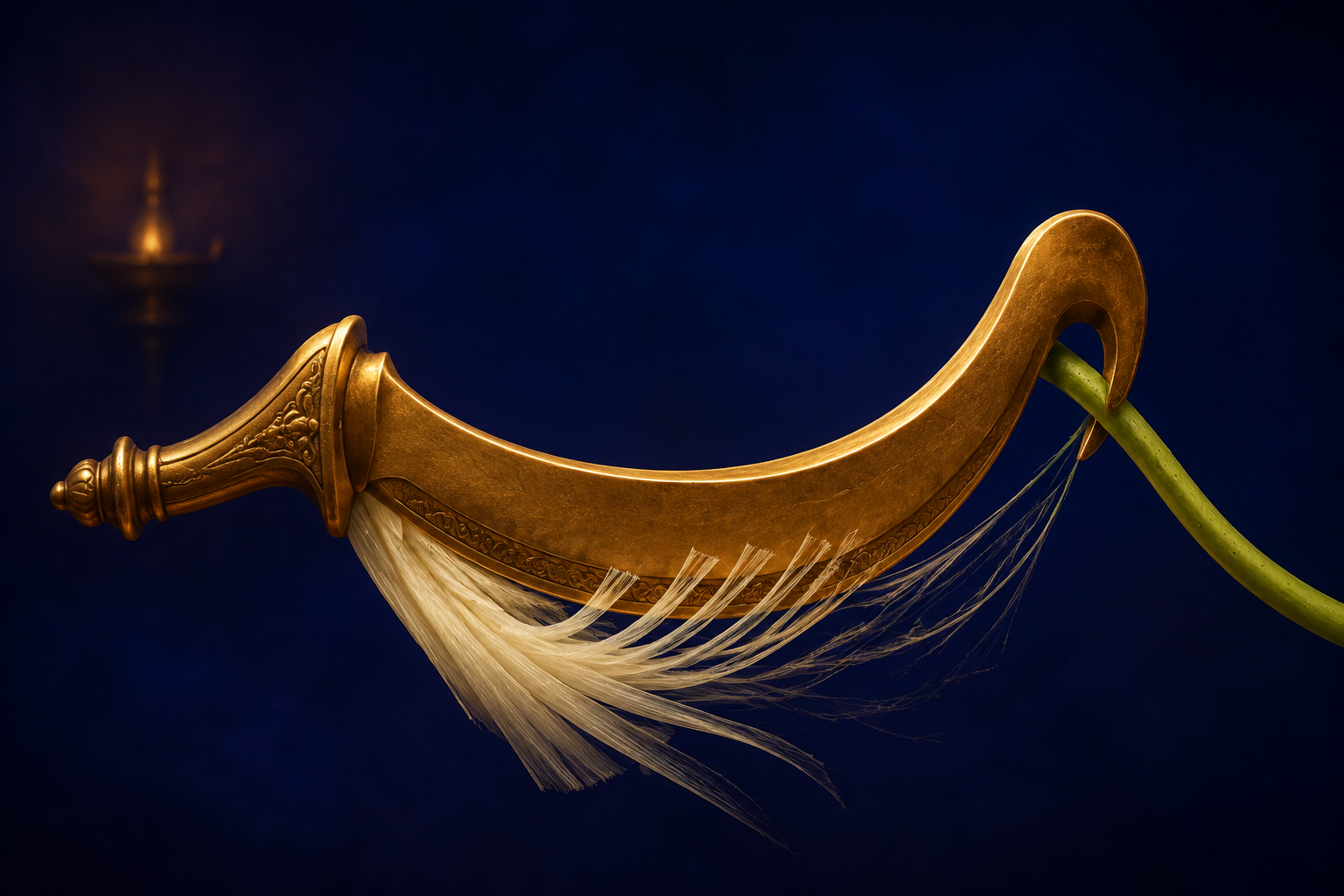
A divine implement is not just an identification label. Its physical action can also make a spiritual principle visible. With the Srini, the two clearest actions are cutting and catching. These actions provide a disciplined range of interpretation, although they do not create a fixed symbolic dictionary.
The cutting edge: separation with purpose
A cutting implement separates one thing from another. In a contemplative reading, that action can suggest the removal of an obstruction, the severing of an attachment, or the exercise of discernment. The emphasis should fall on purposeful separation rather than violence for its own sake.
If the outline distinctly evokes a sickle, its familiar agricultural action can deepen the meditation: a sickle cuts in order to gather. That association may help you think about disciplined removal, transformation, or the gathering of what has matured. Treat this as an interpretive possibility arising from the form, not as a universal translation of every Srini image.
The hook: restraint, recovery, and redirection
A hook does something different from a blade. It catches, draws, holds, or changes direction. Spiritually, those actions can evoke the restraint of a wandering tendency or the recovery of something that has moved away from its proper course.
The Srini’s hook-like and sickle-like descriptions should therefore be held together when the image permits it. The same curve may communicate removal at one level and controlled return at another. The deity, the other attributes, and the local tradition determine which emphasis is appropriate.
Let the whole sacred image control the identification
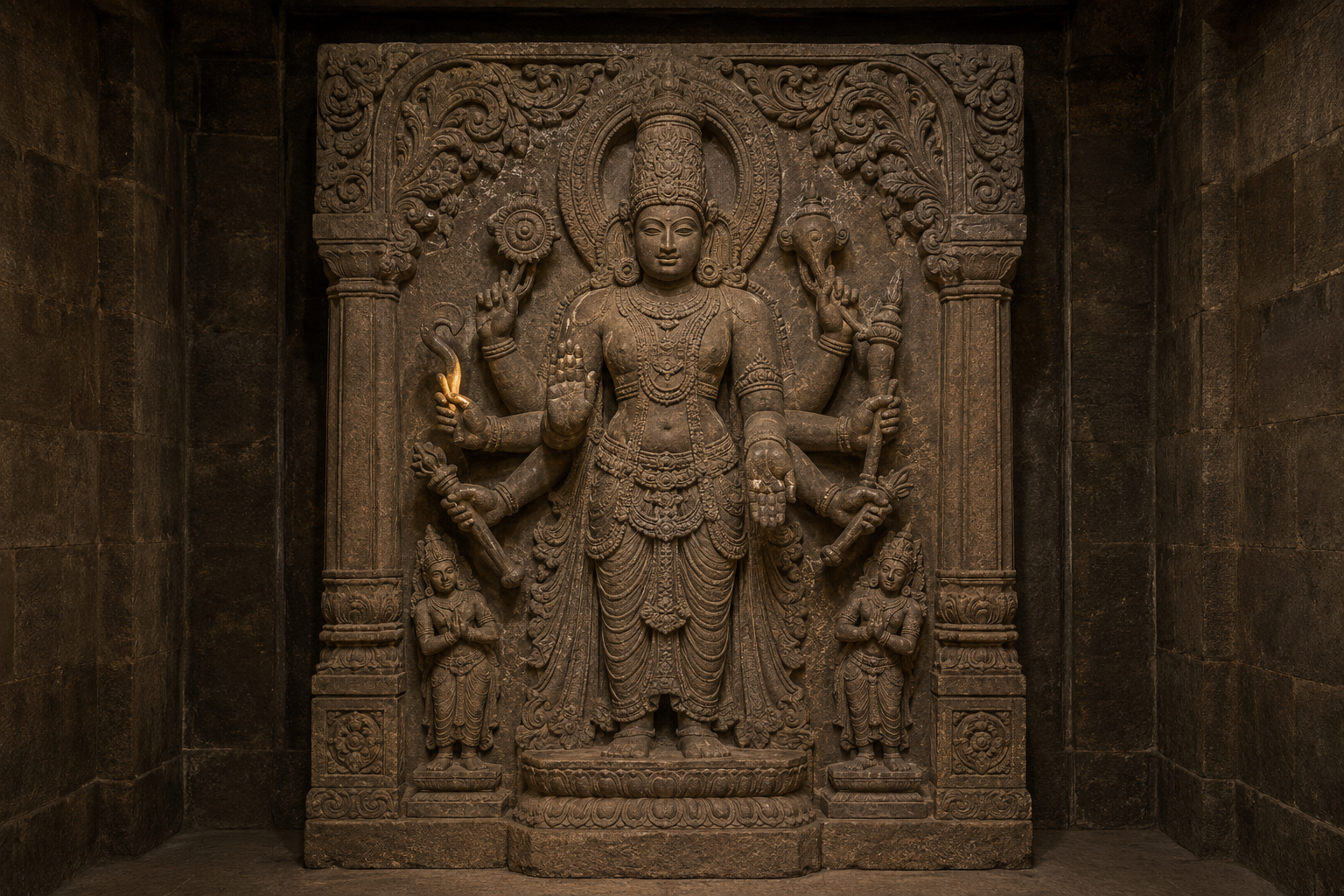
Iconography works through combinations. A single attribute matters, but its relationship to the complete figure matters more. Before reaching a firm conclusion, move outward from the curve to the hand, from the hand to the figure, and from the figure to the larger sculptural setting.
- Identify the figure as securely as possible. Use an inscription, a trustworthy temple or museum label, or the figure’s established ensemble of attributes. Do not make the uncertain Srini identify an otherwise uncertain deity and then use that deity to prove the Srini; that is circular reasoning.
- Inventory the other attributes. Record every object, gesture, posture, companion, and emblem that remains visible. Read the possible Srini as one element within that arrangement.
- Compare nearby carvings. Figures made for the same temple setting may reveal how that sculptural vocabulary renders blades, hooks, ornaments, and handles. Similar curves are most useful when their functions can also be compared.
- Separate observation from interpretation. “The deity holds an inward-curving implement” is an observation. “It cuts attachment” is an interpretation. Keeping those sentences separate prevents a spiritual reading from masquerading as visual proof.
- State your confidence. Use “Srini” when identification is well supported, “probable Srini” when the form and context agree but details are incomplete, and “possibly a Srini” when damage or ambiguity remains substantial.
This graded language is especially important when you write a caption, teach from a photograph, or catalogue a sculpture. Honest uncertainty preserves the integrity of the image. It also leaves room for a better inscription, catalogue entry, or contextual comparison to settle the question later.
Avoid the shortcuts that flatten sacred iconography
- Do not equate curvature with identity. A curved outline is necessary to the basic description of the Srini, but it is not sufficient by itself.
- Do not reduce every ayudha to warfare. A sacred implement can disclose divine capacity, discipline, protection, transformation, or control through the action represented by its form.
- Do not begin with an elaborate allegory. Confirm the visible object first. Symbolism cannot repair a weak identification.
- Do not demand modern tool-making precision. Scale, material, damage, viewing angle, and artistic convention can simplify an implement. Record what the sculptor preserved instead of forcing the carving to match a contemporary object.
- Do not isolate the object from worship. Hindu iconography is not merely a puzzle of visual labels. The attribute belongs to a divine presence and should be interpreted within that sacred relationship.
A careful reading therefore works in two directions at once. It remains exact about the stone or image in front of you, and it remains open to the theological force carried by the implement’s action. Precision need not empty the symbol of meaning, and devotion need not excuse an unsupported identification.
Key takeaways
- The Srini is a sacred Hindu implement with a curved, hook-like or sickle-like form, classified among the curved or cutting ayudhas.
- Identify it through the complete iconographic setting, not through a crescent-shaped silhouette alone.
- Its cutting action can support reflection on purposeful separation; its hooking action can support reflection on restraint, recovery, or redirection.
- These meanings are interpretive possibilities, not automatic definitions detached from the deity and tradition.
- When visual evidence is incomplete, use “probable” or “possible” rather than turning uncertainty into fact.
The next time you encounter a possible Srini, write down three things: the form you can actually see, the action that form performs, and the context that supports its name. If the third entry remains weak, keep the identification provisional. That small discipline will let you look longer, speak more accurately, and meet the sacred image on its own terms.
References
