
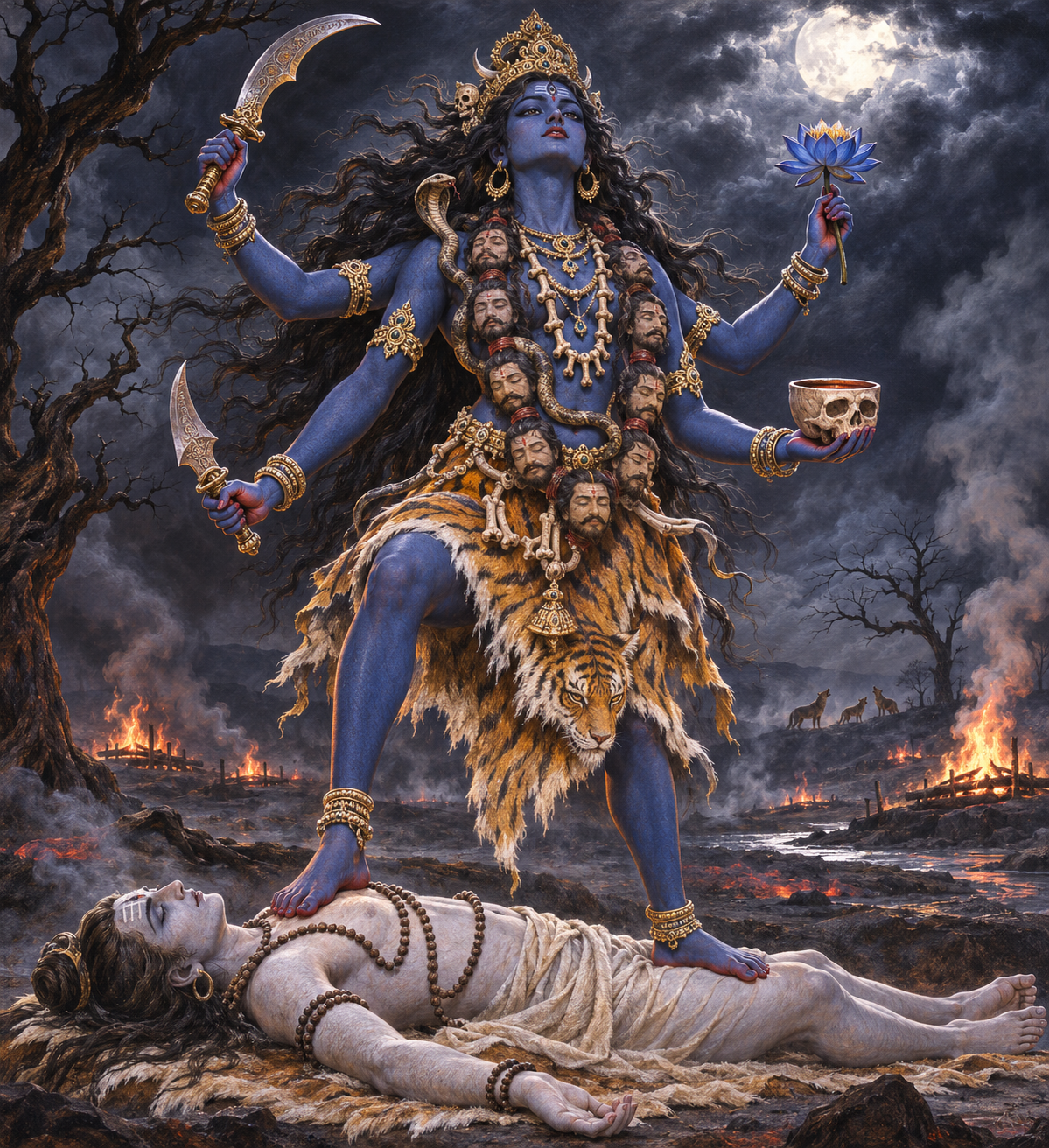
You are looking at a dark blue goddess with loose hair, a skull cup, cutting implements, and a body beneath her feet. Is she Tara, Kali, or a deity from a Buddhist tradition? If you decide from colour or fierceness alone, you can easily misidentify her.
The reliable method is to read the image as a complete composition. Posture, hands, ornaments, setting, and lineage belong together. Once you know what to notice, Tara’s apparently terrifying form becomes a disciplined teaching about fear, discernment, transformation, and liberation.
Begin with the whole image, not one dramatic object
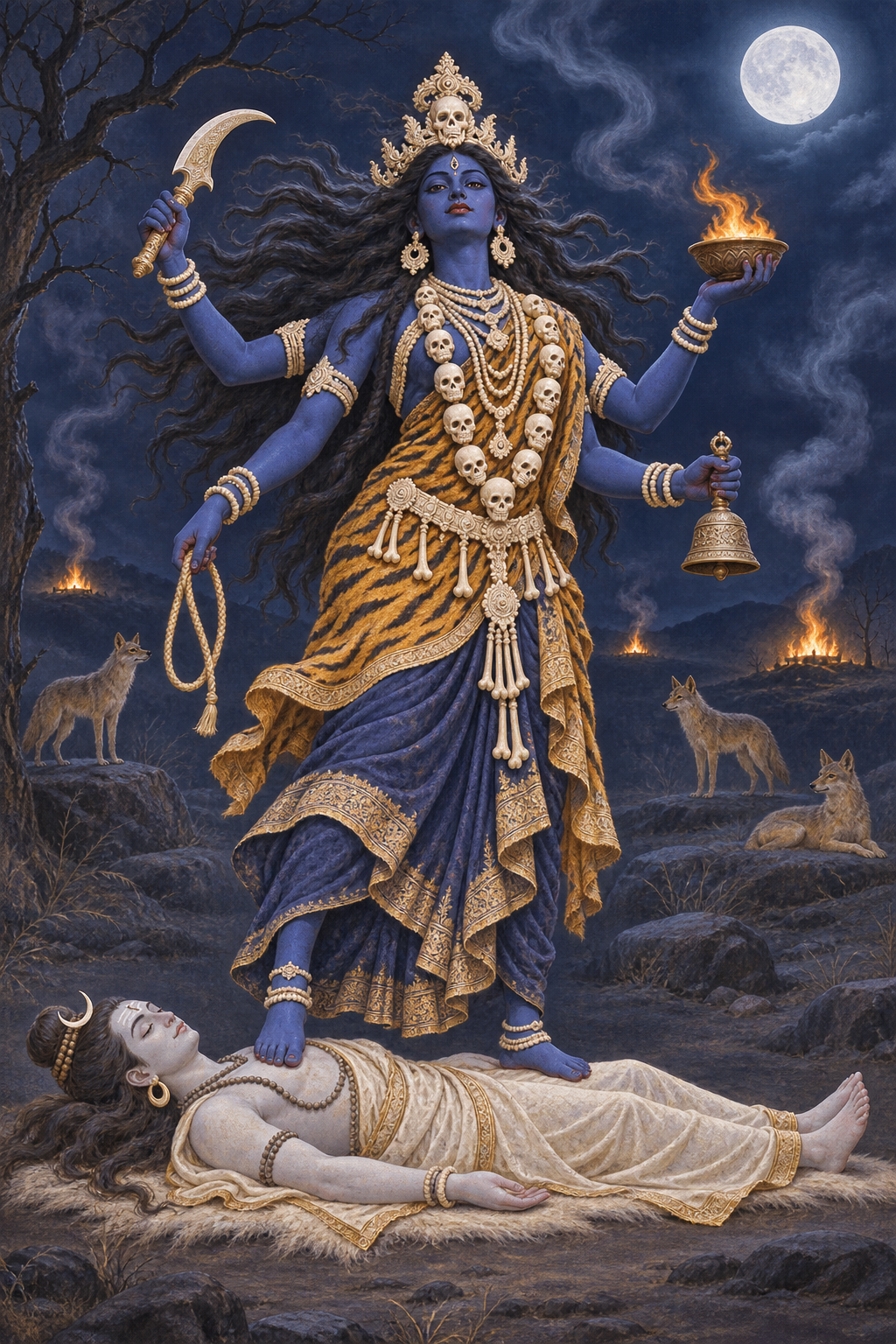
Within Shakta Tantra, Tara is placed second in the Dasa Mahavidya sequence, immediately after Kali. That proximity explains why their images can resemble one another. It does not make them interchangeable. Each Mahavidya reveals a distinct mode of Devi’s wisdom, power, and liberating presence.
Tara’s name is commonly connected with crossing and being carried across. This is the key to her fierce form. She does not merely shelter the devotee from a frightening world; she represents the power that carries consciousness through fear, attachment, mortality, and ignorance. The danger is faced and transformed, not politely hidden.
Read an unfamiliar image in five layers:
- Check the context first: the temple, manuscript, museum label, inscription, or tradition that named the form.
- Observe the silhouette: seated or standing, peaceful or dynamic, and whether another figure lies beneath the feet.
- Count the arms and identify every object by shape before assigning it a meaning.
- Notice the environment and adornments: lotus, cremation ground, skulls, animal skin, serpents, flames, or loose hair.
- Compare the entire cluster with a tradition-specific description. Never identify Tara from blue pigment, a skull, or a lotus alone.
This order prevents the most common mistake in iconographic reading: finding one familiar symbol and forcing the rest of the image to fit. A lotus may appear in many Dharmic traditions. So may a sword, skull cup, or corpse. Identity emerges from the relationship among the signs.
Her body, posture, and setting establish the spiritual terrain
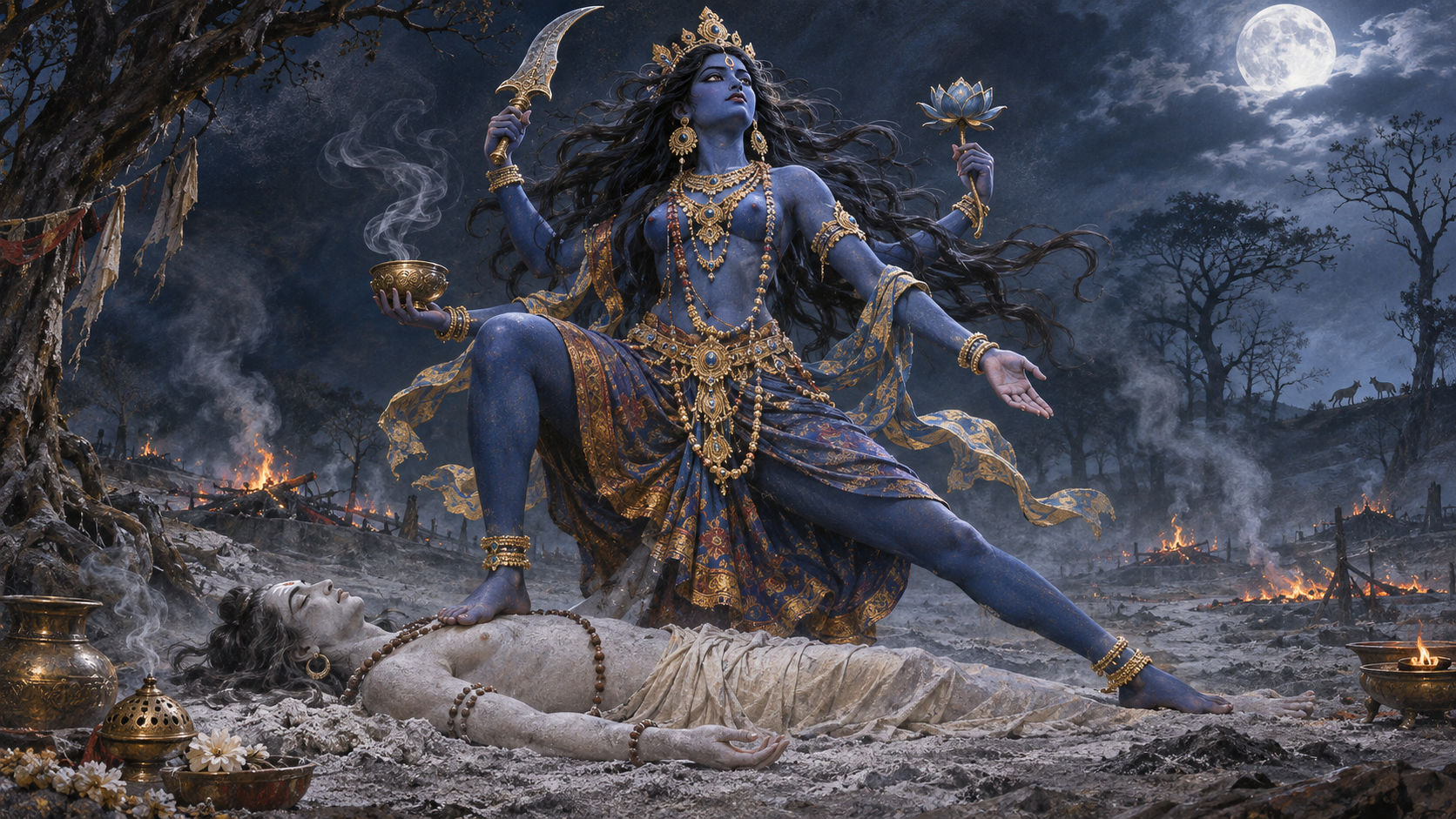
A widely encountered Mahavidya form of Tara is dark blue or blue-black, dynamically standing, and surrounded by imagery associated with death and dissolution. These features are not a declaration of evil. They place the encounter where ordinary identities lose their authority.
| Feature | What to examine | A careful symbolic reading |
|---|---|---|
| Dark blue or blue-black body | Look at the original pigment, if possible; reproductions can shift blue into black or green. | Vastness, depth, and a reality that cannot be confined by ordinary categories. Colour is a clue, not proof of identity. |
| Dynamic standing posture | Notice the direction of the body, the placement of the legs, and whether the pose appears stable or forceful. | Active intervention rather than remote serenity: liberating power enters the condition that binds the devotee. |
| A body beneath her feet | Determine whether it is identified as Shiva, a corpse, or another figure in that particular tradition. | It need not depict a moral victory over a defeated enemy. In Shakta interpretation, the motionless body can evoke consciousness without active Shakti, inert existence, or limited awareness transformed by divine power. |
| Cremation-ground imagery | Look for ash, bones, pyres, jackals, or other signs of the place rather than assuming every dark background is a cremation ground. | Impermanence and the collapse of social pretence. The setting asks whether spiritual insight survives direct contact with mortality. |
| Loose or unbound hair | Distinguish flowing hair from a crown, braid, or formal headdress. | Power outside ordinary domestication and social ordering. The exact significance can change with the named form. |
| Skulls and animal skin | Record their number, placement, and type before consulting an explanation. | Skulls commonly direct attention to mortality and the cutting of ego; an animal skin can indicate mastery of untamed impulse. Do not invent a numerical symbolism unless the lineage supplies one. |
The figure under the goddess deserves particular care. A modern viewer may read the pose as domination because that is the visual grammar most familiar to us. Tantric iconography can be making a different argument: consciousness and power are inseparable, and what appears inert becomes effective only through Shakti. Before saying that Tara has conquered Shiva, check how the temple, text, or lineage identifies the relationship.
The same discipline applies to fierce adornments. A garland of heads is not permission to romanticise violence. It turns the viewer toward everything the ego tries to deny: the body’s end, the instability of status, and the need to relinquish false identity. Some traditions give the heads or skulls more specialised meanings. Use those interpretations only when you can connect them to that form rather than to a generic symbolism chart.
Read the four hands as a coordinated teaching
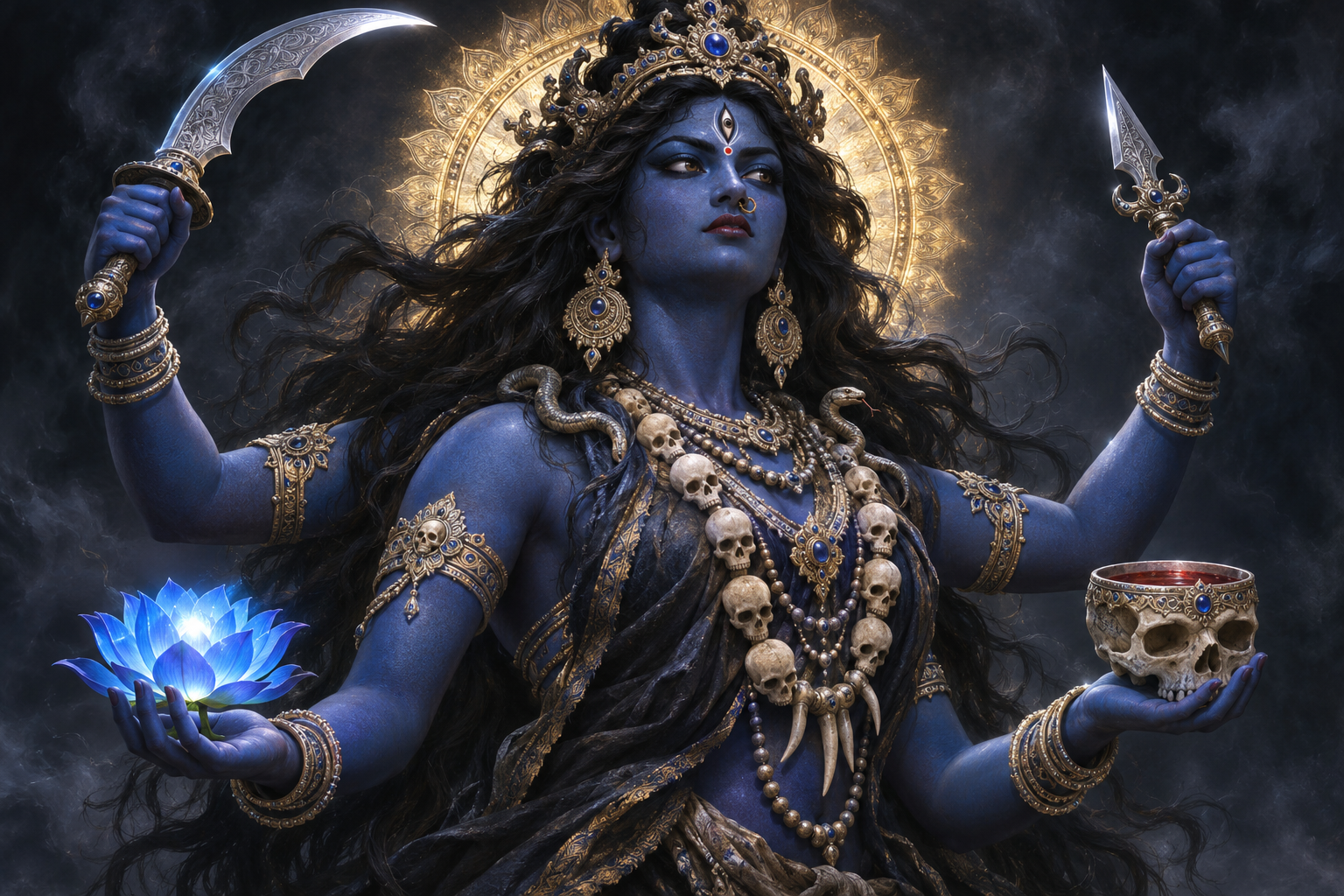
Many recognisable images of Tara Mahavidya have four arms. Common attributes include a sword, a curved knife, chopper, or scissors, a skull cup, and a blue lotus. Artists and catalogues do not always use the same word for a cutting implement, and arrangements can vary. Start by describing what you actually see: a long blade, a hooked blade, a scissor-like object, a cup made from a skull, or a flower.
- The sword, or khadga, can signify discriminating knowledge. It cuts confusion by separating what is enduring from what is merely assumed.
- The curved cutter, chopper, or scissors can signify the severing of attachment. Its sharper visual language tells you that some bonds are not loosened by vague good intentions.
- The skull cup, or kapala, indicates reception and transformation. What has been cut away is not pushed out of sight; mortality and ego are brought into the field of awareness.
- The blue lotus points toward wisdom and liberating compassion. A lotus arises amid difficult conditions without being reduced to them, making it a fitting counterweight to the weapons and skull imagery.
You can read these four attributes as a contemplative movement: recognise clearly, cut attachment, transform what has been surrendered, and allow wisdom to flower. That sequence is a practical way to understand the composition, not a claim that every lineage prescribes one fixed order.
The implements also correct one another. A blade without the lotus could be mistaken for destruction as an end in itself. A lotus without the blade could be reduced to passive reassurance. Tara holds fierce discernment and compassionate liberation in the same form. Her tenderness is not helpless, and her ferocity is not cruelty.
If a hand in the image is empty, damaged, or formed into a gesture, do not mentally insert the object you expected. It may be a different Tara form, a regional convention, a later restoration, or simply an incomplete sculpture. Record the discrepancy and let it guide further identification.
Distinguish Tara without flattening Dharmic traditions
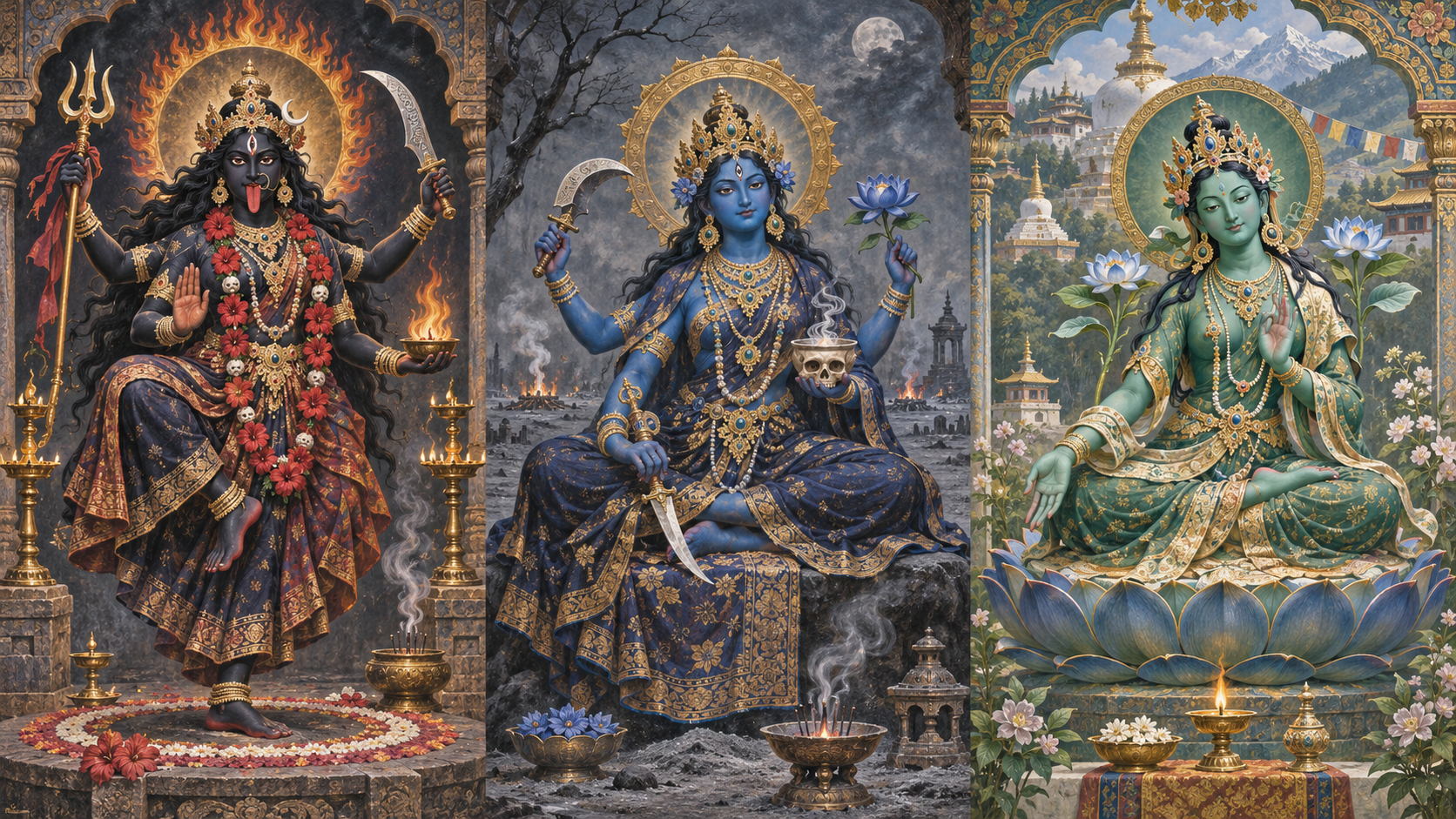
The name Tara appears in both Hindu and Buddhist traditions, but a shared name does not make every image the same deity in the same theological system. Historical interaction and shared symbolic language should be acknowledged without erasing the integrity of either tradition.
When distinguishing Tara Mahavidya from Kali, examine the full set of attributes. Both can be dark, fierce, associated with cremation-ground imagery, and shown with skulls or a figure underfoot. A blue complexion and a combination of skull cup, cutting implement, and blue lotus can support an identification as Tara, but no single one is universal or decisive. An inscription, a traditional meditation description, or the temple’s own identification carries more weight than a colour-based guess.
Many familiar Buddhist images of Green Tara or White Tara are serene, seated on a lotus, and adorned in a bodhisattva-like manner. That contrast can help with an initial distinction, but it cannot serve as an absolute rule because Buddhist traditions also preserve fierce forms of Tara. Context must outrank mood: peaceful does not automatically mean Buddhist, and fierce does not automatically mean Mahavidya.
Use a simple verification process before labelling, sharing, buying, or worshipping an image:
- Ask who named it. A temple tradition or inscription is stronger evidence than an unattributed online caption.
- Ask where it came from. Region, community, ritual setting, and manuscript context can explain features that a generic chart cannot.
- List visible features before interpreting them. This keeps expectation from changing observation.
- Check whether the proposed identity accounts for the posture, every surviving hand, the ornaments, and the attendant figures.
- Mark uncertainty honestly. Naming it as a probable form is better than presenting a fragile identification as settled fact.
If your purpose is puja rather than art-historical identification, visual recognition is only the first step. Use the form and name recognised by your sampradaya, family tradition, or temple. Formal Tantric practices may depend on initiation and lineage-specific instruction; an image found online does not supply that authority. In particular, do not combine a Mahavidya image, a mantra from a different Tara tradition, and ritual directions from an anonymous chart merely because all three use the same name.
Key takeaways
- Tara is the second Mahavidya after Kali, which helps explain their visual proximity but not their identity.
- Identify her through a cluster of features: context, posture, hands, setting, adornments, and lineage.
- Dark colour and cremation-ground imagery express confrontation with fear, impermanence, and limited identity; they do not make the goddess malevolent.
- In many four-armed forms, the sword, cutter, skull cup, and blue lotus bring discernment, severance, transformation, and liberating wisdom into one composition.
- Hindu and Buddhist forms of Tara must be read within their respective traditions. A shared name or symbol is not sufficient evidence for equivalence.
- Iconographic literacy can help you recognise a sacred form, but it does not replace ritual guidance or initiation.
Before you identify the next Tara image you encounter, write down five things without interpretation: colour, posture, figure beneath the feet, objects in the hands, and setting. Then add the temple, text, or collection that supplied the name. That short record will usually show whether you have a coherent identification or only one striking resemblance.
References

Leave a Reply
You must be logged in to post a comment.