
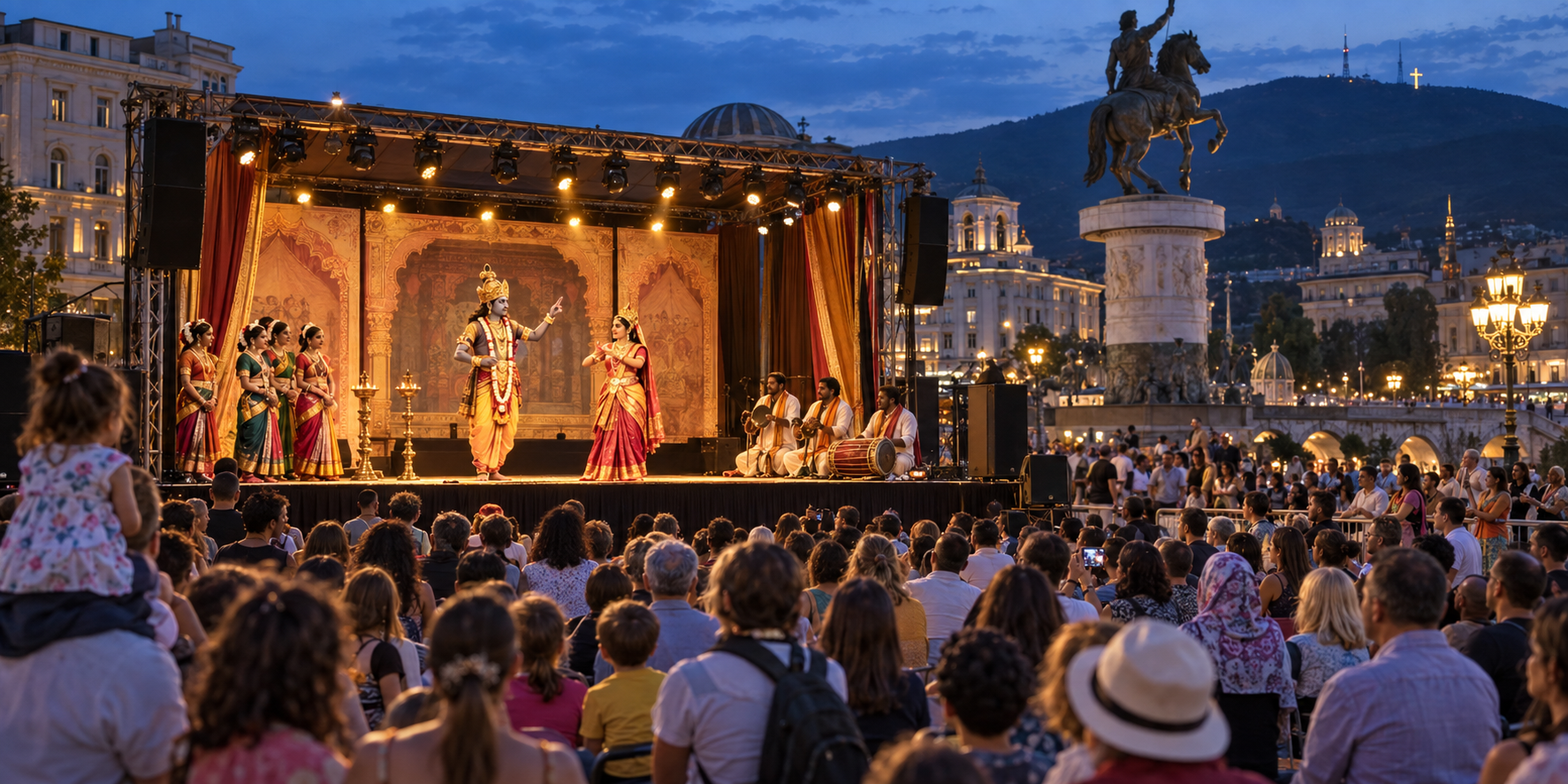
If you encountered the name Soul Culture Festival and wondered whether Skopje hosted a religious gathering, a stage production or an Indian cultural programme, the most accurate answer is that the evening crossed those categories. Its significance lies in how several forms of Dharmic expression were brought together in one public setting.
In Skopje’s main square, the festival combined a Ramayana drama, a philosophical talk, dance, kirtan and the gifting of traditional saris. That combination gave visitors more than one way to approach the tradition: through narrative, ideas, movement, devotional sound and material culture.
What visitors actually encountered
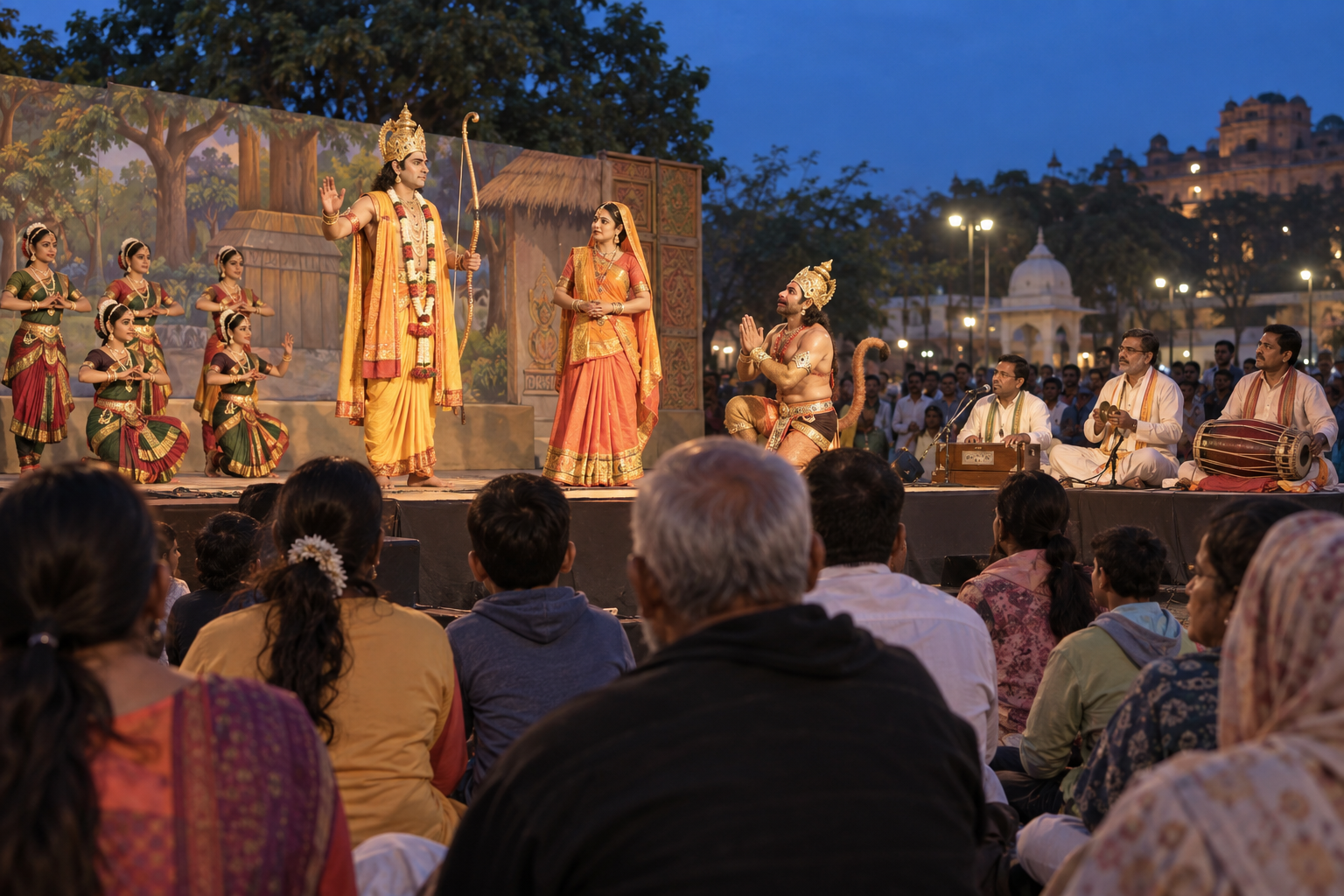
The safest way to understand the festival is to distinguish the role of each element without inventing details that have not been supplied.
- Ramayana drama: Sacred narrative was presented through performance rather than reduced to an abstract explanation. No particular episode or adaptation is identified, so it would be unwise to guess which part of the Ramayana appeared on stage.
- Philosophical talk: The programme made room for reflection as well as spectacle. The speaker and subject are not named, but the presence of a talk shows that ideas were treated as part of the cultural encounter.
- Dance: Movement added a visual and embodied dimension. No dance school, regional style or choreography is specified, so the performance should simply be described as dance rather than assigned a more precise label.
- Kirtan: Devotional singing supplied the evening’s explicitly musical and spiritual dimension. Kirtan can invite participation, but there is no firm basis for claiming that this particular audience sang along.
- Traditional saris: Guests received saris as gifts. This moved the encounter beyond watching a performance and gave some attendees a tangible connection with the culture being presented.
Those limits matter. Cultural events are easily embellished when a short description is repeated: an unspecified dance becomes a named classical form, an audience becomes a crowd of a particular size, or a festival becomes annual without evidence. A trustworthy account preserves what is known and leaves the rest open.
The programme offered several doors into Dharma
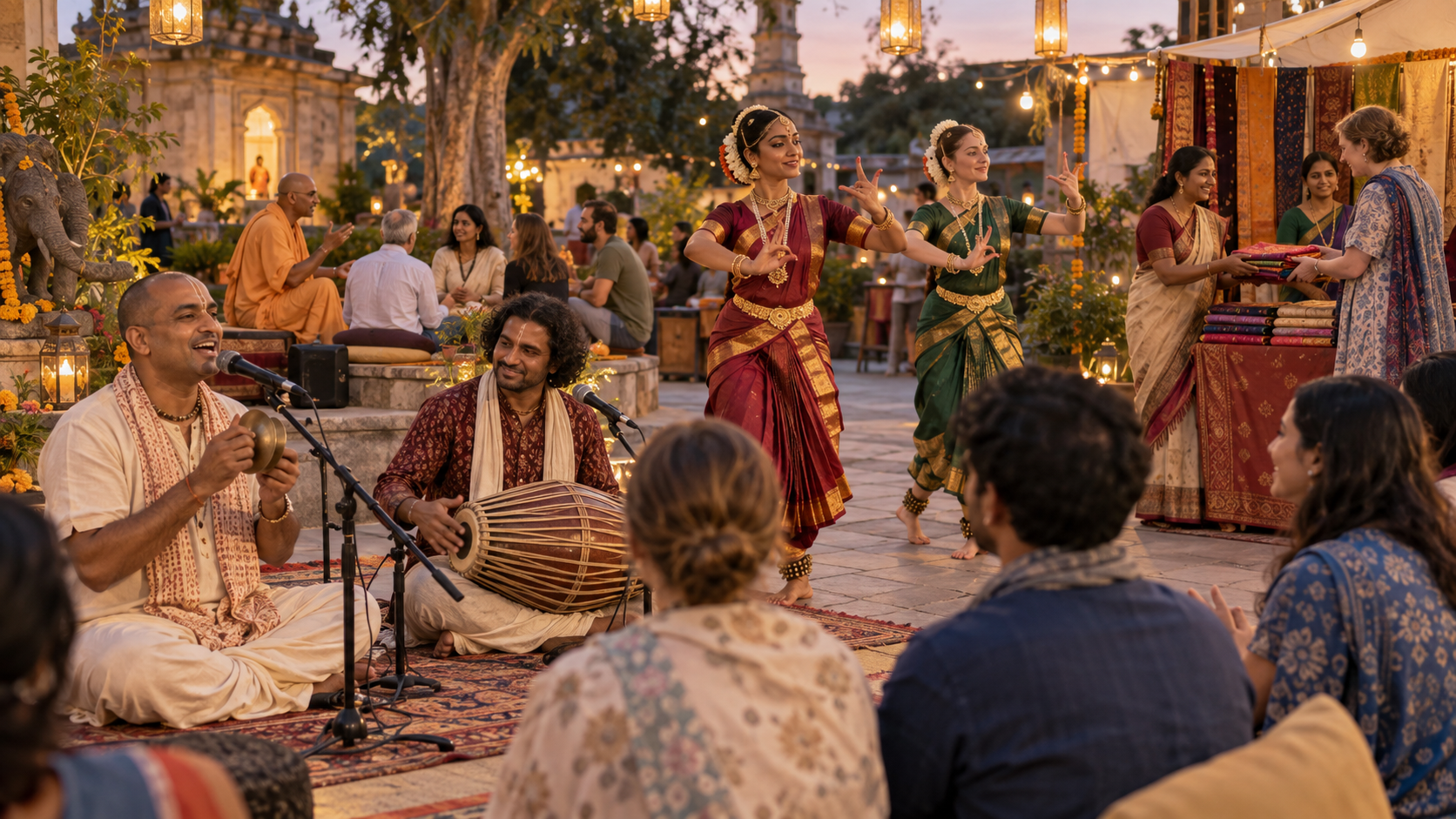
A Dharmic tradition cannot be communicated fully through information alone. A lecture may explain an idea precisely while leaving its devotional and aesthetic life untouched. A performance may stir the imagination while leaving an unfamiliar viewer unsure what it means. Skopje’s festival is useful because its different forms answered different needs.
These can be understood as layers rather than as a confirmed running order:
- Enter through a story. The Ramayana gives the encounter recognizable characters, choices and moral relationships.
- Ask what the story means. A philosophical talk creates a bridge between what is performed and what the tradition asks a person to consider.
- Experience culture through the senses. Dance and clothing make heritage visible and embodied rather than merely conceptual.
- Meet devotion as a living practice. Kirtan shifts attention from representing a tradition to voicing devotion within it.
If you organise cultural outreach, this layered structure is more useful than copying the surface details of the Skopje event. Do not ask one lecture, dance or musical performance to carry the entire meaning of a tradition. Pair narrative with interpretation, beauty with context, and presentation with an appropriate opportunity for participation.
If you are simply trying to understand what happened, the same structure prevents a common misreading. The festival was not only an entertainment programme with religious decoration, and it was not only a discourse accompanied by cultural diversions. Its distinctive feature was the coexistence of story, thought, art and devotion.
Why the main square changes the meaning
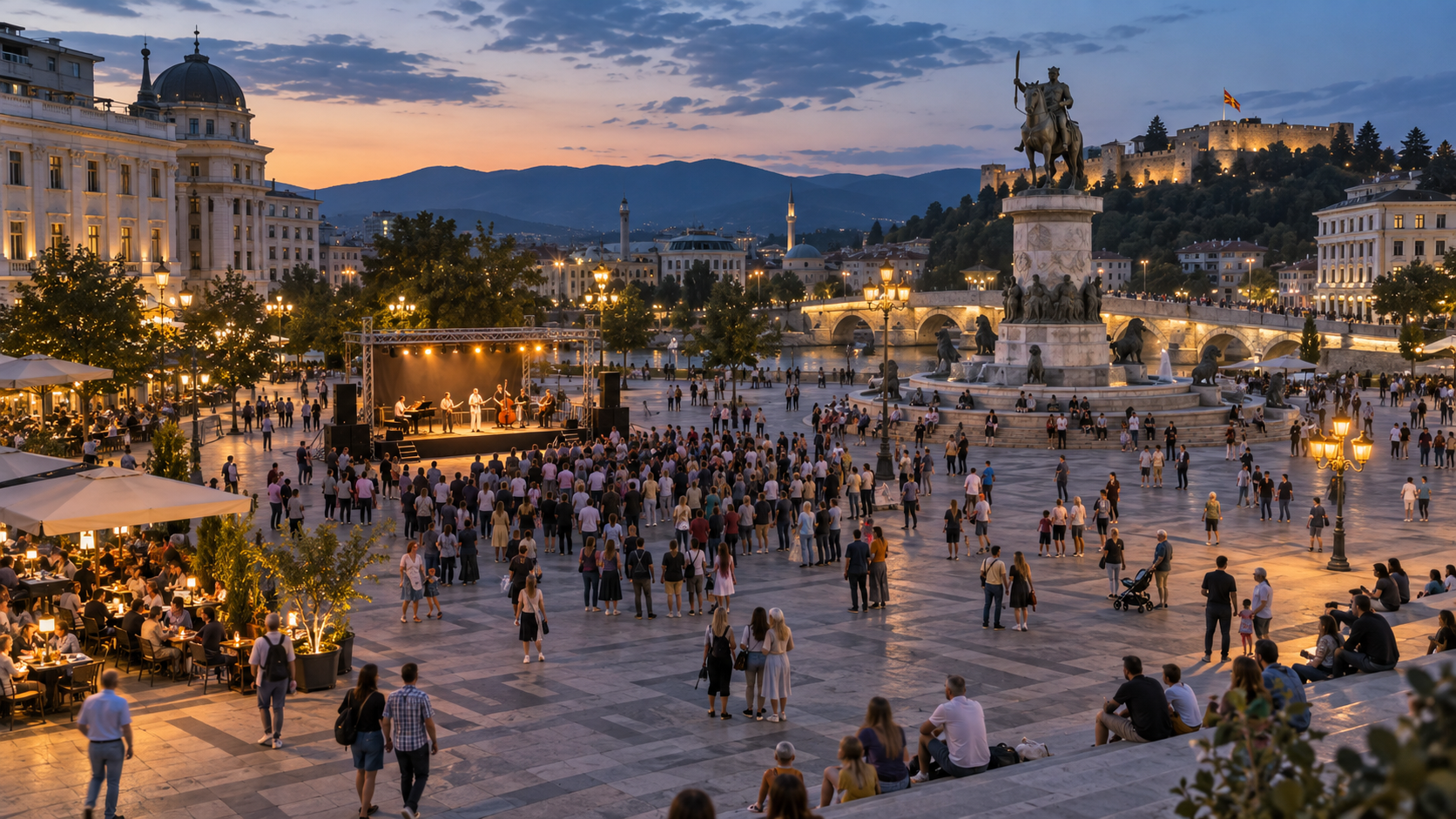
The venue deserves attention because the festival took place in Skopje’s main square. A public square has a different threshold from a temple, private hall or specialist conference. It makes an encounter by passers-by possible, although the location alone does not tell us who attended or how they arrived.
Public presentation also creates a particular responsibility. Dharmic culture must be intelligible to someone without prior knowledge, yet it should not be emptied of the sacred meanings that make it worth presenting. The programme’s components helped hold that balance. The Ramayana anchored the evening in a named sacred narrative. Philosophy signalled that the tradition has an intellectual dimension. Kirtan retained a devotional centre. Dance and saris offered immediate cultural points of contact.
This is a practical distinction for Hindu communities working outside Bharat. Visibility alone is not the goal. A colourful programme can attract attention while leaving visitors with no understanding of Dharma. Conversely, an explanation pitched only to people who already know the vocabulary can close the door to everyone else. A well-designed public event gives newcomers an accessible first step without pretending that the first step is the whole tradition.
Key takeaways
- The festival brought Ramayana drama, philosophy, dance, kirtan and sari gifting together in Skopje’s main square.
- Its importance is better understood through the range of cultural forms than through claims about scale; no attendance figure has been supplied.
- The programme allowed sacred narrative, intellectual explanation, artistic expression and devotion to remain connected.
- The public venue made a low-threshold encounter possible, but it does not establish whether attendees were invited guests, intentional visitors or passers-by.
- No date, Ramayana episode, speaker, dance form, kirtan repertoire or recurring schedule should be inferred from the available details.
How to carry the Skopje lesson forward
If you are sharing news of the festival, a reliable description is simple: Skopje’s Soul Culture Festival presented Ramayana drama, philosophy, dance and kirtan in the city’s main square, and traditional saris were given to guests. That says enough to convey the character of the evening without attaching unsupported names, numbers or motives to it.
If you are planning a similar Dharmic event, use the Skopje programme as a set of design questions:
- Which sacred story will provide the centre? Choose a narrative that can be followed by someone who arrives without background knowledge.
- Who will make its meaning legible? Give the philosophical explanation a clear theme rather than trying to survey an entire tradition.
- How will the arts serve that theme? Connect dance, music and clothing to the event’s meaning so they do not become interchangeable decoration.
- Will kirtan be presented or shared? Decide whether visitors will listen, respond or sing, and explain the expected form of participation plainly.
- What will hospitality look like? If a cultural object is given to guests, provide enough context for it to be received with understanding rather than treated as a novelty.
For your next public programme, begin with one story and one question that a newcomer can carry home. Then select the talk, art, devotional practice and gesture of hospitality that help answer it. That is how a cultural evening becomes an intelligible encounter with Dharma rather than a collection of unrelated attractions.
References

Leave a Reply
You must be logged in to post a comment.