
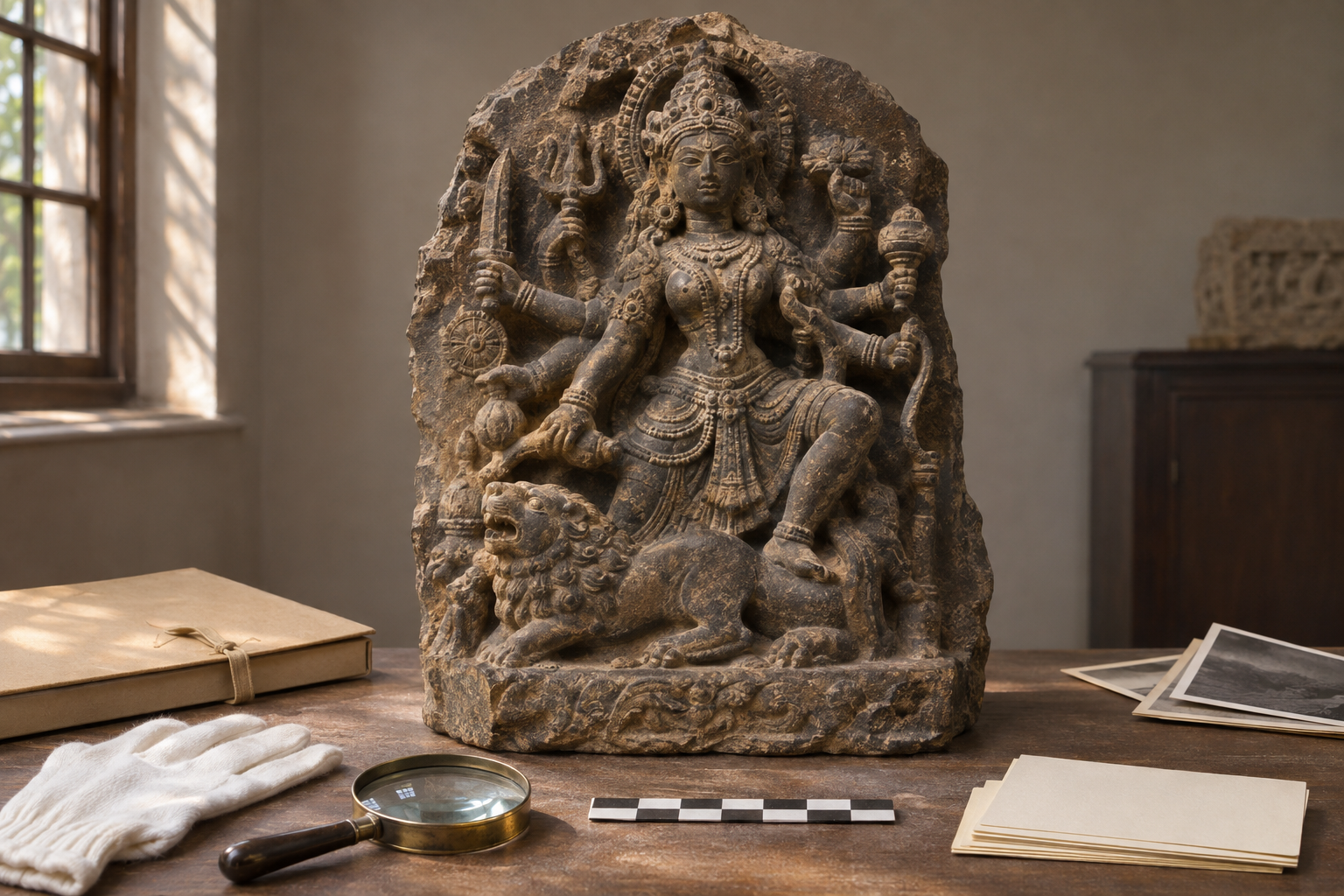
If you found the name Ripu Marini Durga beneath an unfamiliar image, the tempting move is to identify her from a weapon, mount, or fierce expression. That is also how misidentifications begin. With an uncommon form of Devi, you should start with the name and the image’s provenance, then use its visual features to test the identification.
This approach lets you distinguish three things that are often blurred together: what the name actually means, what the image visibly shows, and what a particular temple or lineage teaches about the form. Keeping those layers separate protects both historical accuracy and devotional integrity.
What the name establishes—and what it does not
“Ripu” means a foe or enemy, while “Marini” conveys the female destroyer or slayer. Ripu Marini Durga can therefore be understood as Durga who destroys foes. The name identifies a divine function: the protective power of the Mother confronting that which threatens, obstructs, or opposes.
That meaning is firm ground. It does not, however, give you a complete sculptural prescription. You cannot derive an exact number of arms, a fixed arrangement of objects, a particular posture, a colour, a mount, or a mantra merely by translating the name. A functional title tells you why a form is approached; it does not necessarily tell you every feature by which a murti is recognized.
The word “foe” also needs disciplined handling. At the most direct level, the title expresses protection and the defeat of hostile forces. A devotee may additionally read the foe inwardly—as a destructive tendency, fear, anger, delusion, or another impediment to dharmic conduct. That inward application can be spiritually fruitful, but it remains an interpretation unless a textual or living tradition explicitly teaches it for this form.
A protective divine name should not become a licence for personal vengeance. If you use the name contemplatively, ask a sharper question than “Who is my enemy?” Ask instead, “What is presently defeating discernment, courage, or right conduct in me?” That shift turns an evocative title into a test of your own alignment with dharma.
Why a fierce-looking Durga image is not enough
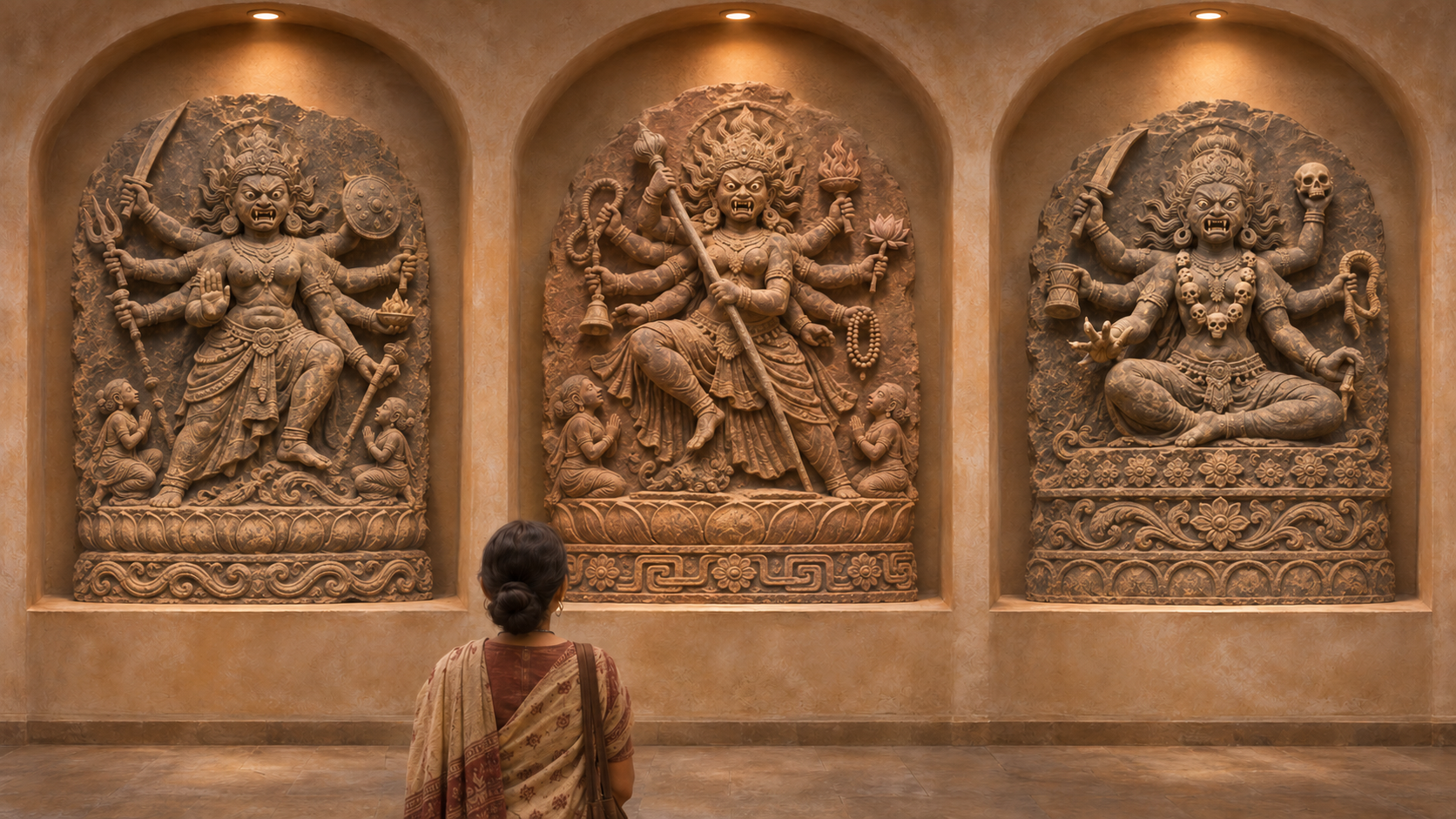
Ripu Marini Durga is seldom treated in mainstream iconographic compilations. Her relative obscurity belongs to a wider Devi tradition in which regional scriptures, temple customs, and oral lineages can preserve forms that broad reference works barely mention.
This matters because iconography works through a configuration, not a mood. Multiple arms, weapons, commanding posture, martial action, or a fierce facial expression may place an image within a broad field of protective Goddess imagery. None of those features, taken alone, proves that the particular name Ripu Marini belongs to it.
The reverse mistake is just as common. An image securely identified by a shrine inscription or inherited temple tradition may resemble a better-known form of Durga. That resemblance does not automatically erase its local identity. Hindu sacred art can share a visual vocabulary while preserving different names, ritual settings, and theological emphases.
Treat identification as secure when a direct identifier—such as an inscription, a named contemplative description, or a continuous temple tradition—agrees with the visible configuration. Treat a catalogue or online caption without provenance as provisional. Treat a name attached only because an image “looks fierce” as speculation.
How to verify a Ripu Marini Durga image
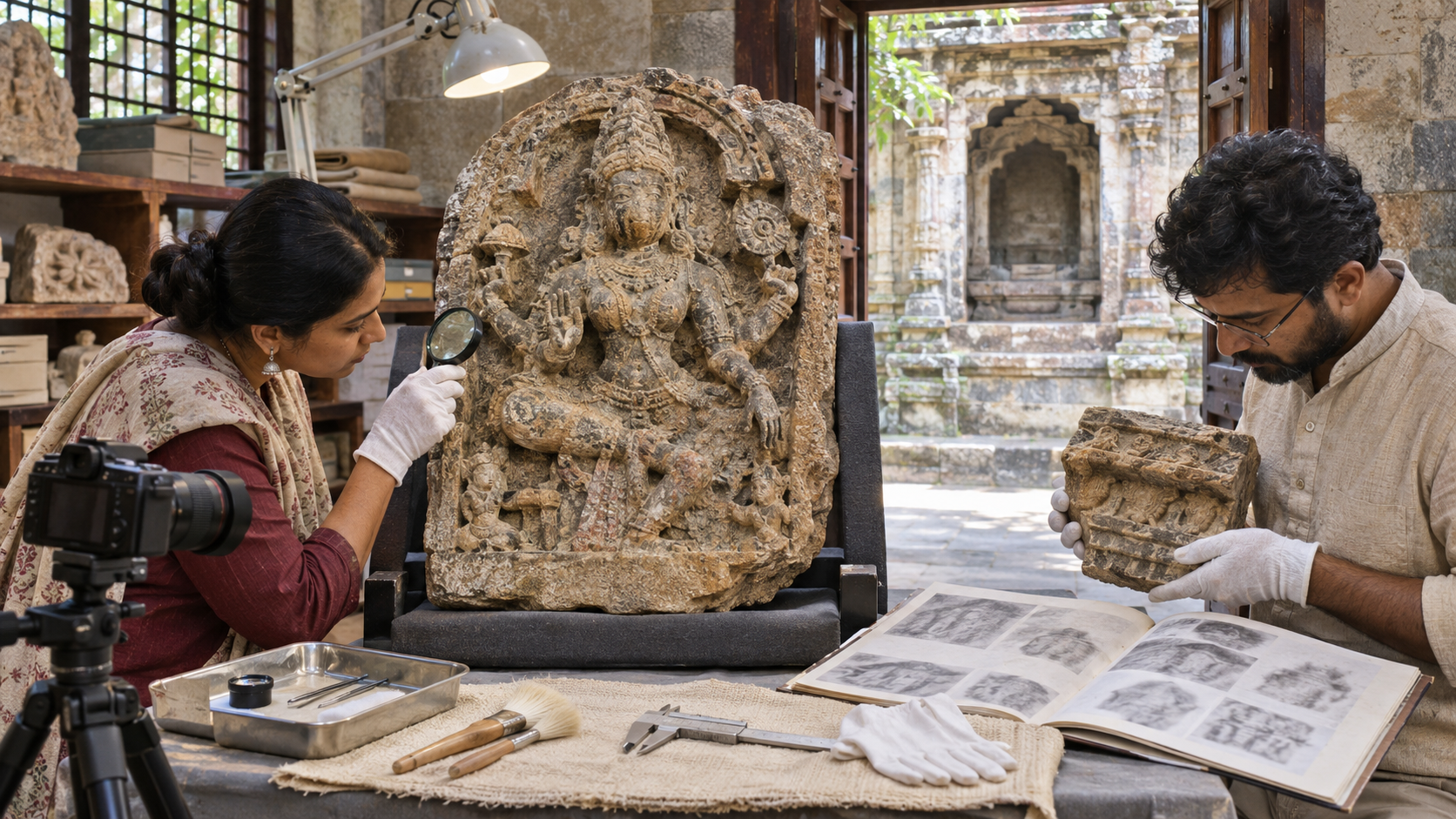
If you are cataloguing a murti, preparing a temple note, writing a caption, or deciding whether to share an image under this name, use the following sequence.
- Preserve the provenance first. Record where the image was photographed or published, the shrine or collection associated with it, the region if known, and the wording of any accompanying label. An uncropped photograph of the base, surrounding niche, and name-board can be more useful than a polished close-up.
- Transcribe the name exactly. Do not silently correct an unfamiliar spelling or replace it with the name of a more familiar Durga form. A spelling may reflect transliteration, pronunciation, or a local naming tradition. Record what is present before proposing a normalized form.
- Make a neutral visual inventory. Count the arms. Note each held object without forcing an uncertain identification. Record hand gestures, posture, seat or vehicle, figures beneath or beside the Goddess, ornaments, headgear, facial expression, and any action shown. Description must come before interpretation.
- Look for a direct identifying tradition. An inscription, temple record, ritual manual, named descriptive passage, or consistent testimony from the custodians of a living shrine carries more weight than resemblance to an image found elsewhere. Ask not only “What does it look like?” but also “Who has called it Ripu Marini, and on what basis?”
- Compare the whole configuration. One shared object cannot establish identity. Check whether the posture, gestures, objects, attendants, setting, and attributed function cohere. If the direct name and the visual arrangement conflict, retain the conflict in your notes rather than resolving it by guesswork.
- State the confidence level. Use “identified as” when the attribution is direct, “traditionally worshipped as” when living practice is the basis, and “possibly” or “tentatively identified as” when the evidence is incomplete. Honest uncertainty is more useful than a confident but unsupported label.
A responsible public caption might read: “Ripu Marini Durga, identified by the shrine’s local tradition; provenance and visible attributes recorded here.” If the attribution is uncertain, say so in the caption itself. Do not hide the uncertainty in an unpublished note while presenting the name as settled to readers.
How to interpret the form without inventing a tradition
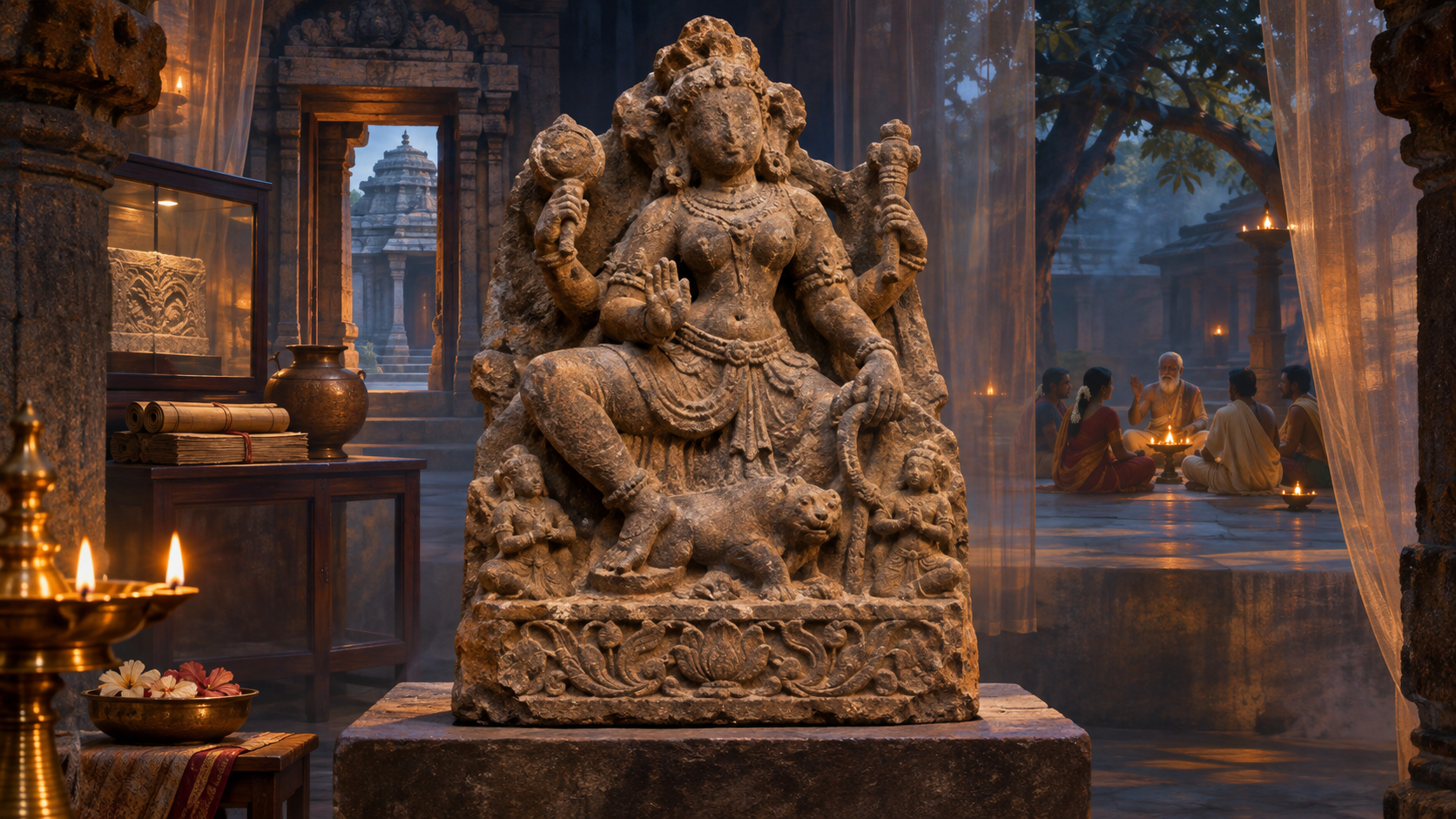
Iconographic interpretation should begin with what the image makes visible. A martial attribute may communicate decisive action; a protective gesture may communicate refuge; a subdued opposing figure may represent the defeat of a threat. Yet the precise meaning of each element depends on the complete image and its inherited explanation. Avoid assigning a separate moral lesson to every object when no relevant tradition supplies one.
The name offers a useful interpretive centre: Durga’s power is directed toward the destruction of enmity or obstruction. You can then test possible readings against the setting. In a temple context, the emphasis may be divine protection. In contemplative use, a devotee may direct the image inward and confront the tendency that repeatedly defeats right action. In historical documentation, the priority is neither devotional application nor imaginative symbolism but an accurate account of the object’s identity and provenance.
Keep ritual claims under an even stricter standard. A title does not generate a mantra, visualization, offering sequence, or initiatory practice. If Ripu Marini Durga belongs to a particular temple or lineage, follow the instruction preserved there. If you cannot locate such instruction, do not assemble a supposedly ancient rite from unrelated fragments. It is more respectful to remain within an established Durga practice you have actually received than to manufacture a rare-form practice because the name sounds powerful.
The same restraint applies when publishing devotional art. A newly created image may legitimately be an artist’s interpretation, but it should be labelled as such. Do not present a modern composition as a recovered canonical icon merely because it contains familiar Goddess attributes. “Contemporary devotional depiction inspired by the name Ripu Marini Durga” is a clear and honourable description.
Key takeaways
- Ripu Marini Durga means Durga as the destroyer of foes; the name establishes a protective function, not a complete visual formula.
- A fierce appearance or a single shared attribute cannot identify this uncommon form by itself.
- Inscription, shrine tradition, a named descriptive passage, and documented provenance carry more weight than visual resemblance.
- Record the full configuration of the image before interpreting it: arms, objects, gestures, posture, setting, associated figures, and identifying text.
- Mark uncertain attributions as uncertain, and distinguish inherited worship from modern artistic interpretation.
- Do not invent a mantra or specialized ritual from the meaning of the name; follow a living or textually grounded tradition.
If you encounter a Ripu Marini Durga image, your most useful first act is simple: save the uncropped image, its label, its location, and the context in which the name appears. That small discipline may preserve the very evidence needed to understand a rare form of the Divine Mother without flattening her into a generic image or surrounding her with invented detail.
References

Leave a Reply
You must be logged in to post a comment.