
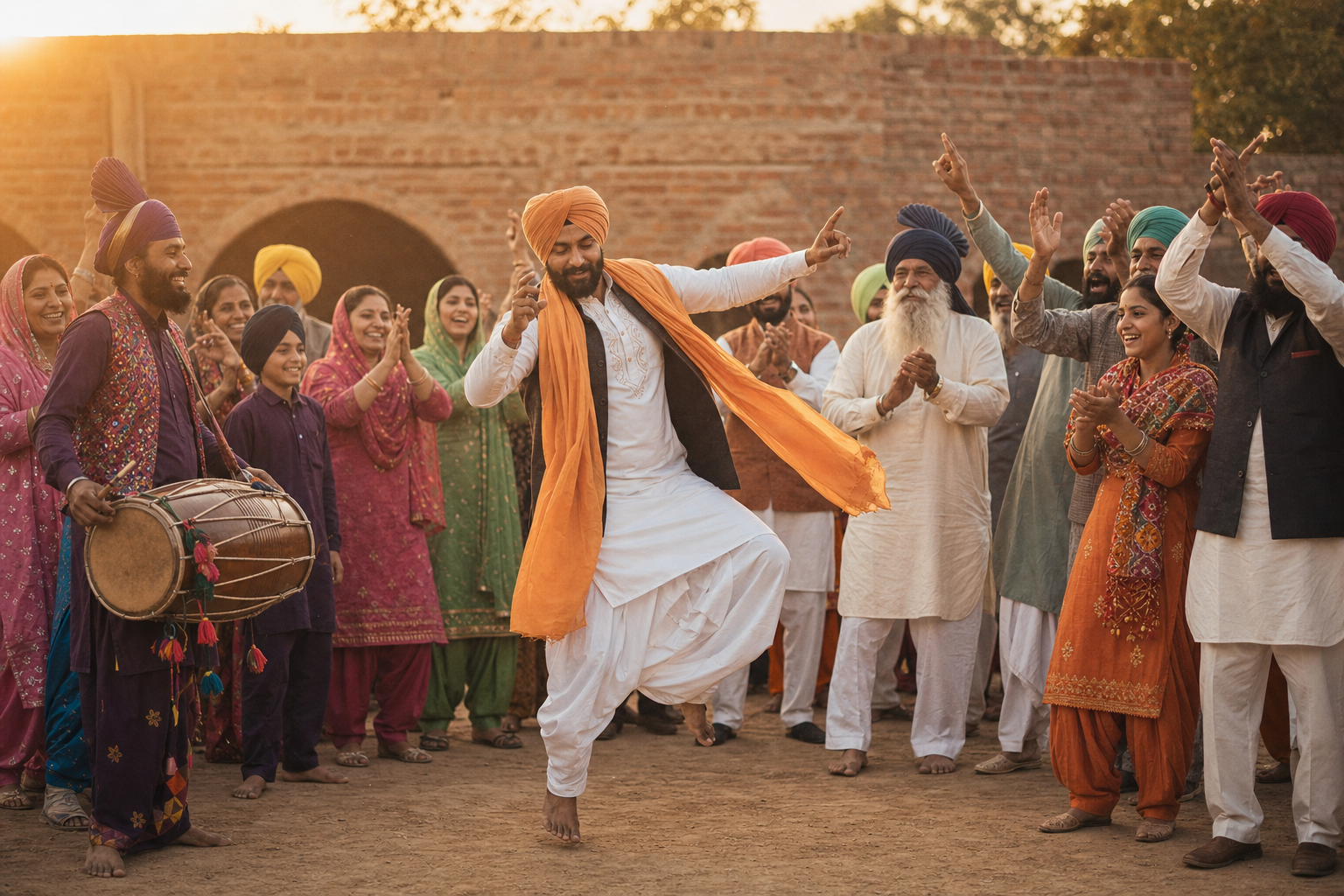
You may have heard “Matak Hulāre” at a Punjabi celebration, watched it named in a dance video, or tried to follow it in a Giddha or Bhangra circle. The visible movement looks simple: a sway, a rebound, a flash of expression. Copy only the outline, however, and it quickly becomes either a stiff side step or an exaggerated hip gesture.
The useful way to understand Matak Hulāre is as a relationship between two energies. One settles the body into measured grace; the other releases that stored energy as communal uplift. Once you can see that contrast, you can recognise the form more accurately, practise it more safely, and join the celebration without reducing Punjabi culture to a collection of poses.
Matak Hulāre is a contrast, not a single pose
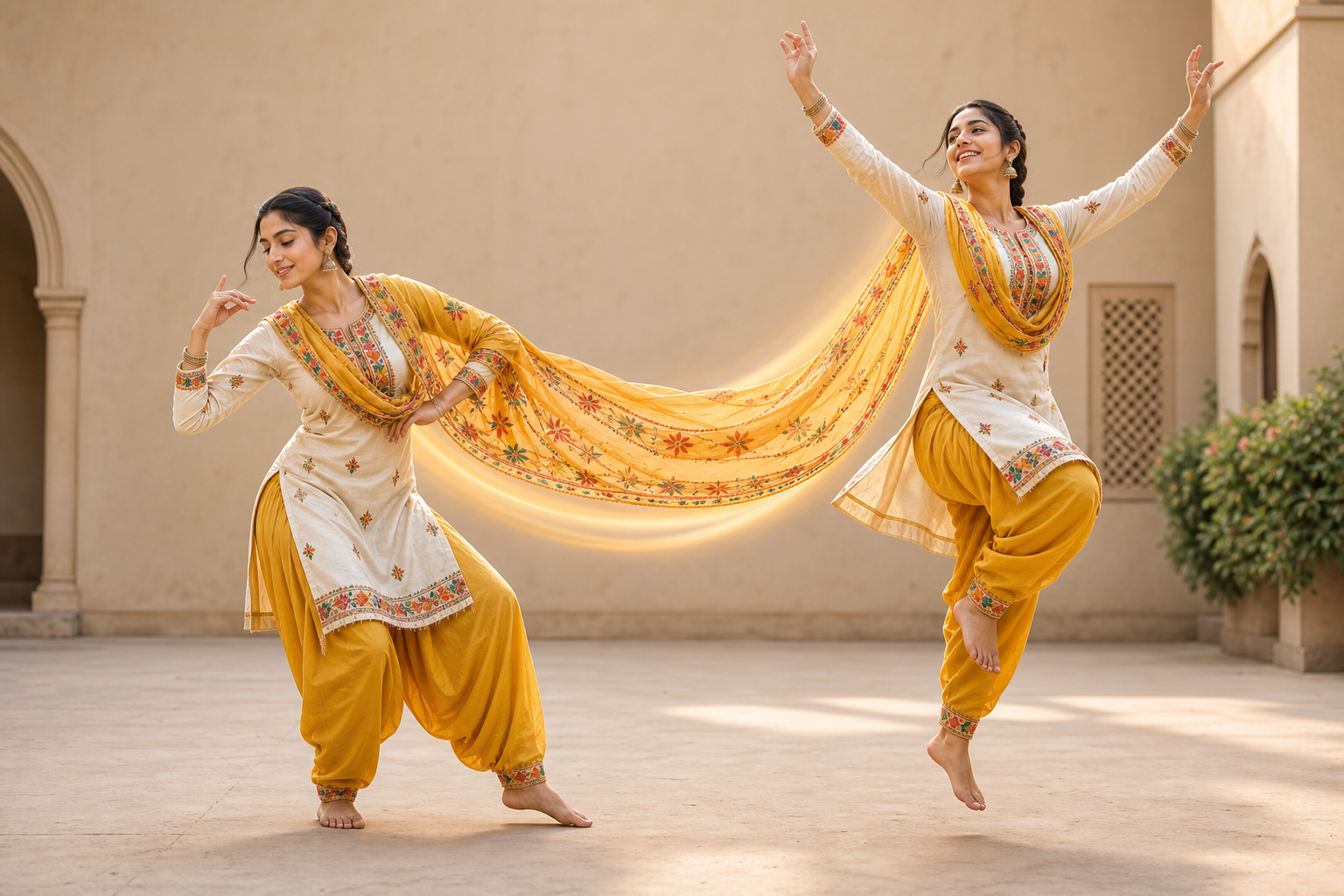
In this Punjabi movement vocabulary, matak indicates a poised, sometimes coy sway led through the hips and torso. It is measured rather than abrupt. Hulāre carries the sense of a jubilant rise: an answering lift in the legs, chest, face, voice, or collective energy of the room. The phrase therefore names grace opening into buoyancy, not two unrelated dance steps placed beside each other.
You can use a simple test when watching a performance. Follow one dancer through several beats rather than pausing on the most dramatic moment. During matak, the weight transfers laterally and the torso draws a continuous curve. At a musical or lyrical accent, the dancer rebounds upward and the gaze brightens: that is the hulara. The first movement gathers; the second declares.
This distinction also tells you what has gone wrong when an imitation feels unconvincing. Constant jumping produces energy without contour. Continuous swaying produces elegance without arrival. An isolated pelvic push removes the movement from its relationship with the feet, ribs, shoulders, rhythm, and expression. Punjabi grace lives in the transition between restraint and release.
Nor is the release merely individual display. A hulara may be answered by a drum accent, a vocal cry, a clap, a lyric’s punch line, or the visible response of the surrounding circle. Performer and onlooker are not sealed into separate roles. The room helps complete the phrase.
Read the movement from the ground upward
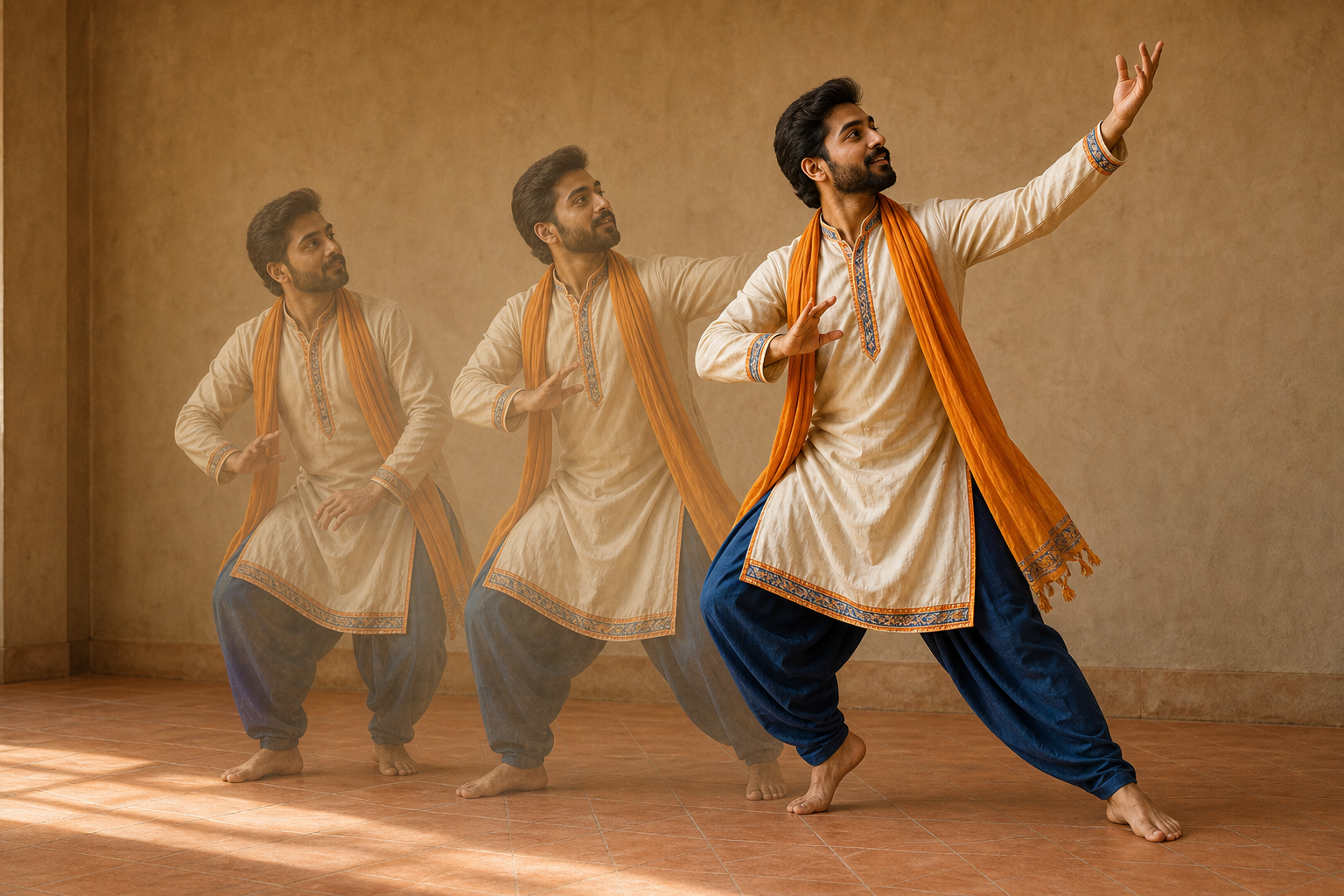
To see matak clearly, begin at the feet rather than the hips. The dancer stands with the knees flexed and the weight grounded. As weight moves toward one side, the pelvis lowers or shifts laterally; the opposite shoulder softens; the spine bends gently to the side with a small amount of rotation. Hips, ribs, and chest cooperate, creating a supple line rather than a hinge at the lower back.
- Establish the base. Keep three points of each supporting foot connected to the floor: the heel, the base of the big toe, and the base of the little toe. Let the knee follow the direction of the toes rather than falling inward.
- Transfer weight before shaping the torso. Move onto one leg with both knees still responsive. The pelvic change should emerge from the shift, not from forcibly pushing a hip outward.
- Let the curve travel upward. Allow the ribs and opposite shoulder to answer the pelvis. Keep length through the spine so the waist articulates without collapsing the lumbar area.
- Use the head as the end of the phrase. A light change of gaze or head position completes the wave. Throwing the head first disconnects it from the rest of the body.
- Rebound into the hulara. Press through the feet, release the knees, lift the sternum, and let the expression open on the accent. The rise should feel like the crest of the previous sway, not a separate jump pasted onto it.
A practical drill is to remove the arms at first. Walk a repeating pulse, alternate the weight, and find the ground-to-torso wave. Add the upward accent only after the sway remains stable. Arms, costume, and facial expression can magnify a phrase, but they cannot repair a missing base.
Keherwa offers a useful rhythmic frame because its eight mātrās can be walked and counted repeatedly. One illustrative sequence is “Dha Ge Na Ti Na Ka Dhi Na.” Let the unaccented spaces carry the sway, then place a modest lift on a strong beat. Punjabi dancing also moves through six-mātrā Dadra and lilting Jhumar feels, often heard in a twelve-pulse shape or in regional variations. The important skill is not memorising one universal count; it is learning to hear where the music invites continuity and where it asks the body to rise.
The dhol often makes those invitations unmistakable. Strong opening and mid-cycle accents can launch the hulara, while the beats between them sustain matak. The tumbi’s pointed twang, the algoza’s reedy flow, the chimta’s metallic jingle, and the dholki’s sharper pulse add further cues. Instead of dancing on top of a generic “fast Punjabi beat,” listen for which instrument is carrying the phrase and answer that sound.
Alignment matters when you practise repeatedly. Keep a stable foot, avoid forcing the knee inward, and do not manufacture a larger sway by arching or compressing the lower back. A clean, smaller curve is closer to the movement’s character than a painful, exaggerated one. Sharp pain, joint pain, or continuing back discomfort is a reason to stop; a qualified dance teacher can correct the movement pattern, while persistent pain belongs with an appropriate health professional.
Giddha and Bhangra place different accents on the form
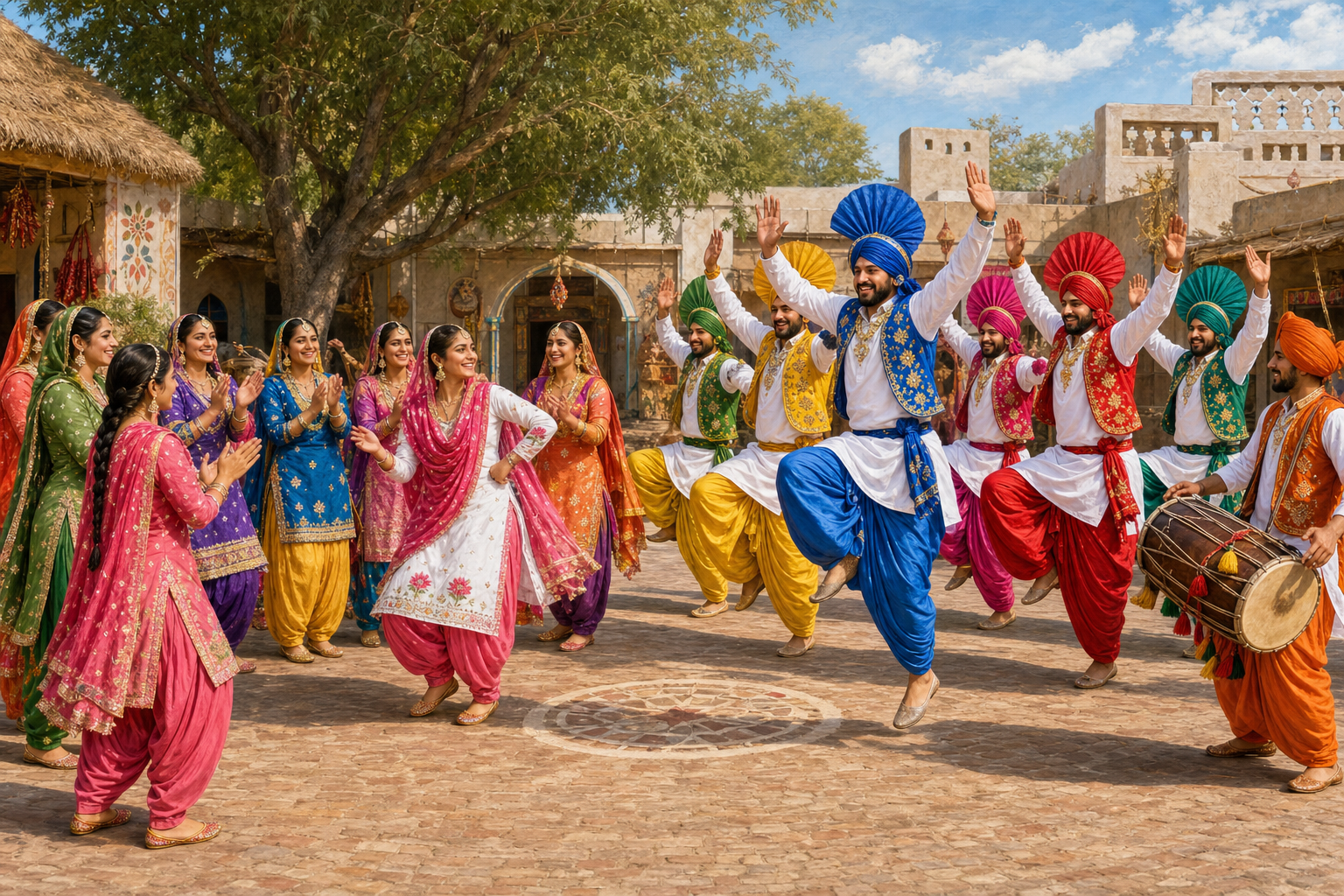
Matak Hulāre does not look identical in every Punjabi genre. Before copying a clip or teaching a sequence, identify whether you are seeing Giddha, Bhangra, or a contemporary staging derived from them. That context changes the scale, spatial design, expression, and social purpose of the movement.
| Context | How matak appears | How hulāre appears |
|---|---|---|
| Giddha | A poised through-line within clapping, circles, diagonal entries, and lyric-led expression | A bright accent answering a bolī, a punch line, a clap, or a drum cue |
| Bhangra | Fluid torso shaping that keeps athletic movement from becoming blunt or heavy | More propulsive elevation, travel, open-chested projection, and crowd-facing energy |
Giddha’s customary women-led setting is inseparable from the boliyān: short call-and-response couplets through which participants carry humour, affection, satire, social observation, and memory. The circle makes that exchange visible. One participant can enter, deliver the expressive centre of a verse, and return to a group that answers with clapping, movement, or recognition. A hulara landing with the verbal turn is therefore more than decoration; it helps the body deliver the wit.
Bhangra expands the movement outward. Travelling steps, fuller elevation, and an open chest give hulāre a vigorous, public quality. The sapp, also called chhikka, can snap open and closed with percussive accents, making the shared lift audible as well as visible. Yet force alone does not produce the desired silhouette. Matak continues to shape the torso and gives the athletic action elasticity.
This is why “Giddha is graceful and Bhangra is energetic” is too crude a division. Both contain grace and energy; they arrange the relationship differently. When you are learning, match the quality to the genre before increasing the size of the movement. A controlled shift with clear timing teaches you more than an indiscriminately large bounce.
The music, clothing, and circle are part of the meaning
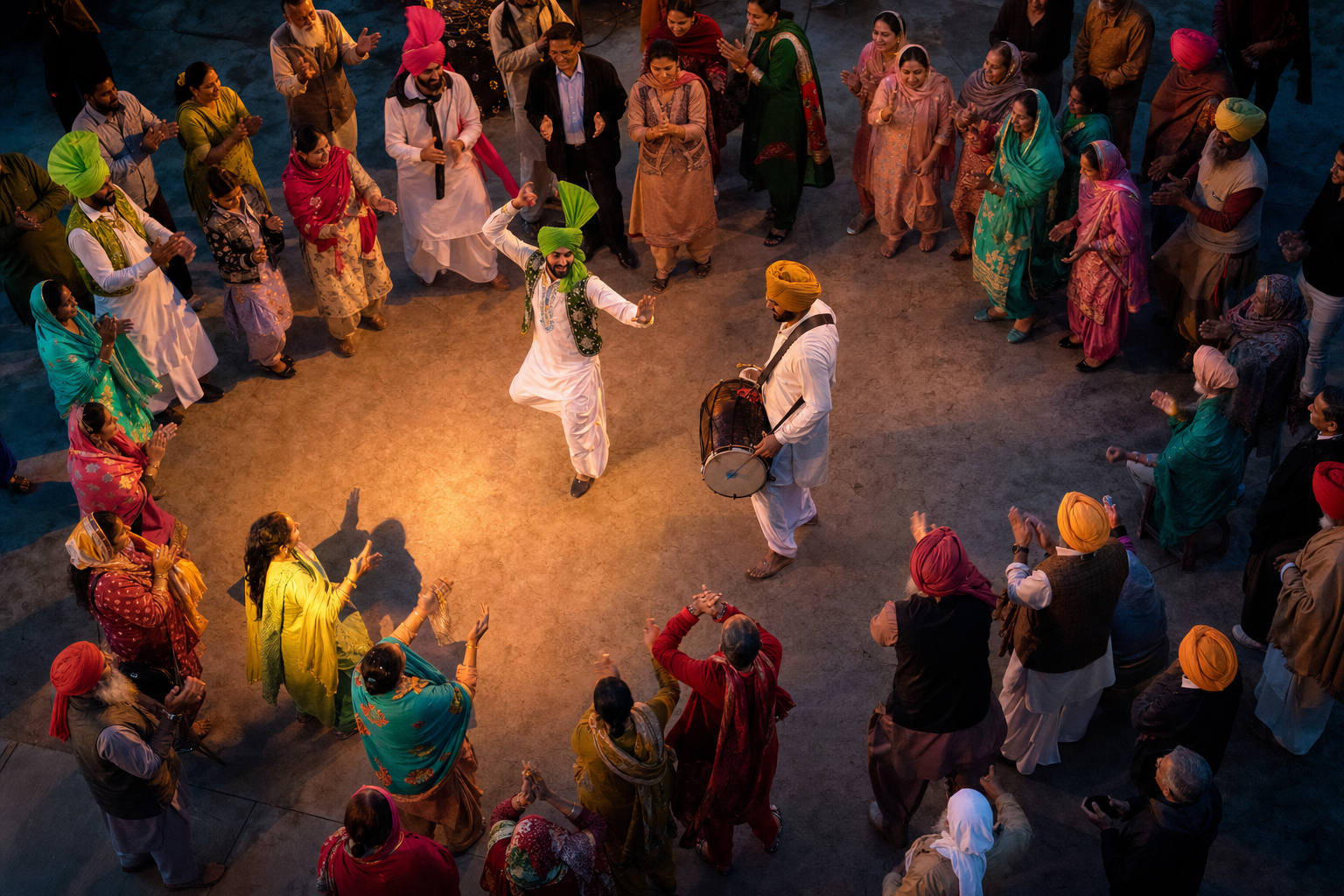
A Punjabi folk movement separated from its social setting can retain its mechanics while losing much of its intelligence. Matak Hulāre belongs in wedding sangeets, village gatherings, Vaisakhi celebrations, Lohri festivities, Teeyan, and harvest occasions because these settings give the sway and lift something to answer: kinship, seasonal labour, gratitude, teasing, resilience, and collective abundance.
At such gatherings, participation commonly passes across generations. An elder may establish a clap pattern; a younger relative may enter the circle; cousins may exchange boliyān; experienced dancers may increase the energy until the wider group answers. You do not need advanced choreography to contribute. You do need attention. Watch the group’s pulse, begin with the clap or weight shift, and let those who know the form establish the scale and timing.
Clothing makes the movement easier to read. In Giddha, salwar kameez ensembles and phulkari dupattas frame the torso’s changing line, while parandi braids and jhanjar ornaments extend the rhythm through motion and sound. In Bhangra, the chola, chaadra, pag, and turla emphasise breadth and height. As the dancer rises, the costume traces the same vertical energy. These are not random splashes of colour placed over interchangeable choreography; material culture and movement reveal one another.
The same principle helps you evaluate a staged or diaspora performance. Punjabi teams in Canada, the United Kingdom, the United States, and elsewhere may work on large stages, use amplified sound, or arrange folk material for competition and education. Adaptation is not automatically loss. Ask whether the performance still preserves the intelligible relationship among sway, accent, music, expression, and group response. Those relationships carry cultural continuity even when the venue changes.
A Dharmic interpretation needs both sympathy and precision
Matak Hulāre can speak powerfully within a Dharmic cultural world without being turned into a doctrine or made to prove that all Dharmic traditions are identical. Its spiritual significance is carried through lived values: joy shared without loss of dignity, gratitude joined to labour, disciplined energy, intergenerational belonging, and difference held within a common celebration.
The upward impulse of hulāre has a natural affinity with Chardi Kala, the Sikh orientation toward an ever-ascending spirit. Matak’s poised grounding can likewise be read beside the value placed on sattvic steadiness in broader Indian thought. This is a relationship of resonance, not a claim that a folk step is a formal religious teaching.
Indian aesthetic language offers another useful lens. Matak can carry the gentle quality of lasya; playful or flirtatious expression can evoke śṛṅgāra; comic boliyān can bring forward hāsya; and a forceful, competitive chorus may awaken vīra. Abhinaya matters because the dancer does not merely execute a count. Gaze, face, gesture, lyric, and social recognition make the movement expressive.
These concepts can clarify what you are seeing, but they should not erase Punjabi distinctiveness. Matak may recall the three-part curves associated with Odissi’s tribhaṅgī in spirit, and the buoyant rise may resemble celebratory movements elsewhere in northern India. Resemblance is not identity or proof of direct descent. Punjabi gait, musical accent, verbal humour, clothing, and communal structure give Matak Hulāre its own grammar.
That precision matters when speaking of unity. Hindu, Sikh, Buddhist, and Jain families can recognise values in shared joy and dignified participation without having their separate histories or teachings flattened. The cultural bridge is strongest when difference is welcomed into the circle, not explained away.
Learn the relationship before enlarging the performance
If you want to practise or teach Matak Hulāre, build it in layers. The aim of the following sequence is not to manufacture a complete Giddha or Bhangra routine. It is to develop the listening and coordination that keep the signature contrast intact.
- Walk the pulse. Use a repeating folk cycle and keep the steps even. In an eight-count Keherwa frame, vocalise the counts or the illustrative bols until you no longer rush the second half.
- Add the lateral transfer. Keep your arms relaxed. Let each shift begin at the floor and pass through soft knees into the pelvis.
- Connect ribs and shoulders. Allow a gentle opposing response above the waist. Check that the movement remains long through the spine rather than folding into one side.
- Choose the accent. Place one clear rebound on a strong musical beat. Return immediately to the underlying sway so the hulara has both an approach and a recovery.
- Add expression last. Let the chest, gaze, face, and arms brighten with the lift. Expression should answer the rhythm or lyric, not remain as a fixed smile.
- Restore the social setting. Practise with clapping, a partner, a circle, or an appropriate bolī. Notice how another person’s timing changes your own. Matak Hulāre becomes fully legible when energy is exchanged.
When teaching, name the form and its setting. Explain whether a phrase comes from Giddha or Bhangra, identify the boliyān or instrument cue when one is being used, and make room for regional variation. Avoid labelling every lateral hip motion “matak” or every jump “hulara.” Cultural respect begins with accurate attention, not with making the movement solemn.
Key takeaways
- Matak is the grounded, torso-led sway; hulāre is the buoyant accent that grows from it.
- Look for a wave travelling from feet through knees, pelvis, ribs, shoulders, chest, and gaze rather than an isolated hip action.
- Hear the rhythm before enlarging the movement. The beats between accents sustain matak; strong drum or lyrical cues can release the hulara.
- Giddha often places the contrast inside boliyān, clapping, humour, and circle exchange; Bhangra gives it a more athletic, travelling projection.
- Dharmic language can illuminate the form’s joy, steadiness, courage, and belonging, but it should not erase Punjabi specificity or collapse distinct traditions into one.
- To participate respectfully, begin with the shared pulse, watch experienced dancers, and let expression arise from the music and the room.
At your next Punjabi celebration, resist the urge to chase the largest move. Find the recurring pulse, watch how an experienced dancer settles before rising, and enter with a simple weight shift or clap. Once you can feel grace gathering into lift, Matak Hulāre stops being a pose to reproduce and becomes what it is meant to be: joy made shareable.