
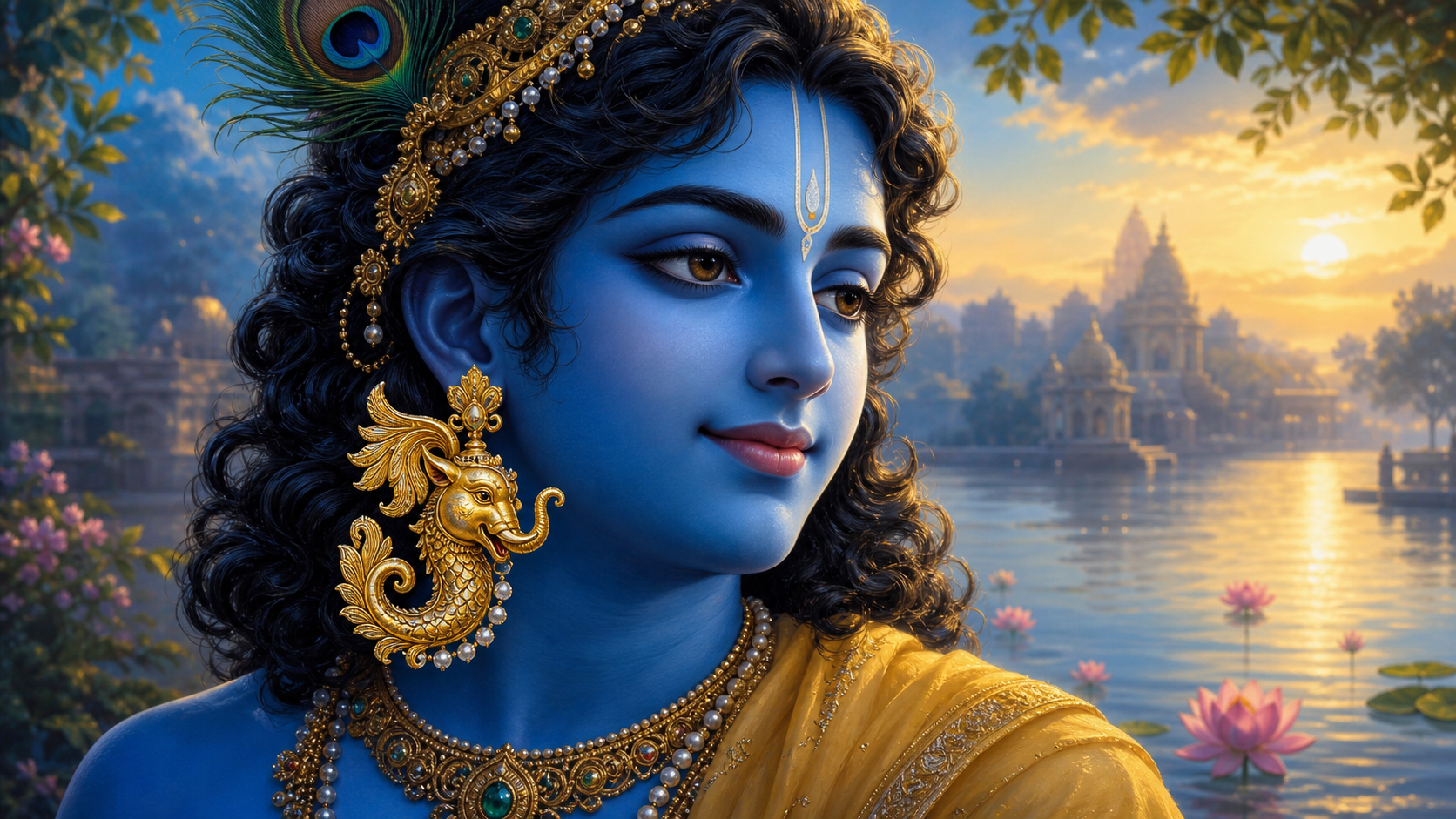
If you have looked closely at an image of Bhagavan Krishna and wondered why his earrings resemble aquatic creatures, the answer is richer than “decorative fish.” Their traditional name, makara kundala, directs your attention toward sacred waters, divine beauty, and the way a devotee listens.
The most useful interpretation begins with what the ornament actually establishes. It then distinguishes traditional association from personal devotional reflection. That discipline matters: it keeps you from flattening the makara into an ordinary animal, but it also keeps imaginative symbolism from being presented as settled doctrine.
Begin with the name, not the simplified silhouette

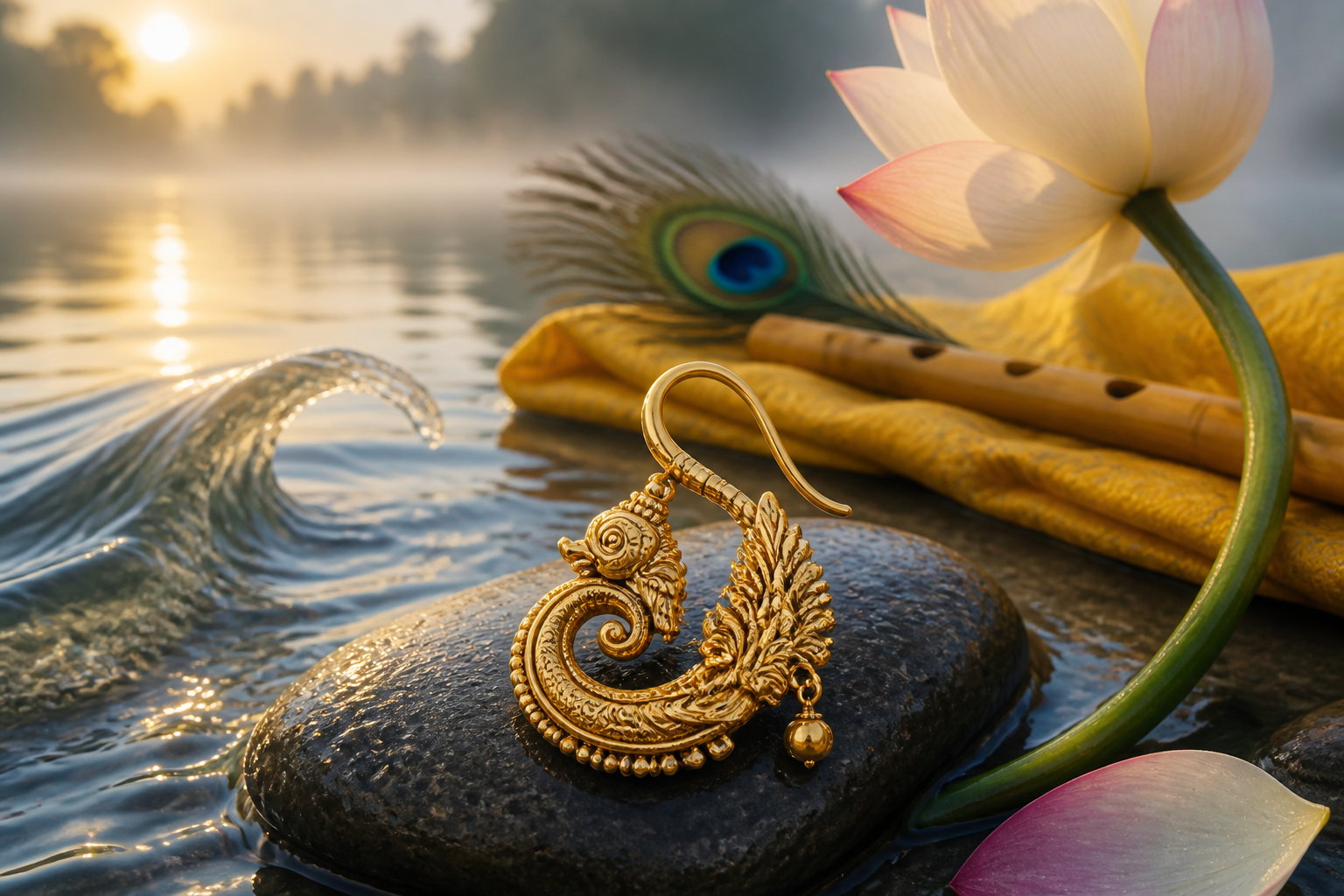
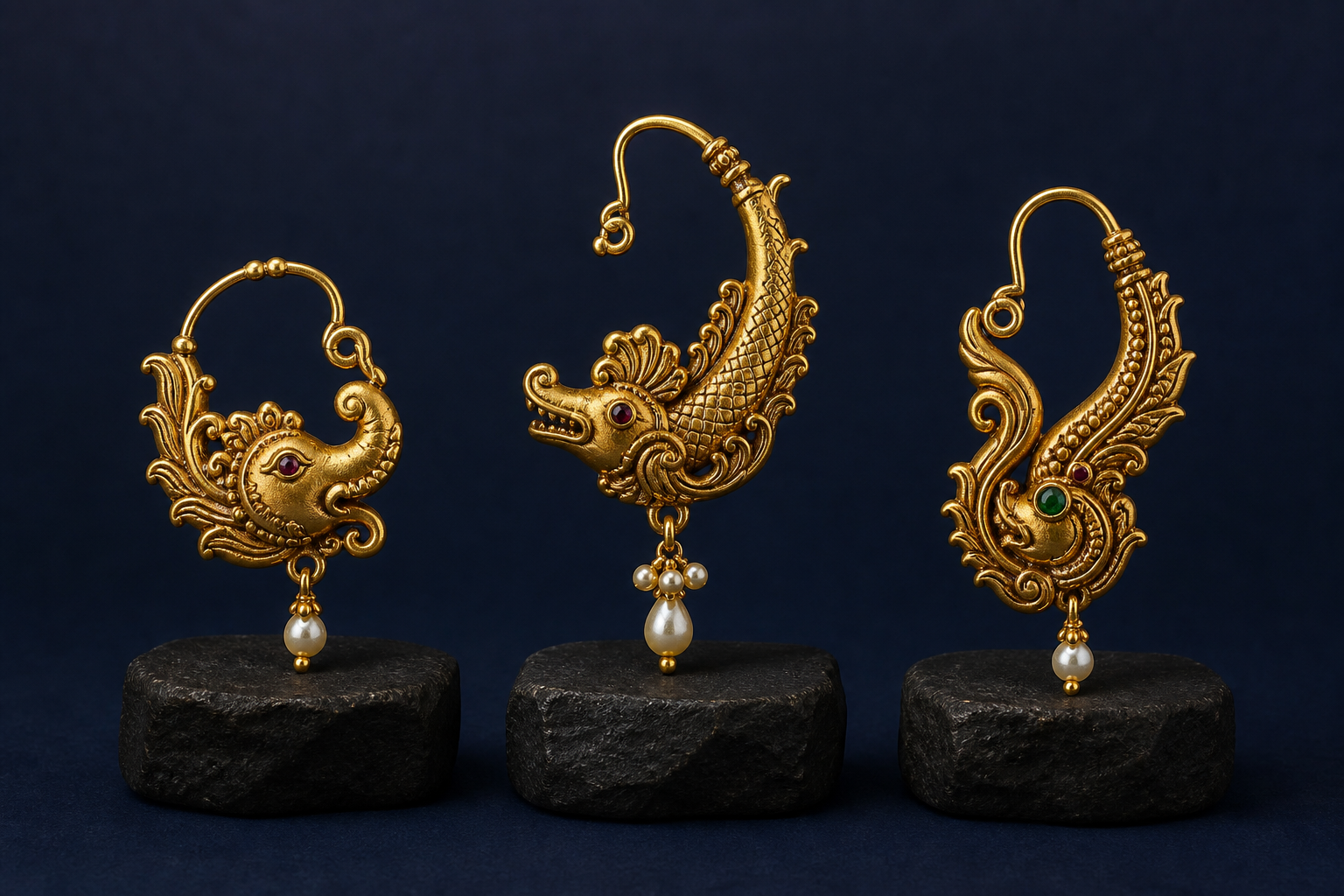
Kundala means an earring. Makara names a mystical aquatic being rather than an ordinary fish. In the Krishna tradition, the ornament therefore is better described as a makara-shaped earring than simply as a fish earring. The distinction is important because the makara is associated with the sacred waters of the Ganga, giving the form a religious horizon that a zoological label cannot convey.
“Fish-shaped” can still be a useful first visual description. It helps someone recognize the curved aquatic form. But it is only shorthand. If you are writing a museum label, teaching a child, describing a murti, or discussing a painting, use language that preserves both levels: “a makara, a mystical aquatic being sometimes simplified as fish-shaped.”
This wording also prevents a common mistake. A resemblance does not establish identity. You should not assign every curved or fish-like ornament the same meaning without checking its traditional name. Nor should you turn the makara into an ordinary species and then build an interpretation from the habits of that species. The sacred figure is the starting point.
Read the ornament through form, water, and wearer
A reliable reading of makara kundala moves through three connected layers. None should be isolated from the others.
- The form: The makara belongs to an imaginative sacred world. Its aquatic character can draw your attention beneath the visible surface, toward depth and mystery. Treat that as an interpretive invitation, not as a rigid definition that every tradition must repeat word for word.
- The water association: The connection with the Ganga changes the atmosphere of the motif. Water is no longer merely the creature’s habitat; it recalls sacred water, movement, and purification. This association does not prove that every depiction of Krishna’s earrings narrates a particular event involving the Ganga.
- The wearer: Krishna remains the centre of the image. The purpose of recognizing the ornament is not to let a secondary motif displace him. The makara kundala participates in the splendour of his manifested form and gives the devotee another detail through which attention can settle on him.
You can use these layers during darshan in a simple sequence. First notice the aquatic shape. Then remember its sacred-water association. Finally return your attention to Krishna as the one who wears it. The last movement is essential. In Krishna devotion, an ornament is most meaningful when it leads the eye back to the divine person.
The position at Krishna’s ears invites a practice of listening

A makara kundala is not an abstract sign floating beside Krishna. It is worn at the ear. That placement permits a further devotional reflection: what reaches the ear shapes attention, memory, and conduct.
Listening to divine names, teachings, prayers, and accounts of Krishna is a familiar part of bhakti. You can therefore let the earrings remind you to listen with greater care. This is a devotional inference drawn from their location. It should not be overstated as proof that every lineage formally defines makara kundala as a symbol of hearing.
The distinction between doctrine and application makes the symbol more useful, not less. A forced claim asks you to accept an undocumented universal meaning. A devotional application asks you to do something concrete: give sacred listening your undivided attention.
Try that the next time you encounter Krishna’s form. Pause at the ears, notice the earrings, and then listen to a name, verse, kirtan, or teaching without simultaneously checking a screen or moving to another task. The ornament becomes a prompt for disciplined attention. No promise of a worldly result needs to be attached to it.
How to interpret makara kundala without overclaiming
Sacred iconography is easily mishandled in two opposite ways. One approach reduces everything to decoration. The other assigns a fixed cosmic meaning to every curve. You can avoid both errors by following a short reading method.
- Identify before interpreting. Confirm that the ornament is actually named makara kundala in the tradition, caption, or explanation attached to the image. Visual resemblance alone may not be enough.
- Use the precise traditional term. Say “makara-shaped earrings” first. Add “fish-shaped” only as an accessible visual aid, not as a complete translation.
- Separate three kinds of statement. “It is an earring” is description. “The makara is associated with the Ganga’s sacred waters” is traditional context. “It reminds me to listen devotionally” is an application. Keeping those levels distinct makes your explanation trustworthy.
- Read the detail within the whole form. Notice how the earrings frame Krishna’s face and contribute to his adornment. Then return your gaze to Krishna instead of treating the creature as an independent object of speculation.
- Let a specific tradition explain its own image. When a temple, artist, teacher, or lineage gives a more particular account of the earrings, preserve that context. A general interpretation should not erase the meaning attached to a specific murti or artistic convention.
A careful caption might read: “Krishna wears makara-shaped earrings, an aquatic sacred motif associated with the Ganga; their position may also invite reflection on devotional listening.” The words “associated” and “may” do useful work. They preserve the traditional connection without pretending that a reflective application is the only permissible interpretation.
If someone gives you a more elaborate explanation, ask one clarifying question: is this a textual definition, a teaching maintained by a particular tradition, an artistic interpretation, or a personal meditation? Each may have value, but they do not carry the same kind of authority.
Key takeaways
- Makara kundala means makara-shaped earrings; “fish-shaped earrings” is a convenient but incomplete description.
- The makara is a mystical aquatic being associated with the sacred waters of the Ganga, not merely an ordinary fish used as decoration.
- The Ganga connection provides a sacred-water context, but it does not by itself turn every Krishna image into the illustration of one specific story.
- The earrings’ position can support a practice of attentive devotional listening, provided you present that as reflection rather than universal doctrine.
- In darshan, move from ornament to association and then back to Krishna. The detail should deepen attention to the wearer.
- For a particular murti or artwork, prefer the explanation preserved by its temple, artist, teacher, or lineage over a generic symbolic formula.
At your next darshan, spend a few moments with this one detail. Name it accurately, remember the sacred waters it evokes, and let its place beside Krishna’s ears sharpen the quality of your own listening. Then return your full attention to Krishna. That movement from seeing to remembering to listening is a sound way to let sacred iconography become practice.
References
