Madana Gopala iconography brings posture, music, colour, landscape, and relationship into a single devotional image. Its central concern is not beauty in isolation, but beauty understood as a force that draws human longing toward Bhagavan Krishna.
The available source is one DharmaRenaissance article rather than a multi-publication dossier. The analysis below therefore connects its iconographic, theological, aesthetic, and ecological strands without claiming independent corroboration or a complete historical survey.
Key takeaways
- Madana Gopala combines Krishna’s identity as the cowherd protector with his power to awaken and spiritually redirect love.
- The flute and graceful threefold posture are the principal identifying features, while colour, dress, ornaments, and expression deepen their meaning.
- The surrounding cows, forest, Radha, and gopis are part of the image’s theology, not merely decorative additions.
- The form is best read through bhakti and rasa: attraction becomes self-offering devotion, and divine majesty becomes emotionally accessible.
Identifying the figure through a constellation of signs
The name itself supplies the first interpretive key. The source associates Gopala with Krishna as protector of cows and nourisher of living beings, while Madana evokes attraction, longing, and Kamadeva. Joined together, the terms identify a form in which pastoral care and captivating beauty belong to the same divine personality.
This also explains the form’s proximity to other Krishna names. According to the source, Venugopala foregrounds the flute-playing cowherd, Madana Mohana presents Krishna as one who enchants even Kamadeva, and Govinda stresses protection and delight in relation to cows, the earth, and the senses. Madana Gopala gathers these emphases together rather than depending upon an entirely separate visual checklist.
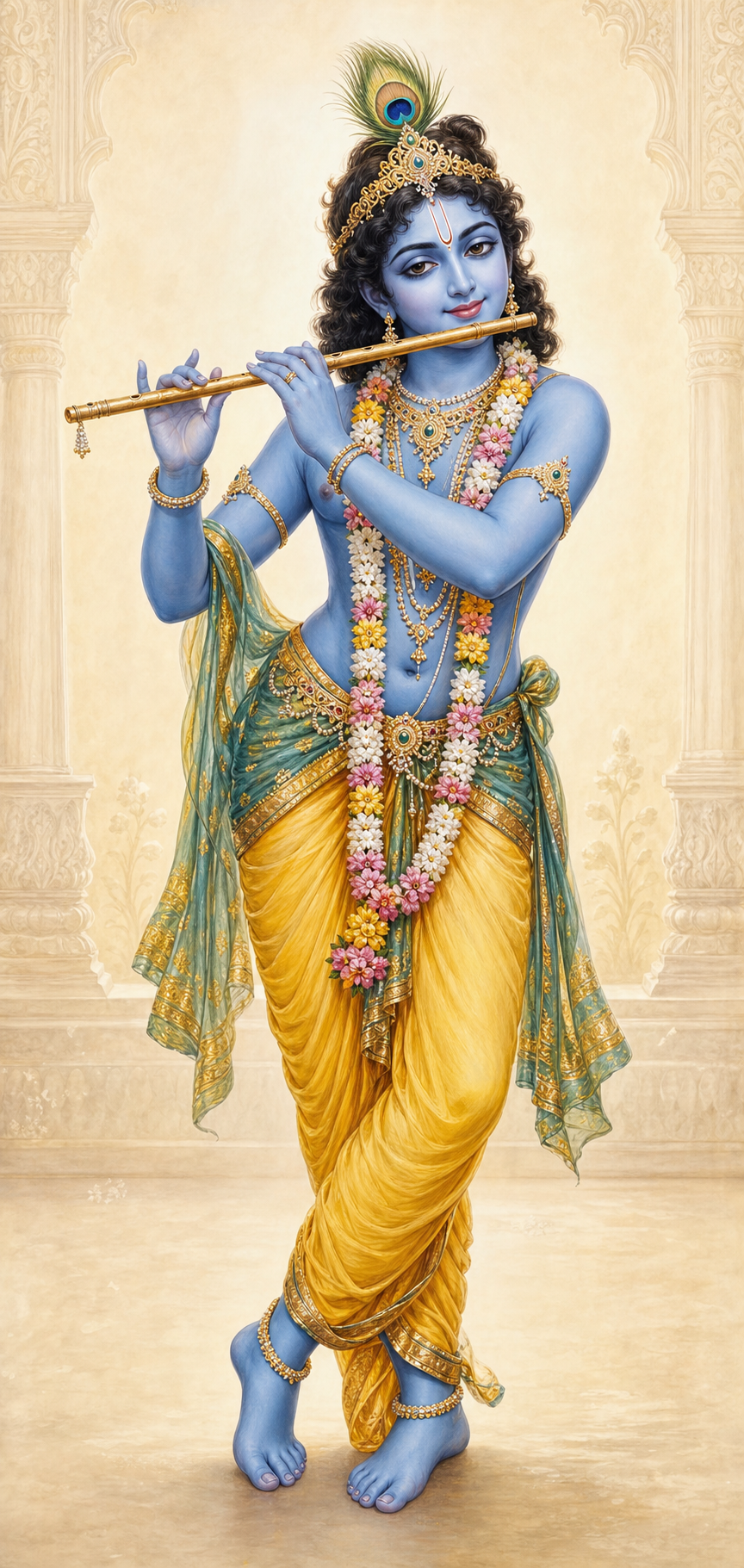
The most recognizable configuration is a youthful Krishna playing or holding the flute, often near his lips. His body commonly assumes tribhanga, the threefold bend articulated through the neck, waist, and knee. One leg may carry the body’s weight while the other crosses or bends lightly. This asymmetry gives a still murti the suggestion of rhythm: the form appears poised within music rather than fixed in a commanding stance.
Expression completes the silhouette. The source describes a serene face, extended compassionate eyes, and a restrained smile. These qualities distinguish the image’s authority from martial or judicial power. Madana Gopala attracts and receives the devotee; he does not visually overwhelm through severity.
How the visual grammar turns attraction into devotion
The flute is the theological centre of the composition. In the source’s devotional reading, its emptiness signifies receptivity: when possessiveness and ego are relinquished, the individual can become an instrument of divine purpose. Krishna’s breath supplies the music. The resulting call represents invitation and remembrance rather than compulsion.
That symbolism clarifies how Madana functions here. The source cautions against reducing the term to ordinary sensuality. Human desire is neither ignored nor automatically sanctified; it is redirected. Restless kama becomes prema, a love expressed through devotion and self-offering. The icon therefore stages a spiritual movement: attraction opens the heart, but bhakti determines its destination.
Colour and clothing reinforce that movement. Krishna’s dark blue or blue-black complexion is compared with a rain-bearing cloud, linking mystery and transcendence with nourishment. The yellow pitambara places warmth and auspicious radiance against that depth. Read together, body and garment hold the beyond and the manifest world in visual relation.
The peacock feather performs a similar balancing act. Its associations with colour, rain, dance, and celebration soften the distance normally implied by a crown. Garlands, anklets, armlets, and necklaces likewise do more than embellish the body: within the source’s interpretation, ornament communicates the fullness of divine beauty. The forest garland is especially significant because it joins Krishna’s splendour to Vrindavan rather than to an isolated courtly setting.
The source interprets this ensemble through rasa, refined aesthetic experience contemplated and spiritually tasted. Madana Gopala belongs particularly to madhurya, or sweetness. Majesty remains present, but it becomes intimate enough for Krishna to be approached as cowherd, friend, child, or beloved while still being worshipped as supreme.
Why the surrounding world belongs to the icon
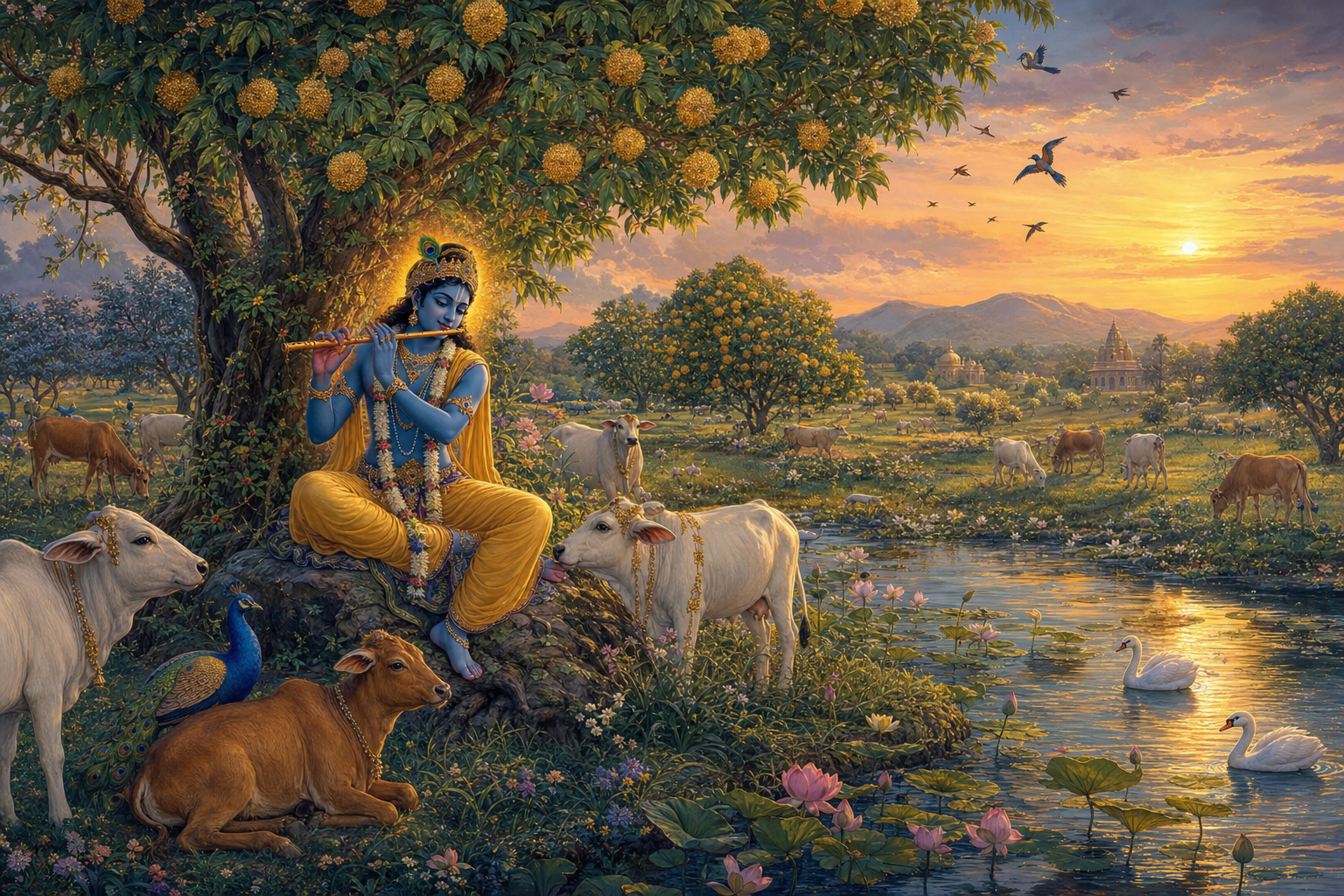
A Madana Gopala image cannot always be understood by examining Krishna alone. The source treats Vrindavan’s trees, flowers, birds, riverine setting, cows, and cowherd paths as participants in the devotional field. Nature is not an empty backdrop for a beautiful figure; it is the living environment within which divine attraction, nourishment, and harmony become visible.
Cows make this connection ethical as well as pastoral. They signify nourishment, patience, abundance, and an economy of non-violent care in the source’s account. Their presence grounds Krishna’s captivating beauty in responsibility toward vulnerable life and the community it sustains. The title Gopala consequently describes conduct as much as identity.
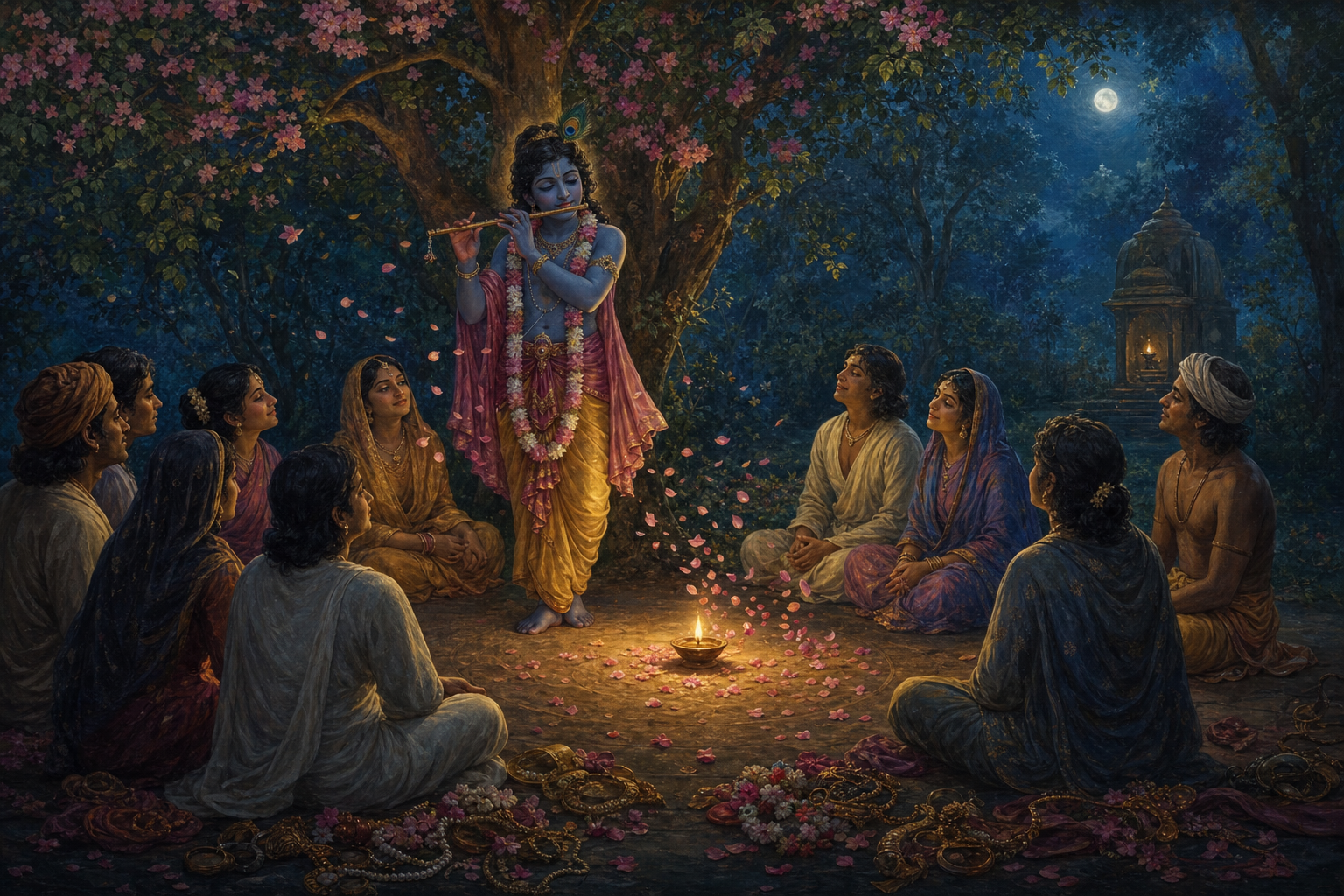
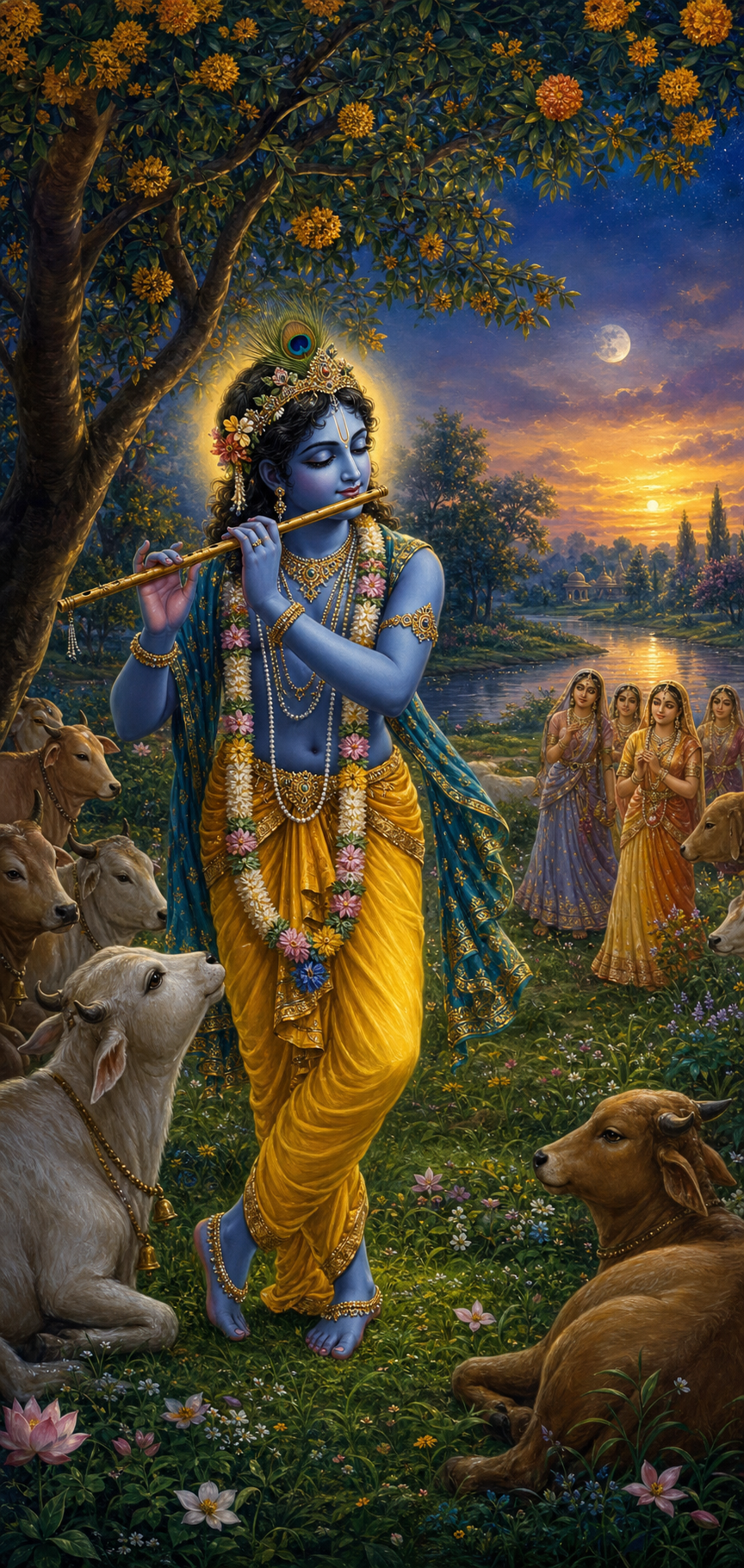
Radha and the gopis introduce the answering side of devotion. The source reads their longing as spiritual absorption and presents Radha as an exemplary embodiment of devotion in many Vaishnava traditions. Krishna’s flute summons a response; their devotion discloses the depth of the one who calls. When these figures appear together, the image becomes relational: divine attraction and devotional surrender illuminate one another.
This relational reading prevents two common reductions. Madana Gopala is neither simply a solitary flute player nor merely the centre of a picturesque rural scene. Posture, sound, animals, vegetation, and companions together express a world ordered by loving reciprocity.
A disciplined way to read variations of the image
A careful reading can begin with the body: youthfulness, tribhanga, the disposition of the legs, and the flute establish the composition’s musical character. The next question is relational—whether cows, Radha, gopis, companions, or elements of Vrindavan specify the aspect of Krishna being emphasized. Colour, garments, feather, and garland can then be considered as an integrated symbolic vocabulary rather than as disconnected attributes.
Such readings should preserve the source’s qualifying language. Features described as usual, common, or frequent are not universal requirements for every murti or painting. The source also connects the form broadly with the Bhagavata Purana and later Vaishnava literature, worship, poetry, music, and art, but it does not provide individual verse citations, dated examples, regional comparisons, or a formal catalogue of sculptural prescriptions. Those details should not be inferred from the article alone.
Within those limits, the icon’s coherence is clear. Its beauty, care, music, longing, and natural setting express one devotional proposition: the power that attracts the senses can also educate them. Further study can build on that proposition by comparing primary textual passages, regional temple forms, paintings, and liturgical interpretations without forcing every representation into a single fixed model.