
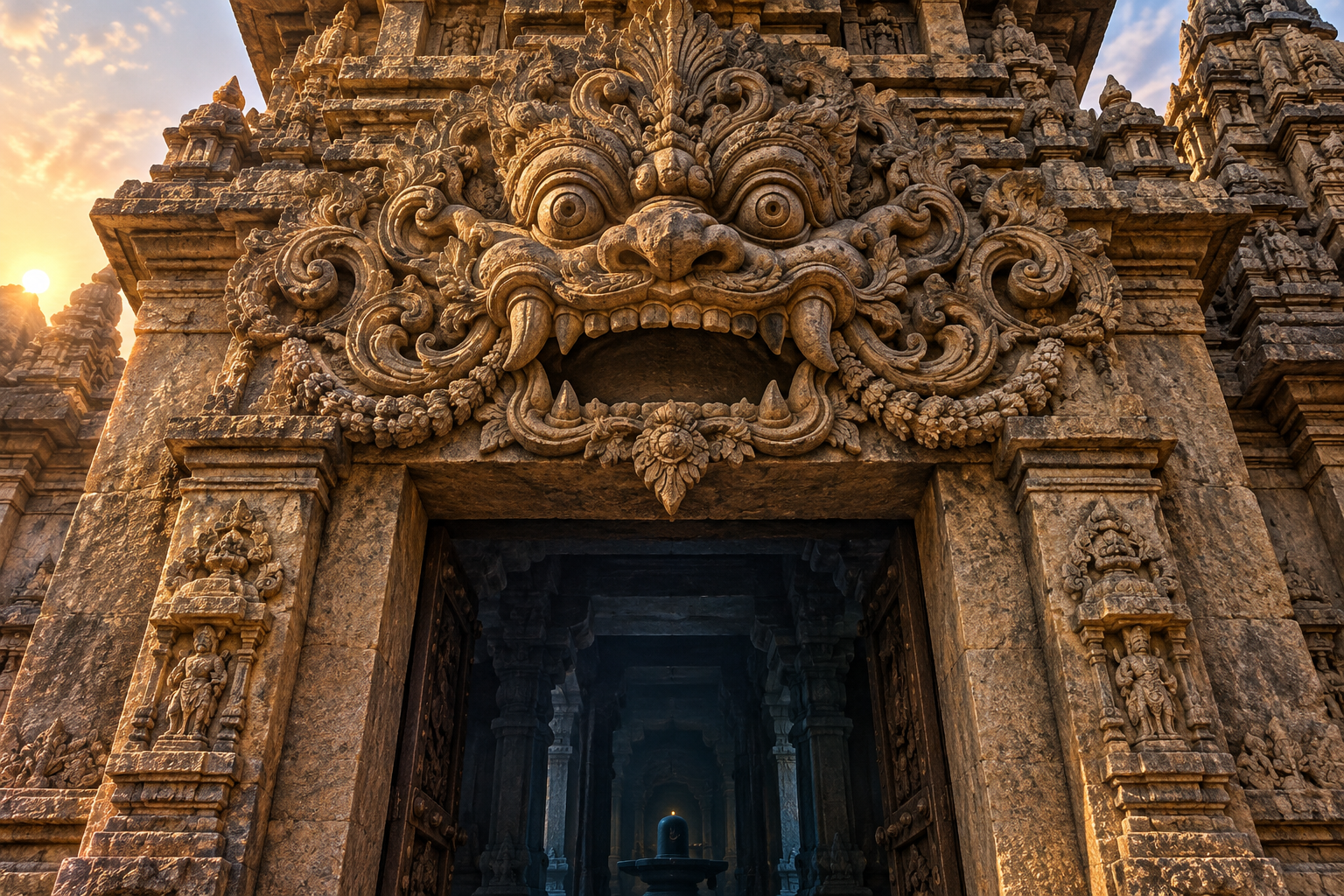
You look up at a Hindu temple doorway and find a fierce face staring back: round eyes, bared teeth, a vast mouth, and apparently no body. Is it a demon, a deity, an ornament, or a warning?
It is usually Kirtimukha, the self-devouring guardian associated with Shiva. If you read it merely as a frightening creature kept above the door, you miss its purpose. Kirtimukha turns the temple threshold into a spiritual checkpoint: before you approach the sacred, notice the appetite, pride, and sense of entitlement you are carrying with you.
The story begins with power becoming entitlement
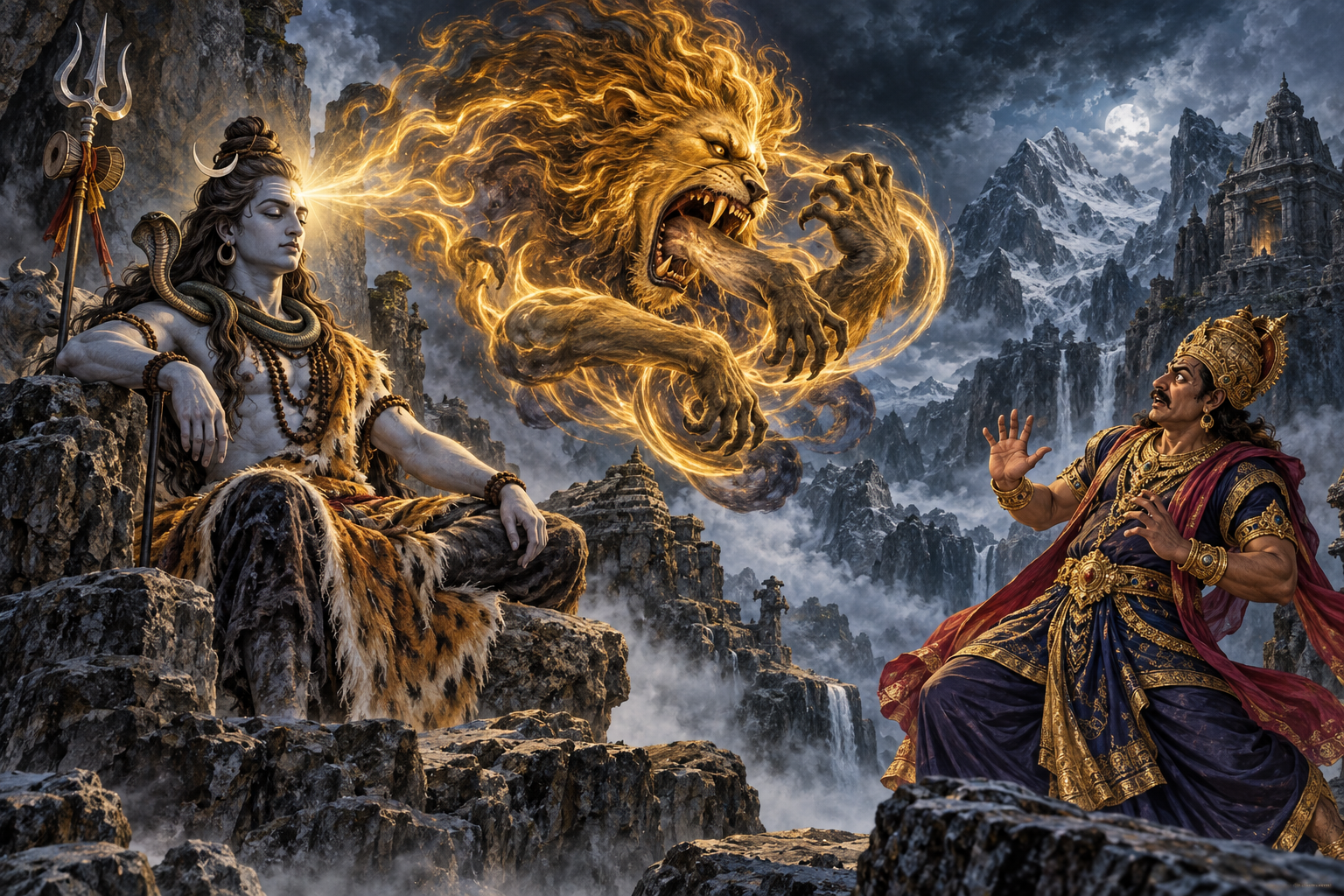
The Kirtimukha narrative is preserved in the Skanda Purana and unfolds during the conflict involving Jalandhara, a formidable asura born from Shiva’s wrathful energy. Jalandhara possesses real power, but power gradually becomes presumption. He challenges the divine order as though strength entitles him to whatever he desires.
An emissary carries Jalandhara’s arrogant demand to Shiva. In response, Shiva manifests a ravenous being capable of consuming the challenger. The emissary, confronted by the consequences of that demand, seeks protection. Shiva grants refuge rather than allowing the creature to devour someone who has surrendered.
That act of protection leaves an immediate problem: the newly manifested being is still consumed by hunger. Shiva directs it to feed upon itself. It obeys, devouring its own limbs and body until only the face remains. Shiva is pleased by its obedience and transformation, names it Kirtimukha, and gives the once-terrifying being an honored place at the sacred threshold.
The sequence matters. Kirtimukha is not honored because hunger is sacred in itself. It is honored because destructive appetite submits to a higher order. What began as an instrument of wrath becomes a guardian. What could have consumed another turns upon the very basis of its own excess.
This is also why the story should not be reduced to a command to despise the body. The self-devouring is mythic language, not a prescription for literal self-denial or harm. It depicts appetite consuming its own foundation when it recognizes no limit. The target is not embodied life; it is desire that has forgotten dharma.
Why the terrible face is an auspicious symbol
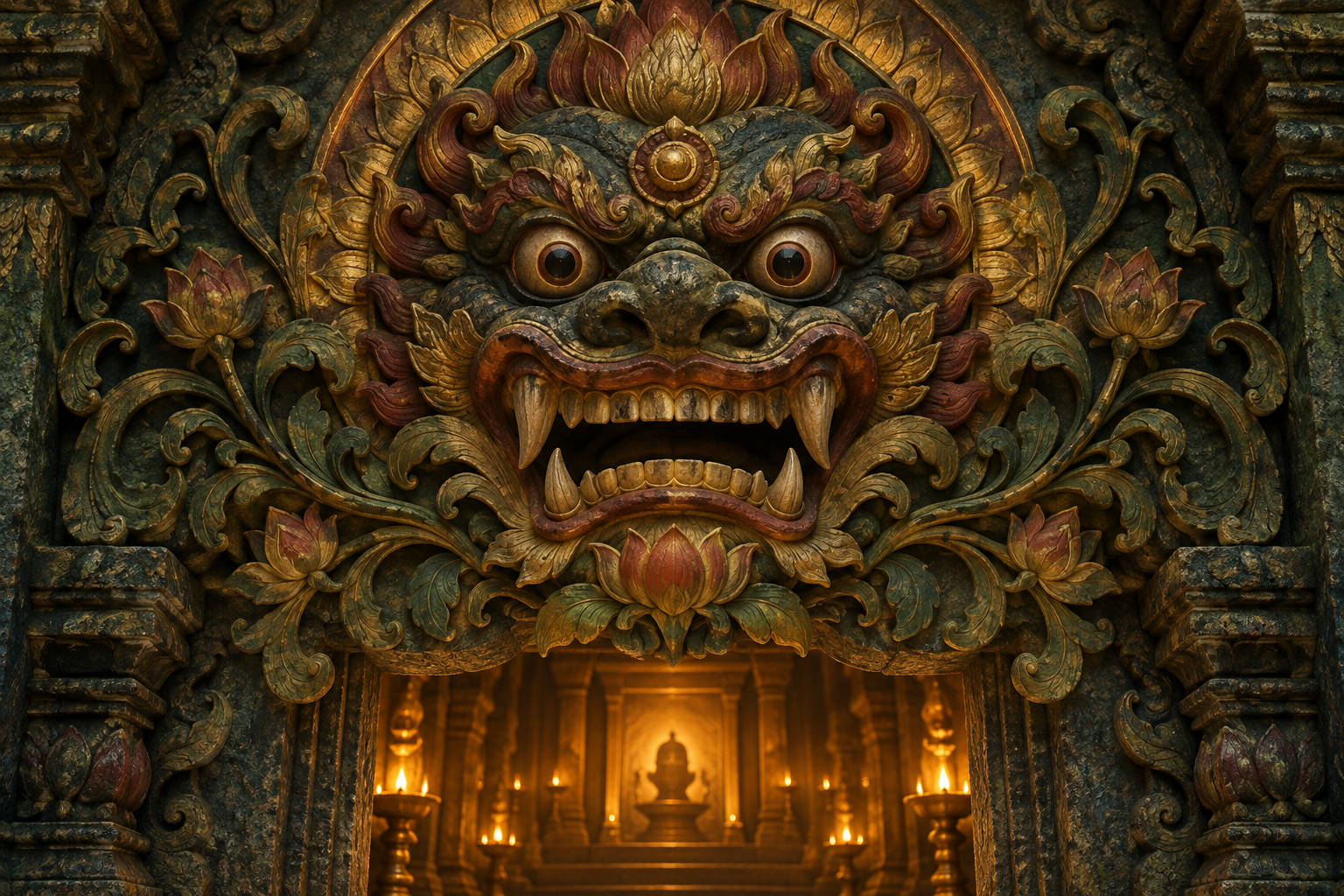
The name is commonly understood through two Sanskrit terms: kirti, meaning glory or renown, and mukha, meaning face. The result is often rendered as the face of glory. That sounds paradoxical only if glory is confused with attractive appearance. Kirtimukha’s glory lies in the conversion of uncontrolled force into disciplined service.
Its first lesson concerns appetite. Hunger naturally seeks an object outside itself: food, wealth, status, influence, pleasure, or control. When that hunger becomes limitless, no object can finally satisfy it. Kirtimukha makes the mechanism visible. An appetite without measure eventually consumes the person, household, institution, or society that carries it.
Its second lesson concerns ego. Jalandhara’s mistake is not simply that he is strong. The mistake is treating strength as proof that no boundary applies to him. That distinction is important. Dharma does not require weakness, timidity, or withdrawal from responsibility. It requires power to accept rightful limits and serve an order larger than personal desire.
Its third lesson concerns transformation. Hindu sacred imagery often refuses the shallow equation of pleasant appearance with goodness and frightening appearance with evil. Kirtimukha remains fierce after its hunger has been mastered. Its teeth do not disappear, and its gaze does not become gentle. The energy is retained, but its direction changes. The same force that threatened disorder now guards sacred order.
Its fourth lesson concerns refuge. The emissary’s plea interrupts destruction, while Shiva’s response places protection under dharma rather than vengeance. The mythology therefore holds firmness and mercy together. Destructive arrogance is confronted, but surrender creates the possibility of preservation and change.
These meanings overlap; they should not be turned into one rigid formula. A devotee may see protection, an artist may emphasize the devouring mouth, and a philosopher may contemplate self-consuming desire. The image can carry all three readings without becoming vague, because each returns to the same movement: unruly force is brought under sacred discipline.
How to identify and read Kirtimukha at a temple
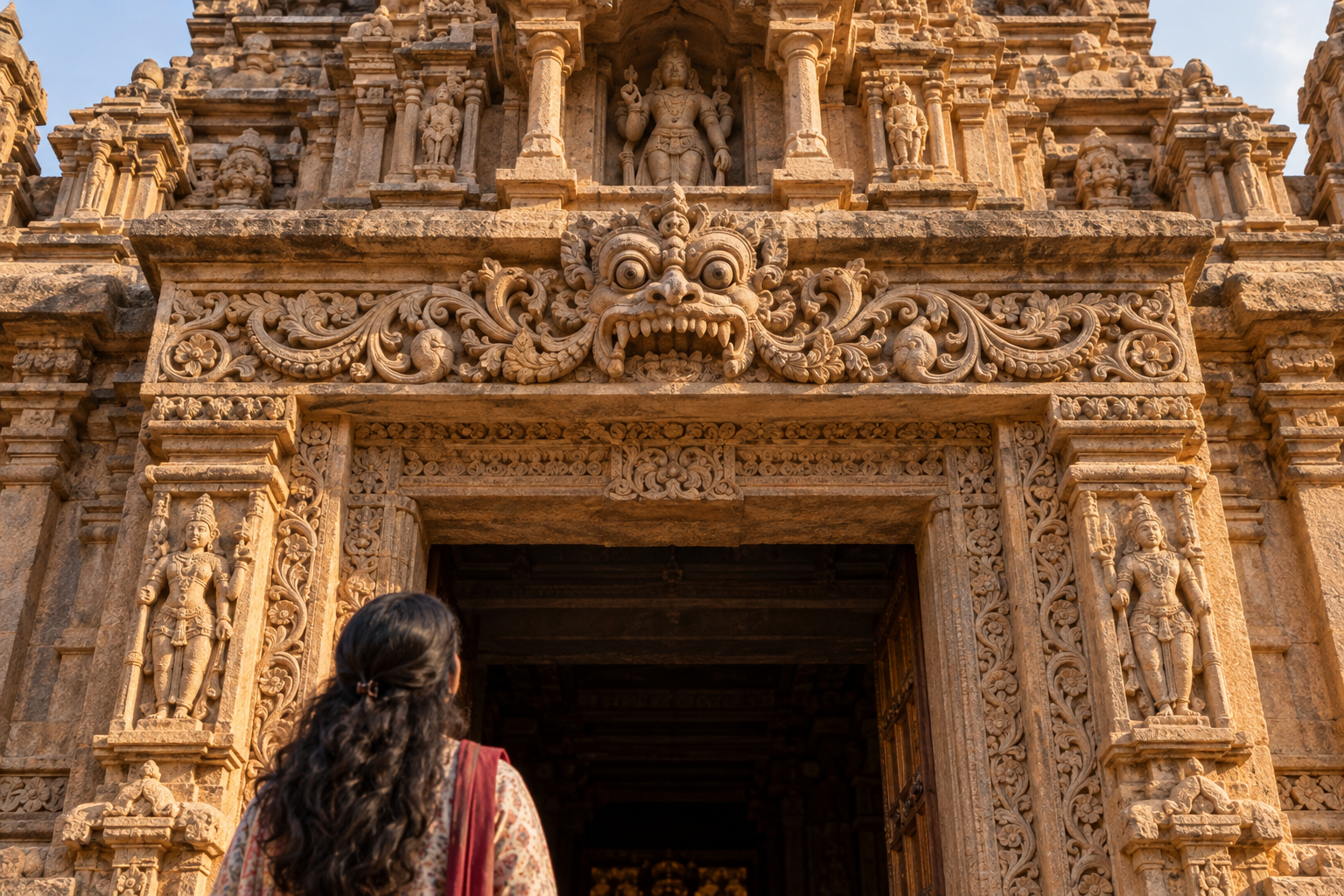
You will most often understand Kirtimukha correctly by reading placement, form, and context together. A fierce face alone is not enough; Indian sacred art contains many guardians and powerful beings. Use the following checks rather than identifying every fanged face by resemblance.
- Look above the passage. Kirtimukha commonly occupies a high, central position over a doorway, arch, gateway, or sacred image. Its location is part of its meaning: it watches the point of transition rather than behaving like an ordinary figure within a narrative scene.
- Look for the face without a normal body. The image is usually dominated by staring eyes, flared features, teeth or fangs, and an expansive mouth. Regional styles vary, but the disproportionate face recalls the conclusion of the self-devouring story.
- Notice whether the form crowns an ornamental scheme. When the face appears at the apex of a carved frame, it can organize the surrounding decoration while also marking the boundary as protected. Do not dismiss it as a decorative flourish simply because it is integrated into architecture.
- Read the doorway as part of the image. The guardian faces outward while the sanctum or sacred space lies beyond it. That relationship turns the carving into an instruction for the entrant: leave arrogance, predatory desire, and restless distraction outside.
- Confirm the local identification. Closely related protective faces can share bulging eyes and exposed teeth. If you are documenting a particular temple, consult its own iconographic account, priest, guide, inscription, or conservation record before applying a universal label.
If you are photographing Kirtimukha for study, record more than a close-up. Take in the complete doorway, the figures beside it, the structure it crowns, and the route through which a worshipper approaches. A cropped face tells you about style; the whole threshold tells you about function.
Resist calling it a devil or assuming that frightening imagery must represent an enemy of the sacred. That imported good-face-versus-bad-face shortcut fails here. Kirtimukha is formidable precisely because a guardian must face what threatens the boundary. Its appearance communicates vigilance, not moral corruption.
Turn the threshold image into a practice
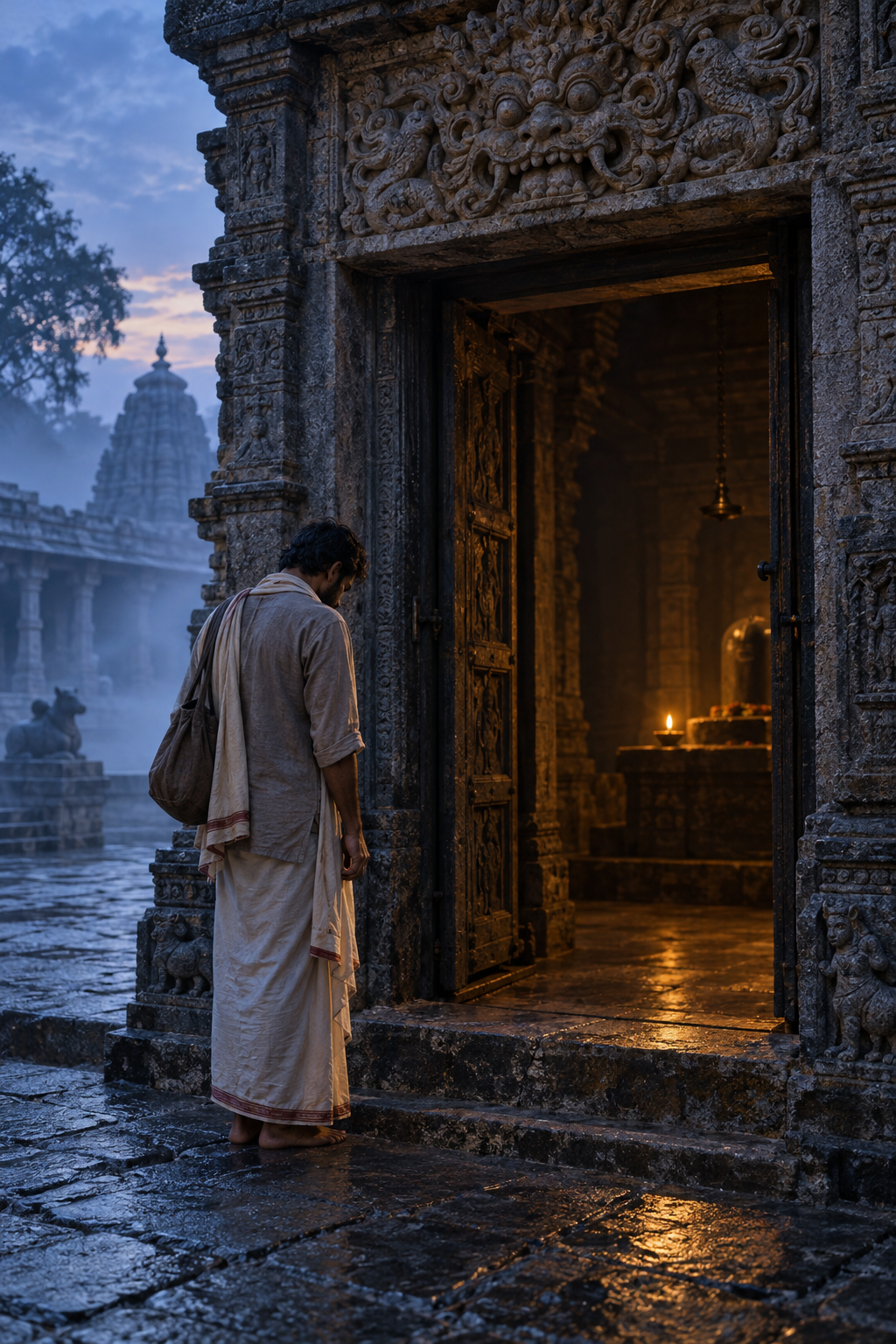
You do not need to invent a mantra or perform a ritual that the temple does not recognize. A brief, honest pause is enough to let the symbol do its work. Before crossing the threshold, ask what demand you are carrying as though the world owes it to you. Then ask which appetite grows stronger each time you feed it. Finally, choose one claim, grievance, or distraction that does not need to accompany you inside.
The same examination works away from a temple. Use Kirtimukha when a decision is being driven by status, retaliation, or endless acquisition. The useful question is not whether you want something; desire by itself is not the problem. Ask whether the desire still serves a legitimate purpose, whether it recognizes a boundary, and what it will consume if you refuse to limit it.
This prevents two opposite mistakes. The first is indulgence: assuming that power or longing justifies its own fulfillment. The second is passivity: assuming that spiritual discipline means having no force at all. Kirtimukha offers a more demanding alternative. Keep the force, remove the entitlement, and give the energy a protective purpose.
If you keep an image of Kirtimukha, do not treat it as a mechanical guarantee that misfortune cannot enter. Let it function as an ethical reminder. Protection begins with recognizing the disorder that enters through one’s own habits: speech sharpened by pride, anger fed for pleasure, possessions pursued for display, or authority used without restraint.
Key takeaways
- Kirtimukha is the self-devouring guardian face associated with Shiva, not merely a random monster placed on a temple.
- Its mythology traces a movement from Jalandhara’s entitlement, through ravenous force, to disciplined guardianship.
- The missing body is essential to the symbolism: appetite without limits consumes the ground on which it depends.
- Its fierce appearance is auspicious because dangerous energy has been mastered and assigned a dharmic purpose.
- At a temple, identify it through placement, bodily form, and local context, then use the threshold to examine what you should not carry into sacred space.
The next time this face looks down from a temple entrance, stop before walking beneath it. Do not ask only what Kirtimukha is guarding you from. Ask what in you must accept a boundary so that you can enter with attention, humility, and strength directed toward dharma.
References

Leave a Reply
You must be logged in to post a comment.