
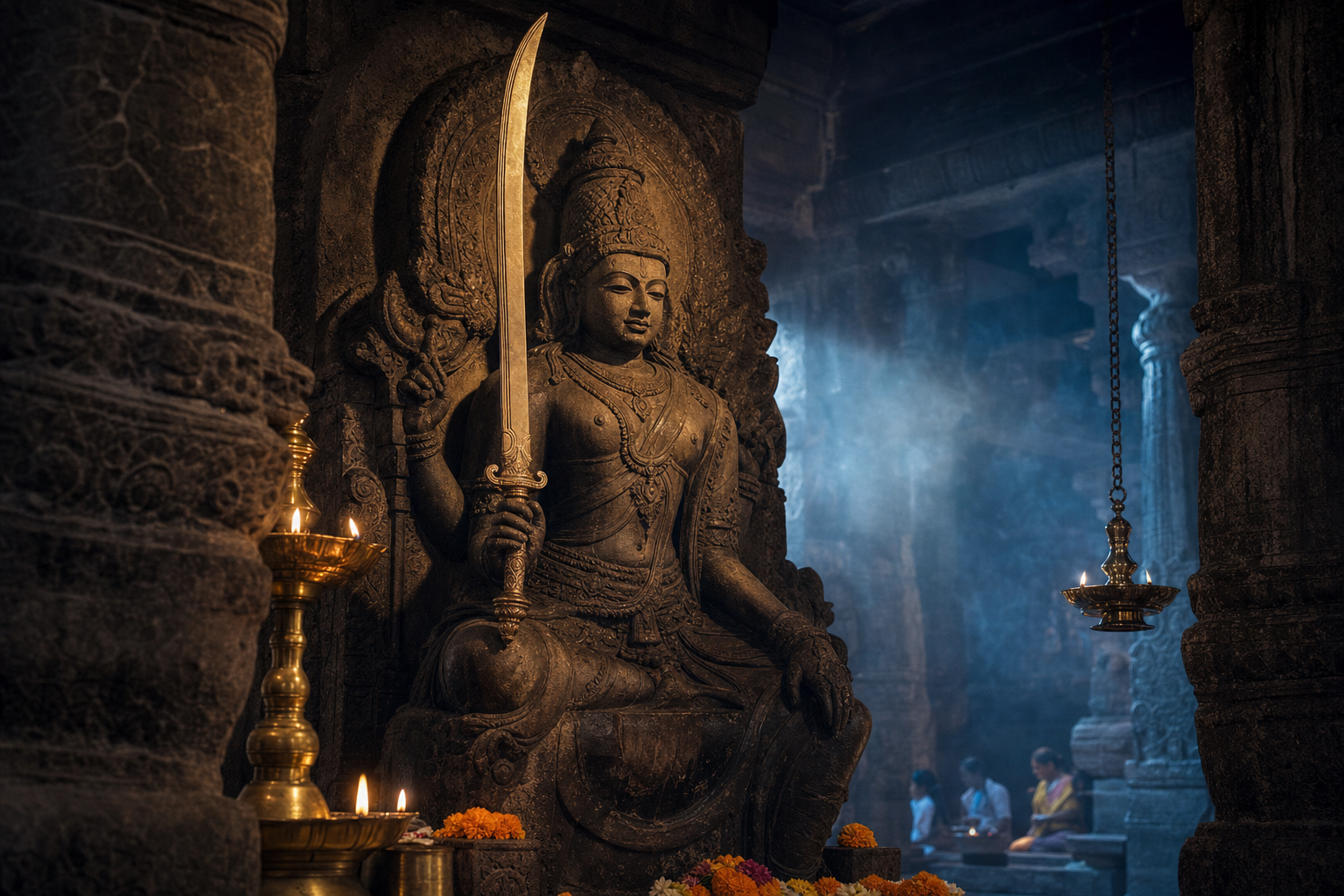
You are standing before a murti and notice a sword in the deity’s hand. Is it simply a weapon, a warning to enemies, or a symbol of something inward? The most useful answer is that the khadga can operate on all these levels at once.
It represents the power to make a necessary cut: between dharma and adharma, knowledge and delusion, disciplined protection and uncontrolled anger. Reading it well means neither glorifying violence nor explaining the weapon away as a harmless metaphor.
The khadga begins with a decisive distinction

A sword does not persuade, bind, or gradually wear something down. It separates. That physical action gives the khadga its central symbolic grammar. At the philosophical level, the blade can represent discernment: the faculty that distinguishes what is true from what merely appears true, what serves dharma from what disguises self-interest as dharma.
This is why the khadga’s symbolism is sharper than a general call to be wise. Discernment must eventually result in a decision. You may understand that a habit is destructive, a claim is dishonest, or a duty is being neglected. Until you act on that understanding, however, confusion still governs the situation. The symbolic sword joins clear seeing to decisive conduct.
The khadga therefore helps you notice four related qualities:
- Discernment: identifying the real issue beneath distraction, appearance, or rationalisation.
- Decisiveness: ending hesitation after the relevant distinction has become clear.
- Detachment: cutting attachment to an outcome, status, possession, or identity that obstructs right action.
- Responsibility: accepting that a necessary decision may be difficult without pretending that difficulty makes it wrong.
This interpretation does not require you to pretend that the sword is not a weapon. Its force gives the symbol seriousness. Ignorance, disorder, and entrenched wrongdoing are not always overcome by pleasant intentions. Yet the precision of the blade matters just as much as its power. A khadga is not an image of uncontrolled destruction; it is an image of a directed cut.
Why a divine weapon is not a celebration of aggression
The presence of a weapon in sacred art can trouble a viewer who assumes that holiness must always appear passive. But a deity bearing a khadga asks a different moral question: what must protecting power be capable of when persuasion fails and harm continues?
Within this iconographic logic, force receives meaning from dharma. Who acts, why the action is taken, what it protects, and whether it is restrained all matter. A weapon held for domination does not mean the same thing as a weapon held to end domination. Outwardly similar acts can have different moral characters because motive, authority, necessity, and limits are part of the action.
Keep three distinctions in view:
- Protection is not aggression. Protection responds to a real threat against life, order, truth, or legitimate duty. Aggression manufactures excuses for conquest, humiliation, or revenge.
- Clarity is not rage. Anger can alert you to wrongdoing, but it can also distort judgement. The khadga symbolises force governed by awareness, not emotion given unlimited permission.
- Ending harm is not hating a person. Dharma may require resistance to an act, habit, falsehood, or unjust power. It does not require turning personal dislike into a sacred mandate.
This last distinction is especially important. The language of adharma should not become a shortcut for declaring every opponent evil. Before invoking the symbolism of divine combat, ask what concrete duty is being protected, what harm is actually occurring, and what limit will govern the response. If those questions have no clear answers, personal anger may be borrowing religious language.
The khadga also corrects the opposite mistake: treating restraint as helplessness. Moral seriousness includes the capacity to defend what ought not be surrendered. Strength alone is not dharmic, but dharma without the strength to protect its responsibilities can become merely decorative.
How to read the khadga in a murti or temple carving
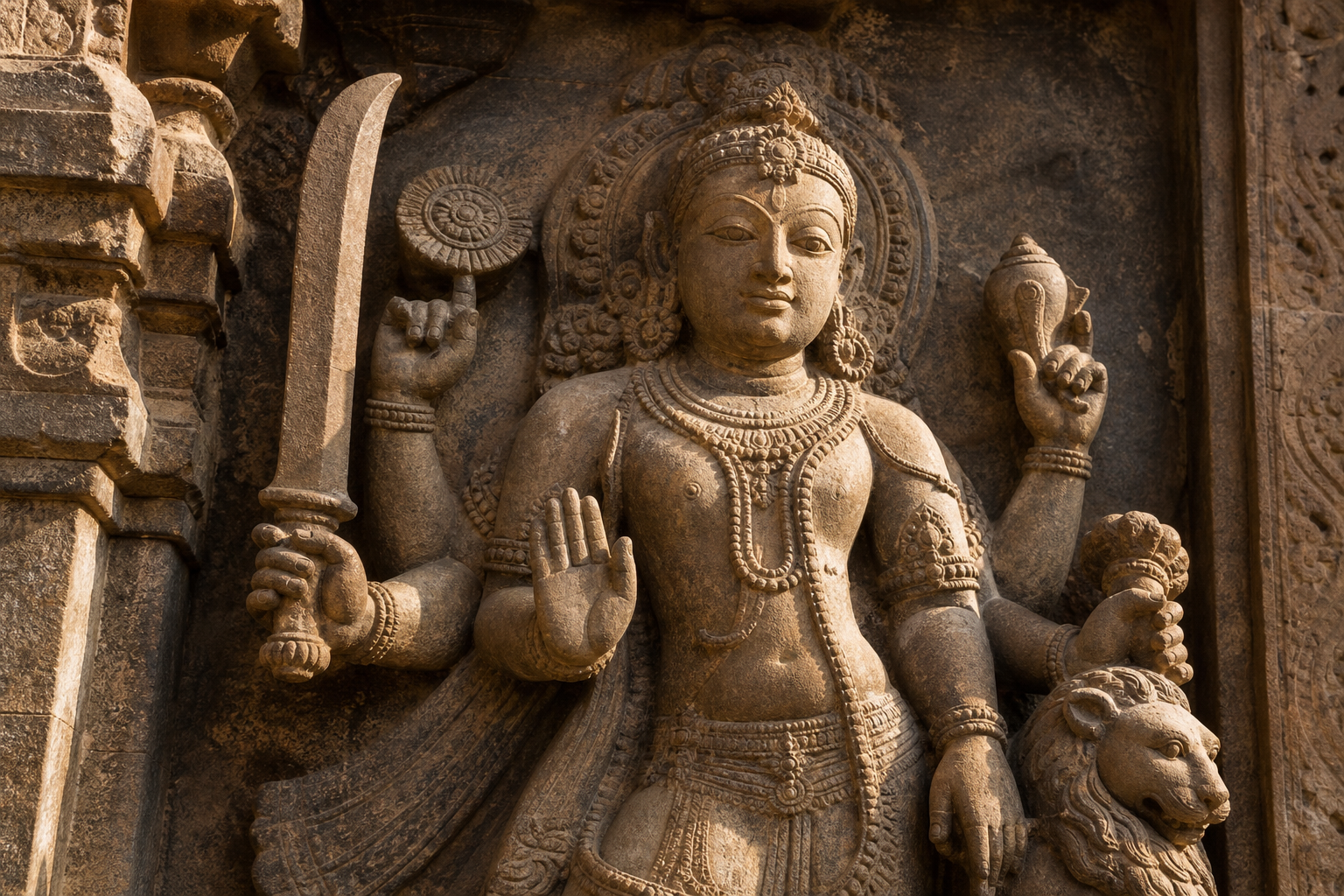
The khadga appears across sculpture, bronze casting, and temple carving. Its repeated presence does not give it one mechanically fixed meaning. Iconography works through relationships: the deity, posture, other attributes, narrative setting, and worshipping tradition together shape what an object communicates.
Use the following sequence when you encounter one:
- Identify the deity and tradition before interpreting the weapon. Do not begin with a universal dictionary entry for sword. Begin with the identity and function of the figure who carries it.
- Notice whether the khadga is acting or present. A blade raised in a narrative scene may emphasise the defeat of a specific disorder. A blade held as an attribute can signify permanent readiness, authority, or protective capacity. Treat this as a question to investigate, not an automatic decoding rule.
- Read the other hands and attributes. A single object rarely exhausts the meaning of a multi-armed form. Protective, beneficent, contemplative, and martial signs can appear together. Their combination may show that severity and grace belong to one ordered divine purpose.
- Look at what the image protects or confronts. If the work belongs to a narrative, identify the conflict rather than assuming that every scene represents generic violence. The target of the sword often helps disclose the kind of disorder being addressed.
- Check the local explanation. A temple name, recited description, narrative associated with the shrine, or explanation from a knowledgeable practitioner can outweigh a generic symbolic reading. Regional and sectarian contexts should not be flattened into one formula.
- Separate observation from inference. First record what you can actually see: the hand, blade, posture, surrounding figures, and setting. Then state what you think these features mean. This small discipline prevents a preferred philosophy from being projected onto every image.
This method is useful in both a living temple and a museum. In a temple, the image belongs to worship, lineage, and local memory. In a museum, it may be separated from those relationships. A label can help identify material or provenance, but it may not carry the full theological meaning that devotees recognise. In either setting, humility is more accurate than instant certainty.
Keep the inner, social, and sacred meanings together
Modern readers often turn a divine weapon into a purely psychological metaphor: the sword cuts ego, ignorance, fear, or attachment. That reading can be fruitful, but it becomes incomplete when it removes every outward responsibility from the symbol.
Dharma concerns the formation of the person, yet it also concerns duties, relationships, institutions, memory, and the protection of a community’s sacred inheritance. A khadga can therefore confront an inward falsehood while still affirming that the vulnerable require defence and that public wrongdoing should not be renamed tolerance.
The reverse reduction is equally damaging. If the khadga is treated only as a sign of external enemies, the devotee escapes self-examination. It is always easier to see adharma elsewhere than to notice vanity, cowardice, dishonesty, resentment, or indiscipline within oneself. A sacred weapon that never turns the mind toward its own impurities has been recruited by the ego it was meant to challenge.
A balanced interpretation moves across three levels:
- Inner: What delusion, attachment, or self-deception needs to be cut?
- Ethical: What right action has become clear, and what motive must govern it?
- Protective: What person, duty, truth, or inheritance requires firm defence rather than passive approval?
None of these levels should erase the others. The inner reading disciplines the defender. The ethical reading sets limits. The protective reading prevents spirituality from becoming an excuse for inaction.
A practical khadga reflection for difficult decisions
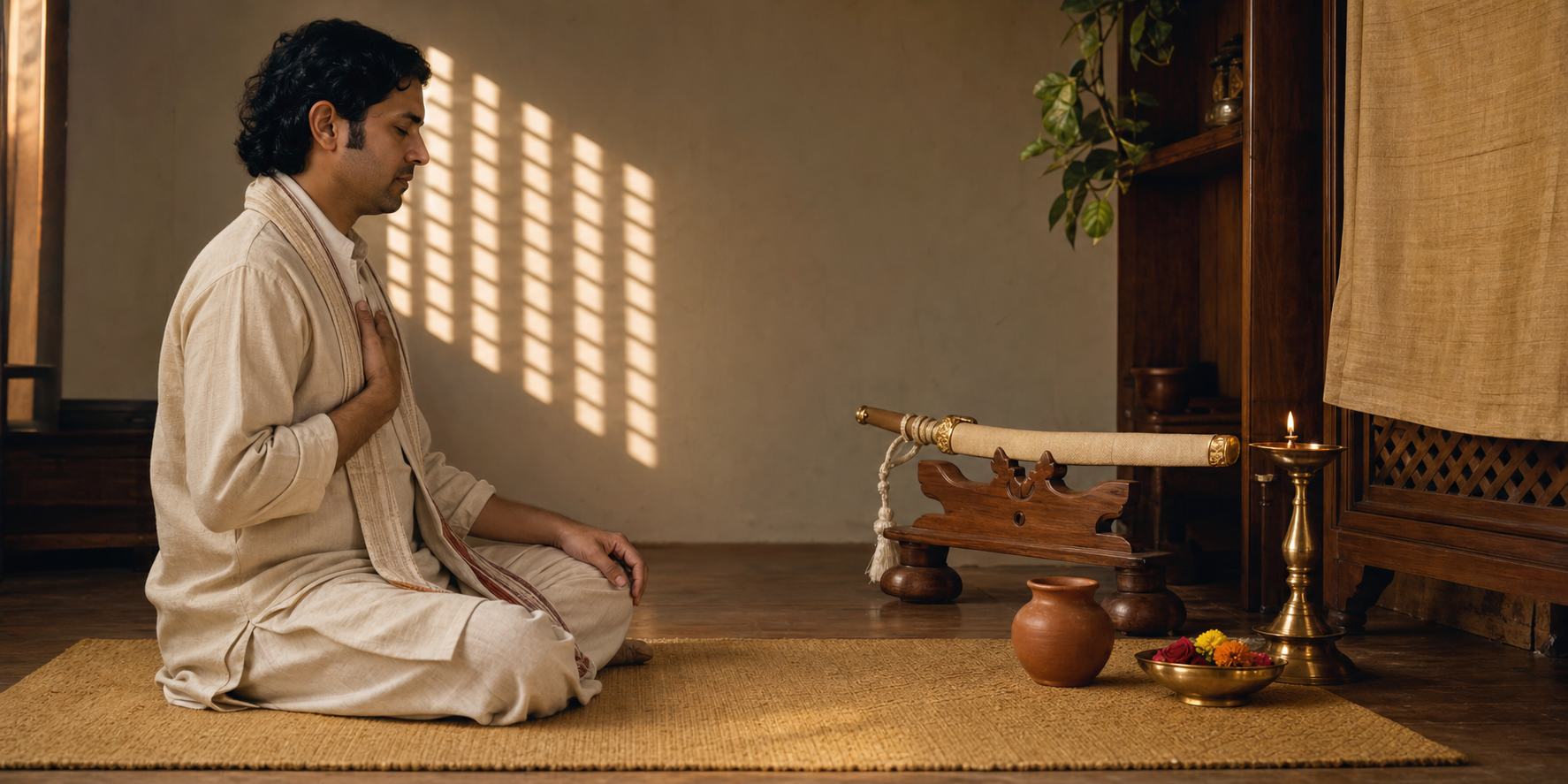
You do not need to invent a ritual to apply this symbolism. The following is a contemplative exercise inspired by the khadga’s meaning, not a prescribed act of worship. Use it when you face a decision clouded by attachment, fear, anger, or delay.
- Name the confusion in one sentence. Write the conflict without blaming a person: for example, a duty is being avoided, a boundary is being crossed, or an attachment is distorting judgement.
- State the distinction that matters. Separate truth from assumption, obligation from preference, protection from revenge, or courage from impulsiveness. If you cannot state the distinction clearly, you are not ready to make the cut.
- Define the dharmic boundary. Decide what you will not do, even to achieve a desired result. Refusing deception, needless humiliation, cruelty, or indiscriminate harm keeps decisiveness from becoming aggression.
- Choose one precise action. Correct the false statement, end participation in the dishonest arrangement, decline the harmful demand, fulfil the neglected duty, or stop feeding the habit. Precision is better than dramatic gestures.
- Examine the motive once more. Ask whether the action protects something worthy or merely satisfies the wish to punish. If humiliation is the reward you secretly want, pause and reconsider the form of the response.
- Accept the clean consequence. A necessary boundary may cost approval or comfort. Do not confuse that discomfort with evidence that the decision was wrong.
Use the khadga on confusion, falsehood, attachment, and harmful conduct. Do not use it to turn another human being into a symbolic monster. That single discipline preserves the force of the image without surrendering it to private vengeance.
The next time you see the sacred sword, pause before translating it as either violence or metaphor. Identify the distinction being made, the order being defended, and the discipline governing the wielder. Then carry one precise, dharmic decision out of the encounter and into your conduct.
Key takeaways
- The khadga symbolises a decisive separation between clarity and delusion, dharma and adharma, or disciplined action and uncontrolled impulse.
- Its martial form matters: divine protection is not passive, but its power remains bounded by purpose, restraint, and responsibility.
- A khadga should be interpreted through the whole image, including the deity, posture, other attributes, narrative context, and local tradition.
- A purely inward reading can erase the duty to protect, while a purely outward reading can shield the ego from self-examination.
- In daily reflection, apply the sword to a falsehood, attachment, harmful act, or neglected duty rather than using sacred language to condemn a person.
References
