
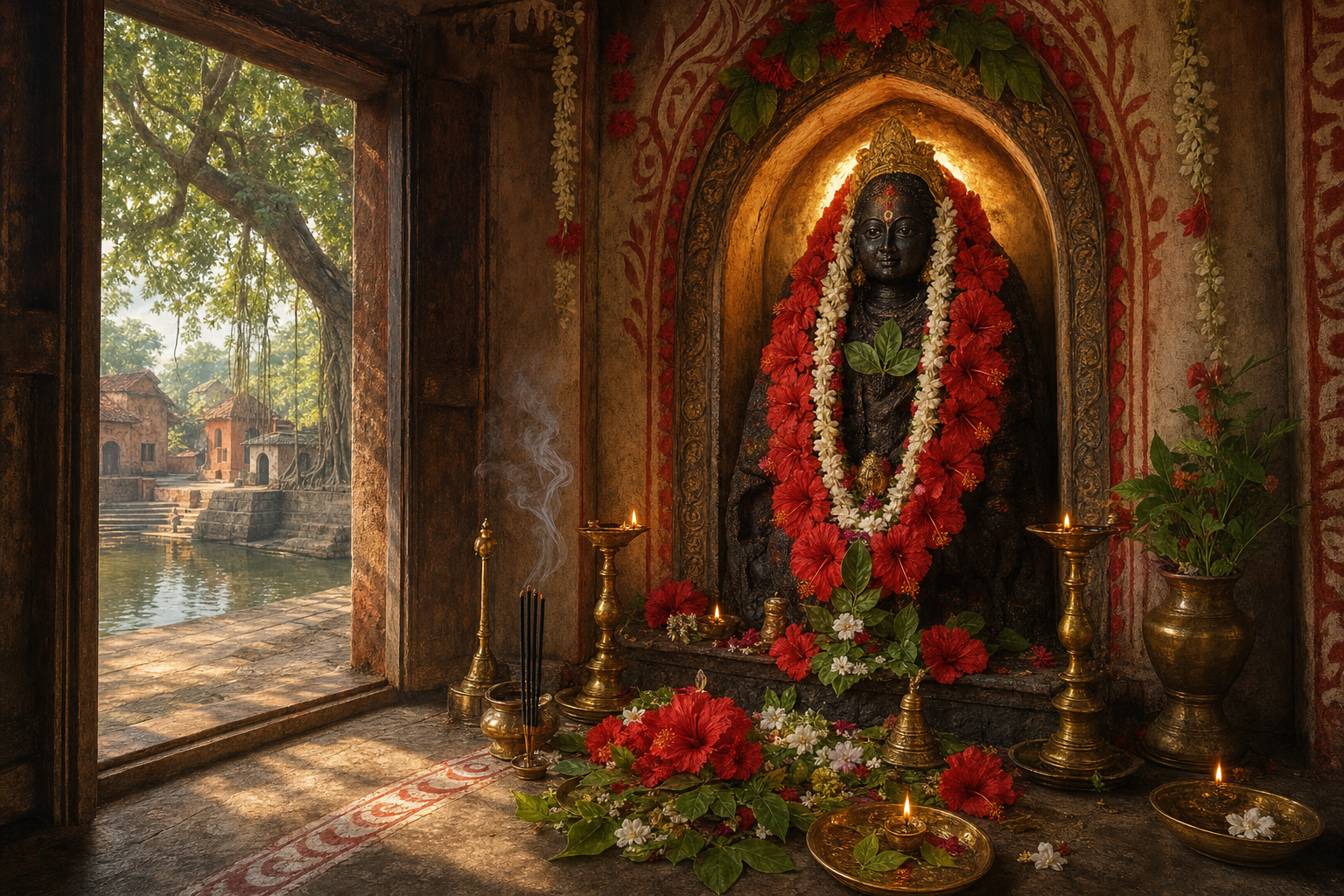
If you have heard the name Jogadya from a family elder, a village tradition, or a shrine in Bengal, your first question may be simple: is she another name for Durga, or a distinct form of the Goddess? The most useful answer is that she is both recognizably Durga and locally, intimately Jogadya. Her identity joins primordial Shakti, inward discipline, Bengali sacred geography, and inherited community memory.
That distinction matters when you worship, visit a temple, or recover a family tradition. You do not need to force every Jogadya custom into the standard pattern of metropolitan Durga Puja. You need to recognize the theological center while allowing the local form, calendar, and ritual discipline to speak in their own voice.
Begin with the name: Yoga joined to Adya Shakti

Jogadya is also written Yogadya. The variation does not indicate two different goddesses. It reflects the Bengali rendering of a name that brings together Yoga and Adya. Here, Yoga means more than physical posture. It points to collected attention, inner integration, disciplined practice, and the movement toward spiritual absorption. Adya identifies the first or primordial Mother: the Shakti from whom manifestation proceeds.
The name therefore carries a complete Shakta teaching. Primordial power is not merely an external force that grants protection, and Yoga is not a self-powered attempt to escape the world. The Mother animates the practice by which her presence is realized. The devotee responds by bringing mind, speech, emotion, and conduct into alignment.
This is why Jogadya’s fierce, maternal, and contemplative aspects should not be separated. As Mahishamardini, she defeats the force that disorders the world. As Adya Shakti, she is its origin and sustaining power. As the Goddess approached through Yoga, she asks the devotee to notice the inner forms of disorder as well: scattered attention, uncontrolled impulse, fear, and action detached from dharma. Her martial imagery and her stillness belong to the same spiritual vision.
The Devi Mahatmya, contained in the Markandeya Purana, supplies an important theological grammar for this vision. Its Goddess protects cosmic order while remaining the supreme power behind creation. It should not be treated as a narrowly local biography of Jogadya. It helps you understand why a Bengali manifestation of Durga can be at once village guardian, family deity, cosmic Mother, and focus of contemplative discipline.
There are resonances elsewhere in the dharmic world, but they should be handled with care. Buddhist traditions of eastern India honor feminine wisdom through Prajnaparamita and protective compassion through Tara. Jain communities know protective figures such as Ambika while maintaining their own emphasis on ahimsa and disciplined conduct. Sikh teaching begins from the oneness expressed by Ik Oankar, while portions of the Dasam Granth employ a poetic language of valor and power defending righteousness. These are meaningful points of conversation, not grounds for pretending that distinct traditions, doctrines, and sacred figures are interchangeable.
Khirgram anchors a sacred geography larger than one temple
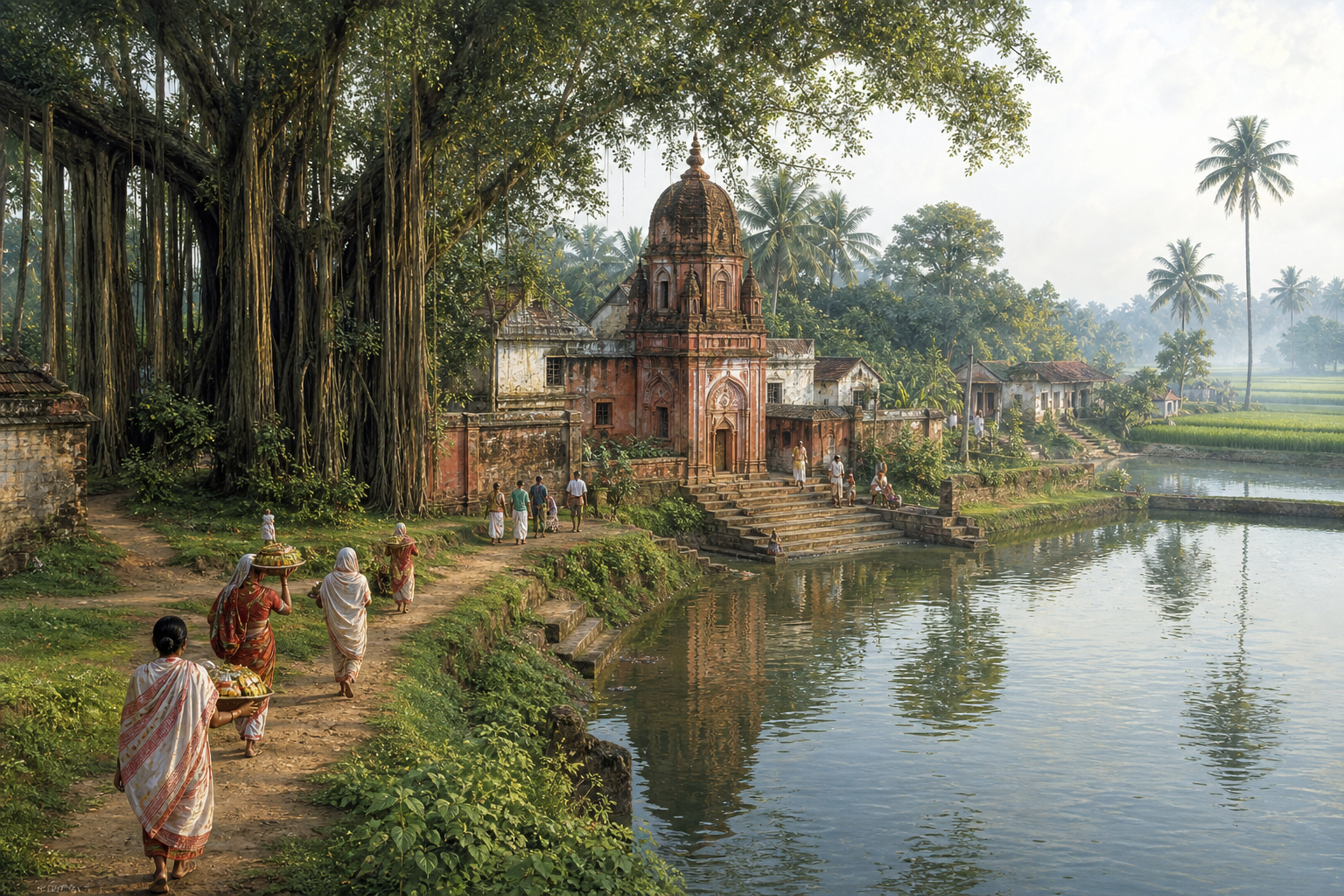
Jogadya worship is especially associated with Khirgram, also written Kshirgram, in present-day Purba Bardhaman. Devotional connections also appear in Murshidabad, Birbhum, Hooghly, and Bankura. This regional spread is important because Bengali Shakta tradition has never lived only in texts or major urban festivals. It has been carried by village shrines, family observances, artisan communities, seasonal vows, oral memory, and relationships between a deity and the people who regard her as their own Mother.
The historical pattern is best understood as a long synthesis rather than a single founding event. Between roughly the 10th and 13th centuries, Shakta forms became increasingly consolidated in medieval Bengal through the interaction of local goddess traditions, Puranic understandings of Durga, Tantric ritual structures, patrons, and temple communities. That period does not provide a reliable construction date for every present shrine, nor does it prove that every current custom has remained unchanged. It explains how regional and pan-Bharatiya layers could become inseparable.
This protects you from two opposite mistakes. One is to dismiss a village form as an unscriptural corruption because it does not resemble a familiar Durga image. The other is to label every existing custom ancient without evidence. A living tradition can be deeply rooted while still adapting its images, offerings, processions, and public presentation.
If you are visiting a Jogadya shrine or documenting a family connection, ask questions that reveal the local lineage instead of beginning with assumptions:
- Which name is used locally: Jogadya, Yogadya, or another pronunciation?
- Is the Goddess represented by a sculpted murti, a temporary festival image, or an aniconic sacred emblem?
- Which annual observance is considered central at this particular shrine?
- Are there inherited family vows, offerings, or rites of passage associated with her as Kula Devata?
- Which practices belong to the public congregation, and which are reserved for the temple’s ritual custodians?
Write down the answers with the name of the elder, priest, or custodian who gave them. Family memory becomes fragile when everyone assumes someone else will preserve it. Recording the local vocabulary, festival name, and inherited obligation is more valuable than forcing the tradition into a generic online template.
Learn the ritual grammar before copying a ritual
Jogadya’s iconography can vary. In a Mahishamardini form, she may be lion-borne and multi-armed, triumphing over the buffalo demon while carrying such emblems as the trishula, chakra, shankha, bow, and sword. During major celebrations, the familiar Bengali parivara of Lakshmi, Saraswati, Karttikeya, and Ganesha may accompany her. Elsewhere, an aniconic emblem or a more inwardly oriented visualization may occupy the center.
Do not treat an aniconic form as an incomplete substitute for a statue. The point of an aniconic emblem is not visual deficiency. It directs reverence toward a presence that cannot be exhausted by one human form. Conversely, do not read a many-armed image as mere decoration. Its multiplicity expresses the Goddess’s capacity to meet several forms of disorder and need at once.
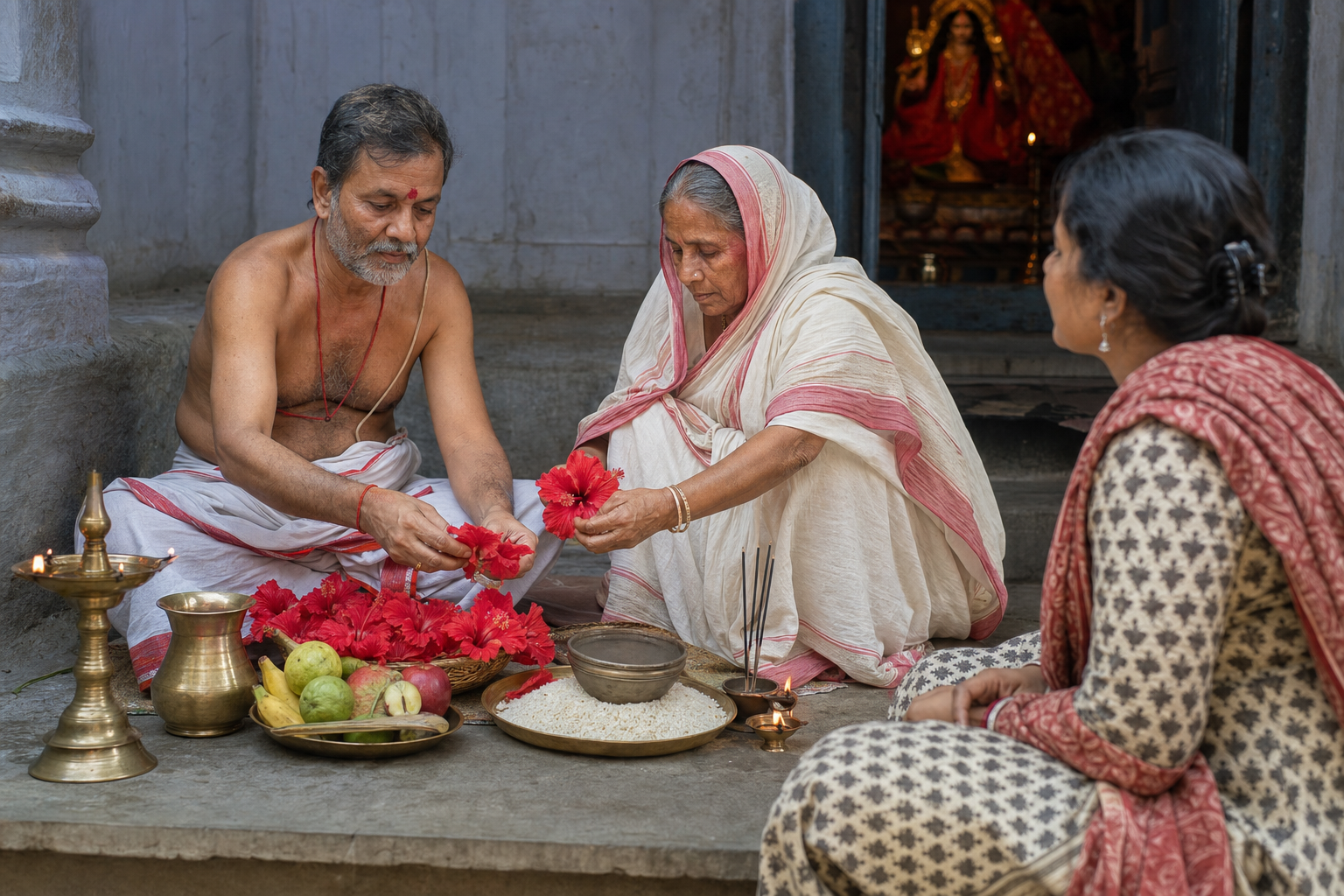
Daily worship commonly follows the upachara pattern. Panchopachara centers on five offerings: gandha, or fragrance; pushpa, or flowers; dhupa, or incense; dipa, or a lamp; and naivedya, or consecrated food. Dashopachara extends the sequence. On selected occasions, abhishekam may be performed with water, milk, or other substances authorized by the tradition. Mantra-japa, dhyana, and recitation of the Devi Mahatmya connect the outer offerings to disciplined attention.
The practical rule is straightforward: temple worship is not a do-it-yourself ceremony. Do not pour an abhisheka substance over a shrine image, move an offering, enter a restricted space, or repeat an unfamiliar Tantric procedure merely because you have seen it elsewhere. Ask what is permitted. Ritual precision is part of devotion because it respects the form in which a community has learned to serve the Goddess.
Panchamundi Asana imagery requires the same restraint. Within Tantric symbolism, it can signify the transformation of base impulses into insight and spiritual command. For a contemporary devotee encountering that imagery, the useful response is contemplation, not literal improvisation. Esoteric ritual belongs under qualified lineage guidance.
If your family has no surviving Jogadya procedure, you can begin with a modest, non-esoteric practice rather than inventing lost details:
- Clean the place of worship and settle your attention before making an offering.
- Offer one or more familiar upacharas, such as a flower, fragrance, incense, a safely tended lamp, or vegetarian naivedya.
- Use the Goddess’s name or a prayer already known in your household. If you have not received a specialized mantra, do not borrow an esoteric formula and claim initiation you do not possess.
- Sit quietly with the breath or undertake mantra-japa so that the ritual does not become hurried hand movement without inward attention.
- Carry the worship into conduct through gratitude, self-restraint, seva, and responsibility toward family and community.
This simple sequence preserves Jogadya’s central union of Adya and Yoga. It also leaves room for a priest, guru, or knowledgeable family elder to restore a more specific lineage practice later.
Let the festival calendar show which aspect is being honored
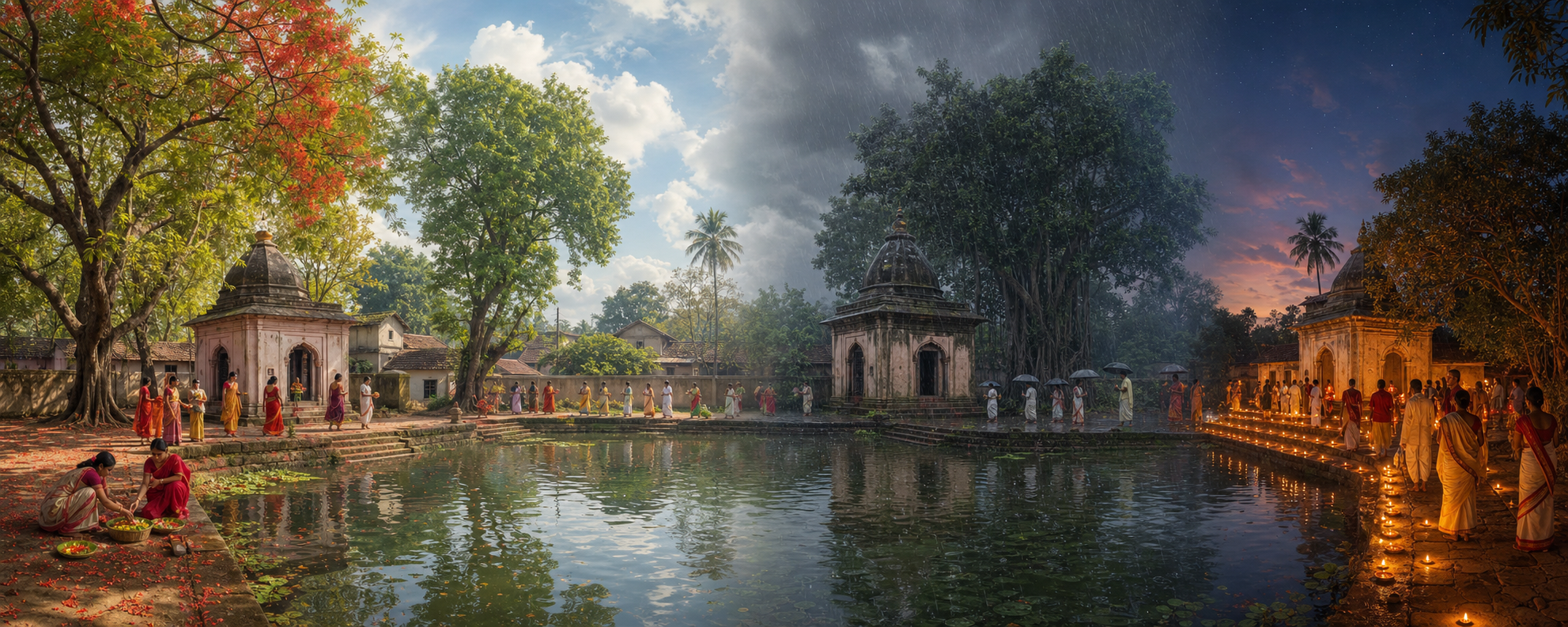
Jogadya worship participates in more than one Bengali seasonal rhythm. During Chaitra, some temples and communities observe Gajan, Charak Puja, and Charak Sankranti. These observances can join Shaiva and Shakta motifs with vows, austerity, and public expressions of disciplined devotion. During Ashwin, Sharadiya Durga Puja and Navaratri bring forward the better-known autumnal cycle, with Mahalaya preceding the worship and Vijaya Dashami bringing it to completion.
These cycles should not be flattened into one generic festival. Chaitra discipline and the Ashwin homecoming of the Mother can illuminate different dimensions of the same Goddess. The actual emphasis varies by shrine, so confirm the local tithi, accepted offerings, and public programme before arranging a visit. A city Durga Puja calendar is not automatically the complete Jogadya calendar of a village temple.
The sensory forms are also part of the teaching. Dhak rhythms, conch sound, alpana designs, floral toranas, terracotta work, painted backdrops, and images shaped by Kumor artisans turn worship into a shared act of cultural memory. They are not merely decoration around a supposedly more serious ritual. They teach children how the community receives the Mother, give artisans a role in transmitting sacred form, and bind household devotion to public responsibility.
Offerings require local awareness as well. Some Shakta centers historically included animal offerings, while many contemporary communities have adopted symbolic or vegetarian naivedya in keeping with local ethical reflection on ahimsa. Do not assume either practice applies everywhere. If you follow an ahimsa-based discipline, ask whether fruit, sweets, flowers, or another vegetarian offering is accepted. You can remain faithful to your conscience without turning darshan into a confrontation with another community’s inherited custom.
For families who regard Jogadya as Kula Devata, the annual festival is only one layer. Her presence may enter naming, marriage, household vows, and the transmission of family obligations. Before adopting an attractive public ritual, ask whether your lineage already has a quieter one: a remembered day of worship, a food traditionally prepared, an offering made before a marriage, or a visit once undertaken by an elder. Recovering that thread may be the most consequential form of worship you can perform.
Key takeaways for approaching Jogadya with understanding
- Jogadya or Yogadya is a Bengali form of Durga whose name unites yogic discipline with Adya, the primordial Mother.
- Her local identity is not a lesser version of an all-India deity. Khirgram and the wider Bengali sacred landscape give her worship its inherited social and ritual form.
- A Mahishamardini murti, an aniconic emblem, and a contemplative visualization can all direct worship toward the same Shakti through different ritual languages.
- Begin with familiar offerings and inward attention. Leave specialized abhisheka, mantra, and Tantric procedures to the relevant lineage and temple discipline.
- Check the local calendar rather than assuming every shrine follows the same Durga Puja programme; Chaitra and Ashwin observances can carry different emphases.
- If Jogadya is your Kula Devata, preserve names, vows, festival memories, and rites of passage by recording what elders know now.
Your next step does not need to be elaborate. Learn which form of her name your family or local shrine uses, identify the observance that matters there, and preserve one reliable account of the custom. Then let worship move in both directions: toward the primordial Mother through reverence, and back into daily life through steadiness, courage, ahimsa, and seva. That is where the Yoga in Jogadya becomes visible.