
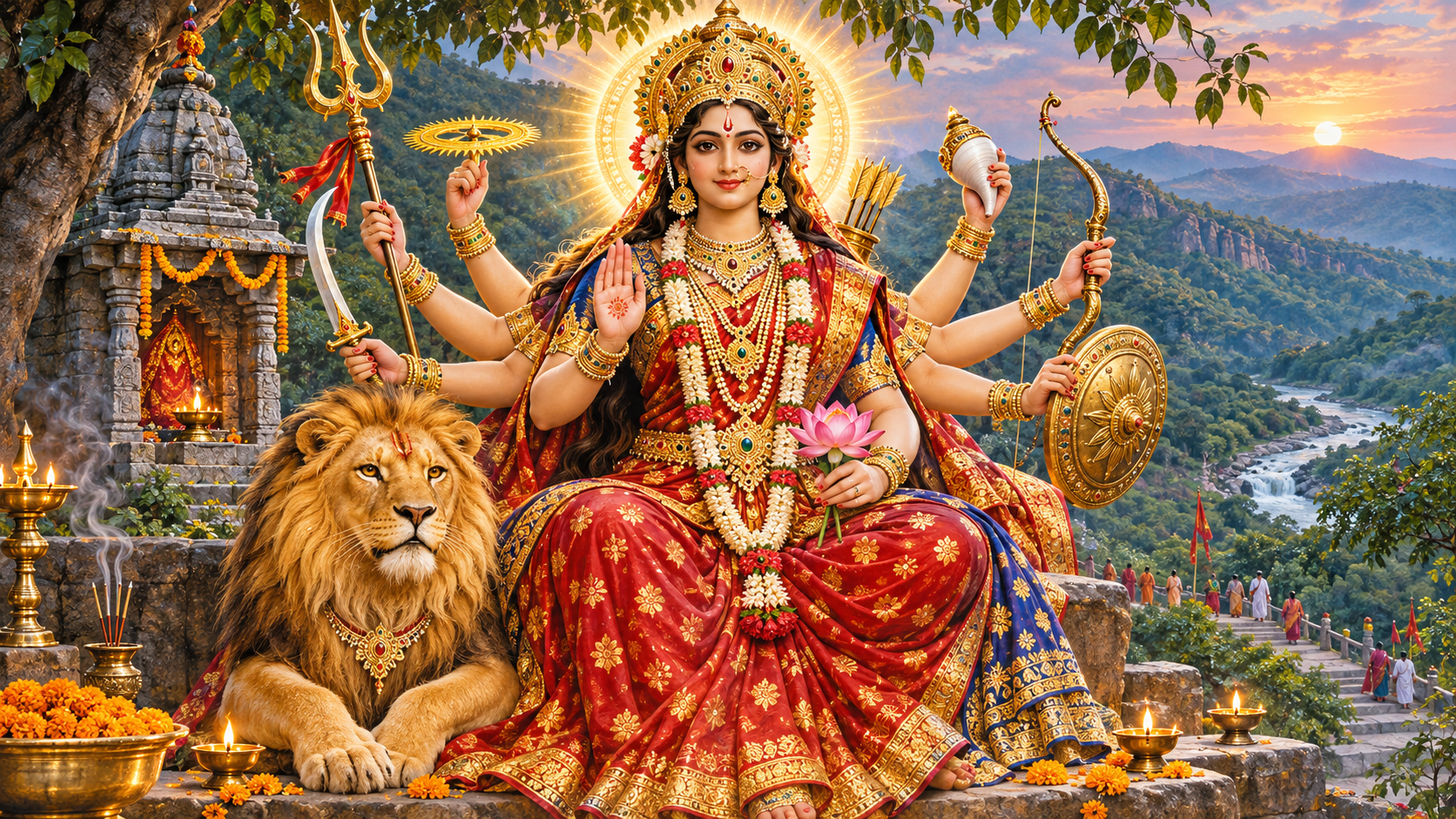
You have a temple photograph, a calendar print, or a sculpture of Durga in front of you. The label says Vindhyavasini, but the image resembles several other forms of Devi. Can you confirm the identification by counting arms, checking the weapons, or looking for a lion?
Usually, no single feature settles the question. Vindhyavasini iconography has to be read through three kinds of evidence together: what the name means, what the local tradition calls the Goddess, and what the image actually shows. That method will help you identify a murti carefully without forcing every representation into one supposedly universal design.
Begin with the name, not the weapon count
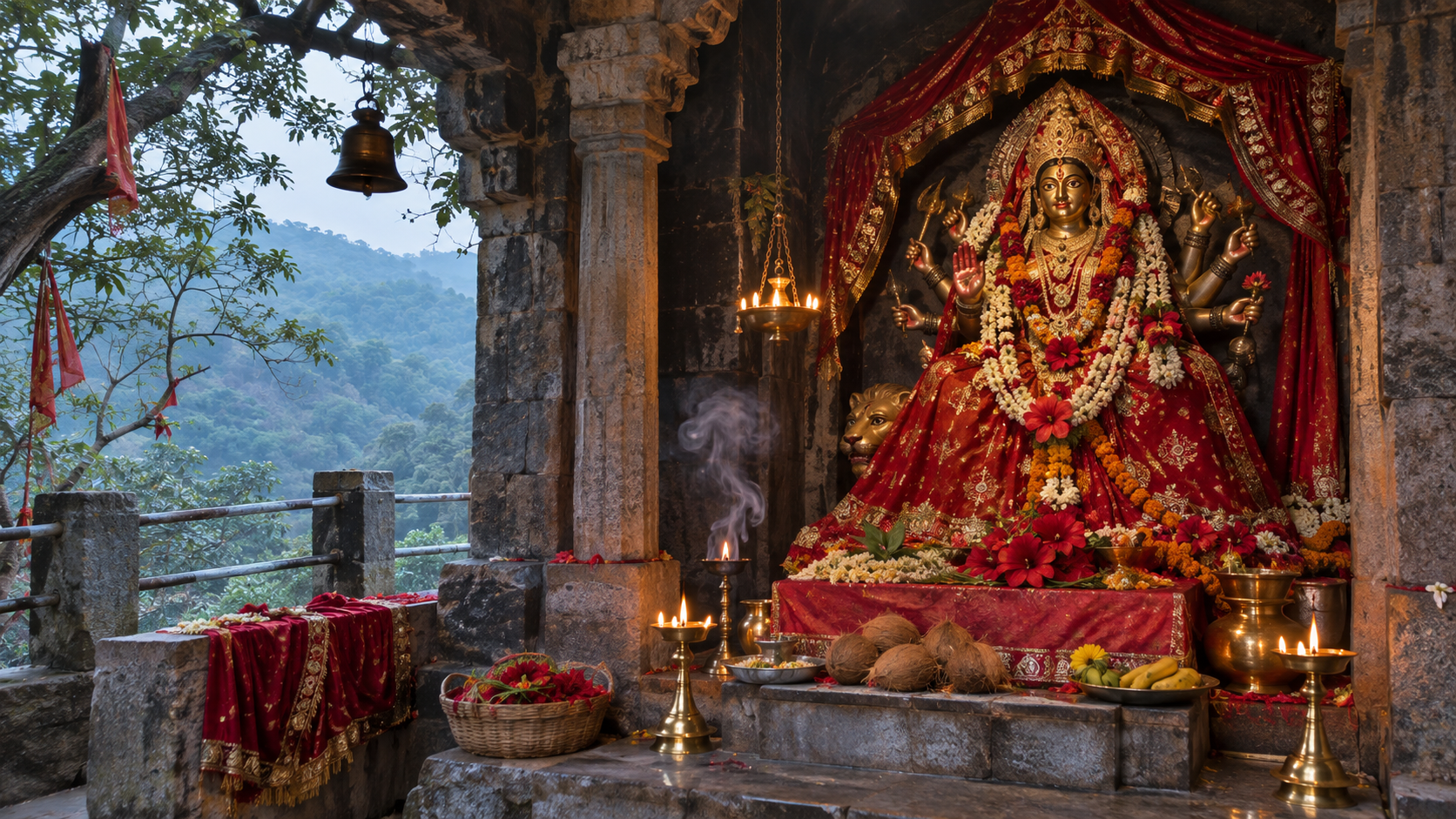
Vindhyavasini is a place-bearing name. Vindhya-vasini means “she who resides in the Vindhya mountains”. The geography is therefore part of the Goddess’s identity, not incidental background added to a generic Durga image.
This gives you the first rule of identification: do not begin by hunting for one decisive weapon or gesture. Begin by asking why this Devi is being called Vindhyavasini. Is that name preserved by a temple tradition, an inscription, a devotional caption, a ritual context, or a community that worships her under that name?
A location by itself is not conclusive. A Durga image found in the Vindhya region does not automatically become Vindhyavasini, just as an image worshipped elsewhere does not cease to be Vindhyavasini. The important evidence is the relationship among the image, its name, its devotional setting, and its history of identification.
This matters because Hindu iconography does two things at once. It makes a deity recognizable through a shared sacred vocabulary, and it gives particular manifestations their local identities. If you attend only to the shared vocabulary, you may correctly recognize Durga while incorrectly assigning the more specific name Vindhyavasini.
Read the image in three distinct layers

A sound reading separates three layers that are often collapsed into one. Keeping them separate prevents both overconfident identification and the opposite mistake of treating every variation as an error.
- The theological layer: Does the image use the wider visual language associated with Devi or Durga? Multiple arms, weapons, a lotus, protective or blessing gestures, regal ornaments, a crown, a halo, and an animal mount may belong to that wider language. Not every representation will display every element.
- The local-identity layer: What connects this manifestation specifically with Vindhyavasini? A transmitted name, temple setting, inscription, ritual invocation, or established community identification can carry more weight than a generic attribute shared by many forms of Durga.
- The object layer: What does this particular work visibly contain? Record its posture, arms, hands, held objects, mount, attendants, ornaments, facial expression, and surrounding figures before interpreting them.
The distinction is especially important here because Vindhyavasini’s iconographic details are not set out as exhaustively in classical formulations as those of many other forms of the Goddess. You should therefore expect tradition and artistic context to do part of the identifying work. A variation in arm count, posture, or arrangement of attributes does not by itself disprove the name.
Nor does variation mean that iconography is arbitrary. The better conclusion is narrower: a rigid checklist may be less reliable for Vindhyavasini than a combined reading of sacred form, place, and living tradition. When the visual evidence is ambiguous, say so. Devotional accuracy does not require artificial certainty.
Use a five-step identification check
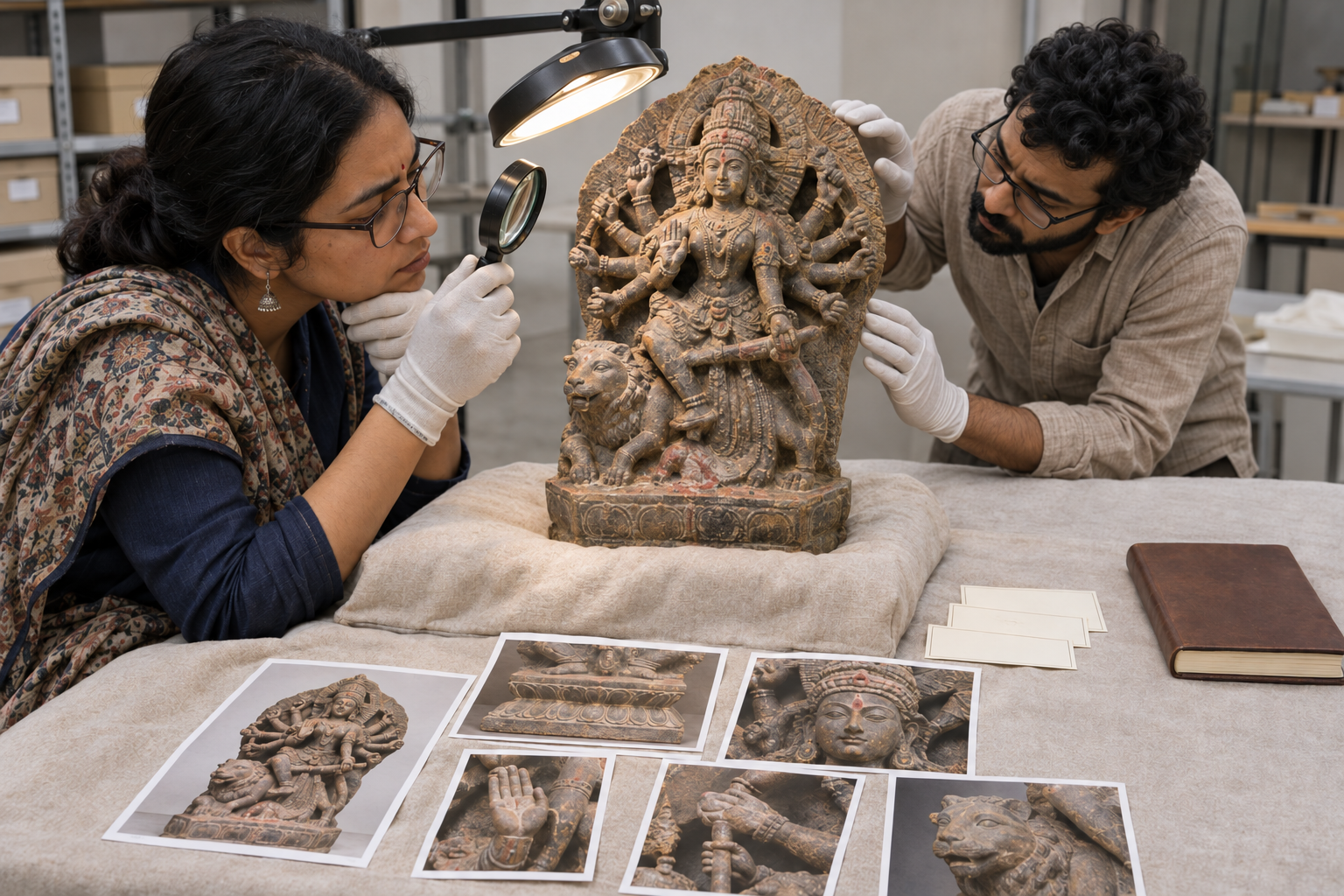
If you are cataloguing an image, preparing a temple note, writing a caption, or checking an online claim, use the following sequence. It keeps observation separate from interpretation and makes your conclusion easier for another person to verify.
- Record the given name exactly. Copy the wording from the inscription, shrine label, caption, or oral identification before standardizing spelling. Note whether the name is Vindhyavasini, Vindhyavasini Durga, Vindhyeshwari, or another locally used designation only when that exact wording is actually present. Do not silently treat related names as interchangeable.
- Establish the provenance. Ask where the image is worshipped or preserved, who supplied the identification, and whether the label belongs to the object or was added later. A temple tradition, museum record, seller’s caption, and unattributed social-media post do not carry equal evidentiary weight.
- Inventory only what you can see. Count visible arms; describe the posture; note the mount, hand gestures, ornaments, attendants, and held objects. If an object is damaged, hidden, or too small to identify, write “unclear” instead of guessing.
- Separate supporting features from decisive evidence. A lion, weapons, multiple arms, or a protective gesture can support identification within Durga’s wider iconographic family. None of those features alone necessarily establishes that the image is Vindhyavasini.
- State the basis and confidence of the identification. Use wording such as “identified by the temple tradition as Vindhyavasini” when local testimony provides the name. Use “possibly Vindhyavasini” when the attribution rests on incomplete visual or contextual evidence. That qualifier is useful information, not a weakness.
This order matters. If you decide on the identity before listing the visible features, you will be tempted to reinterpret every object as confirmation. Description first, comparison second, conclusion last.
The same discipline helps when commissioning a new image. Give the artist the particular temple or devotional tradition you intend to follow, along with a verified reference image if one exists. Asking simply for “the authentic Vindhyavasini design” assumes a single exhaustive template that the evidence does not justify. Ask instead which features belong to the chosen tradition and which are the artist’s stylistic decisions.
Avoid four common misreadings
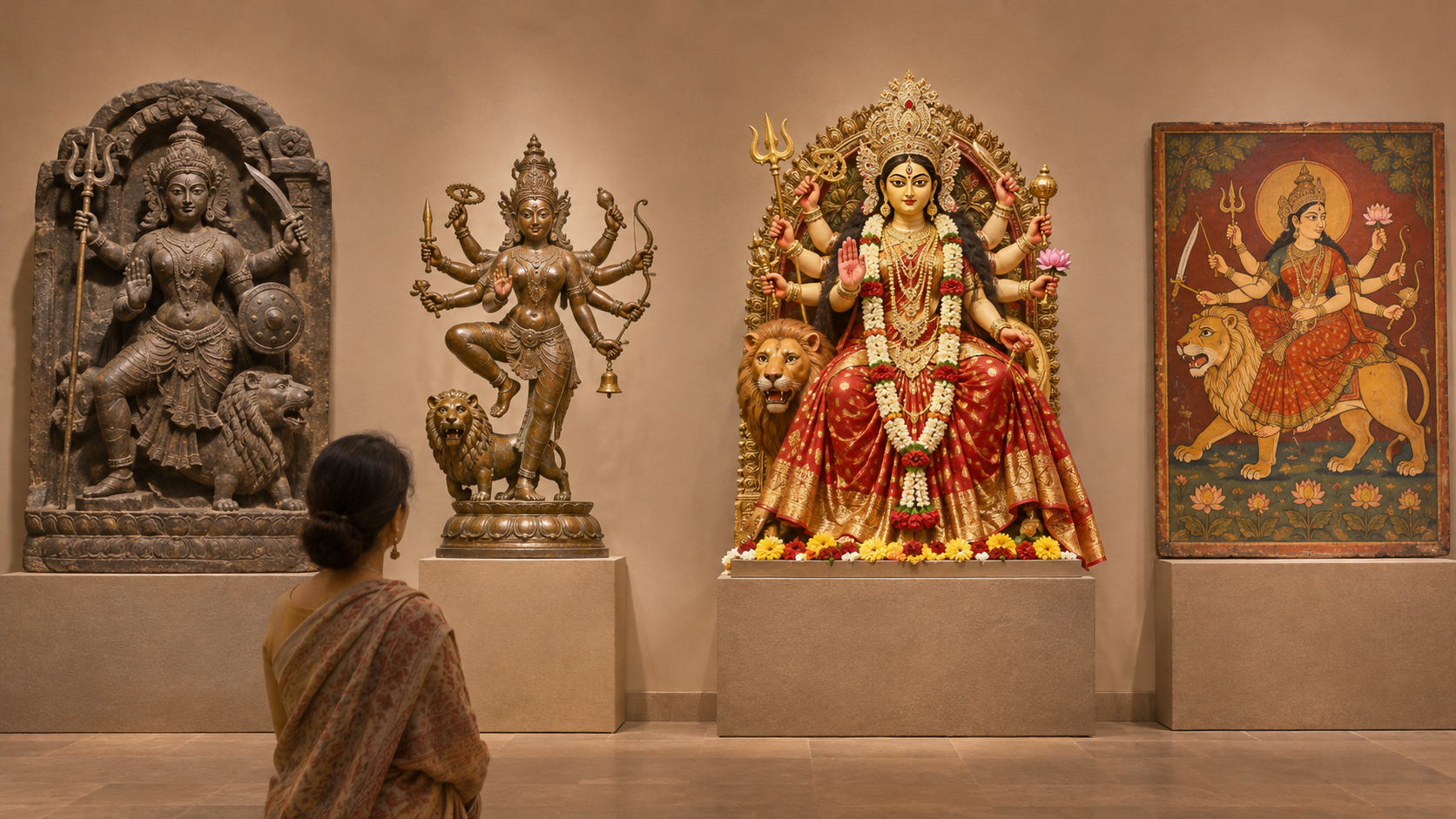
The fastest way to improve your reading is to notice the shortcuts that produce confident but weak identifications.
- “The lion proves it is Vindhyavasini.” A lion can place an image within a broad Durga vocabulary, but a shared emblem cannot establish a specific local manifestation on its own.
- “A different arm count makes the image inauthentic.” Arm count is worth recording, but it should not be turned into an unsupported pass-or-fail test. Regional practice, medium, scale, restoration, and the purpose of the image can affect how a form is represented.
- “Every representation must match the principal temple murti exactly.” A stone murti, painted devotional print, metal image, and small household icon may translate sacred identity through different visual constraints. Look for continuity of identification rather than photographic sameness.
- “The name is merely a caption added to generic Durga.” That can happen in careless commercial or online usage, but it should not be presumed. In a living tradition, the worshipped name, place, and ritual relationship may be central evidence even when the image shares many features with other Durga forms.
These corrections point in both directions. Do not accept every caption uncritically, but do not dismiss a traditional identification merely because it fails a modern internet checklist. Test the caption against provenance and practice, and test the visual reading against the limits of the surviving iconographic prescription.
Key takeaways
- Vindhyavasini’s name identifies the Goddess through her residence in the Vindhya mountains; geography is part of the sacred identity.
- Shared Durga features can support recognition of the divine family without proving the specific identity of Vindhyavasini.
- Local tradition, inscription, provenance, and ritual context may be more decisive than any one weapon, gesture, mount, or arm count.
- Describe visible features before interpreting them, and mark damaged or unclear details as uncertain.
- When the evidence is incomplete, identify the image as traditional, probable, or possible rather than claiming certainty you do not have.
The next time you encounter an image labelled Vindhyavasini, make three notes: what you can actually see, what the worshipping tradition calls her, and where that identification comes from. If those three records remain distinct, you will preserve both iconographic accuracy and the living Dharmic context in which the image has meaning.
References

Leave a Reply
You must be logged in to post a comment.