

You may recognize Shiva in an image yet still wonder what makes the form Pashupati. Is it the presence of animals, a particular object, or simply another name for the same deity? The answer begins with the relationship the image expresses, not with an isolated emblem.
Read Pashupati as a vision of divine power exercised through guardianship. Once you make that shift, the animals cease to be background decoration, familiar Shiva attributes fall into their proper place, and the image becomes an ethical question addressed to you.
Start with the name, not an inventory of objects
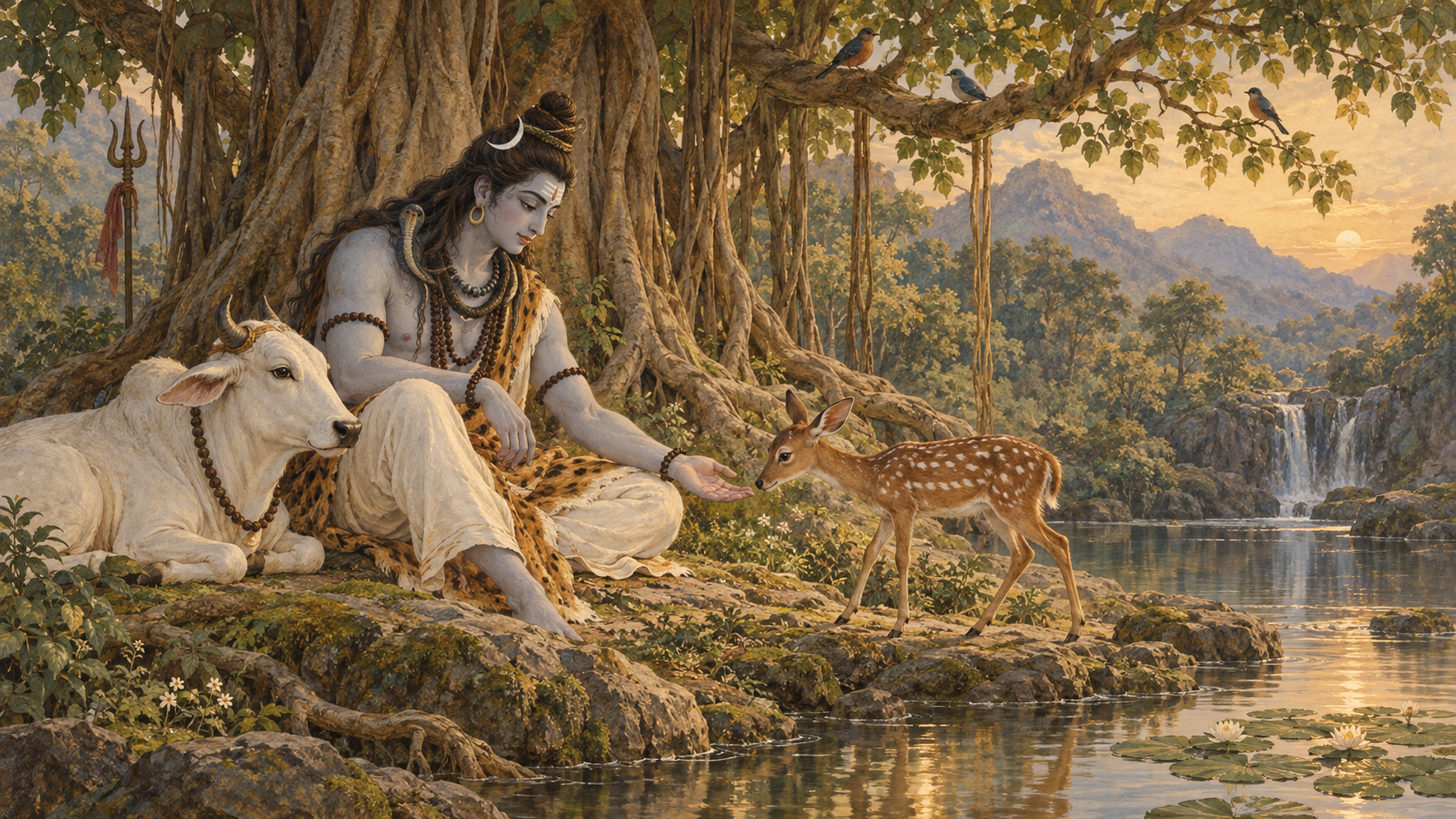
Pashupati joins pashu, meaning animal or cattle, with pati, lord. In this ancient form, Shiva is understood not merely as a ruler over animals but as the benevolent protector of all living beings. The reference to cattle is concrete, but the scope of the symbolism is wider than one species.
That distinction matters. “Lord of animals” can sound like a statement of possession if it is read through a purely material idea of ownership. Pashupati iconography points instead toward responsibility: greater power creates a greater duty to protect life that is exposed, dependent or unable to speak for itself.
The name therefore gives you the first rule of interpretation: do not ask only, “What does Shiva possess?” Ask, “Whom does Shiva shelter?” The second question brings the form’s spiritual character into view.
- If cattle appear, read them first as beings under divine care, not as decorative property.
- If several kinds of life appear, notice how the composition enlarges the circle of protection.
- If no animal is visible, do not reject the identification automatically; a temple dedication, inscription, caption or living tradition may supply the Pashupati context.
- If an interpretation celebrates control but says nothing about care, it has probably missed the form’s central movement.
Read the relationship between Shiva and the living world
Religious iconography is not always a rebus in which every object has one fixed answer. Composition also carries meaning. When you look at a Pashupati image, examine how Shiva and other living beings have been placed in relation to one another.
Begin with proximity. Are the animals close to the deity, arranged within a protected space, or oriented toward the centre? Then look at the emotional register. Does the scene communicate agitation, submission, calm or refuge? Finally, examine the whole arrangement: does Shiva appear as a distant sovereign, an accessible guardian, or the still centre around which diverse life gathers?
These observations do not create a rigid decoding system. They help you see what the image is doing. An animal beside a deity may identify a vehicle, describe a setting or develop the theology of a particular form. Its meaning comes from the whole composition and the tradition that names the image.
Pashupati places non-human life within sacred attention. That is easy to overlook when viewers focus only on the most visually powerful figure. Deliberately reverse that habit: after looking at Shiva, look again at the smallest or least prominent creature. Its inclusion may be essential to the meaning. Divine majesty is being shown through the safety extended to another being.
Separate Shiva’s identifying marks from Pashupati’s theme
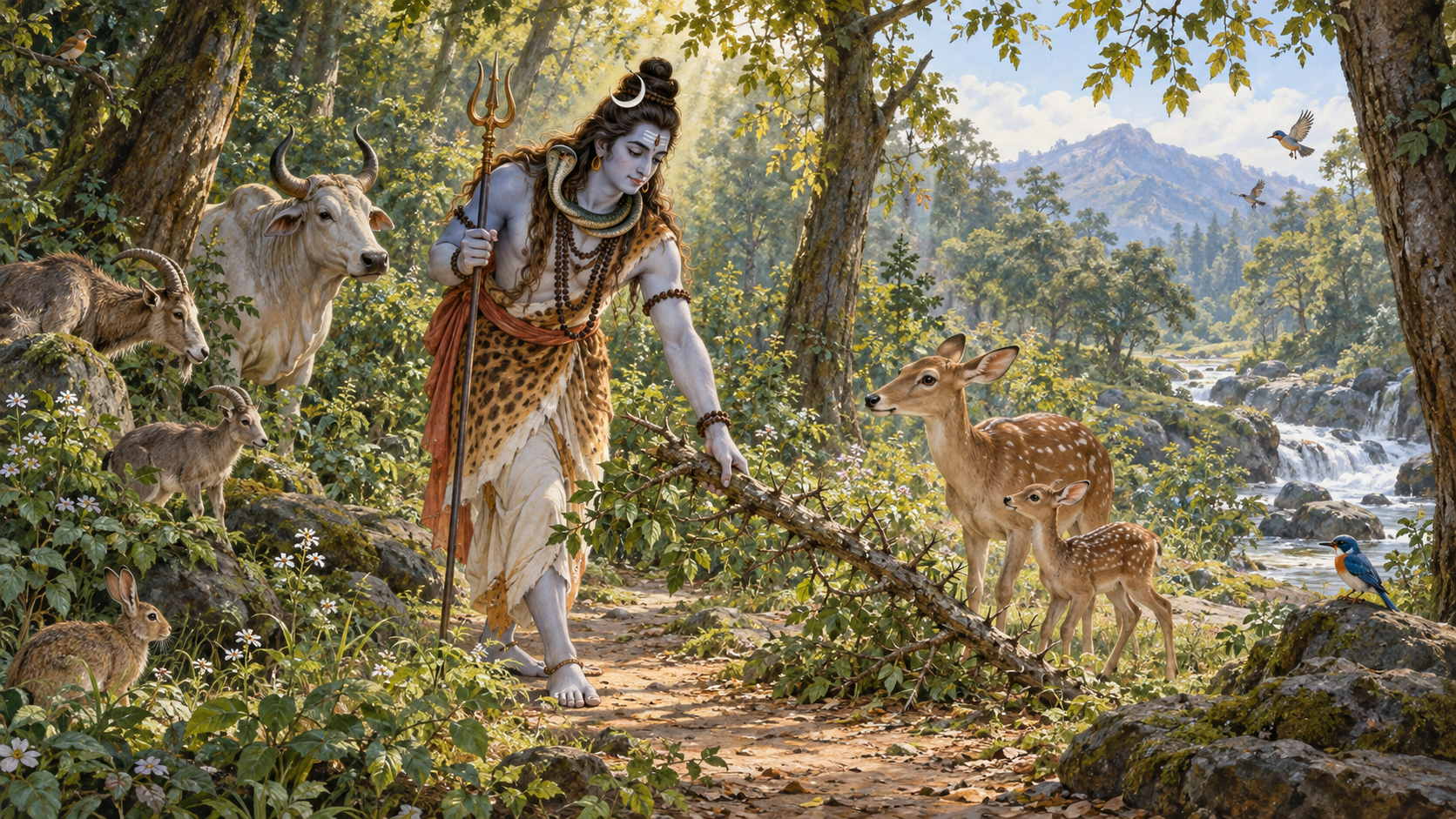
A trident, matted hair, a serpent or the bull may help you recognize Shiva when those features are present. They do not, by themselves, prove that a representation is specifically Pashupati. This is the most useful distinction to make when identifying an unfamiliar sculpture, painting or devotional image.
Work in two stages. First identify the deity. Then identify the aspect of the deity being emphasized. The first stage asks, “Is this Shiva?” The second asks, “What truth about Shiva is this particular form communicating?” Pashupati answers the second question through lordship joined to protection of living beings.
- Record what is actually visible. Note the central figure, animals, gestures, objects and spatial arrangement before assigning meanings.
- Identify shared Shiva features. Treat familiar attributes as evidence for the deity’s identity, not automatically as evidence for the Pashupati form.
- Look for form-specific context. A name, shrine tradition, caption, inscription or protective relationship within the composition may clarify the identification.
- Interpret details through the central idea. Ask how each relevant feature contributes to guardianship, inclusion or the ordering of life around Shiva.
- Keep uncertainty visible. If the context is missing, call your reading plausible rather than certain. A confident label is not a substitute for evidence.
This method also prevents a common mistake: forcing every familiar Shiva symbol to carry a uniquely Pashupati meaning. Shared attributes still belong to Shiva’s broader iconography. What distinguishes the form is the theological emphasis created by its name and context.
Avoid four readings that make Pashupati smaller
The form is straightforward enough to approach, but several shortcuts flatten its significance.
- “Pashupati is only a deity for managing animals.” This reduces sacred guardianship to utility. Animals are not present merely because they serve human needs; they belong within the deity’s protection.
- “The mention of cattle excludes other life.” Cattle give the name an immediate and tangible meaning, while the form’s protective scope extends to all living beings.
- “Any image of Shiva with an animal must be Pashupati.” An animal can play several iconographic roles. Confirm the identification through the work’s name, setting and overall relationship before drawing that conclusion.
- “Every Pashupati image must follow one visual template.” Materials, artistic conventions and local traditions can shape how a divine form is represented. Preserve the core meaning without demanding that every representation look identical.
There is a fifth, subtler error: treating “ancient” as if it meant spiritually obsolete. Pashupati addresses a permanent imbalance. Human beings regularly hold power over animals, environments and vulnerable people. The form asks what makes that power legitimate. Its answer is protection rather than appetite, neglect or domination.
Let the symbol change how you exercise responsibility

Pashupati is not fully understood when it has only been identified correctly. The symbolism becomes practical when it changes how you respond to beings placed within your care.
When you next stand before this form, resist the urge to decode everything immediately. Say the name slowly, notice which lives the image asks you to see, and identify one responsibility that already belongs to you. It may involve an animal dependent on your care, a vulnerable person affected by your decisions, or a shared place whose living inhabitants bear the consequences of neglect.
Then choose an act that genuinely protects rather than merely displaying concern. Provide consistent care for an animal already dependent on you. Remove an avoidable source of harm. Make a household or workplace decision with its effect on living beings in view. The scale of the act matters less than the direction of power: away from careless use and toward attentive guardianship.
Key takeaways
- Pashupati means “lord of animals” or “lord of cattle,” but the form presents Shiva as protector of all living beings.
- The governing symbol is a relationship: divine sovereignty expressed as guardianship.
- Familiar Shiva attributes can identify the deity without necessarily identifying the specific Pashupati aspect.
- Animals should be read within the entire composition and its temple, textual or devotional context.
- A sound interpretation should sharpen your sense of responsibility toward life under your influence.
The next time you encounter Pashupati, use a simple sequence: identify Shiva, establish the form’s context, observe which beings are included, and ask what kind of lordship the image honours. Then carry that standard into the nearest place where another life depends on what you do.
References

Leave a Reply
You must be logged in to post a comment.