
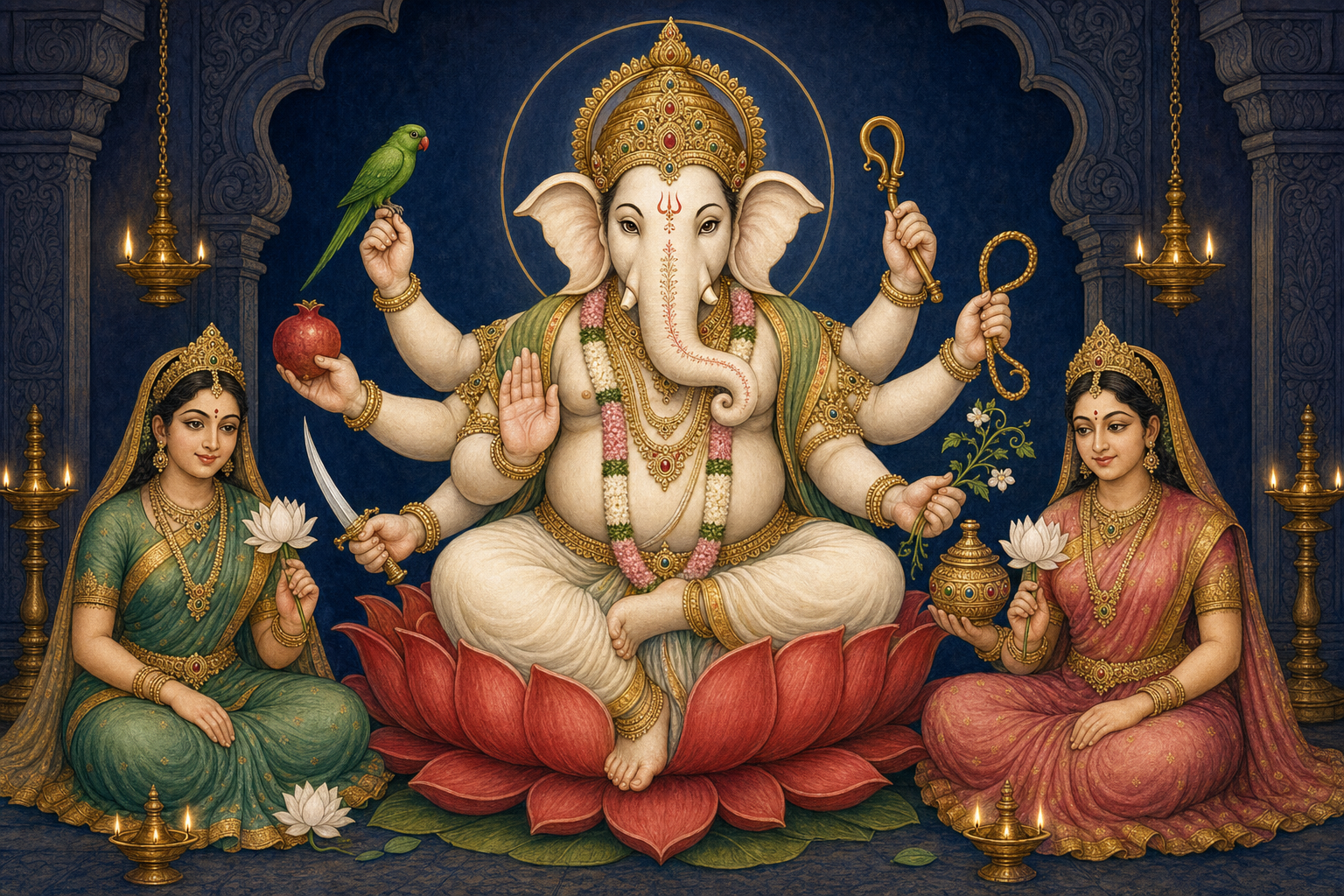
You may have found an image labelled Lakshmi Ganapati and wondered whether it shows Ganesha with Goddess Lakshmi, a regional variation, or a different form altogether. That distinction matters when you are choosing a murti, reading temple art, or deciding how to approach the image in worship.
Start with one rule: do not identify Lakshmi Ganapati from a single object or colour. Read the whole composition – the central deity, attendant Shaktis, number of arms, set of emblems, posture, and gestures. Once those elements are read together, the image reveals its central teaching: prosperity is auspicious when wisdom gathers it, discipline directs it, and dharma governs its use.
The name identifies a form of Ganapati, not Goddess Lakshmi
Lakshmi Ganapati is a distinct form within the traditional group of thirty-two forms of Ganesha. The word Lakshmi indicates the presence of prosperity-Shakti or Lakshmi-tattva. It does not mean that Ganesha has been replaced by Goddess Lakshmi, nor that the central deity is a composite whose identity is uncertain. The deity remains Ganapati.
The two feminine figures attending him are commonly understood as Siddhi and Riddhi. Siddhi represents accomplishment in its inward sense: clarity, steadiness, wisdom, and success in spiritual discipline. Riddhi represents increase, flourishing, and rightful material well-being. Their presence gives visual form to a specifically dharmic proposition: inner attainment and outer prosperity need not be enemies, but neither should prosperity be separated from discernment.
This distinction prevents two common misidentifications. First, an image that simply places an independently identifiable Goddess Lakshmi beside a separate Ganesha should not automatically be called Lakshmi Ganapati. Proximity alone does not establish the form. Second, Lakshmi Ganapati should not be confused with Shakti Ganapati, another of the thirty-two forms. Shakti Ganapati normally has a single consort seated upon his lap and follows a different iconographic vocabulary.
The Ganesha Purana and Mudgala Purana provide the wider theological setting for the forms of Ganapati, while the nineteenth-century Mysore compendium Sritattvanidhi preserves detailed iconographic descriptions. That history helps explain why Lakshmi Ganapati has a stable symbolic grammar without having one compulsory visual template. A regional sculpture can differ from a painted Mysore image and still remain recognisably the same form.
Read the image from the centre outward
A reliable identification begins with the central figure and moves outward. No single feature settles the matter. Golden colour can appear in many auspicious deities, a lotus is widely shared, and even the number of arms varies. The combination carries the identity.
| Feature | What you may see | How to read it |
|---|---|---|
| Central deity | Elephant-headed Ganapati, usually seated | This establishes Ganesha as the governing identity of the composition. |
| Complexion | Golden or red-golden radiance | The colour signals vitality, auspiciousness, and abundance, but should not be used as the sole test. |
| Attendants | Two feminine Shaktis | They are commonly identified as Siddhi and Riddhi, joining spiritual accomplishment with rightful prosperity. |
| Arms | Frequently eight, though four-armed versions occur | A different hand count does not by itself disqualify the image. |
| Core emblems | Noose, goad, modaka, pot of jewels or nectar, and lotus | The set combines mastery of mind, disciplined direction, earned fulfilment, abundance, and purity of purpose. |
| Variable emblems | Axe or fruit may replace another object | Consult the regional or lineage description rather than forcing every version into one inventory. |
| Gestures | Abhaya or varada mudra in some depictions | These communicate fearlessness and boon-bestowing grace. |
| Vahana | The mouse, when included in the surviving or visible composition | It reinforces the identification as Ganapati, especially when colour or smaller attributes are unclear. |
When you inspect a murti or painting, look for four clusters rather than demanding a perfect checklist:
- Ganapati is unmistakably the central and governing deity.
- Two Shaktis participate in the composition rather than appearing as unrelated neighbouring figures.
- Several control-and-abundance emblems appear together, especially the noose, goad, modaka, vessel, and lotus.
- The posture, colour, vahana, and gestures reinforce the identification, where the medium preserves them.
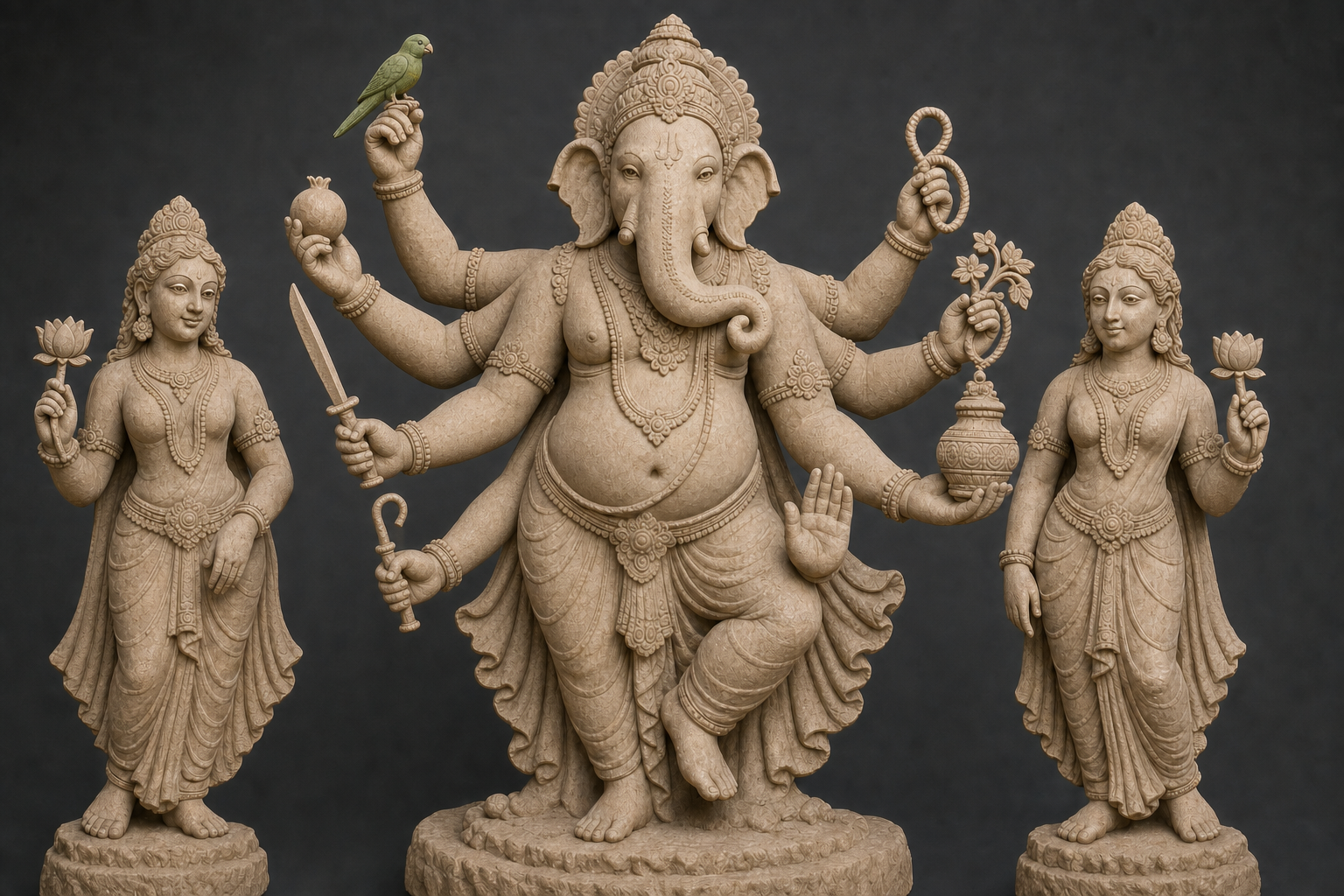
The medium matters. A stone sculpture may preserve posture and emblems but give you no original colour. A bronze may emphasise balanced proportions and ornamental calm. Mysore painting can retain a more carefully codified palette, while Odisha, Bengal, and Newar traditions may elaborate the aura, attendants, jewellery, or hand gestures differently. Treat those differences as regional expression unless the central symbolic structure has changed.
This is especially important when an old sculpture is worn, a photograph is cropped, or several hands are hidden behind garlands. Begin with what survives. The more elements of the cluster that agree, the stronger the identification. Do not reject a regional image merely because its arm count or one emblem differs from a printed chart.
The emblems describe how prosperity should be handled
The objects held by Lakshmi Ganapati are not a catalogue of prizes promised to a worshipper. They describe a sequence of inner governance. Attention must be gathered, energy directed, motives purified, action disciplined, and its fruit received responsibly. Read in that order, the icon becomes a practical map rather than a wealth charm.
Pasha and ankusha: gather the mind, then redirect it
The pasha, or noose, is easy to read only as an instrument that binds. In this form, it also gathers the wandering mind back toward discernment. Before prosperity can be pursued wisely, attention must stop scattering itself among fear, comparison, appetite, and impulse.
The ankusha, or elephant goad, supplies the next movement. It redirects momentum. A habit does not disappear merely because you recognise it; energy has to be turned toward a better course. The practical pairing is precise: the noose recalls you, and the goad gives you a direction.
Apply that pair before beginning a venture or making a consequential purchase. First name the distraction or pressure influencing you. Then name the next dharmic action in concrete terms – checking an obligation, correcting an unfair term, consulting someone with relevant expertise, or postponing a decision made from fear. Attention without action becomes hesitation; action without attention becomes recklessness.
Modaka and ratna-kumbha: distinguish the fruit from the method
The modaka signifies the sweetness that follows disciplined practice and ethical conduct. Its connection with delight does not make it a symbol of effortless reward. The sweet is the fruit, not the method. When the modaka is treated as a promise of gain detached from effort, half of its instruction disappears.
The ratna-kumbha, a vessel of jewels or nectar, represents abundance that overflows. Yet the surrounding emblems qualify that abundance. It has already passed through recollection, direction, and purity of motive. The question is therefore not only how much you can obtain, but how it was obtained and what becomes possible because you have it.
For a householder, professional, or entrepreneur, that changes the examination of success. Ask whether growth strengthens your ability to fulfil duties, support dependants, learn, give, and serve. If the gain depends on exploitation, concealment, waste, or humiliation of others, its outer appearance may be prosperous while its method contradicts the image before you.
The lotus: test the motive, not only the outcome
The lotus rises from mud without taking on its impurity. In Lakshmi Ganapati iconography, it asks for purity of motive amid worldly activity, not withdrawal from worldly activity. Work, trade, ambition, and enjoyment are not automatically rejected. They are tested by the quality of intention and conduct they produce.
This makes the lotus a useful test when two choices promise the same result. Which choice allows you to proceed without deception? Which respects the dignity of the people affected? Which leaves less waste behind? Which can be explained honestly to those who trust you? Purity here is not passivity. It is the refusal to let a desired outcome corrupt the means.
Siddhi and Riddhi: keep attainment and increase together
Siddhi without Riddhi can be misread as an inward achievement with no responsibility toward material life. Riddhi without Siddhi can become accumulation without wisdom. Their paired presence corrects both distortions. Spiritual steadiness should inform the use of resources, while worldly responsibilities give ethical discipline a field in which to operate.
This relationship also clarifies the place of the purusharthas. Dharma governs artha, or material prosperity, and kama, or rightful desire. Artha and kama can then support a life oriented toward moksha rather than displacing it. Lakshmi Ganapati does not present liberation and livelihood as identical goals; he places them in a sound order.
When you want to know whether a pursuit fits that order, use four questions:
- Are the means dharmic, or am I asking a desirable result to excuse an unethical process?
- Will this increase my capacity to meet duties and contribute, or only enlarge consumption and status?
- Is desire being directed by discernment, or is desire making the decision and seeking religious approval afterward?
- Can I remain truthful if the result is delayed, reduced, or denied?
These questions turn the image toward the person doing the looking. Lakshmi Ganapati is not merely showing prosperity to you; the form is asking what kind of person you will become while seeking, receiving, and distributing it.
Approach the icon without reducing worship to acquisition
Lakshmi Ganapati is naturally invoked around new ventures, study, livelihood, and hopes for household well-being. Those are fitting concerns. The error begins when worship is treated as a transaction in which an offering obliges the deity to produce a financial result. The iconography itself refuses that reading because every emblem of abundance is accompanied by an emblem of discipline, redirection, purity, or wisdom.
A simple, informed approach can follow five steps:
- State the purpose honestly. Name the actual matter before you: clarity in study, a new undertaking, stability in livelihood, responsible growth, or the removal of an obstacle. Avoid turning a vague wish for more into the whole prayer.
- Read the icon before asking from it. Let the pasha identify where your mind is scattered, the ankusha identify the corrective action, the lotus examine your motive, and the modaka and vessel remind you that desirable fruit follows disciplined conduct.
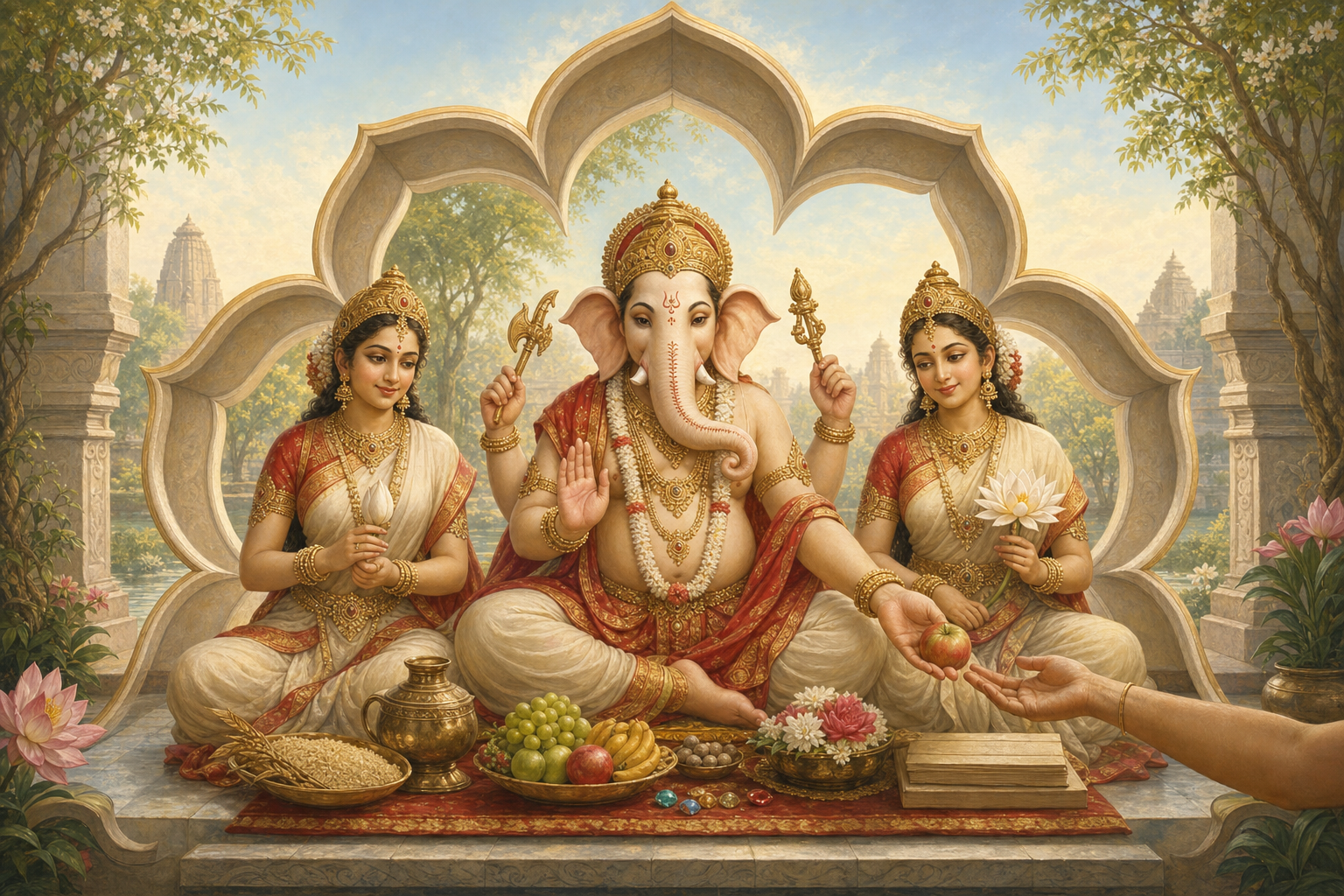
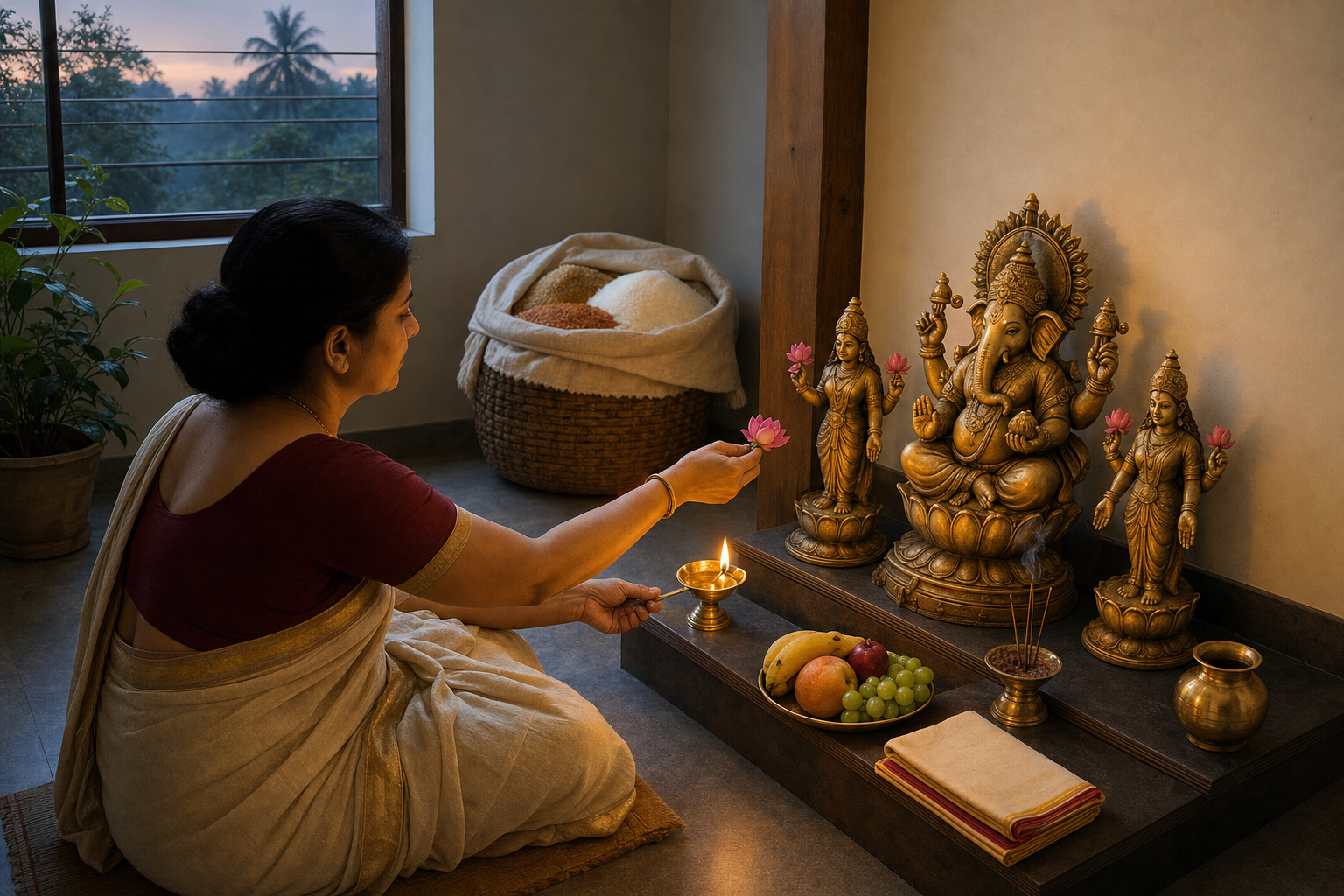
- Offer within your tradition and means. Modaka, coconut, seasonal fruit, durva grass, and red or golden flowers appear in regional practice. You do not need every item, and an offering should not become wasteful display. Follow the paddhati of your household, temple, or sampradaya where one is established.
- Join the prayer to one accountable action. Correct a neglected duty, review an agreement, finish the required preparation, repay what is owed, or set aside a fair share for giving. The action should address the matter for which you seek grace.
- Receive the result without abandoning dharma. Gratitude in gain and steadiness in uncertainty are both part of the form’s teaching. A delay is not permission to deceive, exploit, or take a reckless shortcut.
Shukla Paksha Chaturthi and the period of Ganesh Chaturthi are especially associated with Ganapati worship. The calendar can support attention, but it should not replace the ethical preparation represented by the icon. A well-timed puja joined to irresponsible conduct misses the form’s most important instruction.
If your interest is specifically Tantric, respect the limits of general information. Lakshmi Ganapati mantras differ across lineages and may combine Ganapati and Lakshmi-related bija sounds within mantra, mudra, and visualisation. Such practice belongs within guru-shishya parampara. Do not assemble an esoteric mantra from disconnected seed syllables merely because they appear auspicious. Use the instruction given by a qualified teacher in the lineage you actually follow.
Where the decision concerns investment, debt, contracts, or livelihood, devotional confidence is not evidence that a proposal is sound. Verify the terms, costs, legal duties, and material risks separately. Worship can govern your motive and conduct; it does not remove the need for competent professional judgement.
Key takeaways
- Lakshmi Ganapati is a form of Ganesha infused with prosperity-Shakti, not another name for Goddess Lakshmi.
- The two attending Shaktis are commonly Siddhi and Riddhi, joining inward accomplishment with rightful outward flourishing.
- Identify the form from a cluster of features; eight arms are frequent, but four-armed and regionally varied depictions also occur.
- The noose, goad, lotus, modaka, and vessel describe a disciplined path from gathered attention to ethically received abundance.
- Worship is most faithful to the icon when prayer, responsible action, and dharmic means remain connected.
The next time you stand before Lakshmi Ganapati, pause at each attribute and attach it to one real decision. Let the noose recall your attention, the goad establish your next action, the lotus test your motive, and the modaka and overflowing vessel remind you what rightful fruit requires. Then the icon becomes more than an auspicious decoration: it becomes a method for bringing wisdom into work, wealth, desire, and responsibility.

References
