
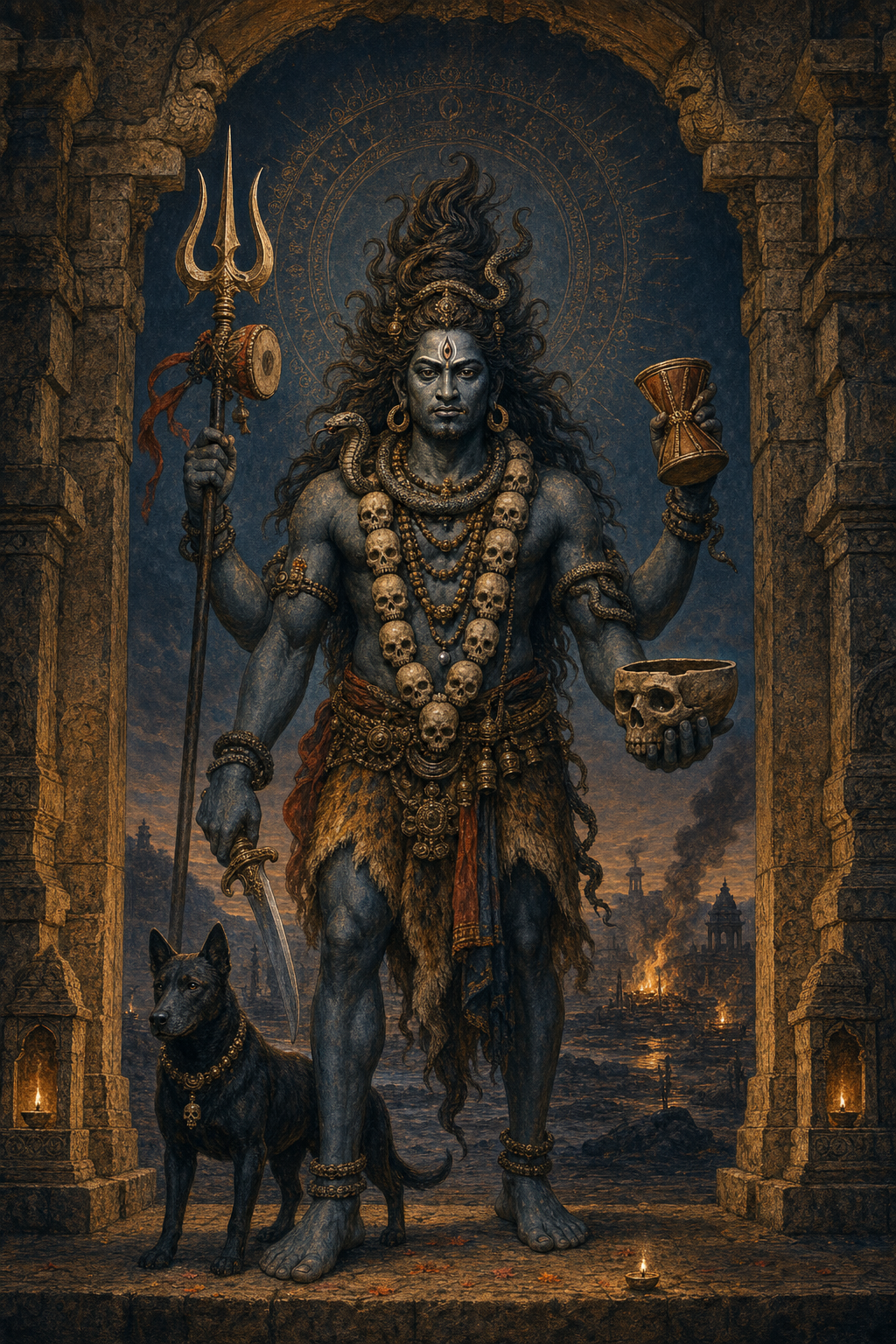
If you are trying to identify a Bhairava image, start with a warning: fangs, skulls, a trident, and a dog do not constitute a name tag. They place the image within Bhairava’s fierce Shaiva vocabulary, but they do not, by themselves, tell you whether you are seeing Kala Bhairava, one member of an eightfold mandala, or a form defined by a local lineage.
You will read the image more accurately when you examine its setting, companions, attributes, hair, vehicle, and ritual use together. What first looks macabre then becomes intelligible as a disciplined instruction: stay alert, face time and mortality, master instinct, and protect dharma without becoming cruel.
Identify the role before trying to name the form

Bhairava is fierce, but fierceness is not the same as malice. The form is meant to confront and dissolve fear while safeguarding dharma. Raudra, the fierce aesthetic mood, shocks the inattentive mind into wakefulness; it does not turn anger into a virtue.
The same broad iconographic language can serve several related functions:
- Threshold guardian: Bhairava protects a city, temple precinct, gateway, or boundary. Placement near an entrance or outer enclosure matters as much as the objects in his hands.
- Governor of time: Kala Bhairava confronts the devotee with limit, consequence, punctuality, and mortality. His guardianship is therefore moral as well as spatial.
- Directional power: Eightfold and tenfold Bhairava arrangements map vigilance around a mandala. Here, position within the group is essential evidence.
- Contemplative reality: In the philosophical world associated with the Vijnana Bhairava Tantra, Bhairava is not only an anthropomorphic deity. The name also points to unbounded, awake consciousness approached through disciplined contemplation.
Use the following order when you encounter a sculpture, painting, shrine, or ritual diagram:
- Read the local name first. Check the shrine label, inscription, temple literature, or name used by the priest and devotees. A lineage’s own identification outweighs a generic chart found elsewhere.
- Record the placement. Is the figure at a gate, on the outer perimeter, in a central sanctum, beside a cremation-ground scene, or within a directional ensemble?
- Count the related figures. A group of eight, ten, or sixty-four gives you a taxonomic clue that an isolated attribute cannot provide.
- List the full attribute cluster. Note every hand-held object, the number and arrangement of arms, the hair, ornaments, vehicle, expression, posture, and accompanying figures. Do not identify the form from the trident alone.
- Ask how the image is worshipped. Observances associated with time, boundaries, protection, or a particular mandala may clarify the shrine’s intended meaning.
This method also prevents a common error: mistaking a theological interpretation for an iconographic identification. A dog can signify alert guardianship, for example, but its presence does not automatically settle which Bhairava form stands above it.
Read the attributes as a coordinated visual language

Bhairava’s attributes work like a sentence rather than a bag of separate symbols. Each element contributes meaning, but the relationship among them carries the strongest message.
| Feature | What to notice | What it communicates | What not to assume |
|---|---|---|---|
| Jata | Whether the matted locks rise, flare, bristle, or form a fiery aureole | Tapas, concentrated energy, vigilance, and the pressure of time | That a yogic interpretation is a literal anatomical diagram |
| Eyes and expression | Incandescent or red eyes, bared teeth, fangs, and an arresting gaze | Raudra as protective intensity: the shock that interrupts complacency | That uncontrolled rage is being praised |
| Skull garland and kapala | Skulls worn as ornaments and the kapala, or skull vessel, held in a hand | Mortality, impermanence, ascetic freedom, and a challenge to shallow ideas of purity | That the image endorses cruelty or harmful ritual |
| Trishula, damaru, khadga, and other implements | The complete combination of trident, drum, sword, skull vessel, and lineage-specific objects | Shiva’s ascetic sovereignty and the fierce capacity to remove obstruction | That any single implement uniquely identifies one form |
| Dog vahana | Its position, orientation, and relationship to the deity | Fidelity, alertness, and instinct brought under ethical discipline | That instinct must be hated or violently suppressed |
| Semi-nudity or cremation-ground setting | The absence of courtly ornament, liminal surroundings, and signs of ascetic life | Freedom from social pretence and confrontation with death, pollution, and exclusion | That transgression means lawlessness |
| Temple location | Gateway, perimeter, directional niche, or independent sanctum | The form’s protective, civic, mandalic, or initiatory function | That location is merely an architectural convenience |
The jata deserves special attention because it changes the emotional grammar of the whole image. Nataraja’s locks spread through the movement of the cosmic dance. Bhairava’s locks frequently surge upward, concentrating rather than dispersing energy. They bring ascetic heat, time, and vigilance into a single flame-like form. The visual demand is immediate: do not sleep through the moment in front of you.
Some yogic interpretations relate this ascent to udana-vayu, awakened inner fire, or kundalini moving toward the cranial aperture. Treat that as symbolic hermeneutics, not as an anatomical claim or a promise that looking at the image will produce a physiological event. The sculpture exteriorizes an interior possibility: energy that has ceased to scatter and now rises as clarity.
The skulls make a parallel demand. They do not decorate death for its own sake. They remove the comforting fiction that status, bodily permanence, and conventional respectability can protect us from time. In Kapalika and Aghora settings, cremation-ground imagery also tests rigid divisions between pure and impure. The point is nondual recognition under discipline, not licence to injure, intimidate, or indulge appetite.
Match the image to the right Bhairava system
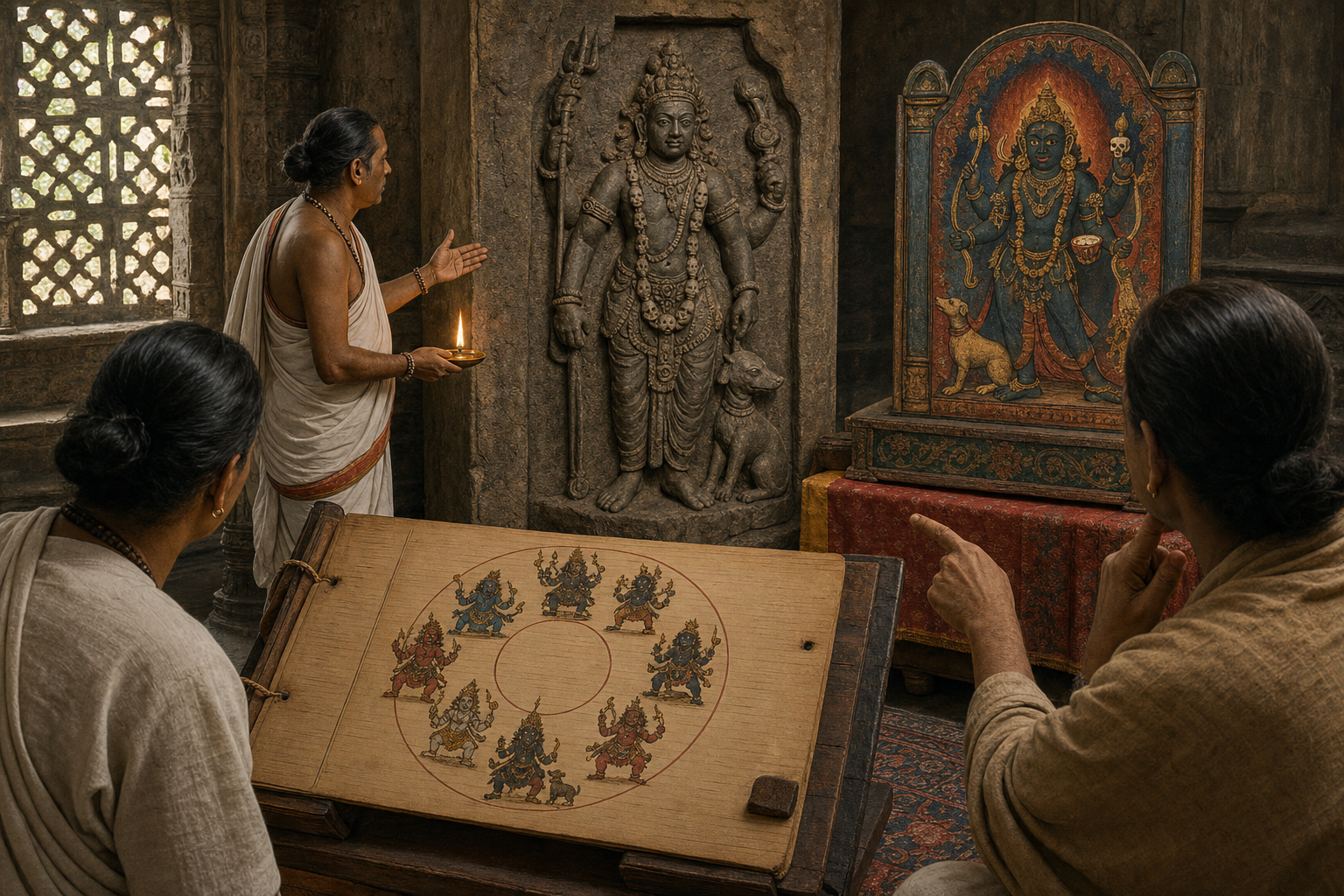
There is no single, universal catalogue in which every Bhairava name always carries the same appearance, mantra, direction, and ritual role. Regional traditions and paramparas preserve real variations. Accurate identification therefore requires you to know which system the image belongs to before decoding its details.
Kala Bhairava: time, consequence, and the guarded threshold
Kala Bhairava is the most prominent public form in many temple and pilgrimage settings. He governs time not as an abstract clock but as limit, ripening consequence, and the discipline that makes freedom possible. In Kashi he is revered as the sacred city’s vigilant guardian, while Kashi, Ujjain, Nepal, and South Indian temple traditions display distinct regional expressions of Bhairava’s protective role. In parts of South India, the name may appear in the regional form Vairavan.
A threshold location, the dog vahana, fierce Shaiva attributes, and worship concerned with time or guardianship can support an identification as Kala Bhairava. None of those clues is sufficient alone. The safest conclusion comes from the local name combined with the shrine’s placement and living ritual function.
Kala Bhairava Ashtami makes this theology practical through vows, accountability, lamps, recitation, and observance at significant hours. The emphasis is not fascination with dread. It is the recognition that postponement, deceit, and carelessness all have consequences.
Ashta Bhairava: an eight-direction mandala
A widely known eightfold sequence names Asitanga, Ruru, Chanda, Krodha, Unmatta, Kapala, Bhishana, and Samhara. These forms commonly operate as directional guardians within a mandalic whole. Their placement, weapons, colours, vehicles, and ritual associations can vary by transmission, so the list of names is a starting point rather than a universal decoding key.
If you are studying an eight-image ensemble, do not assign names from visual mood alone. First establish which direction the temple or diagram treats as east, then obtain the local sequence and compare the complete iconographic program. A fierce face does not prove Krodha; a skull does not by itself prove Kapala. The entire arrangement controls the reading.
Dasa Bhairava: a tenfold map with lineage-specific variations
Dasa Bhairava is especially easy to misrepresent because the tenfold schema is not a single rigid canon. One frequently transmitted enumeration begins with the eight names above and adds Kala and Batuka. Other transmissions organize ten manifestations around the ten directions: the four cardinal points, four intermediate points, zenith, and nadir.
When you find ten figures, establish whether you are looking at an expanded Ashta Bhairava list, a ten-direction mandala, or a local arrangement with its own names. Do not force one lineage’s mantras, colours, or directional assignments onto another. In a living Tantric tradition, the transmitted map is part of the meaning.
The sixty-four Bhairavas and the limits of a quick identification
The sixty-four Bhairavas represent a further elaboration of Bhairava’s mandalic plurality. Their existence should make you more careful, not more eager to label. If a museum record, temple tradition, inscription, or authorized lineage does not supply the identity, leave the form open rather than manufacturing certainty from one familiar weapon.
Bhairava beyond the catalogue of forms
Shaiva Tantra also asks you to look through the icon. Within Kaula and Kashmir Shaiva philosophical settings, Bhairava can name the unbounded consciousness in which every perception appears. Spanda, the subtle vibrancy of that consciousness, helps explain why the icon can be simultaneously still and explosive. The fierce image interrupts habitual thought so that awareness may recognize its own ground.
This does not make the deity secondary or unreal. It shows why devotion, metaphysics, and contemplative method can inhabit the same form. The guardian outside a temple and the awareness encountered within meditation are not competing explanations; they address different levels of the practitioner’s encounter.
Let the fierce image sharpen conduct, not feed aggression

The most reliable interpretation of Bhairava passes an ethical test. Does it make you more truthful, vigilant, restrained, and capable of protecting others? Or does it offer a religious costume for domination, impulsiveness, or contempt? A practice based on cruelty, intimidation, or coercion contradicts the protective purpose it claims to serve.
You can translate the main symbols into concrete disciplines:
- Time: keep the hour you assigned to prayer, work, or service. Kala becomes meaningful when your promise survives inconvenience.
- Gaze: notice the fact you have been avoiding. Bhairava’s uncompromising eyes are an invitation to see clearly, not to scrutinize everyone else.
- Sword and trident: cut through one deception in your own conduct before using fierce language about the faults of others.
- Dog: cultivate loyalty and alertness while training instinct through restraint. Feeding stray dogs responsibly can become an act of seva rather than a token offered for private gain.
- Skull: remember mortality when choosing what deserves your limited time. Status anxiety weakens when impermanence is faced directly.
- Threshold: guard what enters your speech, home, and attention. Protection begins with discrimination, not hostility.
For a householder, accessible observances include temple seva, dana, deliberate truth-telling under pressure, disciplined timekeeping, and recitation of the Kala Bhairava Ashtakam, traditionally attributed to Adi Shankara. Follow the custom of your family, temple, or sampradaya. Advanced mantra, bija, nyasa, yantra, and transgressive ritual material belong under qualified guru guidance; copying an isolated formula from a chart gives you neither its safeguards nor its transmitted context.
Visual parallels elsewhere in the Dharmic world can deepen understanding when they are handled without collapsing distinct traditions. Vajrayana forms such as Vajrabhairava, also called Yamantaka, and Mahakala employ wrathful imagery for protective, liberating purposes. Jain traditions include protective figures such as Nakoda Bhairav, while Sikh teaching places fearlessness, remembrance, service, and the consecrated discipline of kesh within a different theological framework. The shared moral vocabulary includes vigilance and courage; it does not erase doctrinal boundaries or turn every fierce guardian into the same deity.
Key takeaways
- Bhairava’s frightening appearance communicates protective intensity, impermanence, and wakefulness; it does not sanctify uncontrolled anger.
- Identify a form from local naming, shrine placement, group structure, complete attributes, and ritual use, in that order.
- Upward-flaring jata signifies concentrated tapas, time, and vigilance; yogic readings of it are symbolic rather than anatomical claims.
- Ashta, Dasa, and sixty-fourfold Bhairava systems vary across regions and paramparas. A lineage-specific map should not be presented as the only canon.
- Householder practice should convert the icon’s severity into punctuality, truth, dana, restraint, and protection. Esoteric mantra and ritual require qualified guidance.
The next time you stand before Bhairava, make five notes: the local name, the shrine’s location, the number of related figures, the complete attribute cluster, and the observance performed there. If those clues do not converge, leave the identification open. Disciplined uncertainty is more faithful to a living tradition than a confident but borrowed label.
References
- DharmaRenaissance Blog – Dasa Bhairava Unveiled: A Powerful Shaiva-Tantric Journey through Fear, Time, and Grace
- DharmaRenaissance Blog – Bhairava’s Untamed Jata: Shiva’s Tantric Iconography, Cosmic Fire, and the Discipline of Time