
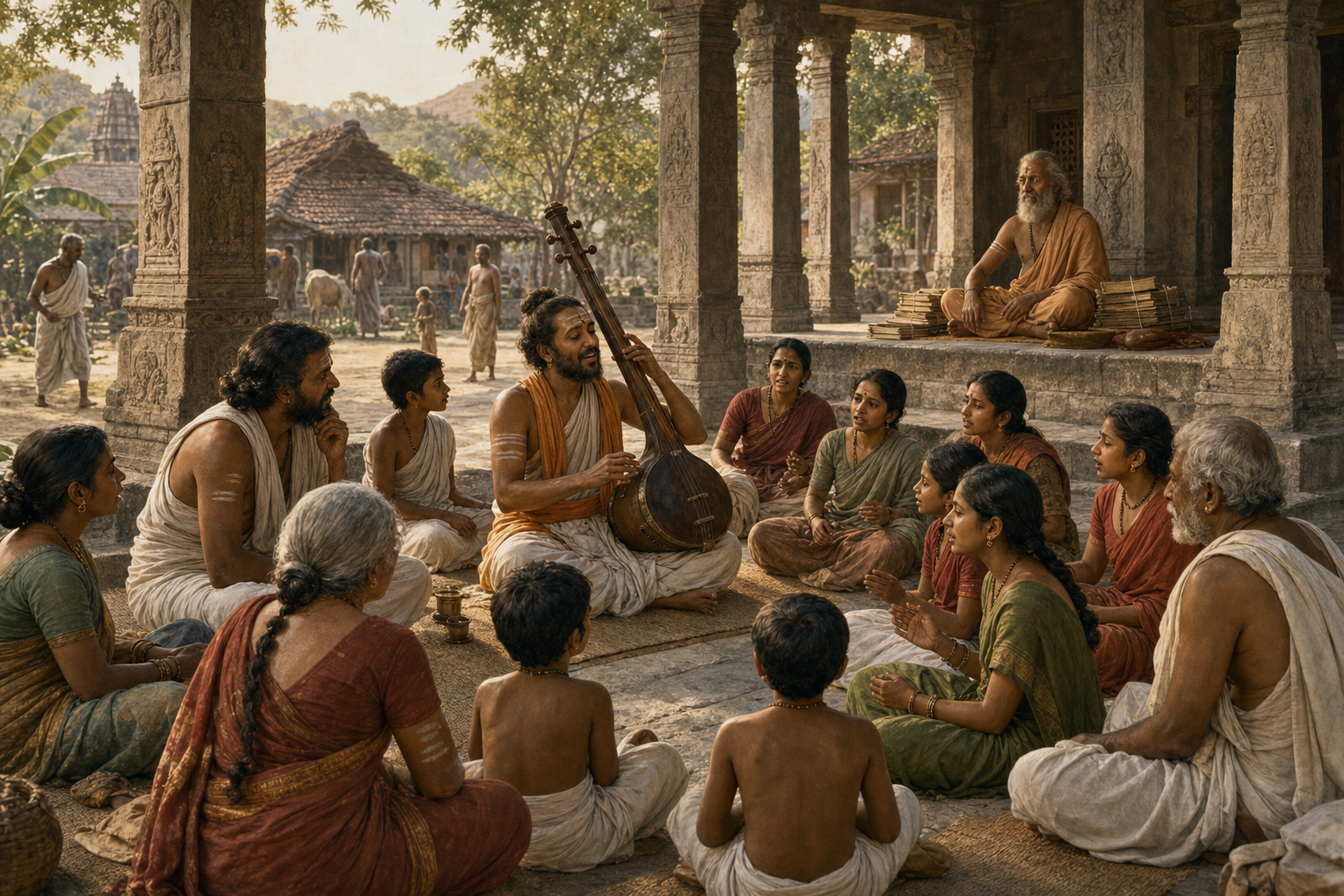
The Haridasa tradition endured because it made devotion portable. Madhva-Dvaita philosophy moved through Kannada compositions, musical performance, household practice, teacher-disciple transmission and institutions that could outlast the political world in which many of the songs arose.
Its significance therefore extends beyond a celebrated body of devotional music. The tradition offers a case study in how philosophical depth, emotional accessibility and social continuity can reinforce one another without requiring every participant to encounter doctrine in the same form.
Political rupture did not break the chain of transmission
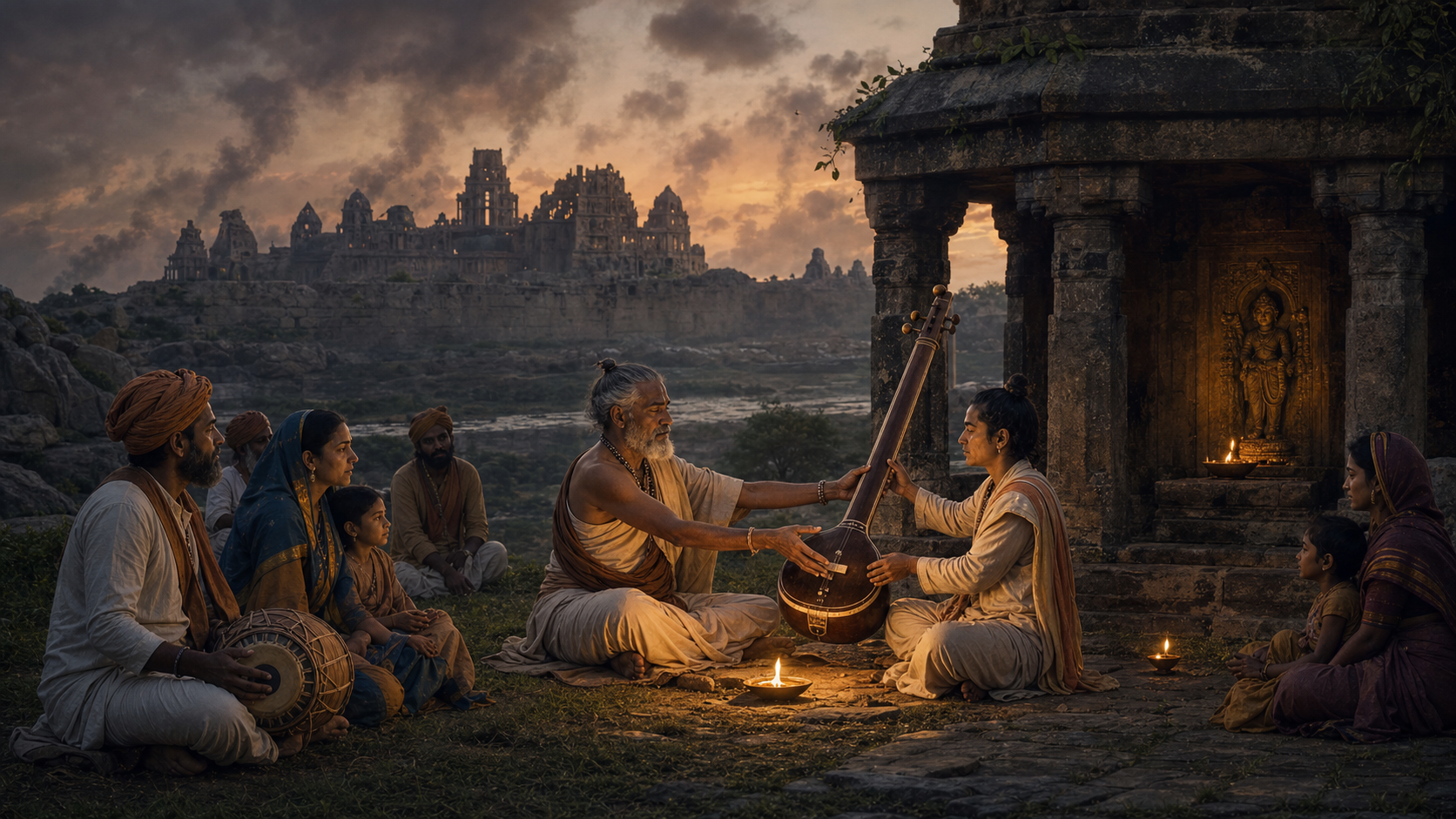
The supplied DharmaRenaissance Blog account places the tradition’s durability against a dramatic historical contrast. It reports that Hampi, the imperial centre of Vijayanagara, was devastated in 1565 following the Battle of Talikota, while compositions associated with Purandaradasa, Sripadaraja, Vyasatirtha, Kanakadasa and later Haridasas continued to circulate.
This contrast helps distinguish patronage from dependence. A court could provide protection and resources, but the songs were not confined to courtly occasions. They passed among religious institutions, performers, students, temples and families. Once knowledge had been distributed across these overlapping settings, the loss of a capital did not amount to the loss of the tradition.
A present-day Carnatic concert provides a small illustration of that continuity. The source describes Purandaradasa’s Lambodara Lakumikara being used during the Margazhi season in Chennai as an invocation to Ganesha. A composition linked to the sixteenth-century Vijayanagara environment can thus remain meaningful in a modern performance setting far from the circumstances of its formation.
The survival of the tradition should not be mistaken for simple stasis. Its continuity rested on movement between settings: philosophical teaching became song, song entered practice, practice formed memory, and institutions helped correct and renew what communities carried forward.
Kannada widened access without displacing Sanskrit scholarship
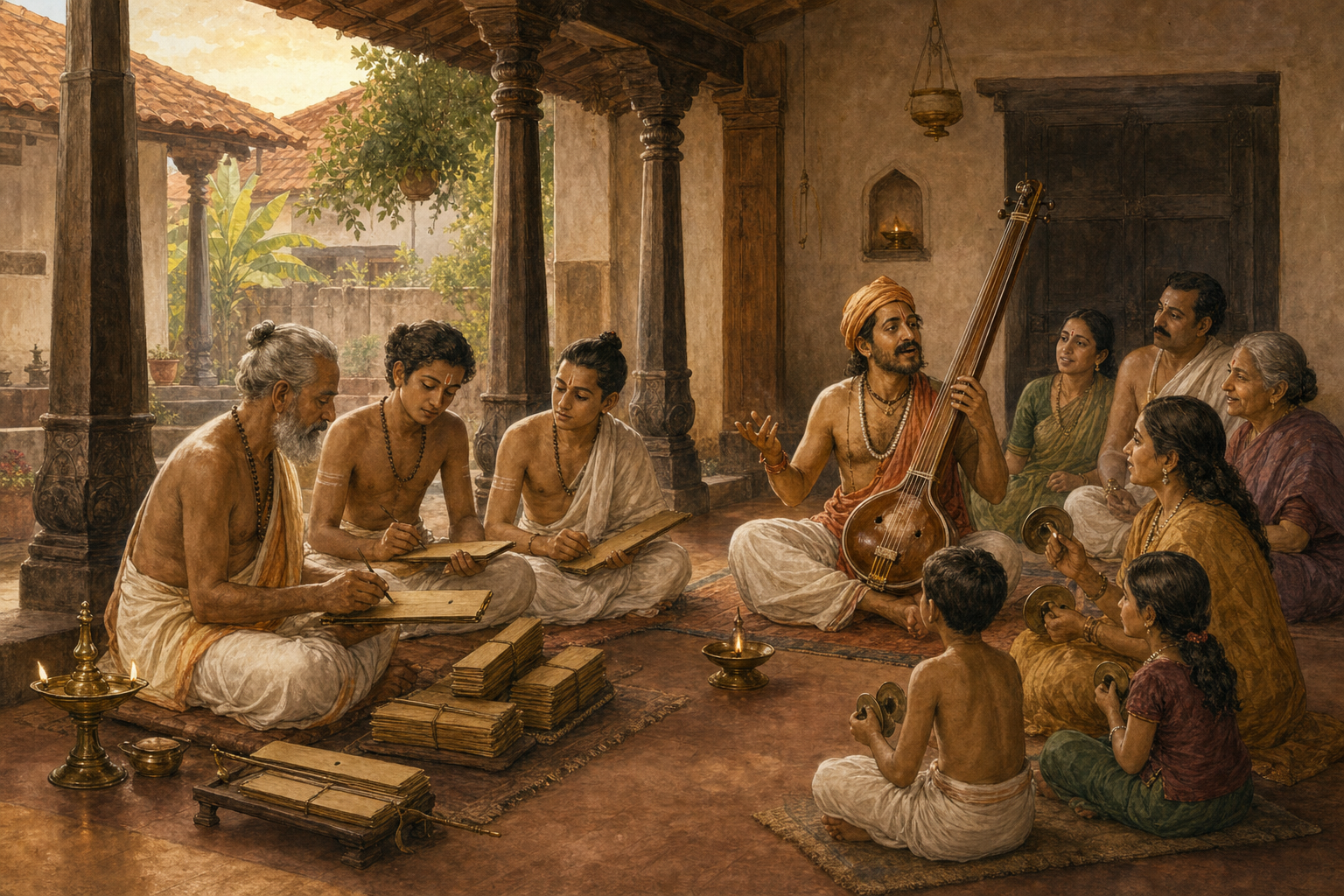
One of the central problems addressed by the Haridasas was linguistic access. The source presents Sripadaraja of Mulbagal, who is reported to have entered Brindavana around 1480, as an inheritor of the sophisticated Sanskrit textual and commentarial tradition of Madhvacharya. That literature preserved doctrinal precision, but direct study required specialised education.
Sripadaraja’s Kannada devaranamas created another route into the same intellectual world. They did not make Sanskrit texts unnecessary or turn devotion into theology-free sentiment. Instead, familiar images gave listeners an initial grasp of philosophical relationships. The description of Hari as the source from which ornaments themselves receive their beauty, for example, communicates a hierarchy of value through an image that can be remembered without technical training.
Vyasatirtha illustrates how the two levels could coexist within one figure. According to the source, he lived from 1460 to 1539, wrote Sanskrit works including Nyayamrita, Tarka Tandava and Tatparya Candrika, and also composed Kannada devaranamas. His widely performed Krishna Ni Begane Baro shows how an author active in rigorous philosophical debate could also address the devotee through an immediate appeal to Krishna.
The resulting knowledge system was layered rather than divided. Scholars could examine argument and commentary at high resolution; singers and householders could encounter recognisable theological principles through language, melody and devotion. The forms differed, but they remained connected to a shared doctrinal centre.
Song converted abstract teaching into repeatable experience
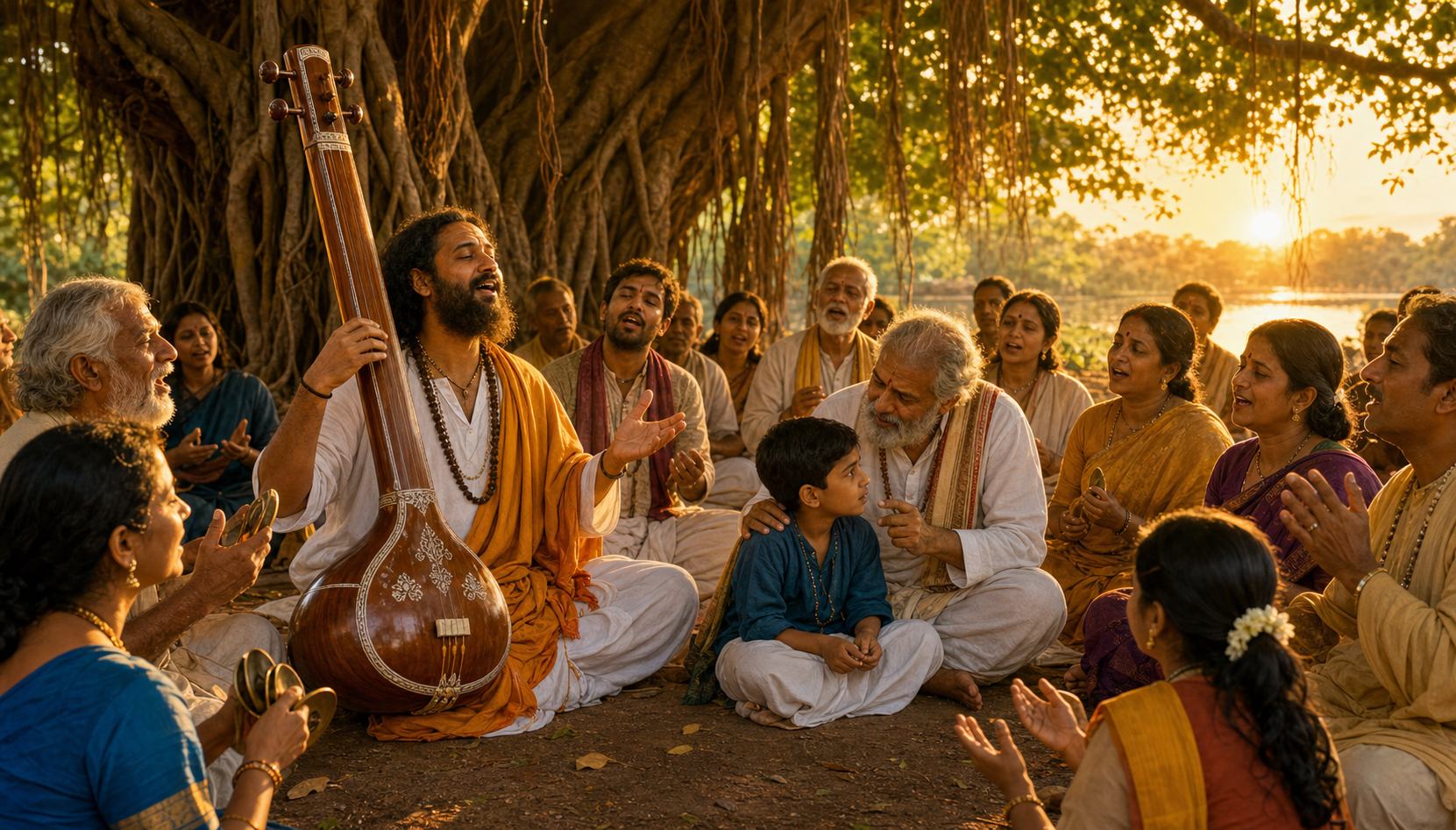
Vernacular language alone does not explain durability. The decisive medium was language organised as song. Rhythm, recurring melodic patterns, vivid scenes and signature phrases made teachings easier to retain and reproduce. Performance also gave the material occasions on which to recur: worship, teaching, domestic observance and public music could all reactivate the composition.
The source’s account of Purandaradasa demonstrates this method especially clearly. It reports that the wealthy merchant Srinivasa Nayaka underwent a spiritual transformation, received initiation from Vyasatirtha at Hampi in 1525 and thereafter composed under the devotional signature Purandara Vittala. It also carefully distinguishes traditional claims of an exceptionally large output from the more limited body of compositions that survives. That distinction matters: his influence rests not on accepting an uncertain total, but on the reach and pedagogical effectiveness of the extant tradition.
Purandaradasa worked in forms identified by the source as kirtana, suladi and ugabhoga. Within them, theological propositions became scenes and sensations. Jagadoddharana presents Yashoda playing with the divine child who is also the uplifter of the world. The relationship between intimacy and transcendence is not merely defined; it is experienced through maternal affection.
Another composition discussed by the source explains remembrance of divine names through the preparation of a sweet dish: the names of Rama, Krishna and Vittala are associated with payasa, sugar and ghee. The analogy works because it begins with an activity familiar in domestic life. Ingredients that acquire their full character through combination become a way to understand a devotional practice built through repeated remembrance.
These examples reveal a disciplined kind of compression. A composition does not reproduce a philosophical treatise in miniature. It selects a relationship, paradox or practice and gives it an emotionally intelligible form. Repetition then deepens recognition: a listener may first enjoy the story or melody and later perceive the theological structure it carries.
Institutions and wider participation gave the repertoire resilience
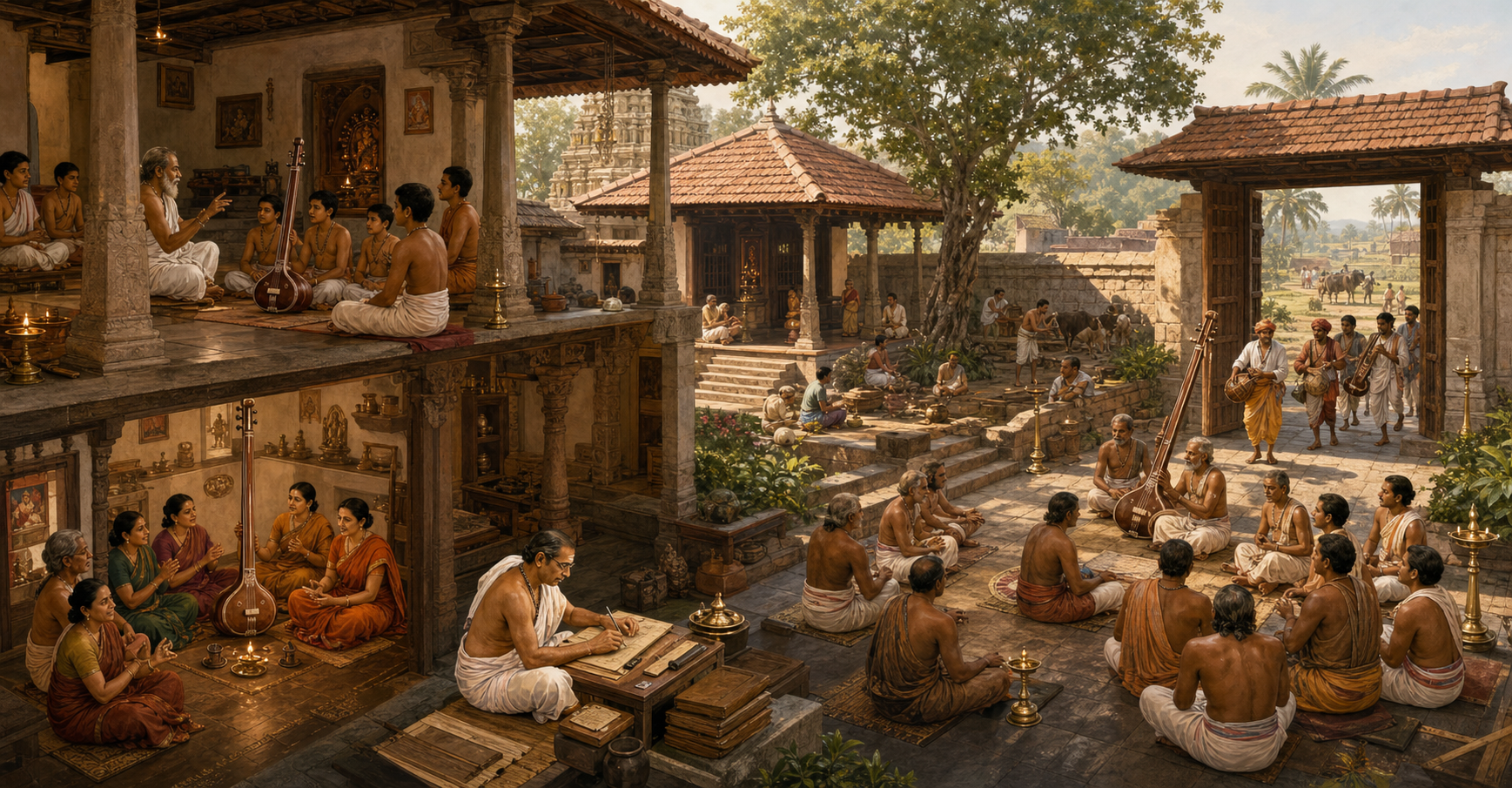
Memorable songs still require communities capable of preserving and interpreting them. The source credits Vyasatirtha with helping sustain that institutional setting while he served as royal guru to Krishnadevaraya. Vijayanagara patronage supplied resources, but the account emphasises that the Madhva mathas retained a purpose not reducible to state control.
Those mathas reportedly trained scholars, received pilgrims, preserved manuscripts and taught compositions. Their functions joined textual memory to living practice. A manuscript could safeguard wording, a teacher could transmit interpretation, and a community of performance could keep the work audible. No single carrier had to bear the entire burden of continuity.
The place of Kanakadasa adds a social dimension to this structure. The source identifies him as Vira Nayaka, born in Karnataka’s Kuruba community, and names works including Mohanatarangini, Ramadhanya-caritre, Haribhaktisara, Nalacaritre and Nrisimhastava. His prominence shows that the tradition’s public field could extend beyond a narrowly bounded social constituency.
This wider participation was not separate from preservation; it strengthened it. Every additional setting in which a composition could be understood, performed or discussed created another route of transmission. The Haridasa tradition’s resilience therefore emerged from the interaction of doctrinal anchors, vernacular expression, musical memory, institutional guidance and a broadened devotional community.
Key takeaways for understanding living bhakti
- Accessibility and depth were complementary: Kannada compositions extended the reach of Madhva-Dvaita thought while Sanskrit scholarship retained its analytical precision.
- Music made teaching renewable: melody, imagery and repetition allowed ideas to return through worship, domestic life, instruction and performance.
- Continuity was distributed: mathas, teachers, performers, pilgrims, families and temples provided overlapping means of preservation.
- Social reach increased resilience: the prominence of figures such as Kanakadasa demonstrates that participation beyond a narrow circle was part of the tradition’s historical strength.
The most useful implication for future preservation is that a living tradition cannot be secured by archiving words or recordings alone. Text, musical form, pronunciation, philosophical interpretation, teacher-disciple correction and occasions for communal use remain mutually dependent. Efforts that reconnect these elements are more likely to sustain the Haridasa inheritance as a mode of learning and devotion rather than as an admired remnant of the past.