
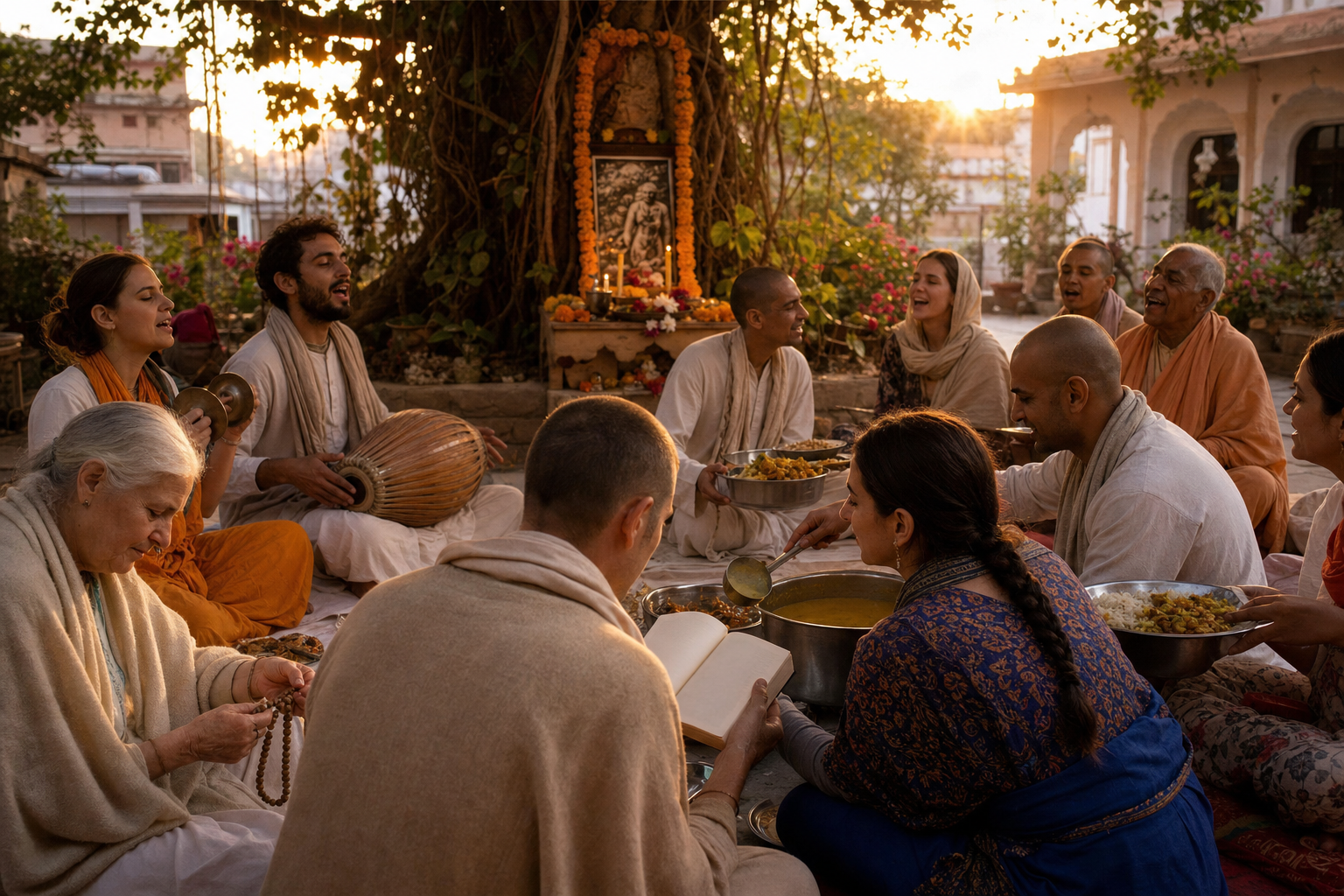
If you know Srila Prabhupada mainly through anniversary observances, old photographs, or a Bhagavad-Gita resting on a shelf, the phrase “global legacy” can feel too large to use. The practical question is smaller: what should be different in your day, your family, or your local temple because his work carried Krishna bhakti far beyond Bharat?
His influence becomes visible when remembrance turns into rhythm: the holy name is chanted again, scripture is opened again, prasadam is shared, and somebody accepts an unglamorous responsibility. That sequence helps you distinguish between honoring a great acharya and actually inheriting the path he transmitted.
Key takeaways
- Prabhupada’s legacy is not confined to institutions or commemorations. It lives through a portable pattern of hearing, chanting, study, association, prasadam, and seva.
- Books open the door, but regular practice turns information about Krishna into a devotional relationship.
- A healthy bhakti community gives newcomers a clear path from attending an event to learning, serving, and becoming dependable.
- Bhakti can redirect grief and self-pity toward acceptance and responsibility, but spiritual practice should never be used to deny painful facts or replace appropriate professional support.
- Cooperation among Hindu, Buddhist, Jain, and Sikh communities becomes stronger when shared values are honored without pretending that their doctrines are identical.
The legacy travelled through repeatable acts of devotion

At the sixty-year milestone following Prabhupada’s arrival in the West, people of varied cultural backgrounds across continents were sustaining bhakti through kirtan, meditation, scriptural study, and service. Those practices are portable, but they are not weightless. Every gathering still needs people who prepare the room, cook, welcome newcomers, teach carefully, distribute books, clean afterward, and return when the excitement has passed.
The movement’s early years make that mechanism unusually visible. In late-1960s Boston, devotees from Buffalo, Columbus, New Vrindaban, Pittsburgh, Philadelphia, and Washington, D.C., joined the local community and travelled together in a rented school bus to welcome Prabhupada. A banner even preserved a misspelling of “Prabhupada” from the period when devotees were still learning to use that honorific instead of the familiar “Swamiji.” The scene was joyful, earnest, coordinated, and still visibly in formation.
That small episode reveals how a global tradition is actually built. Reverence generates cooperation; cooperation gives devotion a durable form. The same communal habit supported the editing, printing, and distribution of Gaudiya Vaishnava teachings. A book could cross a border because someone had treated proofreading, driving, packing, accounting, or carrying boxes as seva rather than as work beneath spiritual life.
This changes how you should evaluate a legacy. Do not ask only how many countries display its name or how impressive a festival appears. Ask whether ordinary people are being taught repeatable practices. Can a newcomer join kirtan without already knowing every custom? Is there regular Bhagavad-Gita study? Can someone receive prasadam and then learn how to serve? Is responsibility shared, or does everything depend on a small exhausted group?
If you want to preserve Prabhupada’s work, begin at the recurring point where your own community needs reliability. The task may be setting out books, welcoming a family, washing utensils, helping with transport, or preparing a study space. The global scale of the movement can distract you from this truth: a tradition becomes stable at the exact place where a person decides to return and do the necessary work again.
Books begin the encounter; practice keeps it from becoming decor

Curiosity does not always begin in an obviously sacred place. A Sanskrit tattoo, a celebrity reference, or an unopened Bhagavad-Gita can become the first threshold into sustained reflection and bhakti. There is nothing wrong with such an entrance. The problem begins only when the symbol is mistaken for the destination.
An old Hare Krishna saying holds that giving someone one of Prabhupada’s books is, in a profound sense, giving that person Krishna. The claim rests on a devotional understanding of sacred text. The Bhagavad-Gita is not approached merely as a historical artifact, a source of attractive quotations, or a badge of Hindu identity. Krishna’s instruction is meant to be heard, considered, remembered, and allowed to challenge your conduct.
You can make that encounter concrete without attempting to master the entire Gita at once. Read a manageable passage at a fixed point in your day. Then answer three questions in your own words: What is Krishna asking Arjuna to see differently? Where does that teaching expose an attachment, fear, or evasion in me? What duty can I perform more honestly before I read again?
Pair reading with the other parts of bhakti. Japa gives your attention a definite devotional center. Kirtan lets you enter the holy name with others rather than keeping spirituality entirely private. Satsang places your interpretation in a community where it can be questioned and refined. Seva tests whether reflection has made you more available to others or merely more interested in your own spiritual self-image.
Do not measure the result by the number of verses you can display or recite. Notice whether you keep promises more reliably, speak with greater restraint, recover from wounded pride more quickly, and become willing to perform work that brings no recognition. If scripture makes your identity louder but your conduct harsher, the book has been collected rather than received.
This reverence for sacred teaching also has a wider dharmic resonance. The Guru Granth Sahib is encountered as the living Guru in Sikh tradition; Buddhist sutras carry the Dharma; Jain Agamas transmit the realized knowledge of the Jinas; and Hindu traditions receive texts such as the Vedas, Upanishads, and Bhagavad-Gita as vehicles of sacred wisdom. The traditions do not understand textual authority in exactly the same way, but they share a refusal to reduce scripture to inert decoration.
Lived bhakti becomes clearest when life resists your plans

Devotional language is easy to repeat when events are moving in the direction you hoped. Its depth is tested when your expected future disappears. When a long-awaited first child was diagnosed with autism and intellectual disability, one parent moved through profound grief, self-pity, and damaged confidence before the question “Why me, God?” gradually became “Why not me, God?”
That change must not be romanticized. It does not mean the diagnosis was desirable, that grief was a spiritual failure, or that a parent should refuse help. It marks a change in the person’s position toward an already-present reality. The mind is no longer occupied only with the life it expected to receive. It begins asking how to love, serve, learn, and carry responsibility within the life that is actually here.
Dharmic acceptance is therefore different from passivity. It does not require you to approve of pain, suppress emotion, or pretend that hardship has vanished. It asks you to stop arguing with the bare fact that has already arrived, so that energy can move toward the next responsible action. In bhakti, remembrance of Krishna can support that movement by placing suffering within a relationship larger than the isolated self.
Japa can give a distressed mind a practice to return to when explanations fail. Scripture can restore a vocabulary of duty when mood alone cannot guide you. Satsang can keep sorrow from becoming complete isolation. Seva can turn love into a practical response: preparing a meal, keeping an appointment, listening without correcting, or advocating for the dignity of a person whose needs differ from your expectations.
Bhakti should not be sold as a clinical treatment. A family dealing with disability, severe distress, or collapsing daily function may also need medical, psychological, educational, or disability support. Seeking that help is not a failure of faith. Spiritual practice is being misused if it becomes a reason to deny a diagnosis, shame a caregiver, neglect available support, or describe another person’s condition merely as a lesson designed for you.
Under pressure, use a modest but honest test. Can you keep a small devotional commitment without pretending to feel serene? Can you accept help without turning vulnerability into humiliation? Can you see the person in front of you rather than only the future you had imagined? Lived bhakti does not require emotion to disappear. It asks that emotion no longer be the sole authority over your conduct.
Community turns private devotion into a public good
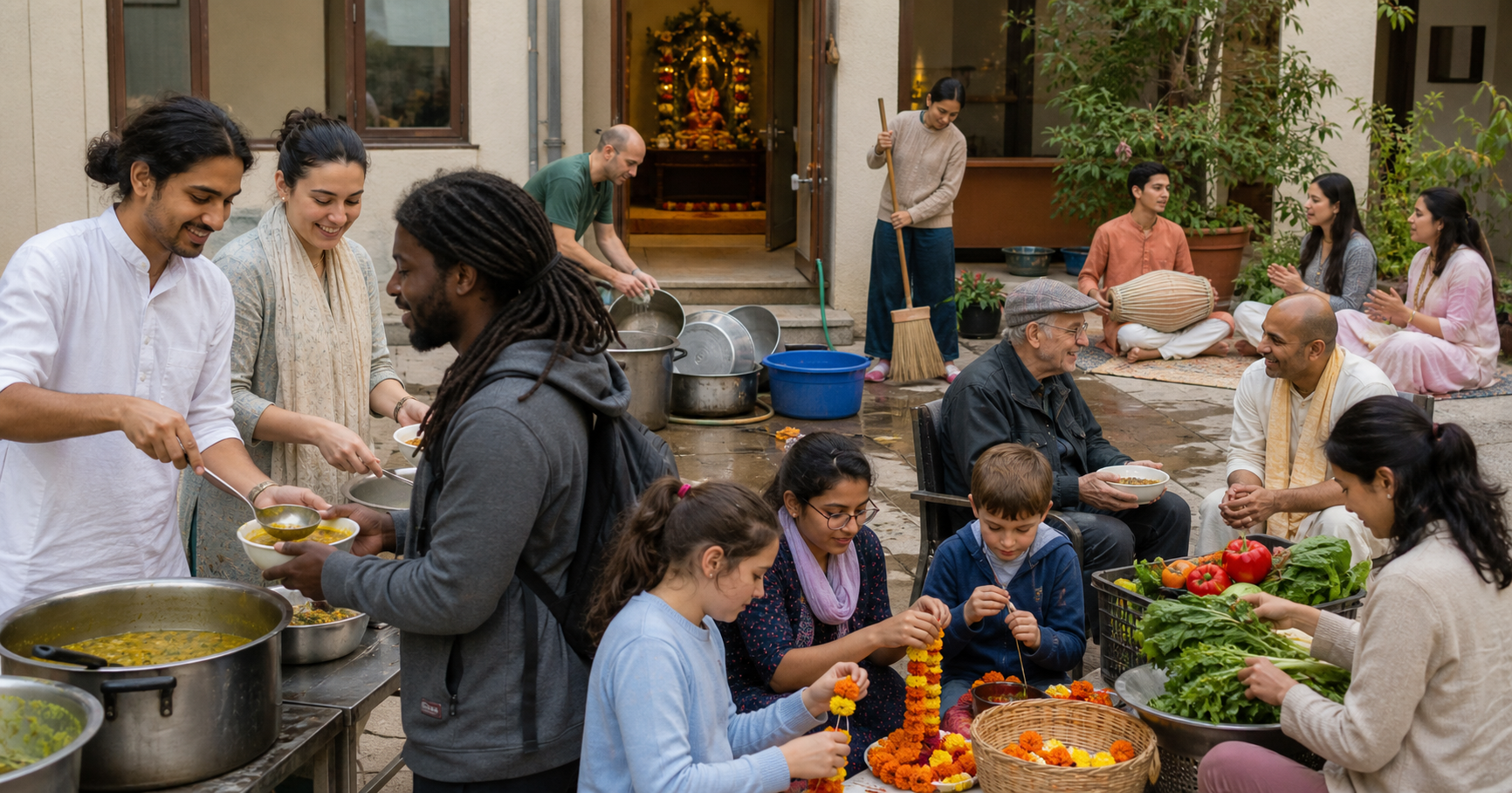
London shows how the pattern can take root in a modern city. Daily kirtan, prasadam distribution, regular Bhagavad-Gita study, festivals such as Janmashtami and Diwali, educational programs, and service initiatives give people several ways to enter. Some arrive through philosophy, some through sacred sound, some through food and hospitality, and others through cultural memory. A serious community helps each entrance lead toward deeper practice.
These activities are not interchangeable. Kirtan establishes a shared devotional center. Study protects devotion from vagueness. Prasadam joins worship to hospitality. Festivals transmit cultural memory and welcome the wider public. Seva distributes ownership by giving people something real to carry. When these parts reinforce one another, a temple becomes an ecosystem rather than an event venue.
When you visit a centre, look for the bridges between those parts. Does a festival tell a curious visitor where to find the next regular gathering? Does a class connect philosophy to choices at home and work? Are service opportunities available to people who are new? Is prasadam offered as sacred hospitality rather than treated as an attraction detached from practice? Can leaders explain the Vaishnava basis of the community without pressuring everyone to imitate an advanced identity?
Prabhupada’s global influence also sits within a wider dharmic family. Hindu, Buddhist, Jain, and Sikh traditions give distinctive expressions to non-violence, service, disciplined remembrance, patient endurance, non-attachment, compassion, and reverence for life. These affinities can support interfaith trust and common service. They do not turn several traditions into one theology, and there is no need to make that claim.
A Vaishnava community serves unity best by being clear about its own center: loving devotion to Krishna. Interfaith cooperation becomes more credible when every participant is allowed the same clarity. If you organize a dharmic gathering, choose a shared action such as feeding people, learning about non-violence, or supporting a local community need. Invite each tradition to describe its motivation in its own language. Name the value held in common, and leave genuine philosophical differences visible. Respect is stronger than a vague declaration that every path says the same thing.
A practical way to enter the legacy
- Choose a recurring devotional anchor. Set a dependable time and place for japa, Bhagavad-Gita reading, or attendance at kirtan.
- Add association before private interpretation hardens. Join a regular study gathering and ask how a teaching should alter conduct, not merely how it should be defined.
- Receive prasadam with attention. Let sacred hospitality remind you that devotion includes gratitude, relationship, and care for the people sharing the meal.
- Accept a concrete seva responsibility. Ask what needs to happen repeatedly, then choose a task you can perform reliably without waiting for recognition.
- Examine the fruit. Look for greater steadiness, compassion, honesty, and willingness to honor other dharmic paths without concealing your own commitment to Krishna bhakti.
At your next visit, do not try to absorb the entire history of a global movement in one afternoon. Open one text, chant with others, receive prasadam, learn one person’s name, and leave with a clear way to return or serve. Prabhupada’s legacy becomes yours at the point where inspiration acquires a place in your calendar and devotion becomes dependable action.
References
- Dandavats – Sixty Years On: Srila Prabhupada’s Inspiring Global Bhakti Legacy and London’s ISKCON Community
- Dandavats – ISKCON Press Origins: Boston’s Joyous Welcome for Srila Prabhupada and a Movement in Transition
- Dandavats – From Despair to Sacred Acceptance: A Dharmic Journey Through Grief, Faith, and Growth
- Dandavats – From Celebrity Tattoos to Sacred Texts: How a Closed Gita Sparked Bhakti and Unity
