
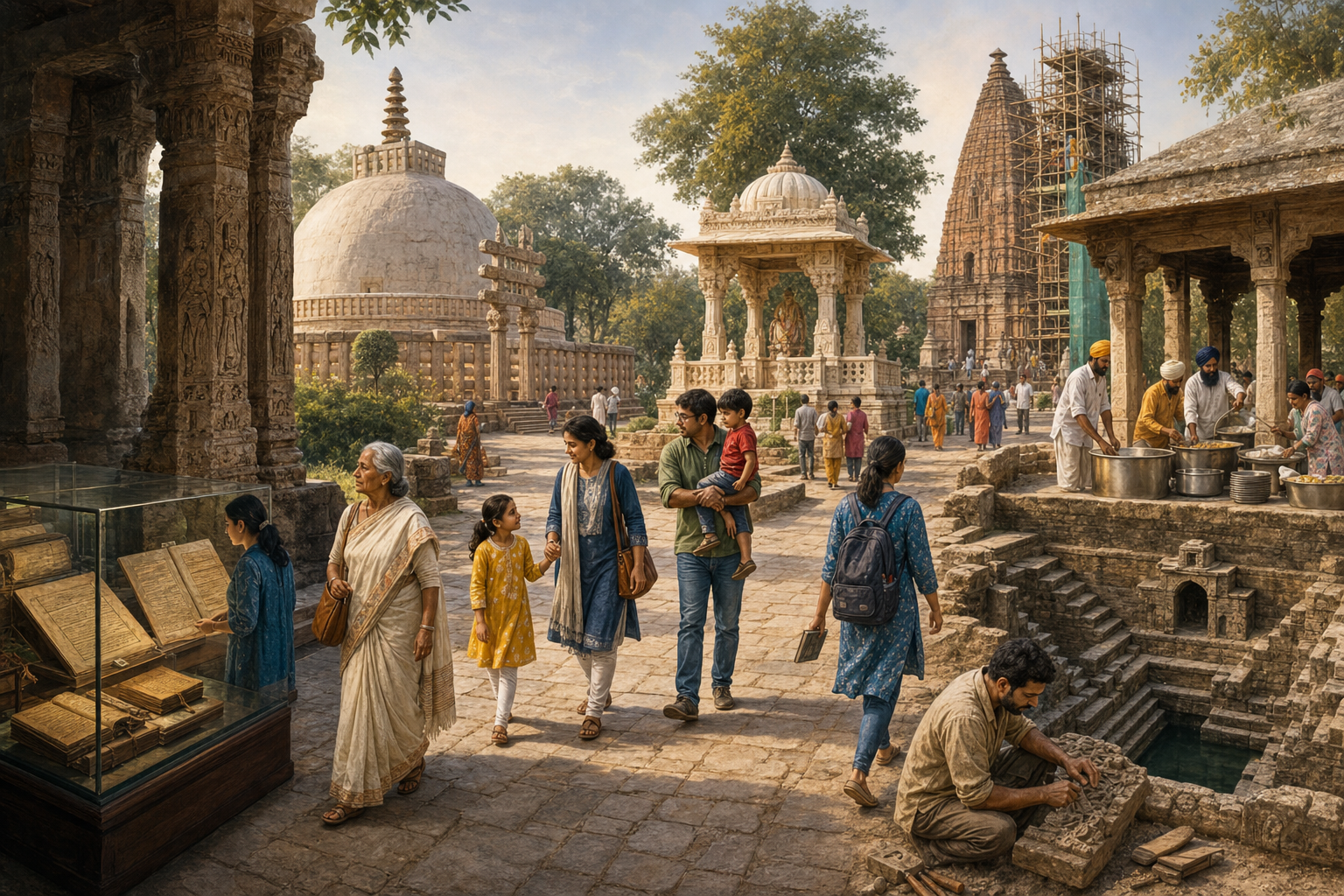
You may be preparing a lesson, exhibition, speech, documentary, diplomatic visit, diaspora event, or even a single social-media caption. The immediate question is practical: how do you present India without reducing it to invasion, exotic spirituality, colonial reform, or a list of ancient achievements?
The answer begins before you choose your facts. India’s civilizational image is shaped by who receives agency, which archives receive authority, which sacred places appear on camera, and whether the story ends in disappearance or living continuity. Once you can see those choices, you can correct them without replacing one distortion with another.
Key takeaways
- Ask who acts, who is merely described, and who is absent. A narrative can be factually detailed while still assigning agency almost entirely to conquerors, rulers, or colonial institutions.
- Separate an event from the narrator’s moral interpretation of it. A court historian’s praise of conquest is evidence about both the campaign and the political-religious ideals surrounding the court.
- Treat diplomatic visits, monuments, rituals, maps, and photographs as arguments. A site placed at the center of an itinerary becomes a symbol of what outsiders are being told India represents.
- Present Hindu, Buddhist, Jain, and Sikh traditions as related participants in India’s civilizational world without pretending that their doctrines and institutions are interchangeable.
- End with continuity. Destruction and subordination matter, but so do preservation, reconstruction, re-consecration, teaching, pilgrimage, service, and renewal.
A civilizational image is built by selection, not slogans
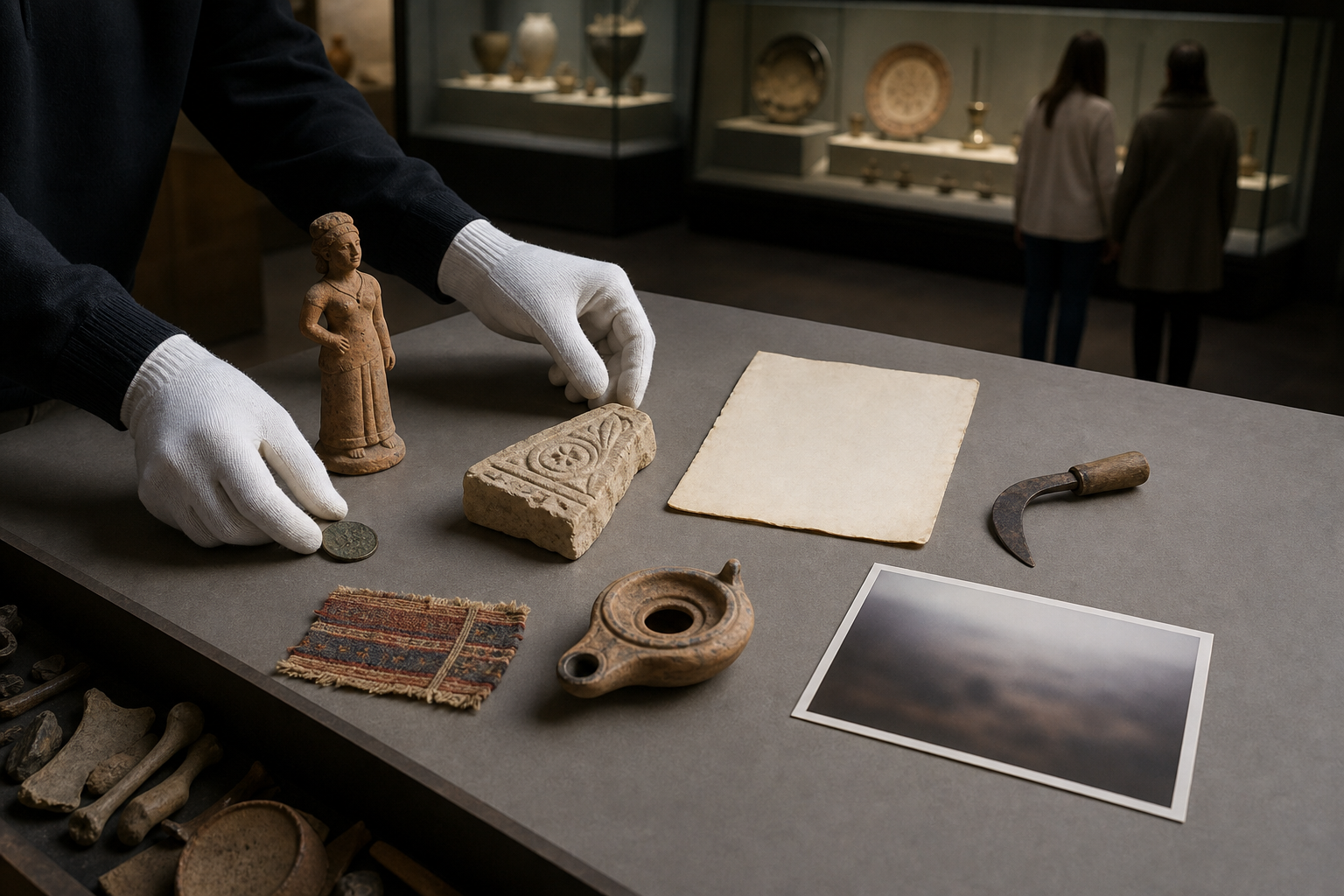
No account can include everything. Selection is unavoidable. The trouble begins when a narrow selection presents itself as the whole civilization.
Consider a familiar historical structure. A foreign dynasty enters the story, a succession of rulers and battles occupies the middle, and a colonial power supplies the final institutions of modernity. Indians appear throughout, but mainly as subjects who are conquered, taxed, classified, converted, rescued, or administered. The details may be real. The arrangement still teaches the reader that history is something other people did to India.
The same compression happens through symbols. A photograph of poverty can stand in for Indian society. A palace can stand in for an entire historical period. A missionary charity can stand in for compassion. A ruined temple can stand in for Hindu history. A yoga pose can stand in for Hindu philosophy. Each image may carry part of the truth, but repetition turns the part into a governing frame.
You can detect that frame with four questions:
- Where does the story begin? Starting with conquest, colonialism, or post-independence politics can make an older civilization seem like scenery rather than the subject.
- Who receives verbs? Notice who builds, teaches, debates, travels, preserves, reforms, resists, or serves. Then notice who is only encountered, ruled, or explained.
- Which institution represents virtue? If learning, charity, pluralism, or rationality appears only through an external institution, the implied hierarchy is stronger than any declaration of respect.
- What is the final image? A narrative that ends with defeat leaves a different civilizational impression from one that follows communities through survival and renewal.
This test is more useful than asking whether a presentation is positive or negative. Civilizational literacy does not require flattering India. It requires giving Indian traditions historical depth, human agency, internal variety, and the capacity to interpret their own experience.
Read conquest narratives as evidence and as acts of power
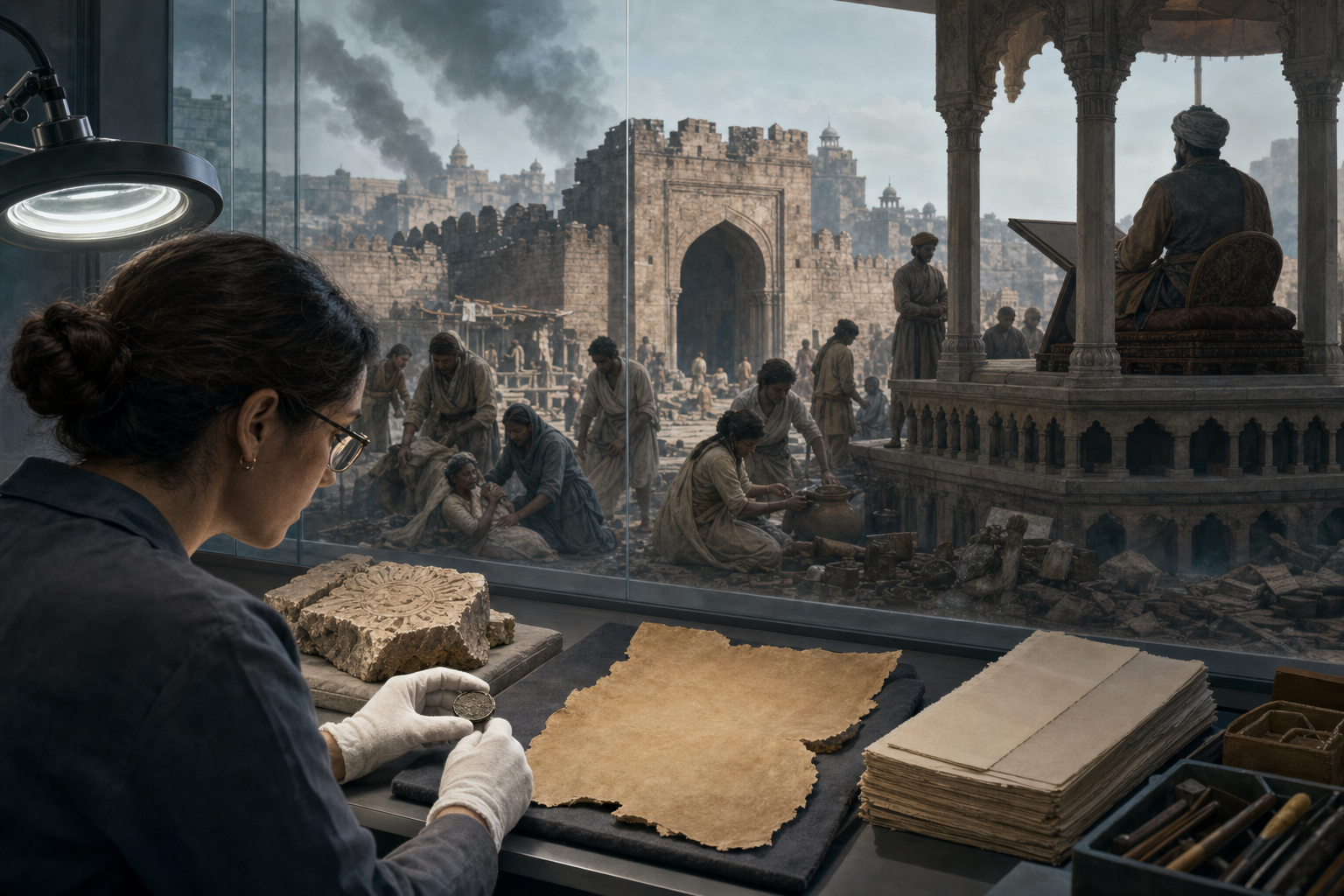
Medieval Arabic and Persian writing contains indispensable information about campaigns, treaties, succession, tribute, administration, and court life. It also arose within particular structures of patronage and belief. A record can preserve an event while casting its meaning in the language of providence, exemplary kingship, sacred victory, or rightful domination.
Genre tells you what kind of truth a writer was trying to produce. Tarikh arranged annals and histories through regnal or sacred time. Maghazi concentrated on campaigns, strategy, and spoils. Sirah presented exemplary lives; ansab established lineage; tabaqat organized people by class or generation; malfuzat preserved remembered discourses; and maktubat collected letters and correspondence. These forms did not make every claim false. They shaped what counted as memorable, exemplary, and worthy of preservation within the courtly and clerical world that produced them.
Use a five-part reading method whenever a historical claim depends heavily on such material:
- Identify the genre and intended audience. An administrative letter, victory narrative, saint’s discourse, and royal panegyric should not be read as though they made the same kind of claim.
- Divide description from judgment. Write down what reportedly happened in one column and the narrator’s explanation of its religious or moral significance in another.
- Identify the patronal ideal. Praise for severity, tribute collection, largesse, or expansion may reveal what a court wanted rulers and officials to emulate.
- List the people who cannot speak in the account. Rural communities, defeated elites, temple custodians, monastics, merchants, women, and tributary populations often appear as collective objects rather than individual witnesses.
- Look for a different archive type. Corroboration is stronger when it crosses institutional boundaries instead of moving from one court history to another derived from the same tradition.
That last step changes the field of vision. Sanskrit and Prakrit inscriptions, temple copperplates, Jain prabandhas, bhakti hagiographies, Sikh janam-sakhis, vernacular charitas and kavyas, and Kashmir’s Rajatarangini tradition preserve other forms of memory. They may illuminate land grants, sacred lineages, local institutions, reconstruction, pilgrimage, devotional authority, and community responses that a conquest-centered record had little reason to foreground. A counter-archive is not an automatic veto. It helps you ask a better question and prevents one institution’s priorities from defining the entire past.
Some medieval accounts celebrated iconoclasm, enslavement after battle, or the humiliation of defeated elites in stark terms. Neither denial nor collective accusation is an adequate response. Such passages are evidence of triumphalist conventions and theories of exemplary rule in particular texts and settings. They do not turn every reported phrase into an exact transcript, and they do not justify treating all Muslims, all Islamic intellectual life, or every period of Indo-Muslim interaction as a single undifferentiated phenomenon.
The disciplined position is harder but more defensible: retain evidence of violence and ideological legitimation; distinguish rhetoric from independently established action; acknowledge philosophical exchange, multilingual courts, administration, and Sufi ethical traditions where they belong; and restore the affected dharmic communities as historical agents. Accuracy does not require amnesia, and memory does not require essentialism.
Treat visits, monuments, rituals, and service as political language
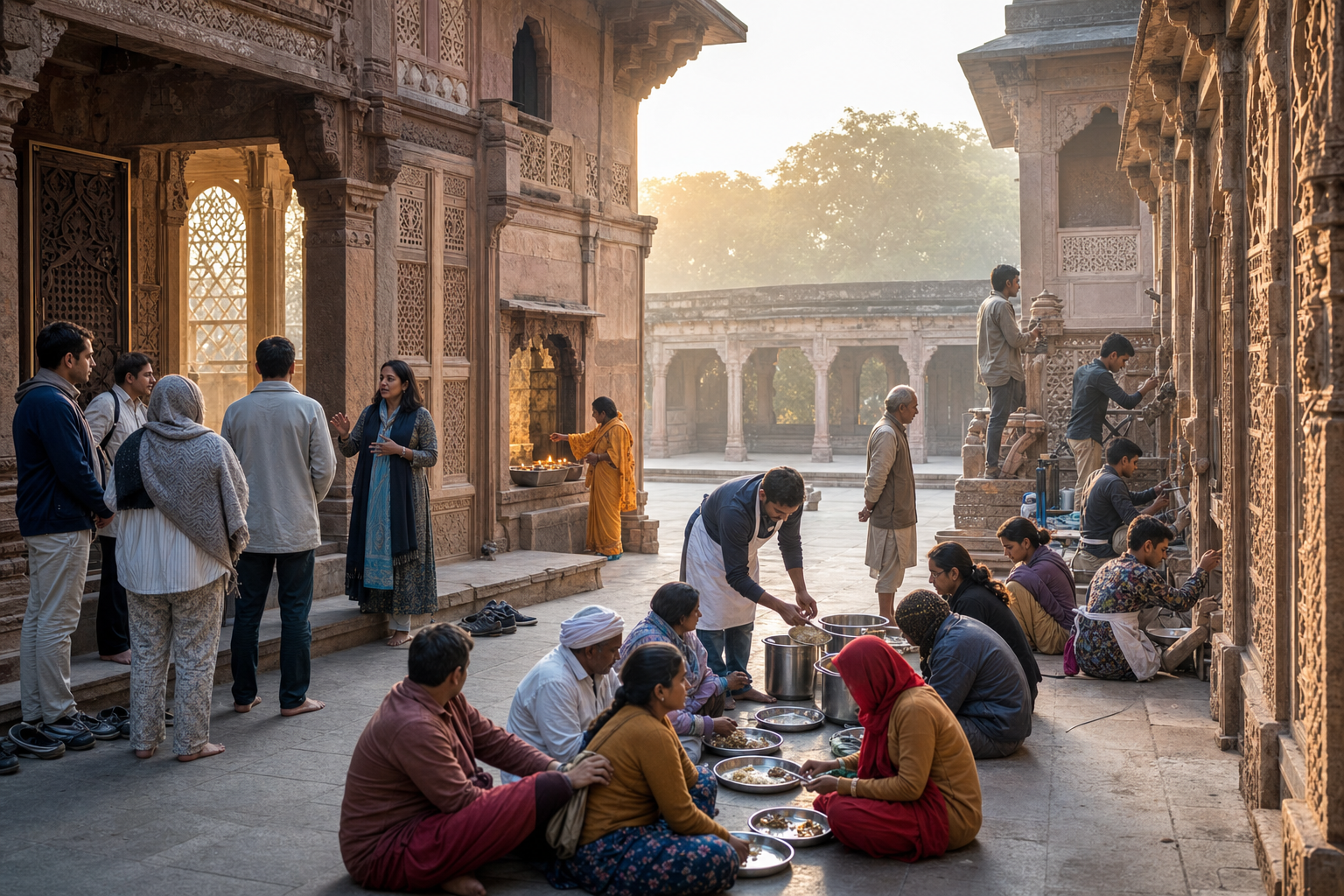
A diplomatic itinerary is a compact civilizational narrative. Most people will never read the briefing book, but they will see the first stop, the bowed head, the host institution, and the photograph repeated in the news. Those choices tell them which parts of India deserve recognition.
When a visiting dignitary gives prominent attention to a Christian missionary institution without comparable recognition of Hindu, Buddhist, Jain, or Sikh centers, many Indians perceive more than a scheduling decision. The image can reproduce a familiar hierarchy: an indigenous civilization supplies the setting while an externally established institution supplies the moral center. The constructive answer is not exclusion of Christian institutions or dismissal of humanitarian work. It is parity, context, and civilizational literacy.
A useful itinerary should communicate four different dimensions of India rather than asking one photogenic stop to represent everything:
| Dimension | Question to ask | Possible civilizational expression |
|---|---|---|
| Sacred continuity | Does the visit encounter a living place where memory, worship, and pilgrimage remain joined? | Kashi, Kedarnath, Madurai, Rameswaram, or Jagannath Puri |
| Dharmic plurality | Are distinct Hindu, Buddhist, Jain, and Sikh inheritances visible rather than collapsed into generic spirituality? | Bodh Gaya, Shravanabelagola, and Harmandir Sahib in Amritsar |
| Indigenous service | Does the program recognize that seva is practiced through Indian religious institutions? | Sikh langars, Hindu temple trusts and mathas, Jain charitable hospitals, and Buddhist monastic initiatives |
| Intellectual continuity | Does India appear as a producer of knowledge rather than only a repository of picturesque belief? | Learning traditions and the civilizational background of Indian contributions to mathematics and science |
Not every visit can include every tradition or region. The standard is not mechanical quota-setting. It is whether the complete program makes indigenous traditions central to India’s self-understanding. Balance can be achieved across several days, across successive visits, or through a combination of sacred, educational, and service institutions.
Protocol teams, cultural organizations, and community hosts can act before an itinerary hardens. Prepare a one-page brief explaining the civilizational meaning of each proposed site. For every high-visibility stop, record the tradition represented, the virtue being signaled, the likely historical associations for Indian audiences, and the image expected to circulate. If all the virtues cluster around outside institutions while dharmic places appear only as tourist heritage, revise the program.
India should apply the same discipline to its own official signaling. Sacred geography, philosophical learning, scientific inheritance, and indigenous service should not appear only when a foreign visitor happens to request them. The decimal place-value system, the formal treatment of zero, work in trigonometry, and contributions to number theory are part of the intellectual inheritance through which India meets the modern world. They should be presented as knowledge with continuing significance, not as decorative claims attached to ceremonial occasions.
Present dharmic plurality without flattening its traditions
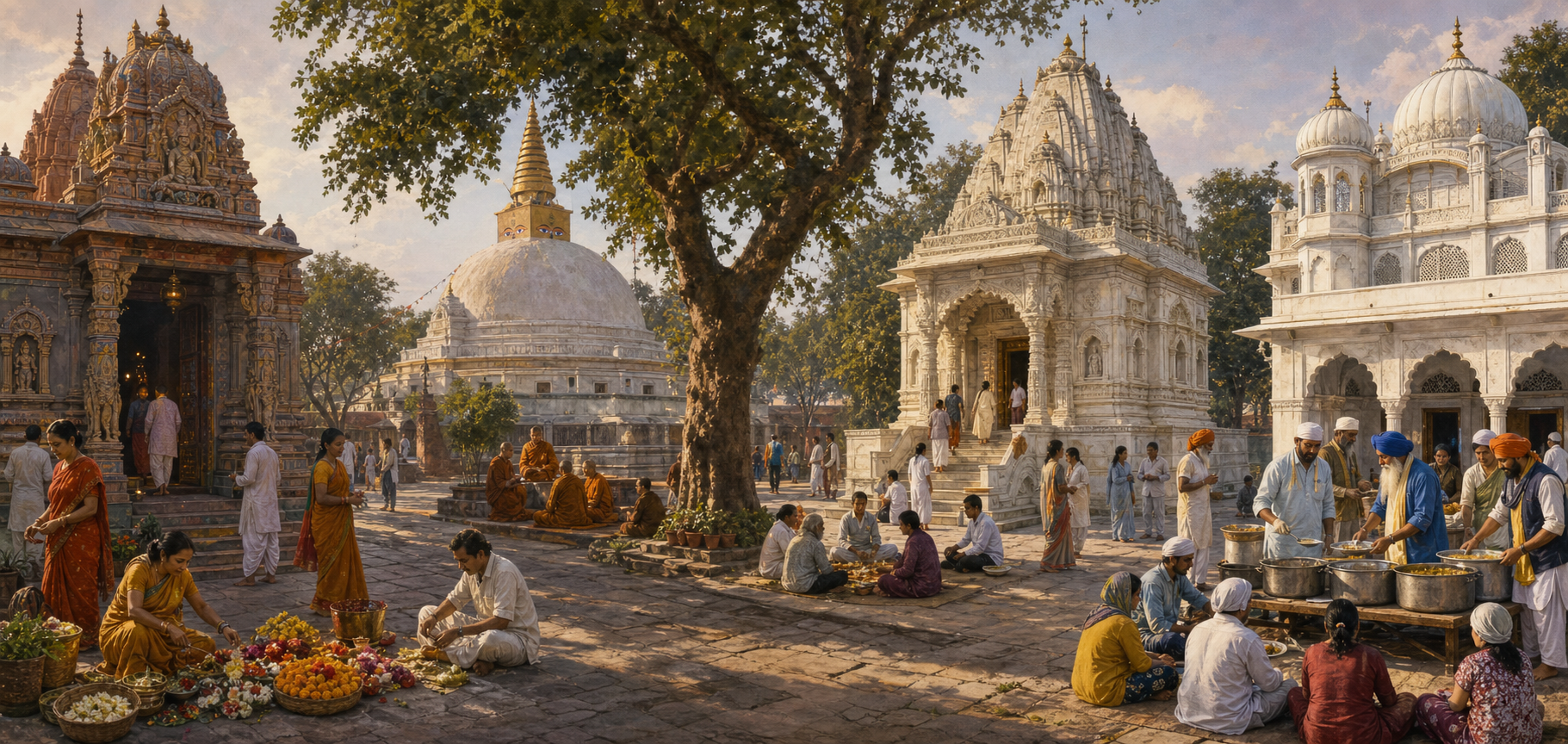
A pro-dharmic account can fail in two opposite ways. It can fragment Hindu, Buddhist, Jain, and Sikh histories until their shared civilizational setting disappears. Or it can merge them so completely that their distinct doctrines, texts, sacred centers, and institutions become interchangeable. Neither approach gives the reader a trustworthy picture.
Use dharmic unity as a relationship, not a claim of theological sameness. Hindu temples and tirthas, Buddhist viharas and places of awakening, Jain centers of renunciation and learning, and Sikh gurdwaras and langar traditions speak in their own voices. Their histories intersect through geography, languages, philosophical debate, artistic forms, pilgrimage routes, patronage, service, and experiences of political change. The relationship becomes clearer when those intersections are named precisely.
Four distortions deserve particular attention:
- Museum India: Ancient achievements receive admiration, but living practitioners disappear. Correct it by showing who teaches, worships, serves, preserves manuscripts, maintains pilgrimage, and rebuilds institutions now.
- Wounded India: Invasion, iconoclasm, and colonial disruption become the entire identity. Retain the injury, then follow the human response: flight and return, reconstruction, re-consecration, recopying, institution-building, and devotional renewal.
- Sanitized India: Every conflict becomes vague cultural exchange. Correct it by distinguishing voluntary exchange from conquest, patronage from compulsion, and coexistence from an absence of unequal power.
- Monolithic India: One tradition is made to speak for all the others without consent or specificity. Correct it by naming the relevant community, institution, practice, and historical setting.
A sound civilizational narrative usually needs five movements: inheritance, encounter, rupture, response, and renewal. Not every subject contains all five in equal measure. The sequence nevertheless prevents a battle from swallowing a millennium and prevents a list of achievements from floating free of the communities that carried the inheritance.
This approach also improves visual choices. If your subject is a temple, do not use only a ruined facade when living worship is relevant. If your subject is Sikh seva, show the institution and disciplined community that sustain the langar rather than reducing it to a plate of food. If your subject is Bodh Gaya, treat it as a living Buddhist center with global resonance, not merely an archaeological backdrop. If your subject is Jain renunciation, do not let a monumental image erase learning, discipline, and community memory.
Pluralism becomes credible when the audience can see its institutions. A slogan about tolerance cannot do the work of representing actual traditions, especially when the people speaking about India are more comfortable with a universalized spirituality than with the concrete Hindu, Buddhist, Jain, and Sikh communities that sustain it.
Use this image audit before you publish, teach, or host
Run the following audit on a draft article, exhibition panel, video script, syllabus, event program, or diplomatic itinerary. It takes you from a vague desire to represent India well to a set of visible editorial decisions.
- Write the implied image in one sentence. Complete this line: After seeing this, a newcomer will think India is primarily a civilization of _____. If the blank produces only victimhood, exoticism, poverty, empire, or antiquity, the frame is too narrow.
- Circle the first named actor. The opening actor often becomes the owner of the story. If an account of India begins with an invader, administrator, missionary, or foreign observer, decide whether an Indian community, institution, place, or question should establish the frame first.
- Underline every active verb. Assign each verb to its actor. If rulers conquer and govern while dharmic communities merely suffer or survive, look for supported evidence of teaching, negotiation, preservation, resistance, rebuilding, service, or creative adaptation.
- Label every evidence type. Mark court history, inscription, administrative record, devotional work, oral memory, hagiography, material remains, or later interpretation. Several quotations do not create independent confirmation when they descend from the same institutional viewpoint.
- Separate event, interpretation, and memory. State what happened, how contemporaries framed it, and how later communities remembered it. This keeps propaganda from becoming raw fact without pretending that propaganda has no historical importance.
- Audit symbolic parity. List every site, ritual, portrait, and service institution shown. Beside each, write the quality it represents: holiness, compassion, knowledge, power, tolerance, reform, or modernity. Ask whether indigenous traditions are allowed to embody those qualities.
- Add the continuity test. Identify what existed before the rupture, what changed, what was lost, what endured, and what was renewed. Do not promise a story of resilience unless you can identify the people or institutions that carried it.
- Pressure-test the language. Replace collective labels with precise actors where the evidence permits. Do not turn a ruler, chronicler, sect, court, or army into a timeless description of an entire religious population.
- Check the final frame. Your last paragraph or final image should give the reader somewhere truthful to stand. End with a living institution, an unresolved responsibility, a continuing practice, or a concrete decision—not merely a slogan about past glory.
The audit can expose a problem without dictating a predetermined conclusion. A documentary may still center on conquest. A museum panel may still describe destruction. A delegation may still visit a Christian charity. The question is whether the surrounding choices silently convert one episode or institution into the definitive image of India.
Take the next item you are responsible for and inspect three things before anything else: its first actor, its most prominent sacred or moral symbol, and its final image. Those choices reveal the civilizational argument already being made. Revise them until India appears not merely as terrain on which history occurred, but as a living subject that remembers, judges, preserves, creates, and speaks.
References
- The Dharma Dispatch — Unmasking Medieval Indo-Persian Chronicles: How Propaganda and Piety Shaped India’s Memory
- Hindu Human Rights — Rethinking Diplomatic Symbolism: Why Rubio’s Kolkata Stop Should Honor India’s Civilizational Depth