
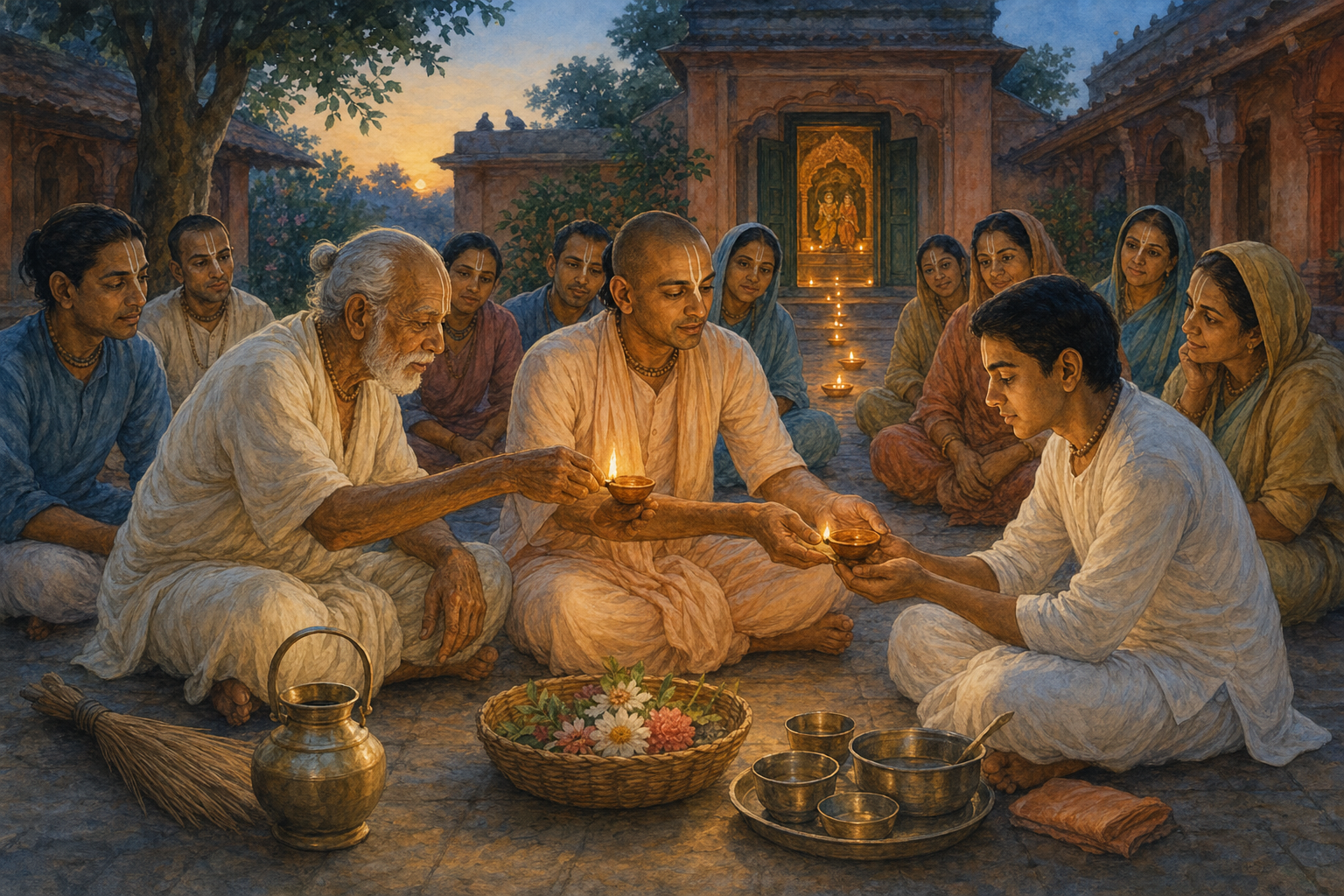
You may feel two duties pulling in opposite directions: honor the guru-parampara without treating every title as proof of realization, and remain open to qualified leadership without turning lineage into a modern social credential. The tension becomes especially sharp when you are considering diksa, evaluating a temple leader, or trying to understand the place of Vaisnavis in spiritual authority.
Gaudiya Vaishnavism gives you a more demanding path than either automatic acceptance or reflexive rejection. It asks you to examine what is being transmitted, how the teacher lives, whom the teacher serves, and what structures can correct the teacher when necessary. That is how sacred inheritance remains living rather than merely ceremonial.
Lineage is a relationship of transmission, not a pedigree
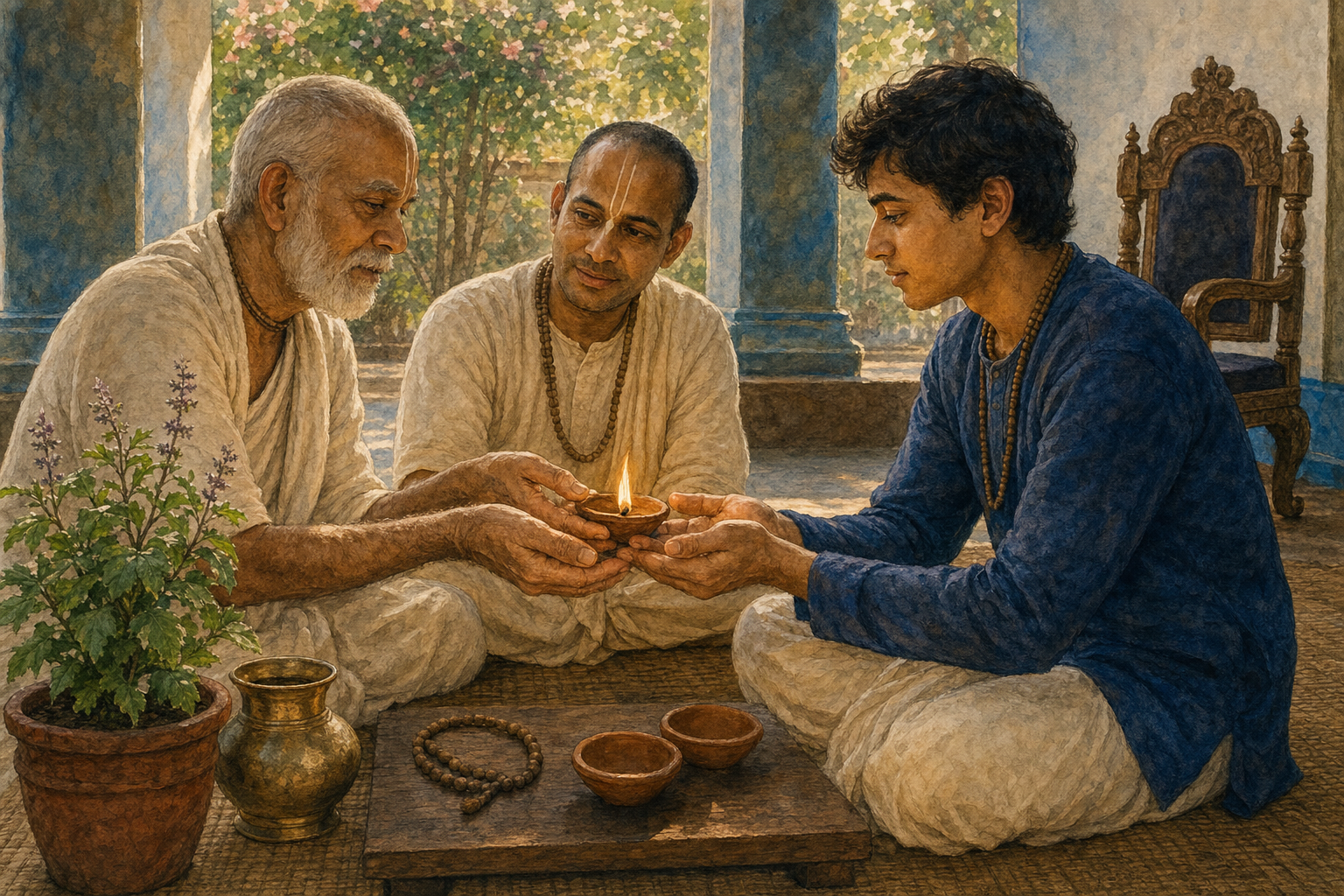
Parampara is often pictured as a chain of revered names. That image is useful, but incomplete. A name in a succession matters because it carries realized understanding, disciplined practice, service, and a recognizable devotional mood. Without those elements, succession can become a list without transmission.
The relationship among Sri Madhavendra Puri, Sri Isvara Puri, and Sri Chaitanya Mahaprabhu makes the distinction concrete. Gaudiya memory presents devotion as a desire tree: its first sprout appears in Madhavendra Puri, it becomes a sapling in Isvara Puri, and it flowers through Sri Chaitanya. Isvara Puri did not merely occupy the place between two famous figures. He received a devotional inheritance through affectionate service, embodied it, and transmitted mantra to Sri Chaitanya at Gaya.
You should therefore distinguish four related forms of authority:
- Diksa is formal initiation. It transmits mantra within authorized discipline and establishes serious responsibilities for both guru and disciple.
- Siksa is instructive guidance. A siksa-guru may shape your understanding and practice profoundly, whether or not that person gives you formal initiation.
- Sadhu-sanga is the wider company of devotees. It keeps spiritual life from becoming an isolated relationship between one powerful teacher and one dependent follower.
- Institutional authorization identifies who may perform defined services within a particular society and provides procedures for education, oversight, and correction.
These roles can overlap, but they are not interchangeable. A respected speaker is not automatically a diksa-guru. A senior Vaisnavi who has guided devotees for years may already be functioning as an important siksa-guru without having institutional authorization to initiate. An administrative appointment establishes an office, not realization. Conversely, sincere spiritual influence does not by itself grant permission to perform every institutional function.
Before you decide whether to accept someone as guru, establish which relationship is actually being proposed. Do not let admiration, familiarity, or community enthusiasm blur the difference between receiving helpful instruction and making a formal commitment.
Use three tests before you trust a spiritual leader
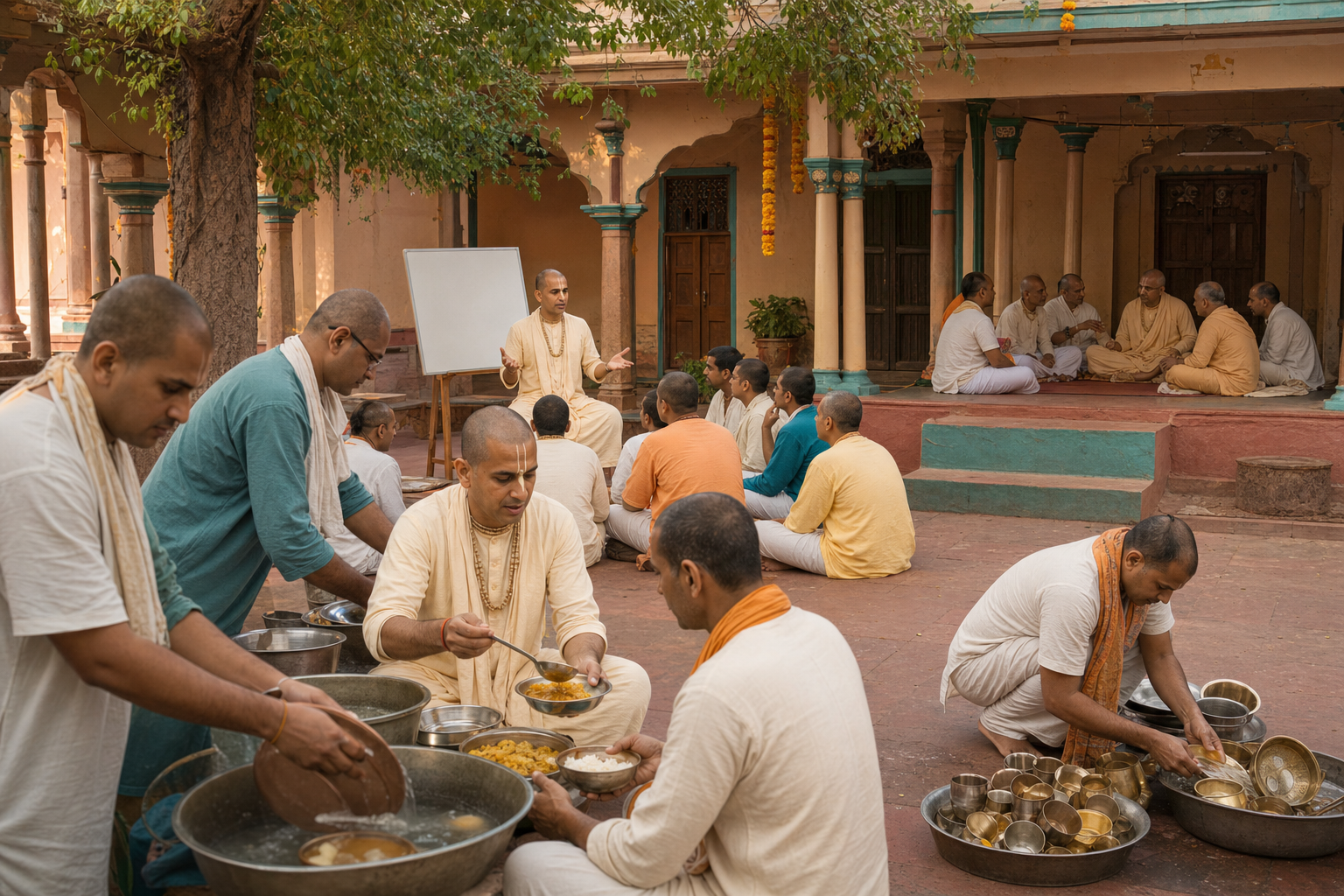
Gaudiya guru-tattva centers authority in sadhu, shastra, and guru rather than personality alone. A practical evaluation can be organized around three connected standards: orthodoxy, orthopraxy, and orthopathy. In plain language, these mean sound teaching, sound practice, and sound spiritual disposition.
| Test | What you can examine | What should make you pause |
|---|---|---|
| Siddhanta: sound teaching | The leader explains Gaudiya conclusions coherently, respects guru, sadhu, and shastra, and does not make personal preference the final authority. | Novel claims are insulated from scriptural examination, or honest doctrinal questions are treated as disloyalty. |
| Sadhana and conduct: sound practice | Public teaching is supported by steady mantra practice, study, seva, discipline, and responsible behavior in ordinary community life. | Charisma, visibility, or institutional rank is offered as a substitute for observable integrity. |
| Bhava and character: sound disposition | Humility, compassion, gratitude, steadiness, and willingness to receive correction appear consistently. | Fault-finding, manipulation, retaliation, contempt, or claims of being beyond accountability become a pattern. |
Do not try to diagnose another person’s inner realization. You cannot inspect the heart directly, and theatrical displays of spirituality are not a reliable shortcut. Examine what is available to responsible observation: teaching, decisions, treatment of less powerful people, response to correction, financial and organizational boundaries, and consistency between private obligations and public claims.
One impressive discourse cannot settle the question. Notice the leader during routine service, disagreement, inconvenience, and situations in which someone else receives the credit. Knowledge is tested when a difficult question is asked. Humility is tested when correction arrives. Compassion is tested when the person seeking help has little status to offer in return.
The expectation of exemplary conduct should not become a demand for staged perfection. A teacher can acknowledge an ordinary mistake and correct it. The serious warning is a repeated contradiction between teaching and behavior, especially when spiritual status is used to conceal the contradiction. If you encounter coercion, secrecy around consequential decisions, or punishment for reasonable questions, postpone any irreversible commitment and seek counsel outside the leader’s immediate circle.
Sacred memory shows what authority does under pressure
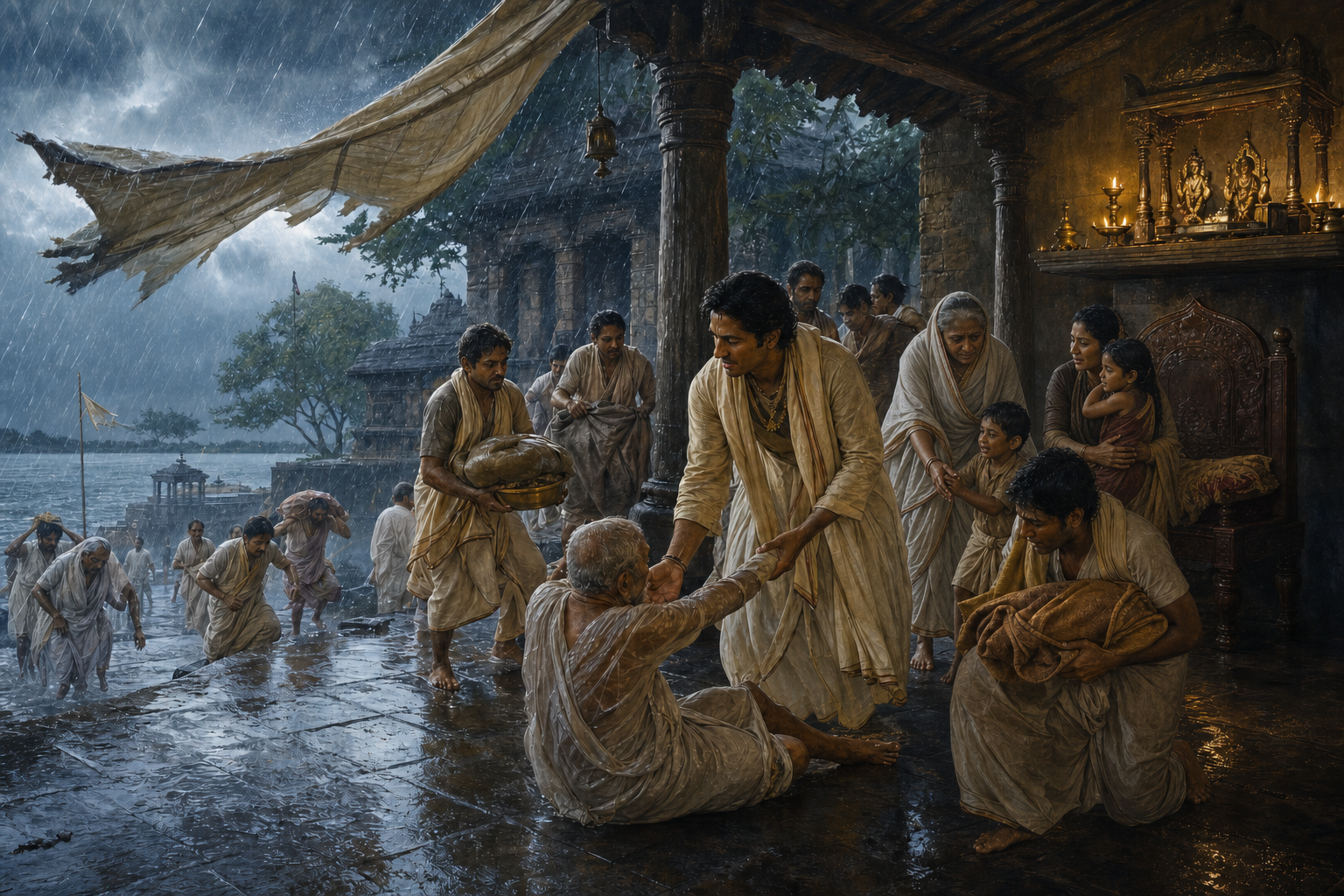
Sri Isvara Puri’s standing in the lineage is inseparable from seva. When Sri Madhavendra Puri was ill, Isvara Puri served him with personal care and affection. The contrasting memory of Ramachandra Puri emphasizes criticism rather than service. The practical lesson is not that discernment should disappear. It is that spiritual intelligence must be joined to gratitude, tenderness, and a willingness to perform difficult service without turning another person’s vulnerability into an occasion for superiority.
That service did not end as private virtue. At Gaya, Sri Chaitanya accepted mantra-diksa from Isvara Puri. The received mantra later flowered in a public sankirtana movement. Authentic lineage therefore moves in both directions: inward toward disciplined remembrance and outward toward service that helps others remember Krishna.
The Gambhira in Jagannath Puri reveals another dimension of leadership. Sri Chaitanya’s final twelve years are remembered as a period of intense interior devotion, with nocturnal kirtana, sacred poetry, scriptural reflection, and the cultivation of viraha-bhava. His public presence at Jagannath Puri and Ratha Yatra was not detached from this hidden discipline.
Nor does the sacred memory present leadership as spiritual isolation. Svarupa Damodara helped select poetry and music suited to Mahaprabhu’s devotional moods, while Ramananda Raya participated in profound theological and aesthetic dialogue. Even extraordinary authority appears within trusted companionship, shared practice, and ongoing sacred conversation.
This gives you a revealing question to ask about any leader: whose counsel do they receive? A healthy teacher can name respected peers, elders, or governing structures capable of offering correction. If everyone around a leader is a subordinate and no one can challenge a consequential decision, the visible hierarchy may be strong while the protective relationships of sadhu-sanga are weak.
Vaisnavi diksa-gurus require the same standard and a clear process
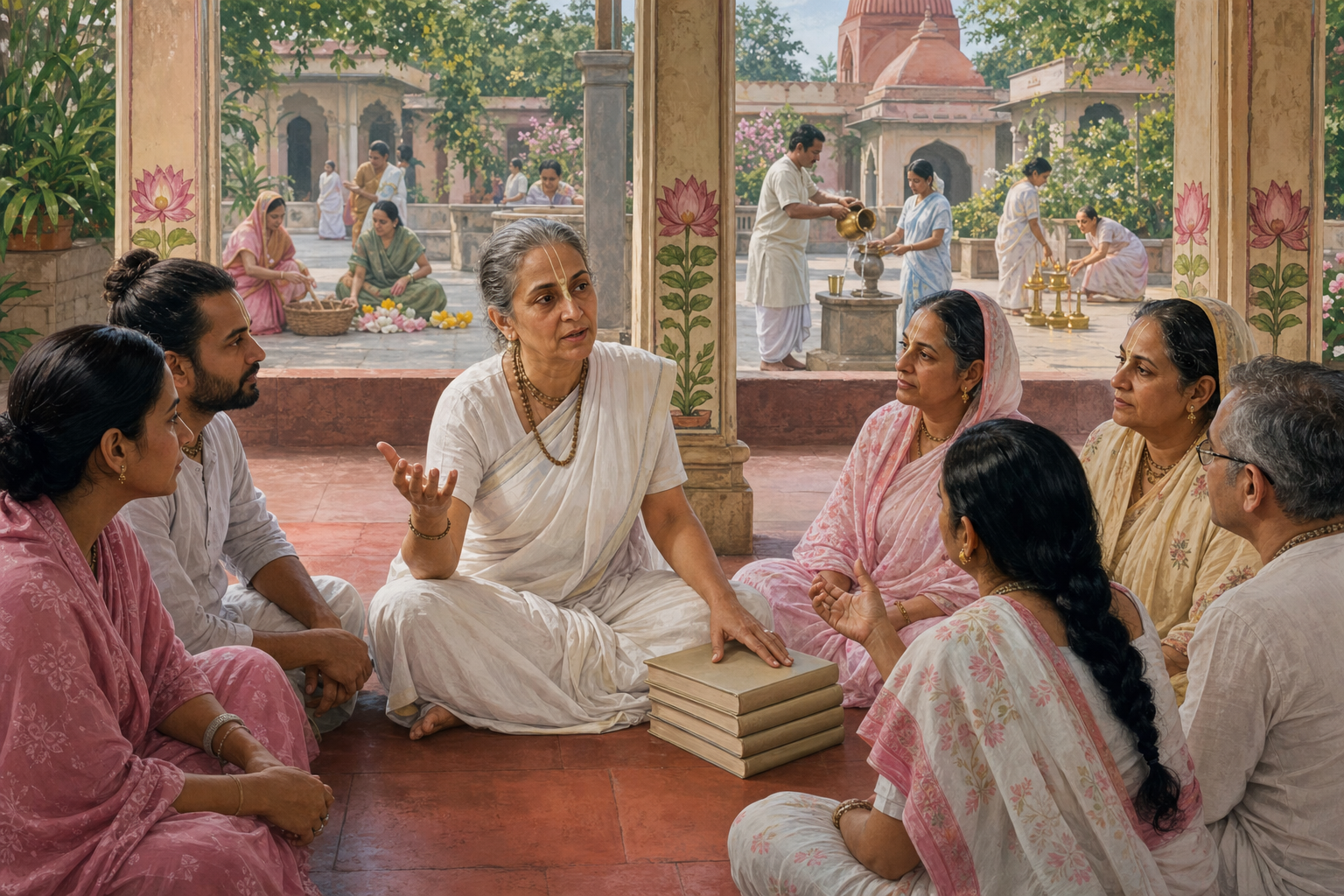
At its 2026 annual general meeting, the ISKCON Governing Body Commission approved a proposal concerning Vaisnavi Diksa Gurus. The essential term is qualified. A Vaisnavi diksa-guru is not simply a prominent woman or an admired community member. She must meet the theological, behavioral, pastoral, and institutional requirements attached to initiation.
The measure belongs to ISKCON’s own governance. You should not assume that one institution’s decision automatically binds every Gaudiya Vaishnava body, nor should you treat the announcement as blanket authorization for any individual. When a particular initiation is contemplated, verify the candidate’s present authorization through the responsible institution.
Female spiritual leadership is not intelligible only as a response to contemporary social pressure. Gaudiya sacred memory honors Jahnava Devi as an acarya and community guide, while senior Vaisnavis in contemporary congregations already teach scripture, counsel families, guide newcomers, and sustain devotional communities. Formal initiation, however, adds obligations that require a defined process rather than reputation alone.
Two opposite errors should be avoided. The first excludes a Vaisnavi without examining her knowledge, conduct, realization, or service. The second celebrates representation while relaxing the tests that protect disciples and the sanctity of diksa. Gender should neither disqualify spiritual competence nor substitute for it.
A credible implementation should let a devotee obtain clear answers to the following questions:
- Which body authorizes the candidate, and how can that authorization be verified?
- What scriptural education, years of steady sadhana, guru-seva, teaching, and pastoral experience are required?
- Who assesses the candidate, and how are conflicts of interest handled?
- What mentorship and peer review continue after authorization?
- Where can a disciple raise a serious concern without reporting only to the guru or the guru’s close associates?
- How are the same core standards applied to male and female candidates?
The principle and the procedure have different jobs. Guru-tattva explains why realized knowledge and character, rather than gender alone, determine spiritual fitness. Governance determines how a particular institution examines, authorizes, supervises, and, when necessary, corrects those who serve as gurus. Neglecting the first produces bureaucracy without spiritual depth. Neglecting the second leaves disciples dependent on personal assurances.
A disciplined way to decide whom to follow
Choosing a diksa-guru is not a contest to identify the most impressive personality. It is a decision about whose discipline, teaching, and service you are prepared to receive within the wider life of the parampara. Use the following sequence before making that commitment.
- Define the relationship. Ask whether the person is offering general instruction, an ongoing siksa relationship, pastoral care, or formal diksa. Do not infer initiation from emotional closeness.
- Verify lineage and authorization. Identify the teacher’s guru relationship and the institution responsible for recognizing the proposed service. Obtain confirmation from that body when formal status matters.
- Listen for siddhanta. Notice whether the teacher can explain Gaudiya conclusions clearly and place personal counsel within guru, sadhu, and shastra. A trustworthy teacher helps you understand the tradition rather than making access to truth depend on personal mystique.
- Observe practice and temperament. Look beyond the stage. Notice steadiness in japa, kirtana, study, seva, ordinary dealings, and responses to inconvenience or correction.
- Map the accountability. Ask who reviews the leader, what happens when a conflict arises, and where a disciple can seek independent help. If the practical answer is that no one can question the guru, do not dismiss that absence as a minor administrative detail.
- Examine the fruit of the relationship. Sound guidance should deepen your remembrance of Krishna, responsible sadhana, service, humility, and connection with healthy sadhu-sanga. Guidance that steadily produces fear, isolation, factional contempt, or dependence on one personality deserves careful re-evaluation.
Key takeaways
- Parampara transmits siddhanta, sadhana, seva, and devotional disposition; it is more than a succession of names.
- Diksa, siksa, community guidance, and institutional office are related but distinct forms of responsibility.
- Judge leadership through sound teaching, disciplined conduct, compassionate character, and openness to correction.
- A Vaisnavi should be neither excluded because she is a woman nor authorized merely because representation is desirable.
- Formal recognition protects disciples only when qualifications, supervision, conflicts, and grievances are handled transparently.
Before your next serious conversation with a prospective guru or community leader, write down four headings: teaching, practice, character, and accountability. Record what you have actually observed under each one, then list what still depends on reputation or assumption. Ask the unresolved questions respectfully. If the answers remain vague, you can continue receiving beneficial siksa while postponing diksa.
That pause is not a rejection of guru. It is one way of honoring the weight of the relationship. Sacred heritage remains strong when reverence is joined to discernment, service is joined to siddhanta, and spiritual authority remains answerable to the parampara it represents.
References
- Dandavats – ISKCON GBC approves Vaisnavi Diksa Guru framework: historic, unifying step for inclusive bhakti
- Dandavats – Gambhira’s Sacred Depths: Sri Chaitanya Mahaprabhu in Puri – History, Bhakti, and Unity
- Dandavats – Sri Isvara Puri’s Disappearance: Guru-Seva, Gaudiya Lineage, and a Living Bhakti Legacy
