
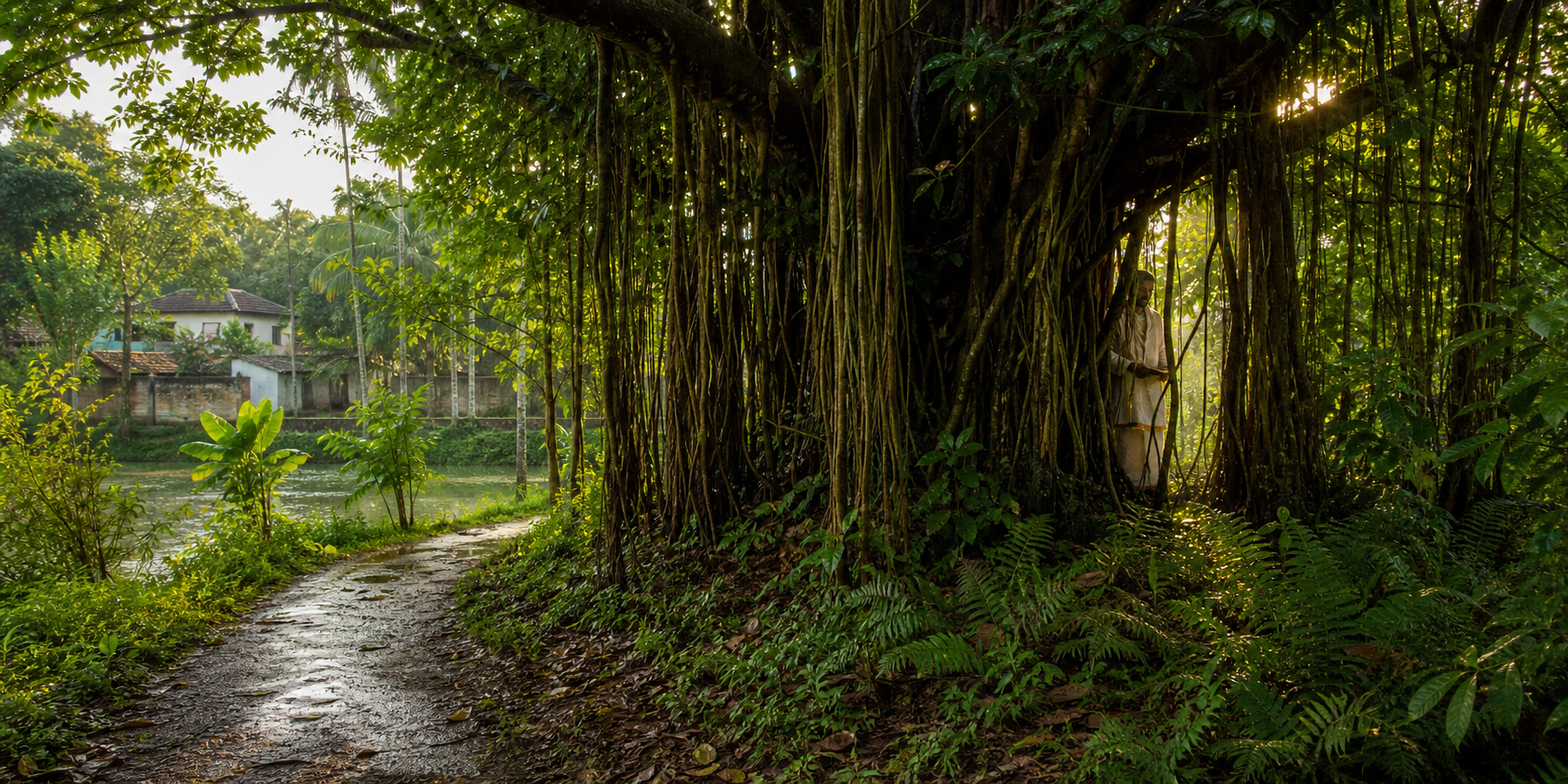
An old banyan at the edge of a Bengali village may look, to an outsider, like a tree with a ghost story attached. If you are trying to decide whether that story is superstition, heritage, or ecological knowledge, the framing is already too narrow. The more useful question is this: what relationship with the place did the story teach people to maintain?
The Brahmadaitya offers a precise way to answer. This learned, generally benevolent guardian joins a tree, a moral code, and a chain of storytellers. Once you learn to notice those parts, you can document sacred-grove folklore without demanding literal belief, dismissing inherited knowledge, or draining the sacred place of its meaning.
A grove story can function as a social boundary
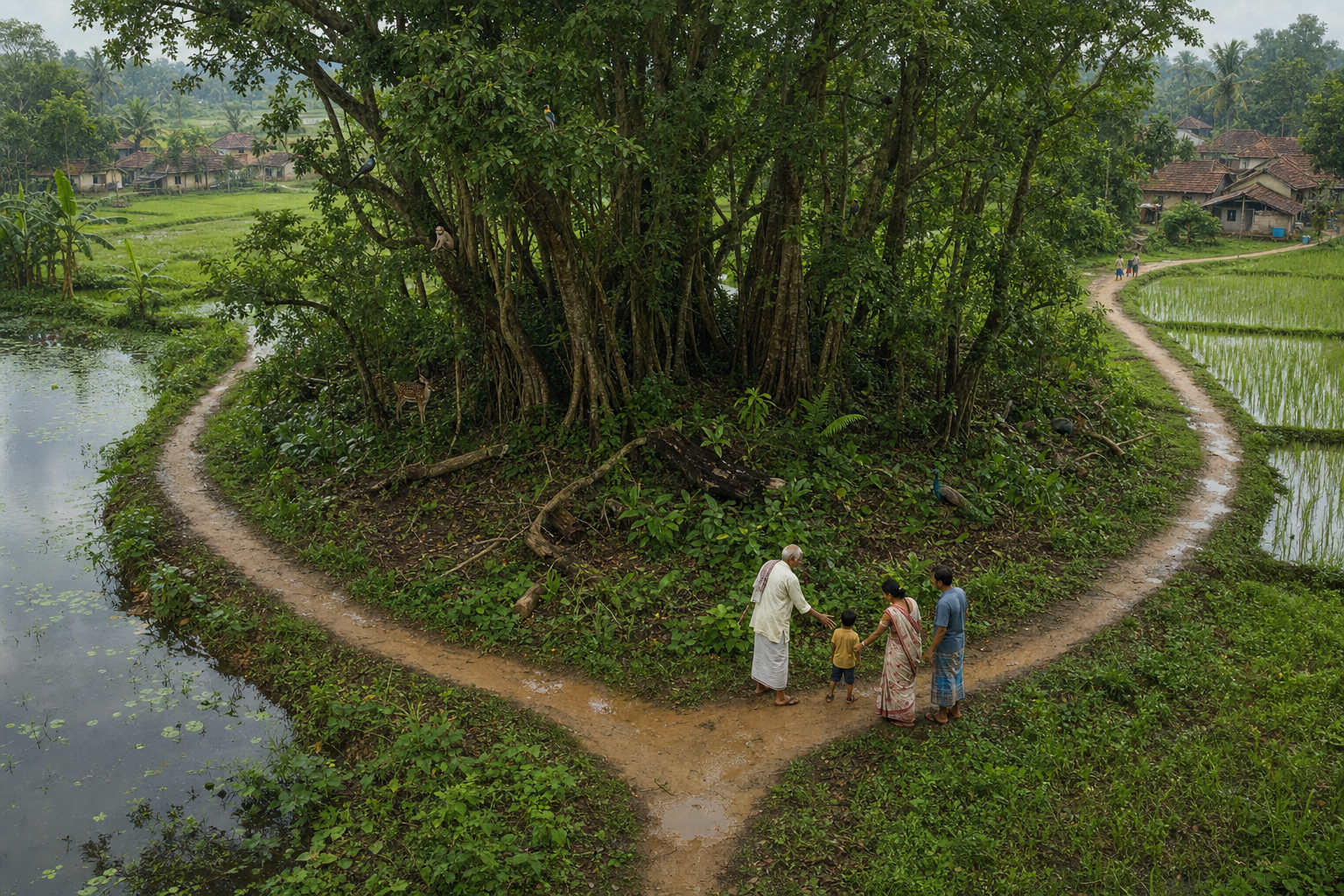
Ecological memory is not simply a community remembering that a tree exists. It is the remembered relationship between a place and the conduct expected there: approach with restraint, recognise an inherited obligation, and pass the rule to someone younger. A story becomes ecological memory when it keeps that relationship intelligible across generations.
This is why the location of a folktale matters as much as its plot. Bengali traditions place the Brahmadaitya near banyan or peepal trees and around village pathways, thresholds, and places associated with learning. These are not interchangeable backdrops. The guardian belongs to a recognisable place through which people move, gather, learn, and remember.
A physical fence merely marks a limit. A guardian story teaches you how to behave at the limit. It can turn careless damage into a breach of respect, while making protection part of ordinary moral life. The effect does not require every listener to make the same metaphysical claim about spirits. The believer, the uncertain listener, and the cultural inheritor can all understand that the place should not be treated casually.
That distinction helps when you encounter sacred-grove lore in a family or village setting. Do not begin by asking whether the supernatural event happened. Begin by asking what the story made memorable: a particular tree, a route, a boundary, a teacher, an elder, or an expected form of conduct. The answer shows you what the narrative has been carrying.
The Brahmadaitya makes knowledge, not terror, the guardian
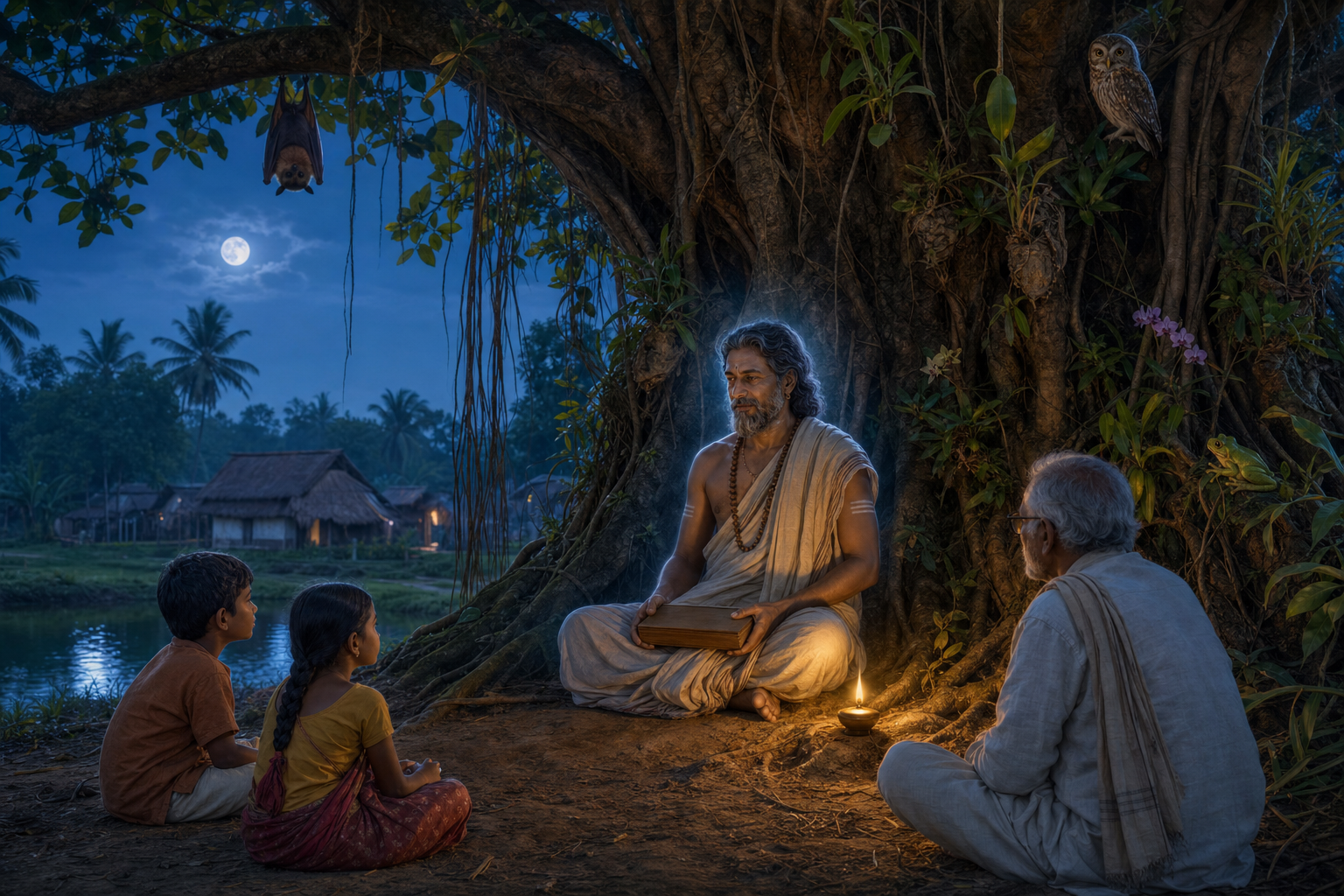
In a familiar Bengali telling, the Brahmadaitya is the spirit of a Brahmin who died prematurely. He is often recognised by the yajnopavita, or sacred thread, and a topknot. Yet these signs do more than identify the figure. The Brahmadaitya is portrayed as learned, refined, restrained, and protective rather than as an apparition driven chiefly by malice.
That characterization changes the lesson of the encounter. If the guardian embodies learning and self-command, the proper response is not blind panic. It is decorum. You respect the place because knowledge, ethical behaviour, and memory have been placed there symbolically. The ancient tree becomes more than material vegetation: it stands within a moral relationship involving teachers, elders, children, and those who came before.
The contrast with a malevolent ghost is therefore essential. Fear may keep someone away for a night, but esteem can sustain a duty. A benevolent guardian tells the listener that protection is not merely avoidance; it is an affirmative respect for wisdom, gentleness, and limits. In this form, folklore encourages conservation through reverence rather than through a technical rule imposed from outside.
The means of transmission reinforces the lesson. Brahmadaitya tales have circulated through evening gatherings, courtyard conversations, elder narration, and local performance. Children receiving the story were also receiving expectations about kindness, humility, and respect for teachers. The tree, the guardian, and the social virtue entered memory together.
The motif is Bengali in form and visibly marked by Hindu ritual identity. That specificity should not be erased by turning it into a generic story about nature. At the same time, its esteem for wisdom, elders, restraint, compassion, and responsible guardianship is legible across Hindu, Buddhist, Jain, and Sikh ethical worlds. Shared Dharmic resonance does not require us to pretend that every tradition has the same cosmology or tells the same tale.
Key takeaways
- Treat the tree, grove, path, or threshold as part of the narrative, not as scenery surrounding it.
- Ask what conduct the guardian regulates: restraint, respect, protection, humility, or regard for learning.
- Distinguish cultural evidence from ecological measurement. A tale can preserve an obligation to a place without serving as a botanical inventory or historical chronology.
- Record who tells the story, to whom, and in what setting. The chain of transmission is part of the heritage.
- Pair documentation with locally directed care. Preserving the plot while losing the tree and its custodial relationship is not preservation of the whole tradition.
Five questions reveal what a local story remembers
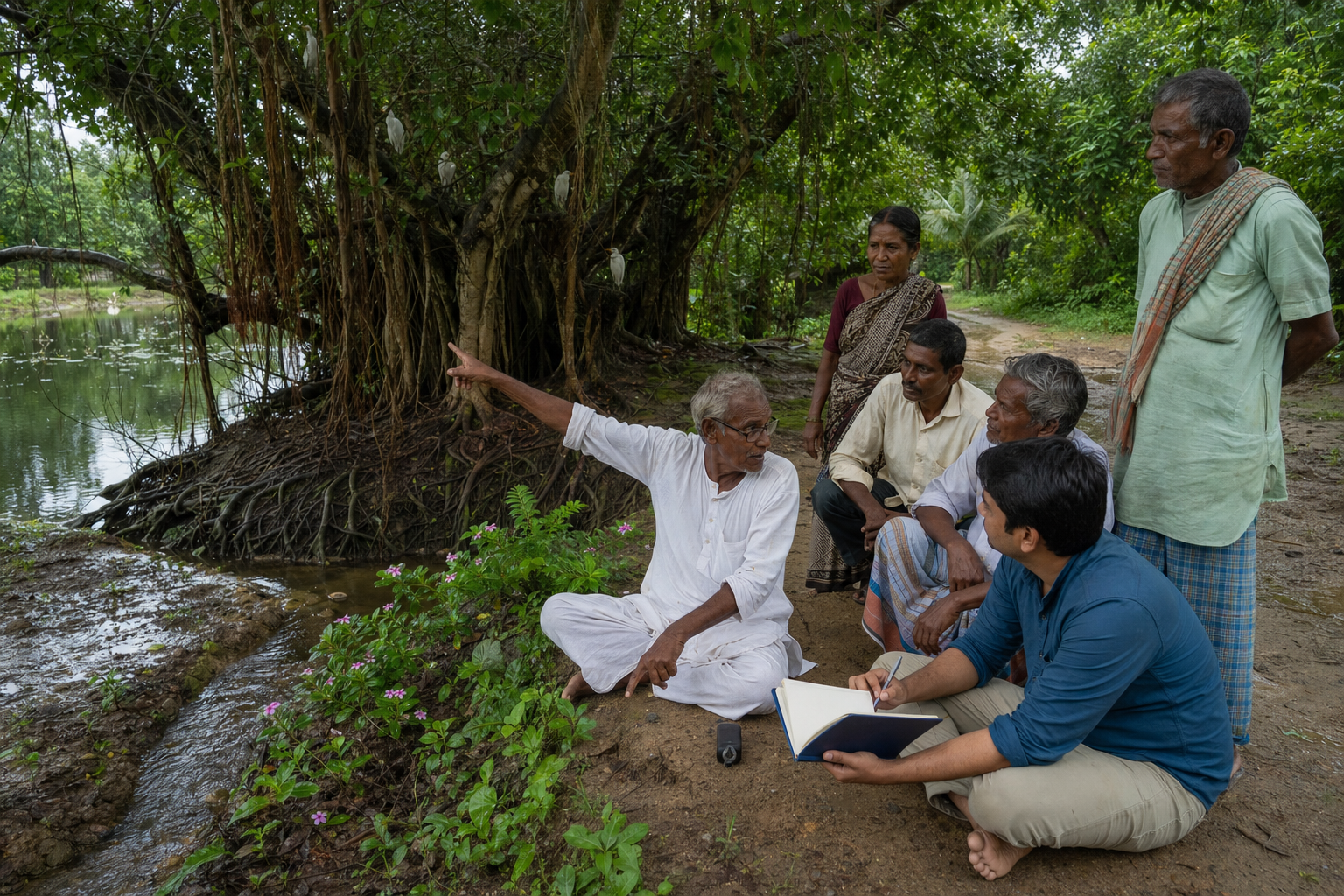
If you are collecting a family story, planning a school project, or trying to understand a grove in your ancestral village, use questions that keep place, meaning, and transmission connected. Let the narrator answer before you offer an interpretation.
- Where exactly does the story belong? Ask for the tree, grove, path, threshold, or learning place associated with the guardian. A general tale and a place-bound memory are not the same kind of inheritance.
- What were people expected to do differently there? Listen for practical conduct rather than only dramatic events. The remembered rule may involve respect, restraint, proper speech, or regard for the people and knowledge associated with the place.
- Why is this particular guardian suited to that duty? A scholarly and gentle Brahmadaitya carries a different moral message from a hostile apparition. The character of the guardian tells you what kind of authority the community placed at the site.
- Who told the story, to whom, and on what occasion? An elder’s evening tale to children, a courtyard retelling, and a local performance may preserve different emphases. Record the setting instead of extracting only a polished plot.
- What has changed around the place and the telling? Ask whether the tree, pathway, audience, vocabulary, or custom remains recognisable. Do not supply the answer. The narrator’s account of change is itself part of the ecological and cultural memory.
These questions do not verify a supernatural claim, and they should not be presented as doing so. They reveal how a community understood a place and what obligations it attached to that understanding. Folklore can be culturally true as a carrier of identity and duty without functioning as a scientific survey. Conversely, reducing the tale to an ecological device misses its sacred and moral dimensions.
Avoid another common mistake: treating one version as the definitive folklore of Bengal. Oral traditions vary among families, communities, and tellers. Preserve a narrator’s phrasing, uncertainty, and variant details instead of silently harmonising them with the version you already know. The variation is evidence of a living tradition, not necessarily an error to correct.
Document the relationship, then let preservation follow it
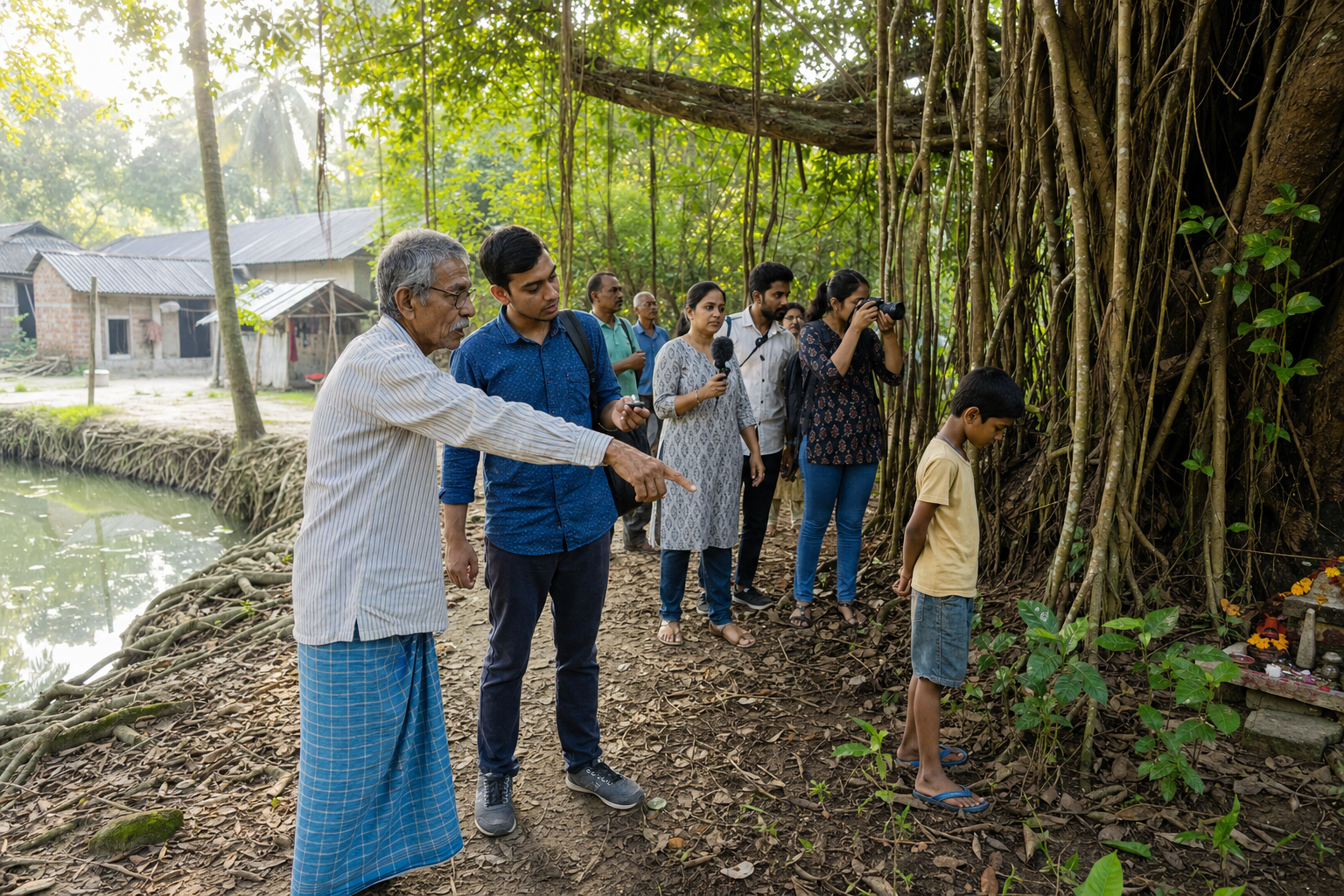
Make a two-layer record
A useful record separates what was narrated from what you think it means. Without that separation, later readers cannot tell whether a detail belonged to the teller or was added by the collector.
- Ask permission before recording, photographing, publishing, or naming the location. Let the narrator choose whether to be identified.
- Preserve the narration in Bengali or the local form of speech when possible. Add a translation separately rather than replacing local terms with smoother equivalents.
- Note the narrator’s relationship to the place, the intended audience, the setting of the telling, and whether the account was remembered, performed, or retold from someone else.
- Write observations and interpretations in a separate field. Label an inference as an inference, especially when connecting a moral rule to care for a tree or grove.
- Return a copy to the narrator or community. Ask what should remain private and whether your interpretation feels faithful to the relationship they described.
Be especially careful with precise public locations. Publishing the exact position of an unprotected sacred place can expose it to attention its custodians did not request. Keep detailed location information in the community record unless the people responsible for the place consent to wider disclosure.
Turn memory into care without taking ownership
Do not arrive with a ready-made conservation campaign and use the folklore as decoration. First identify who already carries responsibility: storytellers, families, local custodians, teachers, and people who regularly use the space. Ask what continuity means to them and what pressure they believe the place faces.
Then choose a form of work that strengthens both sides of the inheritance. An elder-and-youth story circle can restore the chain of telling. A school folklore project can pair oral history with careful observation of the grove. A community effort can treat the sacred site as a living green space rather than merely preserving a transcript in an archive. These approaches follow the same principle: intangible heritage and the place that anchors it need to be sustained together.
Judge the work by concrete continuity. Is the local name preserved? Can a younger participant retell the account without turning it into a generic ghost story? Is the expected conduct clear? Does the tree or grove still have recognised custodians? Has the community retained control over sensitive knowledge? These questions are more meaningful than counting how many times a recording was viewed.
You can begin with one tree-linked story and one living narrator. Ask permission, record the account, identify the place if appropriate, and write down the behaviour the story asks of its listeners. Return the record to the narrator, then ask what form of care would actually help. Listening before interpreting, and returning before publicising, keeps ecological memory attached to responsibility.
References
