

Contemporary Krishna devotion does not travel through a single channel. Across five reported cases, it reaches the public through spiritual books, festival theatre, a children’s alphabet app, devotional cooking and a future-oriented discussion of the Bhagavad Gita.
Together, these cases reveal a wider outreach ecology. The medium changes with the audience, but the central challenge remains consistent: make bhakti accessible without reducing it to promotion, entertainment or cultural decoration. The strongest outreach links an inviting first encounter to trustworthy relationships, meaningful participation and sustained practice.
One devotional ecology, five points of contact
Each source describes a different threshold through which someone might approach Krishna devotion. The book-distribution article considers the brief encounter between a distributor and a stranger. The report on Fish Out of Water places youth-led theatre inside the public setting of Boston Ratha Yatra 2026. The Krishna ABC Kids article moves the encounter into early childhood learning and family life.
The other two sources turn attention from initial contact to devotional depth. The account of Daivisakti Mataji’s cooking class presents kitchen knowledge and prasadam as forms of lived theology. The Gita2050 report describes a May 2026 session in Brooklyn by Svayam Bhagavan Keshava Maharaja, using the Bhagavad Gita to frame questions about moral responsibility, spiritual identity and the future.
These are not competing outreach models. They occupy different places in a devotional journey. A book or street festival can create recognition; an app or youth performance can help transmit identity; cooking and prasadam can turn belief into habitual service; scriptural discussion can supply the philosophical architecture that keeps the other activities from becoming disconnected cultural fragments.
This range also complicates the conventional idea of outreach as preaching directed outward. In these sources, outreach forms the people doing it as well as the people receiving it. Distributors confront impatience and fear of rejection. Young performers learn to carry culture actively. Parents become partners in a child’s learning. Cooks discipline attention through ordinary tasks. Students of the Gita examine the motives behind action. Contemporary outreach is therefore both communication and formation.
The public threshold: invitation must precede persuasion

The book-distribution essay provides the clearest treatment of interpersonal ethics. It distinguishes confidence from pressure and argues that trust, timing, accurate explanation, body language and respect for refusal matter before a stranger can engage with philosophy. Its most consequential insight is that the distributor’s conduct becomes an early interpretation of the book. A profound text can be poorly represented by an interaction that feels manipulative.
The article also resists measuring service only through circulation totals. Numbers can support planning, inventory and discipline, but they cannot show whether an exchange respected the recipient or whether a book will ever be read. This does not make measurement useless; it places measurement beneath the human and spiritual purpose of the activity. Outreach can count outputs without confusing them with transformation.
Ratha Yatra offers a contrasting but complementary public form. According to the Fish Out of Water report, the ISKCON Youth Ministry Bus Tour performed the play at Boston Ratha Yatra 2026. The festival setting combines procession, kirtan, prasadam and cultural presentation in an open civic environment. Rather than beginning with a direct proposition from one person to another, festival outreach lets visitors approach through sound, food, movement, spectacle or curiosity.
Theatre is especially useful at this threshold because it can embody a question before explaining a doctrine. The source interprets the title’s image of a fish separated from water as a metaphor for alienation from spiritual nourishment, while also acknowledging that the supplied material did not establish the play’s complete plot or dialogue. The responsible synthesis is therefore about form rather than unverified content: dramatic performance can make questions of identity and belonging approachable without requiring an audience to possess theological vocabulary in advance.
Book distribution and festival theatre consequently solve different communication problems. A distributor must earn trust within seconds and protect individual agency. A festival creates a hospitable environment in which engagement can unfold less directly. Both work best when the invitation is clear, the participant remains free and the encounter points beyond itself.
Children and youth need participation, not cultural wallpaper
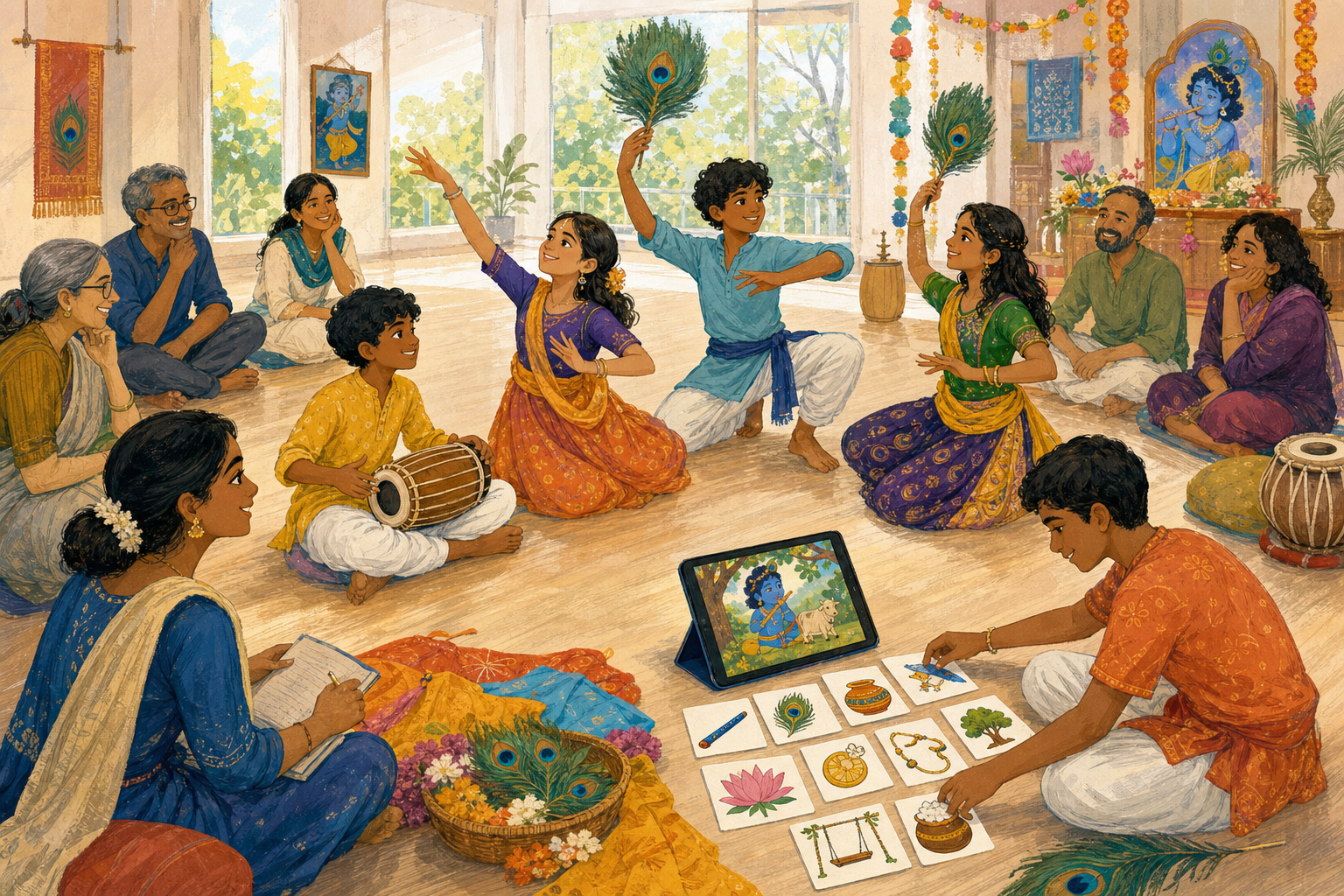
The two youth-oriented cases show why transmission cannot be reduced to placing devotional imagery around otherwise passive consumption. Krishna ABC Kids is introduced as an English alphabet-learning app with a Krishna-centered setting. The source material available to that article was limited, so its discussion largely identifies standards by which such a product should be judged rather than documenting a complete feature set or measured educational results.
Those standards are useful. A culturally rooted learning app still needs clear typography, accurate pronunciation, restrained visual design, suitable pacing and exercises that help children connect letters with sounds and vocabulary. Devotional familiarity may create warmth and motivation, but a Krishna theme alone cannot establish educational quality. The meaningful test is whether learning transfers beyond the screen into speech, books, objects and conversation.
The article accordingly places adults inside the learning process. A parent or grandparent can repeat sounds, connect an image to a story and give the child opportunities to recognize letters away from the device. It also recommends practical safeguards such as short supervised sessions and parental review of advertising, permissions, privacy practices and purchase settings. In this model, technology supports family transmission rather than replacing it.
Fish Out of Water represents a more active stage of cultural formation. The source presents young devotees not simply as an audience but as performers who rehearse, travel, collaborate and contribute to a public festival. Theatre allows them to produce devotional culture in a contemporary idiom. That distinction is particularly important in diaspora life: inherited identity becomes more durable when younger participants can interpret, create and serve within it.
The app and the play therefore illuminate successive forms of agency. A young child first encounters a devotional world through guided recognition and family affection. Older youth can question, dramatize and publicly carry that world. In both cases, continuity depends on participation appropriate to the person’s stage of development, not merely exposure to religious symbols.
Kitchen practice and scripture give outreach its interior depth

Public visibility alone cannot sustain a devotional culture. Daivisakti Mataji’s reported cooking demonstration shifts attention to the repeated disciplines that make bhakti tangible. The article describes her explaining how she prepared lunch for Srila Prabhupada with a distinctive three-tiered cooker. The importance of the demonstration lies not only in a particular utensil or menu, but in the preservation of practical knowledge shaped by cleanliness, timing, economy and service.
The source treats this cooking knowledge as an embodied archive. A written recipe can list ingredients, but demonstration conveys sequence, handling, judgment and the consciousness associated with an offering. It also highlights how women devotees have preserved substantial parts of everyday temple and household culture through cooking, worship, hospitality and festival preparation. Such service belongs within the history of contemporary Krishna devotion, not at its margins.
Prasadam also carries outreach from explanation into relationship. Food offered within Vaishnava practice can then be shared, allowing hospitality, worship and community to meet in one act. This helps explain why kitchens matter to the wider outreach ecology: they turn an abstract invitation into care that can be received, shared and repeated.
Gita2050 supplies a complementary form of depth. The Brooklyn session, as described by its source, frames the Bhagavad Gita as guidance for approaching future pressures rather than as an object of nostalgia. Its reported themes include the enduring self, disciplined action, the psychology of attachment, the three gunas and bhakti. The source also extends the discussion toward technological acceleration, ecological stress and social fragmentation, while appropriately presenting the Gita as an inner framework rather than a source of technical policy prescriptions.
Placed beside the cooking class, this scriptural emphasis shows two inseparable kinds of continuity. One transmits concepts through teaching; the other transmits disposition through practice. The Gita asks how action can become responsible and unattached service. The kitchen gives that question a daily setting in which intention, order, restraint and care are tested. Philosophy protects practice from becoming mechanical, while practice protects philosophy from becoming merely verbal.
What responsible Krishna outreach now requires

The sources collectively suggest that contemporary outreach should be evaluated as a pathway rather than as a collection of isolated projects. The relevant question is not simply whether a book, app, performance, meal or lecture reached an audience. It is whether each encounter created a credible next step toward understanding, association or service.
Key takeaways
- Different audiences require different thresholds: a public conversation, a festival performance, a family learning tool, shared prasadam or sustained scriptural inquiry.
- The messenger is part of the message. Respectful distributors, disciplined cooks, prepared performers and attentive teachers make devotional claims more credible.
- Accessibility and fidelity must develop together. Plain language and contemporary media can widen participation, but educational quality, philosophical depth and reverence still matter.
- Younger generations need meaningful roles. Guided learning can begin the connection, while performance, teamwork and service allow inherited culture to become personally owned.
- Reach is not the same as impact. Counts, views or attendance can describe activity, but deeper assessment asks whether people gained understanding, agency, trustworthy relationships and opportunities for continued practice.
The evidence has clear limits. The book-distribution and children’s-app articles explicitly build much of their analysis from sparse promotional material; the theatre article does not claim access to the full script; and the cooking and Gita reports interpret presentations rather than supplying independent outcome studies. These cases can therefore reveal outreach principles and design questions, but they do not by themselves prove educational, spiritual or community effects.
That limitation points toward a constructive next step. Communities can connect public-facing activity to follow-through: a book with an honest conversation, an app with family storytelling, a performance with opportunities for service, prasadam with sustained hospitality, and Gita study with ethical action. Krishna outreach will remain most resilient where every welcoming doorway leads into a coherent life of learning, relationship and practice.
References
- DharmaRenaissance Blog — Book Distribution: Powerful Lessons from Expectation, Reality, and Seva
- DharmaRenaissance Blog — Krishna ABC Kids: A Powerful Cultural Bridge for Early Alphabet Learning
- DharmaRenaissance Blog — Fish Out of Water: Powerful Lessons from ISKCON Youth at Boston Ratha Yatra 2026
- Dandavats — Sacred Kitchen Wisdom: Daivisakti Mataji’s Powerful Prabhupada Lunch Tradition
- Dandavats — Gita2050 in Brooklyn: Powerful Bhagavad Gita Wisdom for a Future-Ready Dharma