
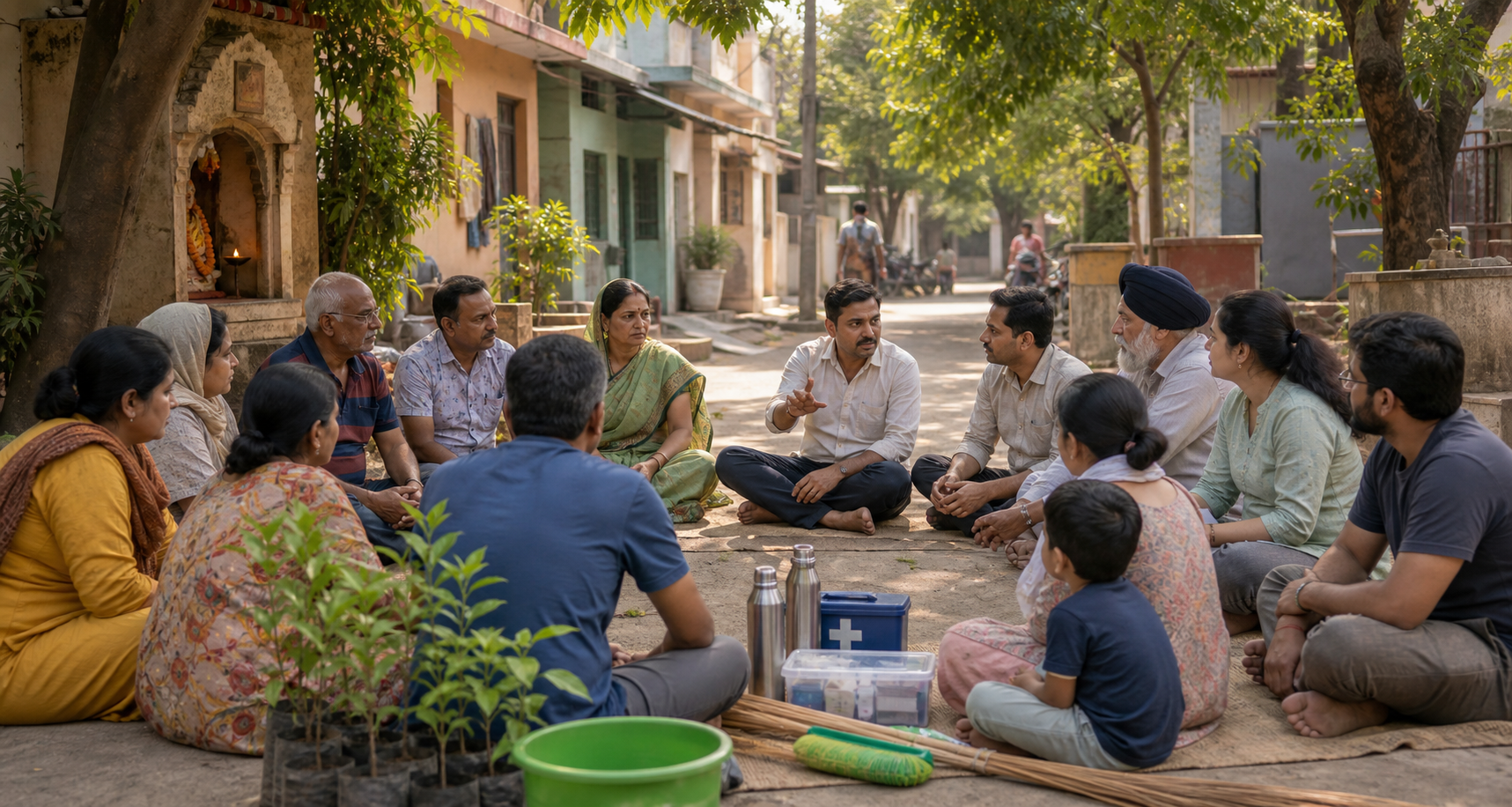
You may be deciding whether to attend an RSS centenary programme, volunteer for home visits, or organise something in your own locality. The useful question is not whether the banner carries an impressive national number. It is whether the work leaves one neighbourhood more trusting, one family better connected to help, and one shared problem closer to resolution.
The 1925–2025 centenary plan envisages up to one lakh conferences and community programmes. That scale creates an opportunity, not a guaranteed outcome. Dharmic civic unity will be built locally, through consent, truthful promises, inclusive seva and visible follow-through after the speeches end.
A large centenary needs a local unit of success
An event is not yet an achievement. Attendance tells you how many people entered a venue; it does not tell you whether distrust decreased, a neglected civic need was addressed, or families gained a reliable way to cooperate. Treat the gathering as the opening meeting of a neighbourhood commitment, not as the completed commitment itself.
Before printing invitations, organisers should complete a short local charter. It should answer six questions plainly:
- Which street, ward, village or cluster of households is this programme meant to serve?
- Which concern did local people identify: education, health, safety, cleanliness, skills or dignified livelihood?
- What can volunteers realistically do about it without making promises beyond their competence?
- Who owns the next action after the event?
- When will participants receive an update?
- Where can a resident question the process, report exclusion or raise a grievance?
This keeps cultural celebration connected to civic responsibility. A programme may include history, identity and cultural education, but it should also give participants a defined way to serve together. Otherwise, the locality supplies the audience while receiving little that lasts.
The planned Panch Parivartan orientation places home visits and neighbourhood conversations at the centre. Its civic value depends on completing a simple loop: listen to a household, identify a legitimate need, connect that need to an appropriate initiative, and return with an honest update. If the loop stops after listening, outreach becomes data collection. If it begins with a predetermined answer, it becomes canvassing. Neither builds durable trust.
Make every home visit consent-first and useful

A doorstep is not a public meeting hall. The householder controls the encounter. Volunteers should identify themselves, state the purpose of the visit, explain whether anything will be recorded, and ask permission to continue. A polite refusal ends the visit. Consent is not genuine if declining brings pressure, repeated persuasion or the fear of losing access to service.
A practical visit can follow five steps:
- Introduce the work. Name the organising group, the locality being covered and the kind of follow-up that may be possible.
- Ask one open question. For example: “What is the most useful improvement neighbours could work on together?” Do not lead the resident toward an answer that fits an existing programme.
- Listen without debating. A complaint about safety, schooling or livelihoods is not an invitation to test the resident’s ideology. Restate what you heard and check that you understood it.
- Record the minimum. Keep only information needed for the agreed follow-up. Do not ask about voting preference, sect, income, diagnosis or family conflict merely because a form has space for it.
- Close the loop. Say what will happen next, what may not be possible, and how the household can receive an update or register a grievance.
Never condition tutoring, a livelihood connection, a cleanliness initiative or any other seva on political agreement, religious conformity, event attendance or public endorsement. Service loses its Dharmic credibility when help becomes leverage.
Household information also needs restraint after collection. Use aggregate findings to choose a project, but do not display names, addresses or sensitive personal details in presentations or public reports. If contact information will be shared with another service group, obtain specific permission first. A family that agrees to speak with one volunteer has not automatically agreed to enter an unrestricted network.
Volunteers need a response for tense conversations as well. Do not rebut an angry resident at the door. Acknowledge the concern, separate what can be verified from what cannot, and route actionable complaints through the stated grievance process. De-escalation is not surrender; it is the discipline that prevents a service visit from becoming a contest of pride.
Use shared values as a bridge, not a blender
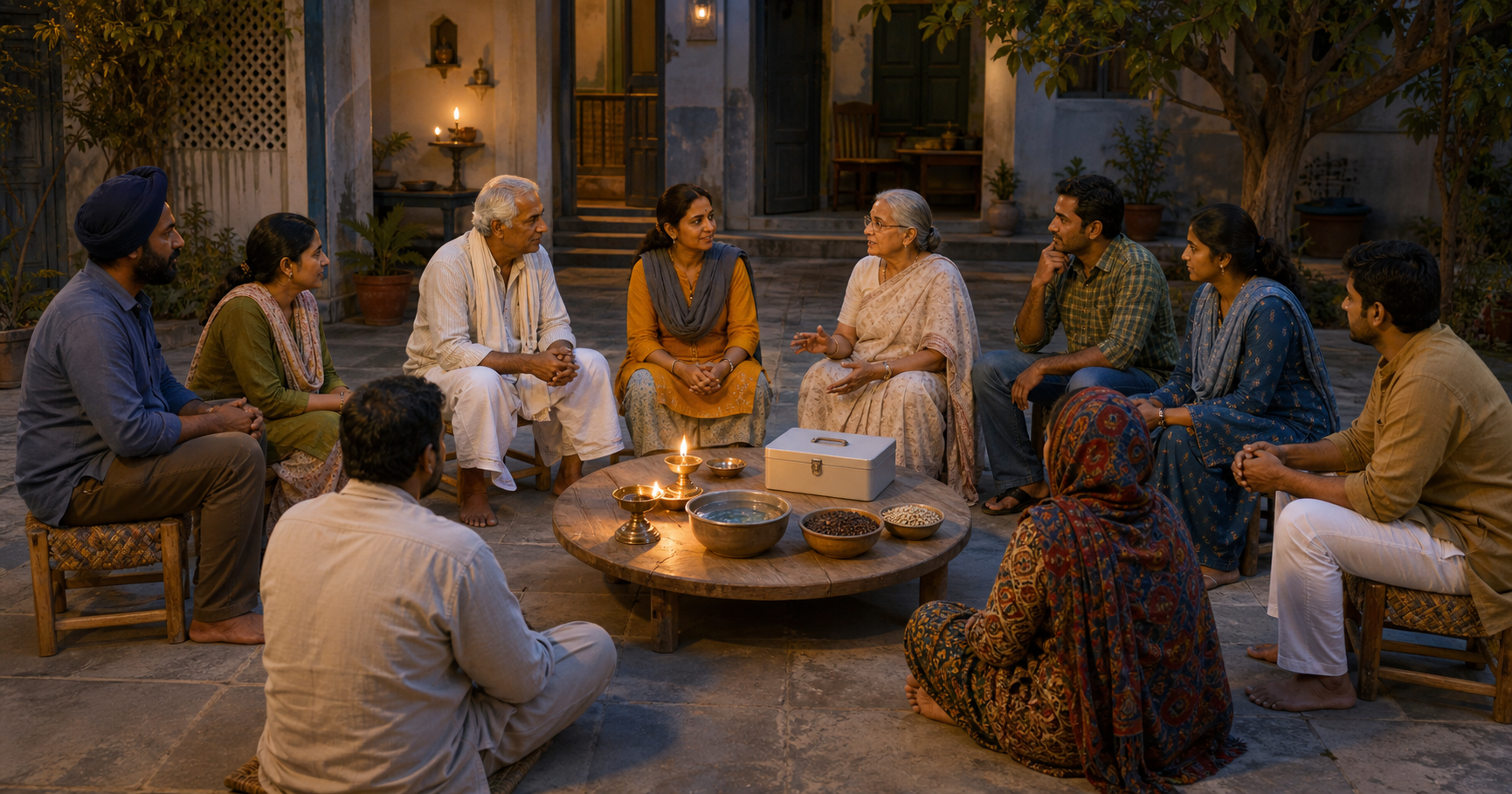
Dharmic civic unity does not require Hindu, Buddhist, Jain and Sikh traditions to become interchangeable. These traditions have distinct scriptures, institutions, histories and theological positions. Cooperation becomes stronger when it respects those differences instead of hiding them beneath a vague label.
The common civic ground is ethical conduct. Karuna, ahimsa, seva and satya offer a practical vocabulary for working together:
- Karuna asks whether outreach begins with attention to another person’s actual difficulty.
- Ahimsa rules out intimidation, humiliation and the treatment of disagreement as enmity.
- Seva turns identity into responsibility for a shared place and its people.
- Satya requires honest claims about what was heard, what was delivered and what remains unresolved.
These values should be visible in the design of the programme, not merely named from the stage. Where members of several Dharmic communities live locally, invite them into planning and project ownership. Let each community describe its own reasons for participating. Do not require a common theological formulation before people can tutor children, improve a public space or help families find legitimate livelihood support.
Representation must also carry authority. Women and young people should help select the local issue, control part of the implementation and speak during the public review. Giving them ceremonial slots while reserving every decision for the same small circle does not broaden participation. Use local languages in invitations, household conversations and reports so that inclusion does not depend on fluency in the organiser’s preferred language.
Regional memory matters too. A phrase that sounds unifying to one group may carry a different historical meaning for another. Ask local representatives to review language and symbols before publication, especially where relations among communities have been strained. Sensitivity is not dilution. It protects the conditions in which candid cooperation is possible.
Keep non-violence, constitutional conduct and non-discrimination as the civic floor. A participant should not have to pass a partisan test to join a service project, and disagreement with an organiser should not make a family ineligible for assistance. This boundary allows a pro-Dharma initiative to express cultural confidence without turning neighbourhood service into a political loyalty exercise.
Require one 30-day project after every gathering
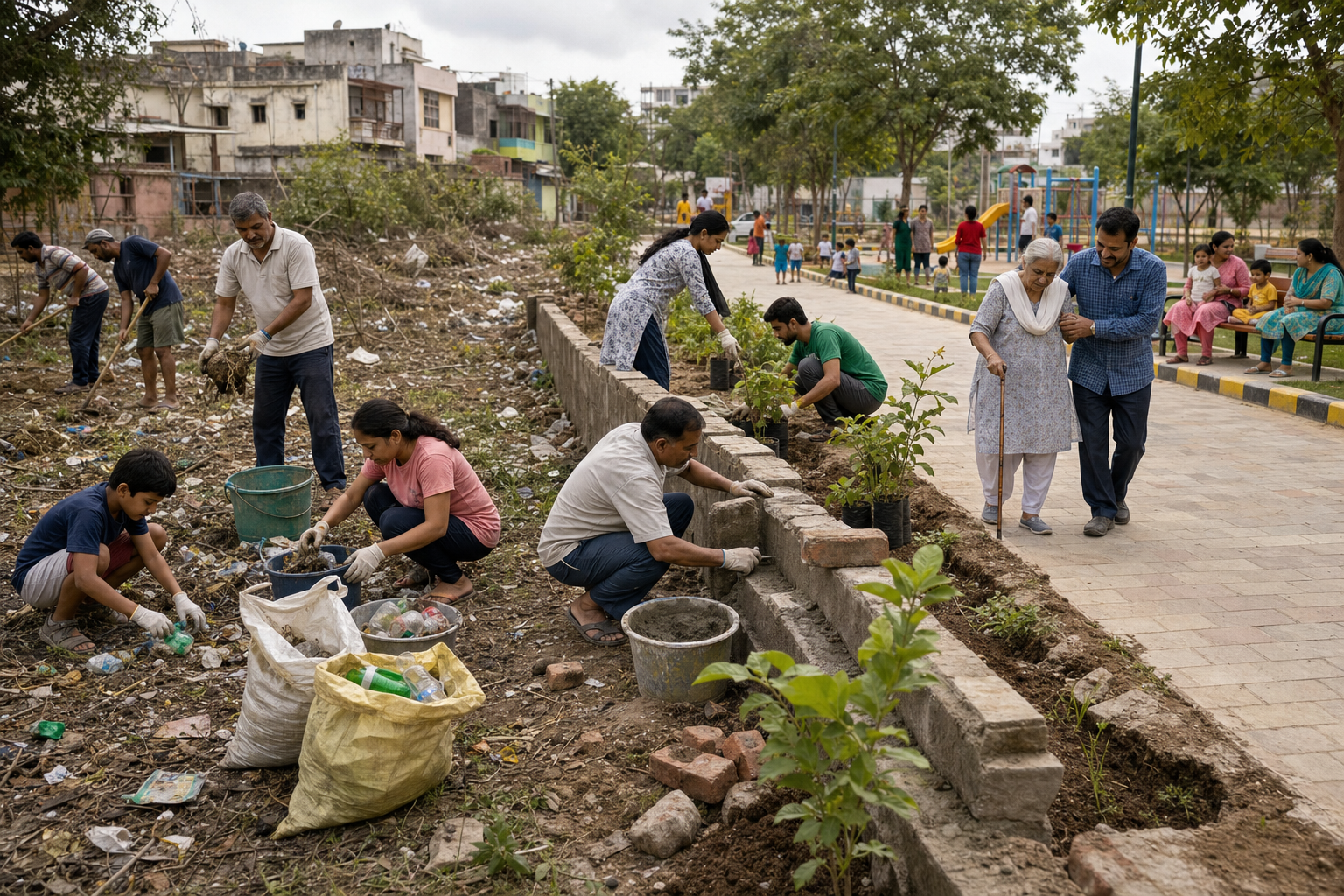
A practical local rule is to attach one 30-day follow-through project to each gathering. Thirty days is long enough to organise real work and short enough to prevent responsibility from disappearing into an indefinite committee. The deadline is a management choice, not a claim that every social problem can be solved in a month.
Choose the project from needs identified during consent-based conversations. Keep the first commitment narrow:
- Cleanliness drive: name the site, arrange lawful disposal, assign responsibility for checking it later, and avoid simply moving waste from one place to another.
- Tutoring circle: define the age group, subject, meeting place, schedule and safeguarding responsibility before enrolling children.
- Skills workshop: connect the session to a real next step, such as a further training contact, artisan network or legitimate livelihood linkage. Attendance alone is not employment.
- Health camp: use appropriately qualified providers, protect privacy, obtain consent and establish a referral route for anything requiring further care. A camp should not be presented as a substitute for continuing medical attention.
- Livelihood linkage: distinguish introductions, applications, interviews and confirmed placements. Do not report a referral as a job secured.
At the event, present household findings only in aggregate. Let participants choose the achievable project, appoint a mixed implementation team, name one accountable coordinator and announce the review date. A project without an owner and a review date is an aspiration, not a plan.
Maintain a simple public ledger. It can report participation, representation of locally present Dharmic communities, volunteer hours, home visits completed with consent, the service undertaken, referrals made, unresolved obstacles and the next action. Publish totals without exposing household identities or sensitive information.
Numbers still need interpretation. A high visit count can conceal rushed conversations; a crowded event can conceal narrow control; many volunteer hours can produce little if the project was not requested. Pair the ledger with short feedback questions: Did residents understand the purpose of the visit? Did they feel free to decline? Was the promised follow-up received? Could women and younger participants influence decisions? Was any group treated differently?
Share a brief review even when the result is disappointing. State what was attempted, what was completed, what failed and what will change. Satya in civic work includes truthful accounting of incomplete work. A modest result reported honestly is more useful than a triumphant announcement that cannot be checked.
Key takeaways for deciding whether to take part
- Judge a centenary programme by the local need it addresses and the follow-through it creates, not by the size of the national event count.
- Join home visits only when residents can refuse freely, data collection is minimal, and the purpose of follow-up is clear.
- Build Hindu, Buddhist, Jain and Sikh cooperation around ethical action while allowing each tradition to retain its own voice.
- Keep seva independent of partisan loyalty, religious conformity and public endorsement.
- Ask for a named project owner, a near-term review date, a grievance route and an aggregate public account of results.
- Treat karuna, ahimsa, seva and satya as standards for conduct, not decorative words for a stage programme.
Before you accept an invitation, ask three questions: What need did local households identify? What will happen during the next 30 days? Where will results and grievances be reported? If the answers are clear, take responsibility for one defined task. If they are vague, offer to help create the charter and accountability ledger first. That is how a centenary commemoration can become a durable act of Dharmic citizenship.
References
