
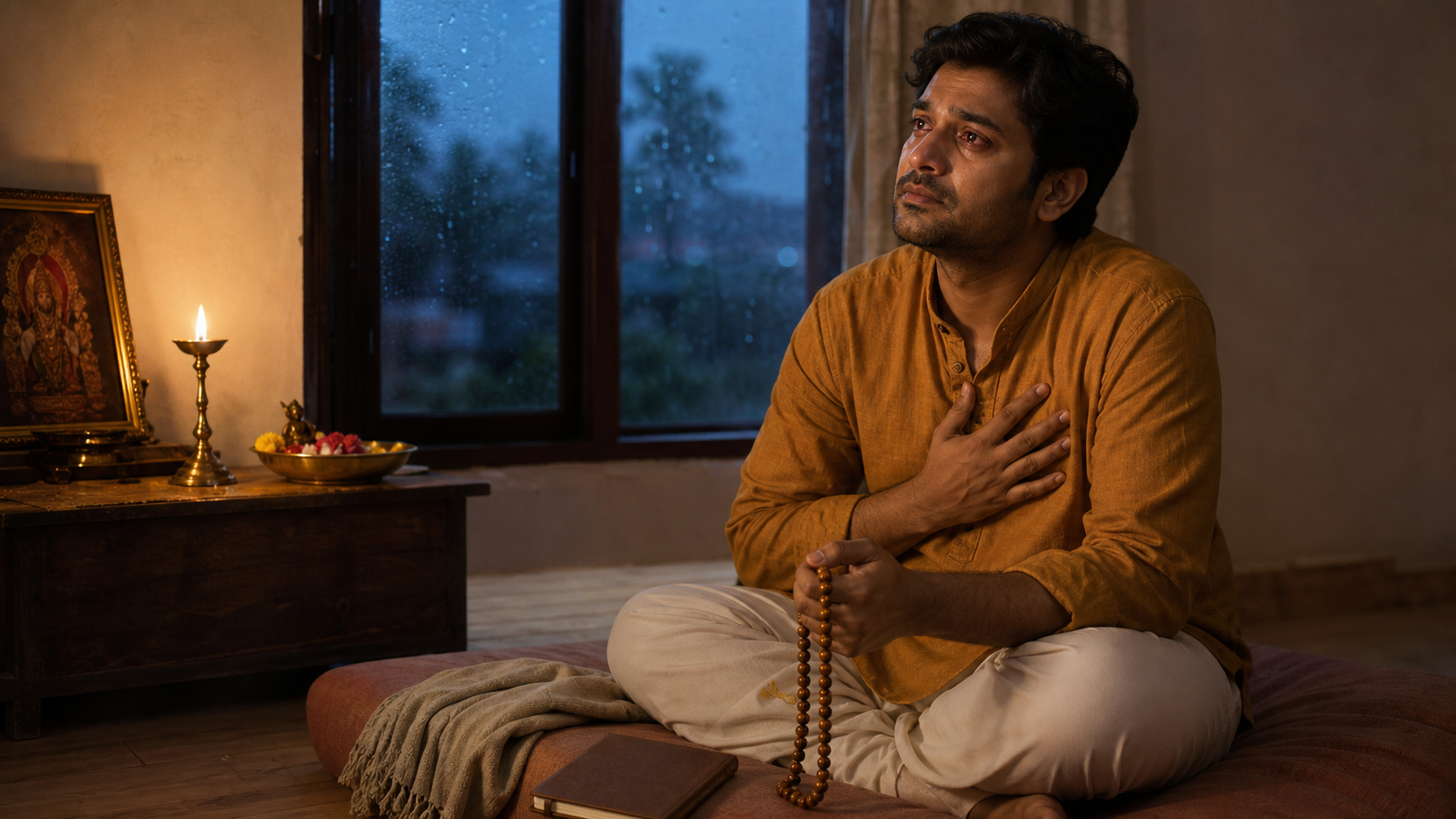
You sit for japa because your heart is unsettled, but the unsettled heart follows you into japa. A painful memory repeats. Envy interrupts the mantra. Anger turns prayer into an argument. Then another thought appears: if your devotion were sincere, should you still feel this way?
Bhakti can support emotional healing, but not by making every difficult feeling disappear. It gives you a way to meet the feeling without obeying it, hiding it, or turning it into a verdict on your spiritual worth. The practical aim is a heart that can tell the truth, return to the Divine, and choose a dharmic response even while pain is present.
Let devotion change your relationship with pain
Emotional healing is not emotional erasure. Grief may still grieve. Fear may still tighten the body. Anger may still announce that a boundary has been crossed. Bhakti begins its deeper work when you stop treating those experiences as either unquestionable commands or shameful intruders.
A difficult emotion usually arrives with several layers. There is the immediate feeling. There is the story the mind builds around it. There may also be an old habit: comparing, withdrawing, attacking, pleasing, grasping, or condemning yourself. Finally, there is the spiritual orientation you choose. Bhakti works most directly at that final level. It asks what will occupy the center of your attention and action: the wounded ego, the passing impulse, or the Divine and Dharma.
This distinction matters because spiritual language can otherwise become another weapon against the mind. Telling yourself that a devotee must never feel angry does not purify anger; it often adds concealment and shame. Repeating that everything is Krishna’s will can become a way to avoid an apology, a necessary boundary, or an honest conversation. Surrender that prevents truthful action is not emotional healing.
Look instead for changes you can observe. Can you notice envy before speaking bitterly? Can you feel hurt without planning retaliation? Can you acknowledge a mistake without collapsing into self-contempt? Can you return to prayer after a difficult day instead of waiting to become emotionally pure first? These are meaningful signs of transformation because devotion is beginning to shape conduct, not merely mood.
Bhakti is especially powerful here because it is relational. You are not required to repair yourself in isolation before approaching the Divine. You can bring gratitude, resistance, fear, longing, and even the inability to surrender. A hesitant heart can itself become an offering. Sincerity means offering what is actually present, then allowing that offering to refine how you live.
Use four moves when a difficult emotion rises

When emotion is intense, abstract spiritual advice is hard to use. A compact sequence helps: notice, name, neutralize, and nourish. This is particularly useful for envy, but the same discipline can help you work with fear, resentment, shame, and compulsive comparison.
- Notice before acting. Pause before sending the message, making the accusation, abandoning the practice, or rehearsing the grievance. Locate the emotion in your present experience. Ask, “What is happening in my body, attention, and impulse right now?” Observation creates a small but crucial space between feeling and conduct.
- Name the feeling and its demand. Use plain language: “This is envy,” “This is fear of rejection,” or “This is anger.” Then identify what it is urging you to do. Envy may demand that another person’s success be diminished. Shame may demand concealment. Fear may demand total control. Naming the demand exposes the pattern without pretending that the feeling itself is a sin.
- Neutralize immediate reactivity. Slow the breath, sit in silence, repeat your mantra, chant the holy name, or engage in simran according to your tradition. The purpose is not to drug the feeling with sacred sound. It is to regain enough steadiness that the feeling no longer decides your next action.
- Nourish the opposing quality. Envy can be answered with gratitude and mudita, the deliberate practice of rejoicing in another’s good. Possessiveness can be met with aparigraha. Hostility can be restrained by ahimsa. Self-absorption can be redirected through seva. Choose a concrete expression of the quality: congratulate the person, give credit honestly, make amends, share something you were gripping, or perform service without seeking recognition.
The final move is what prevents the exercise from becoming private mood management. Bhakti is not complete when you merely feel calmer. Once steadiness returns, ask, “What does Dharma require from me now?” The answer may be patience, but it may also be a truthful conversation, restitution, a firm boundary, or a request for help.
Do not collapse the dharmic traditions into a single technique. Hindu nama-japa, Buddhist mindfulness and metta, Jain ahimsa and aparigraha, and Sikh simran and seva arise within distinct paths. Yet they share a practical recognition: attention, restraint, remembrance, non-grasping, and compassionate action can interrupt the habits that keep suffering in motion. Use the discipline native to your path rather than collecting practices whenever discomfort appears.
Build a daily practice that transforms patterns, not just moods

Emergency chanting only when you feel distressed can bring relief, but transformation requires a rhythm that is present before the next trigger. A sustainable routine does not need to be elaborate. It needs a stable devotional center and a clear bridge between remembrance and conduct.
- Keep a fixed devotional anchor. Choose a regular time for nama-japa, kirtan, prayer, scriptural reflection, or simran. Protect the appointment even when the mind feels dull. Consistency teaches you to return without waiting for the ideal mood.
- Arrive honestly. Before beginning, name what you are carrying: agitation, numbness, jealousy, gratitude, grief, or resistance. This prevents the practice from splitting into a sacred performance on the outside and an unacknowledged struggle within.
- Settle before demanding concentration. A brief period of quiet breathing or attentive silence can reduce immediate reactivity. Then enter the mantra or prayer. If the mind wanders, return without turning every distraction into evidence of failure.
- Offer the resistance. When surrender feels threatening, do not manufacture an emotion you do not possess. Pray from the actual threshold: “I want to trust, and I am afraid to release control.” That is more spiritually useful than reciting the language of surrender while protecting every inner bargain.
- Carry remembrance into conduct. Connect the practice to a concrete dharmic action before the day ends. Speak more truthfully, serve without advertising it, celebrate another person’s good, repair a harm, or decline to participate in gossip. This is where devotion begins reorganizing character.
- Record the pattern briefly. Note the trigger, the emotion, the impulse, the practice you used, and the action you chose. The purpose is not obsessive self-monitoring. It is to discover which reactions repeat and whether your response is becoming freer.
Keep the distinctions clear as you practise. Surrender is not passivity before manipulation. Humility is not self-hatred. Seva is not compulsive pleasing. Acceptance of an emotion is not approval of everything the emotion wants. A bhakti practice that makes you less truthful, less responsible, or less capable of healthy boundaries needs correction from a mature teacher, qualified counselor, or both.
Sangha can help because other practitioners may notice patterns you cannot see alone. It can also become the setting in which comparison, conflict, and the desire for recognition surface most strongly. Treat those moments as part of practice. Seek guidance without turning a spiritual teacher into a therapist, and seek counseling without asking a therapist to determine your theology. Each form of guidance has its own competence.
Know when sadhana needs professional support beside it

Bhakti can supply meaning, relationship, ethical direction, and a place of surrender. It does not follow that every psychological difficulty will resolve through greater devotional effort. Conditioned habits, unresolved samskaras, trauma responses, and entrenched relational patterns may continue to obstruct attention and conduct. In such cases, counseling can serve as a supportive companion to sadhana rather than a substitute for it.
Consider qualified mental-health support when distress persistently interferes with daily responsibilities or devotional practice; anxiety repeatedly makes japa unmanageable; intrusive memories or trauma responses recur; self-criticism drains the capacity for seva; or the same relational pattern keeps damaging family or sangha life. These signs do not prove spiritual weakness. They show that a pattern may need focused skills and attention beyond what solitary practice is currently providing.
A therapist may help you examine distorted thought patterns, regulate strong reactions, understand triggers, and communicate with greater clarity and compassion. That work can make attention more available for chanting and service. Bhakti, meanwhile, continues to answer questions that therapy is not meant to settle: what you worship, what gives life meaning, what you owe to others, and how you orient the heart toward the Divine.
When evaluating a counselor, look beyond a claim of being “spiritual” or “dharmic.” Verify professional qualifications. Ask whether your devotional commitments will be respected rather than pathologized. Explain that you want psychological tools to support agency, ethical living, and stable sadhana. Ask how the counselor approaches anxiety, trauma, self-criticism, or relational conflict, depending on the difficulty you are bringing. A respectful counselor need not share your sampradaya, but should be able to work without belittling it.
Do not use chanting as a test that you must pass before seeking help. Do not use therapy as a reason to abandon the devotional commitments that give your healing direction. The useful integration is simple: spiritual practice keeps the highest purpose in view, while appropriate psychological care helps loosen the patterns that repeatedly block attention, responsibility, and relationship.
If distress creates an immediate risk of harm to you or someone else, use local emergency or crisis support. A devotional routine is not acute crisis care, and waiting for the next prayer period can allow danger to escalate.
Key takeaways
- Bhakti heals by changing how you relate and respond to pain, not by requiring every painful emotion to vanish.
- Do not add spiritual shame to an already difficult feeling. Notice it, name its demand, steady reactivity, and nourish the opposing virtue.
- Use mantra, prayer, or simran to recover freedom of action, not to avoid an apology, boundary, decision, or honest conversation.
- Connect daily sadhana to conduct. Devotion becomes transformative when remembrance produces truthfulness, restraint, gratitude, and seva.
- Surrender does not mean accepting mistreatment, and humility does not mean despising yourself.
- Persistent distress, trauma responses, intrusive memories, or recurring destructive patterns warrant support from a qualified mental-health professional who respects your dharmic commitments.
Begin with the next emotion that interrupts your peace. Pause before acting, tell the truth about what is present, return to the Divine through the practice rooted in your tradition, and make the next dharmic choice visible in conduct. If the same knot keeps tightening despite sincere practice, bring qualified help alongside your sadhana. The goal is not to perform serenity. It is to become steadily more truthful, less reactive, and more available for devotion.
References
- DharmaRenaissance Blog – Bhakti-yoga and Psychotherapy: Integrating Krishna Consciousness for Resilient Well-Being
- DharmaRenaissance Blog – When Surrender Feels Hard: Transforming Inner Resistance with Bhakti to Sri Krishna
- DharmaRenaissance Blog – Transforming Envy into Devotion: Kartik 2025 Insights to Center the Divine in Life
