
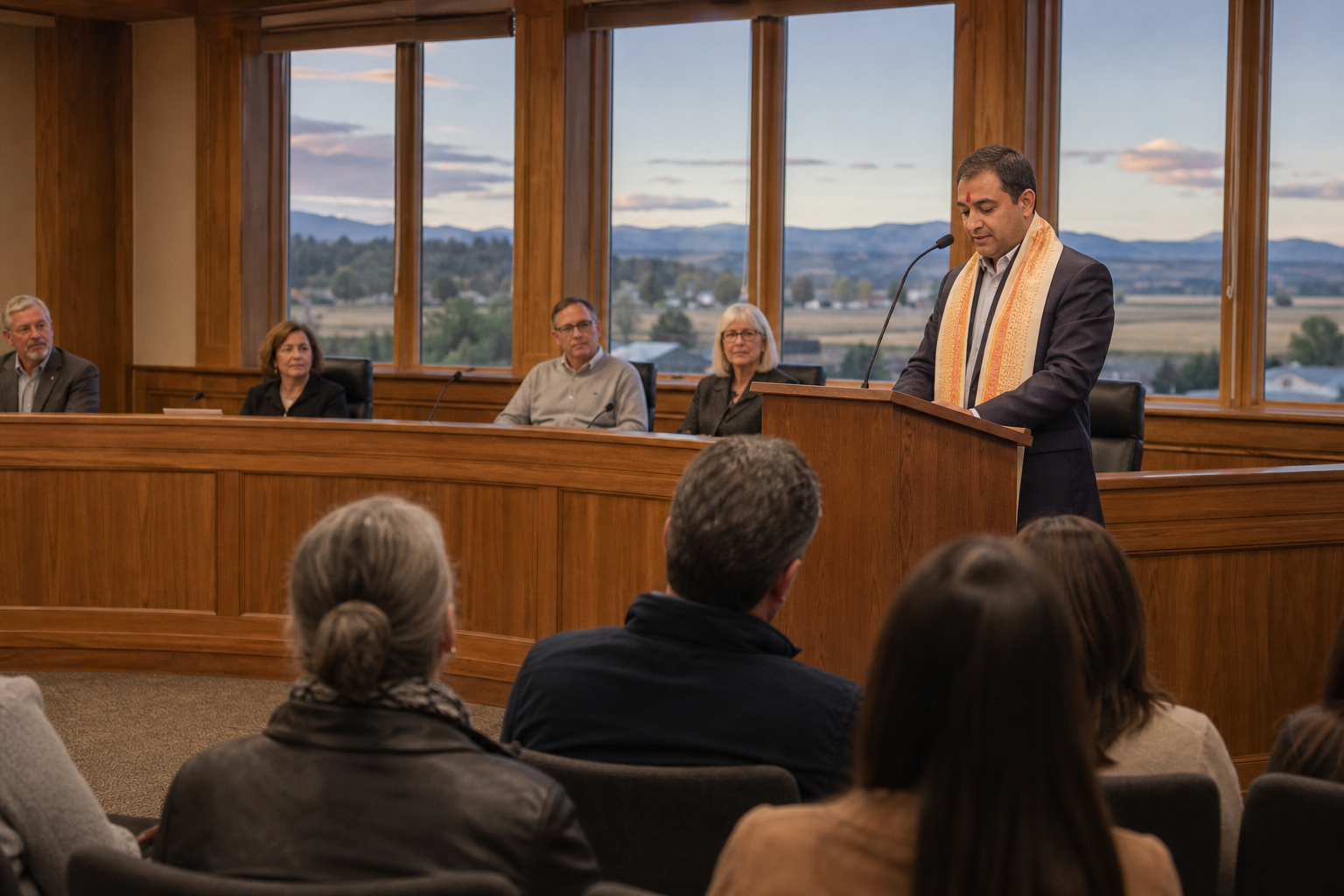
You may be approaching your town council with a simple question: if its meetings already open with prayer, can a Hindu invocation be heard there too? Idaho now offers a concrete precedent, along with a useful lesson about how a symbolic first can become a fair and repeatable civic practice.
The real goal is not merely to have Sanskrit heard once. It is to make Hindu participation intelligible to neighbors, authentic to the tradition, and available through the same civic process that welcomes other voices.
What changed in Burley, Arimo, and St. Anthony

On October 7, 8, and 9, 2025, the city councils of Burley, Arimo, and St. Anthony opened their meetings with Hindu prayers. Each occasion was identified as the council’s first recorded Hindu invocation since its city was incorporated: Burley in 1909, Arimo in 1923, and St. Anthony in 1908.
Hindu statesman Rajan led the invocations. He used Sanskrit mantras from ancient scriptures while emphasizing peace, compassion, and mutual respect. Those themes gave residents unfamiliar with Sanskrit a clear civic point of entry without requiring the prayer to conceal its Hindu identity.
The precise verses are not specified. If you discuss these events publicly, do not attach a mantra name, Sanskrit text, or translation to them without confirmation from the speaker or an official council record. Accurate advocacy is stronger than decorative detail.
These meetings matter because local recognition is felt locally. National declarations about pluralism can remain distant, while a familiar council chamber communicates something immediate: Hindu residents belong among the people whose presence and traditions are acknowledged in the civic life of the town.
Inclusion should preserve identity, not dissolve it
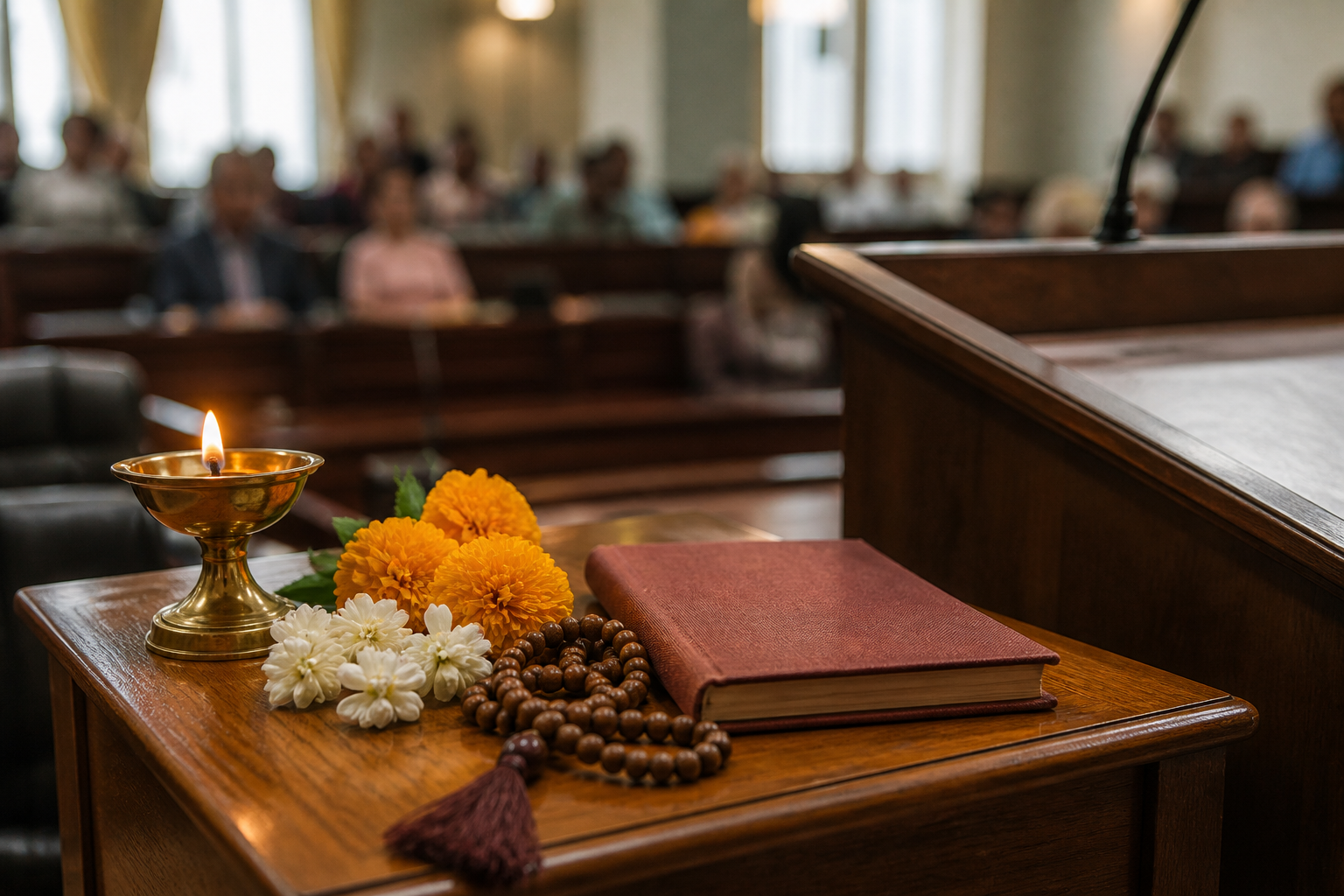
A Hindu invocation can be welcoming without being reduced to a vague moment of inspiration. Universal relevance does not require religious anonymity. The council can identify the recitation as Hindu, name Sanskrit as its language, introduce the speaker accurately, and still make clear that residents are being invited to listen respectfully rather than affirm a doctrine.
That distinction is especially important for Hindu communities. When every unfamiliar tradition is translated into generic spirituality, inclusion comes at the cost of visibility. A better approach keeps both parts intact: the invocation is recognizably Hindu, and its civic framing explains why people of many convictions can receive its wishes for peace and mutual regard.
The same care applies when speaking about the wider Dharmic family. Hindu, Buddhist, Jain, and Sikh communities have histories and values that can support mutual recognition, but they are not interchangeable labels for one religion. If a Hindu is delivering the invocation, call it Hindu. If representatives of several traditions are participating, identify each tradition on its own terms.
Nor should anyone treat the invocation as a test of loyalty. Residents may listen, remain silent, or decline to participate inwardly. A council meeting is strengthened when recognition does not become compulsion. Officials can establish that tone through a brief introduction that welcomes quiet attention and demands no spoken response from the room.
There is also an important procedural distinction to notice before making a request. Asking to join an existing invocation practice is different from asking a council that never uses invocations to create one. Find out which situation you are in. That answer determines whether your next step is a speaker nomination, a scheduling request, or a broader discussion about meeting policy.
How to make a workable request to your council

Your first message should ask about process, not argue the entire case. Council offices are more likely to act on a request that identifies the correct decision-maker, supplies the needed information, and fits the meeting format.
- Contact the city clerk and ask whether meetings include an invocation or another opening reflection. Ask who selects speakers, whether there is a rotation or invitation list, what information must be submitted, and how far ahead scheduling occurs.
- Request consideration under the process the council actually uses. If other faith representatives are invited, ask how a Hindu speaker may be considered through that same route. If there is no established route, ask which official can place the matter on an agenda.
- Propose a prepared speaker. Provide the person’s full name, the way it should be pronounced, an accurate description of the speaker’s Hindu role or community connection, and reliable contact details. Do not inflate a title to make the request appear more authoritative.
- Offer a compact program description. State that the invocation will be delivered in Sanskrit, give its expected duration, and explain in one sentence that its civic framing will center on peace, compassion, and mutual respect.
- Let the speaker control the sacred text. If an English meaning will be supplied, have the speaker verify it. Do not assemble an invocation by copying unrelated verses from the internet merely because they look or sound familiar.
- Confirm how the agenda, minutes, livestream title, and verbal introduction will identify the invocation. Small errors in a name, language, or tradition can outlast the meeting in the public record.
You can adapt the following wording for your first email:
Subject: Process for proposing a Hindu invocation. I am writing to ask whether the council includes invocations or opening reflections at its public meetings. If it does, please share the process, contact person, submission requirements, and scheduling timeline for proposing a speaker. I would like to propose a brief Hindu invocation in Sanskrit, accompanied by a plain-English introduction and centered on peace, compassion, and mutual respect. The speaker can follow the council’s time and agenda requirements.
That message gives the clerk something answerable. It does not assume that every Idaho council follows the same procedure, and it does not force a routine scheduling question into an immediate dispute.
If the request is denied, ask for the reason and the applicable policy in writing. Distinguish a neutral rule, such as the absence of any invocation program, from a rule applied differently because the proposal is Hindu. If you believe the council is imposing a faith-specific exclusion, preserve the correspondence and speak with a qualified local lawyer before asserting a legal claim; the governing rules and the exact facts will matter.
What officials and speakers should get right
Frame the invocation before the recitation
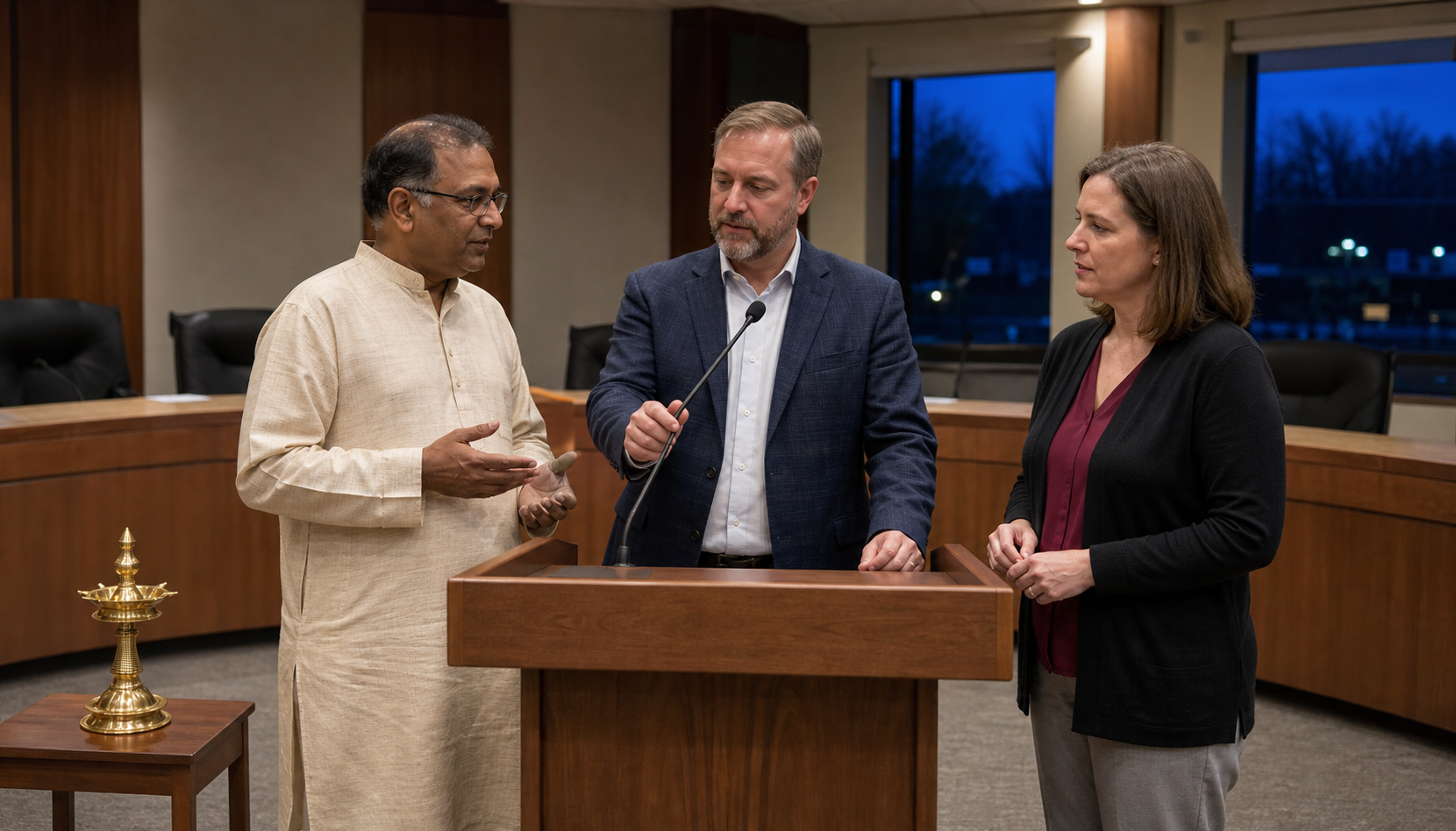
A short introduction can prevent most confusion. It should identify the speaker, the Hindu character of the invocation, and the use of Sanskrit. One further sentence can tell listeners that the prayer directs attention toward peace, compassion, or mutual respect. The introduction should orient the room, not turn into a lecture on Hindu theology.
Officials should confirm the wording with the speaker before the meeting. This avoids mispronounced names, accidental relabeling, and the common mistake of presenting one Hindu speaker as a representative of every Hindu community or every Dharmic religion.
Protect authenticity and freedom of response
Sanskrit should not be treated as atmospheric sound. The speaker should choose a coherent invocation, prepare its pronunciation, and decide whether a concise explanation or translation is appropriate. Organizers should not shorten or rearrange sacred lines merely to create a more dramatic performance.
At the same time, no resident should be instructed to repeat the mantra, adopt a posture, or make a religious affirmation. An invitation to quiet reflection is enough. This preserves the speaker’s religious integrity while respecting the different commitments present in a public chamber.
Turn the first invitation into a usable path
A ceremonial first can disappear from institutional memory unless someone completes the administrative follow-through. After the meeting, send the clerk the correct spelling of the speaker’s name, the name of the tradition, and any approved description used during the introduction. Check the published agenda, minutes, or recording title and politely request correction of material errors.
Then ask whether the speaker-selection process can be documented for future participants. One month later, four questions will tell you whether the event created more than a photograph: Can another Hindu speaker find the procedure? Does the clerk know whom to contact? Does the public record accurately identify what occurred? Can another underrepresented tradition request consideration without rebuilding the process from nothing?
This is where civic symbolism becomes civic capacity. Burley, Arimo, and St. Anthony supplied precedents. A durable model emerges only when respectful access can be repeated.
Key takeaways
- Burley, Arimo, and St. Anthony each recorded a first Hindu council invocation on consecutive dates in October 2025.
- A welcoming invocation can remain explicitly Hindu and use Sanskrit while offering civic themes that neighbors of different beliefs can understand.
- Before proposing a speaker, determine whether the council already has an invocation program and obtain its actual scheduling procedure.
- Give officials a complete, compact request: speaker details, expected duration, language, civic framing, and accurate wording for the public record.
- Judge success by whether the next participant can use a clear process, not only by whether the first ceremony occurred.
If you want to pursue this in your own town, send the procedural inquiry first. The clerk’s reply will show whether you need a nomination, an agenda request, or a policy conversation. Use the Idaho dates as a constructive precedent, then build a proposal suited to the rules and people in your own civic chamber.
References
